
 I DIDN’T KNOW
there was so many options
PREVIOUS: Multiple Intelligences (#1)
SITEs : Five New Minds for the New Year (Dec. 2012)
• Your 12 types of Intelligence
Multiple Intelligences (M.I.) are mainly about our style of learning.
We may have a dominant one, a mixture, or use a different style for different situations. The most well-know ones are based on our senses (eyes, ears, gut, & less used are tongue & nose). Nor are they fixed – less dominant ones can be developed, & preferred ones enhanced.
• In the 1960‘s, Dr. Howard Gardner, a Harvard Professor of Cognition & Education, revolutionized our understanding of Intelligence (I.).
The inspiration for his theory of Multiple Intelligences (M.I.) came from his work with two distinct groups: stroke victims & children. “Both were clueing me into the same message : that the human mind is better thought of as a series of relatively separate faculties, with only loose & non-predictable relations with one another – rather than as a single, all-purpose machine that performs steadily at a certain horsepower, independent of content & context” (Theory development)
 Dr. Gardner’s framework for M.I. offers a practical model for identifying the many paths to learning – regardless of content, skills or desired outcome. He believes that the current list is not exhaustive, & he’s added 7 to them since he first started. I. is much more than IQ, because it requires useful action to be valid. “Intelligence is a bio-psychological potential to process information that can be activated in a cultural setting to solve problems, or create products that are of value in a culture”.
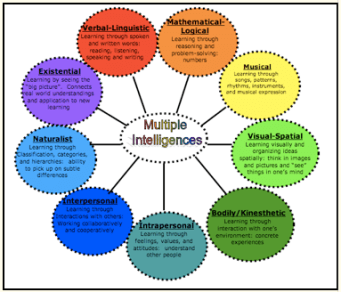
These 9 Is are expanded in future posts:
• Body /Kinesthetic: interacting with one’s environment
• Inter-personal I.: connecting with others
• Intra-personal I.: self-awareness, values & attitudes
• Linguistic / Verbal: expression thru the spoken & written word
• Logical / Mathematical : problem solving through reasoning
• Naturalistic I.: classifying and categorizing data
• Rhythmic I.: identifying and extending patterns
• Spiritual / Existential: understanding beyond the senses
• Visual / Spacial : the ability to see, envision & imagine
NOTE: Only Linguistic & Logical are measured by old-fashioned IQ tests.
• This list is a way to categorize how humans naturally become aware of, understand & process our environment. This helps us figure out where our weaknesses come from, but mainly they pinpoint natural strengths – seen in our preferred learning, behavior & work styles – so we can make the best use of inborn preferences. Sadly, from ignorance or necessity, many people are in jobs that go counter to those natural preferences.
 EXP: A highly Body-Kinesthetic person may be stuck in a Logic desk-job, instead of being able to move around, such as a forest ranger, sports coach, physical therapist, gym teacher…..
— or a Visual / Artistic person in a Linguistic position, instead of being able to dance, paint, act….
• Although each of us can access all 9 styles, no two people have the same amount of each.
— Some people are Mono-endowed, like being able to speak 4 languages – but takes them awhile to calculate a tip, OR someone who’s a whiz with numbers – but are awkward in conversations. If their single talent is honed & monetized, such people can become celebrated for incredible accomplishments
— A few are at the other end of the spectrum, ‘Renaissance’ men or women who can cross-access several Intelligences, superior at almost everything they do
— The rest of us have one or two dominant talents, which serve us well if we have the opportunity to freely express them
• Dr. Gardner tells us that I. involves problem solving – creating ‘products ’ (outcomes) when in a context-rich & natural setting. What many scientists used to think were just soft-skills, such as the Inter-/ Intra-personal ones, Gardener realized were actually types of Intelligences.
EXP: Being a math whiz gives the ability to quantify the world, but so does being people-smart, just from a different perspective. So someone with Intra-Personal talent may not be able to calculate the rate at which the universe is expanding, but will easily find someone who can!
The 9 types also provide a way to recognize & own potentials which many of us left behind in childhood (love for art, computers…), & can now take the opportunity to develop.
BOOSTING Intelligence
Since different areas of Is are related to each other, it’s possible to increase it in one area by developing another, because many problems can be dealt with in more than one way. 
— One third-grade teacher found her students’ scores on a math test (logic) nearly doubled after giving them training in visual (spatial) skills with a micro-computer program
— “Early music training (for 3-year olds) prepares young brains for spatial & abstract reasoning skills crucial to engineers, scientists & mathematicians.” ~ study from U of Cal. Irvine
— “An enriched environment that helps very young children develop each area of talent or intelligence is one of the best possible investments in their future” ~ Ron Fitzgerald, D.Ed.
NEXT: Multiple Intelligences (Part 3)


 HEAL & GROW for ACoAs