
 AS WATER FLOWS OVER ROCKS
so do my Gifts from out of me
PREVIOUS: STRENGTHS (#2)
SITE: Popular Enneagram books
REMINDER: In this context – EGO = FALSE SELF, NOT the same as a HEALTHY EGO, and read “EGO”)
OVERVIEW – Fall from Higher Essence Qualities to Ego Distortions
Oscar Ichazo made a connection between the 10 spheres of Kabbala’s Tree of Life, & the Enneagram symbol. The Tree’s first sphere, Keter, is reserved for the Messiah, leaving 9 others for humans, suggesting 9 kinds of souls as emanations or facets of the Divine Unity. (MORE...)
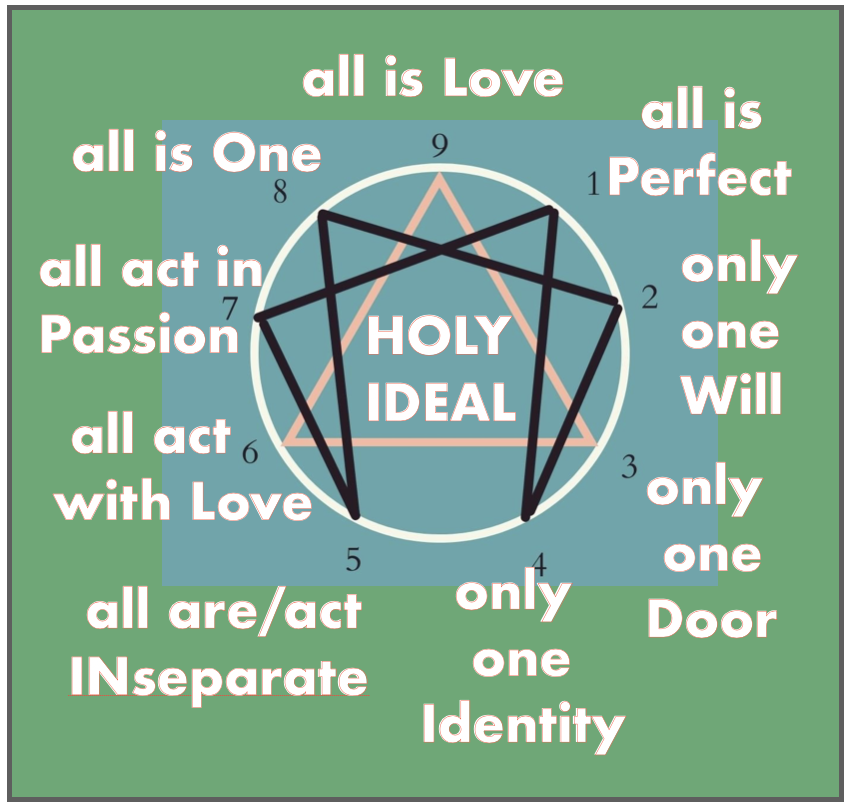 ● While everyone has the capacity to embody all of the Holy Ideas and Virtues, one pair of them is central to the soul’s identity, so their loss is felt acutely, & the person’s ego (conscious False Self) become totally preoccupied with recreating it, although in futile, self-defeating ways
● Based part on this, Ichazo created a hierarchy of expressions:
9 HOLY IDEAS (Part 1) the objective, experiential understanding of higher Truth. Their loss or absence generates specific delusions /fixations, the underlying Toxic Rules of our ego-driven lives. Each delusion forms the center of a psychological complex, which the core of that particular fixation.
VIRTUES
Based on the Holy Ideas, the Virtues are the natural expression of the awakened heart – the unified, expansive qualities humans experience when we are abiding in Essence, our True Self. AND they can not be ‘practiced’ or claimed as personal achievements. While our ego-self is most preoccupied with recreating it, doing so would only be a narcissistic self-aggrandizement for the ego – the very opposite of a Virtuous state.
They are each type’s antidote to its Passion – pointing to our STRENGTHS – so as we “Let-go-&-let-God”, accepting what is already waiting in us to emerge, our specific Virtue begins to express itself in our daily life. They are not simply ‘their own reward’ but expressions of Grace & a method of transformation*.
*Transformation can be understood as a conversion of energy: shifting from the narrowness & futility of our Vice to our Virtue. It is not easy to do, since out Type is hardwired & a life-time of doing things a certain way are hard to soften & dissolve. Shifting this energy takes time, along with great desire & determination, persistent effort & a willingness to look deep inside ourselves. Repetition of new habits & patterns create new neural pathways that, over time, allow us to catch our automatic responses before they get going. This makes it possible to choose a new way of responding to PPT (people-places-things).
 EGO-FIXATIONS
As a person loses Awareness & Presence of the Holy Idea, we fall away from Essence into the trance of the outer personality – an ego delusion about self or reality. But once the True Nature is restored we can see through the particular delusions of our type. Again, our underlying Truth is antidote to the ego-fixation when we want to restore the balance & freedom of our personal Holy Idea
PASSIONS
They represent the underlying characteristic emotional response (Basic Fear column) to reality which was created by the loss of contact with our Essential nature – the Virtue. The underlying hurt, shame & grief this loss entails are enormous, so our ego (defended Self) is compelled to come up with its particular way of emotionally coping with the loss, altho misguided & ineffective.
— It can also be thought of as our untamed animal nature before it’s transformed by contact from higher influences—an awareness and Grace. Together with the ego-fixation, these represent the ways that spiritual qualities become contracted into ego states
INSTINCTS
Our Instinctual Self is a primal aspect of personality, & our dominant one insures our fundamental survival in the physical world, but in so doing can block the way to growth. The Enneagram’s 3 instincts are an anchoring counter balance to the higher spiritual Essential Self, rooting us in the dualistic (good-bad) defended self, which ‘forces’ us to distort & habitually overuse our survival strategies.
● They are considered the way we forget our connection to the Divine. Losing our Essence-center distorts our Thinking, Feeling & Doing (TEA). Spiritual / emotional growth comes from being able to balance, release & transform our instinctual nature into its higher opposite.
NOTE that the strengths and weaknesses of each type are two sides of the one coin. There is NO point in wanting to change to another type, since that would just mean swapping one set of problems for another.
NEXT: Type VIRTUES (Part 4a)



 HEAL & GROW for ACoAs