
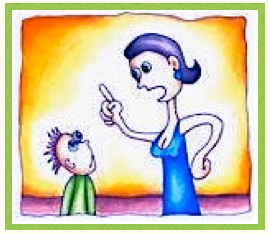
 IF IT WEREN’T FOR YOU….
everything would be OK!
PREVIOUS: LEVELER Role
POST: Parents blaming us
ROLES – Blamer, Computer, Placater & Distracter
2. BLAMERS (B) – a Twisted form of Power
STYLE : about 30% of people use this defense. They say NO, regardless of what they really feel or want (it’s the principle of it!)
THEY
• act like they’re superior & make disparaging comparisons
• always think they’re right, & never respect others’ point of view
• are dictatorial, loud, tyrannical & expect everyone to obey them
• bully, shove their thoughts & feelings at others, are more likely to initiate conflict
THEY
• constantly find fault & point out problems or weaknesses in others (sometimes called ‘skunks’ in NLP because they ‘spray’ criticizing language)
• push responsibility for everything onto others, always looking for someone to take the blame when things go wrong, hinting that others ‘are in trouble’
 • their attitude is oppressive, which can trigger Placating in others out of fear (EXP: they’re harsh when giving a speech —-> to make firm points & elicit guilt)
THEY
• think no one will accept their view of the world unless they yell
• use authoritarian & direct language, with generalizations, to distract & assign blame
• use complex comparisons without proofs to confuse
• want to win at any cost, sometimes will “cut off their nose to spite their face” or win the battle only to lose the war
• no matter how someone replies to their accusations, Blamers will use it to make the other person even more wrong, using a double-bind with a mismatched response (EXP: if you stand up for yourself, you’re arrogant, if you back down you’re a wimp!)
Energetic Description (by Dr. Mary Jo Bulbrook)
• blamers can operate from malicious OR unintentional intent
• as Sender – their verbal bullets attack with varying intensity at vulnerable spots in another person’s energy system, impacting their energy field, centers, tracts, head line & core 
• Blaming causes terror & depression in any receiver who is in a psychologically weakened state, making them vulnerable to outside negative energies
• this receiver will experience varying amounts of pain if they can’t block or shield themself from the Blamer’s targeting, This can create holes, tears, shattering or disruptions in their energy field, blocking or shutting down the chakras & stopping energy flow in the meridians
B Statements: “It’s your fault , You can’t do anything right , I’m the boss! , If it weren’t for you everything would be all right , You never… / You always …./ Why don’t you ever….”
B’s Stance: They use visual cues with breathing, posture & gestures
• body square on, legs apart, head slightly down, tightened neck muscles, leaning forward a bit
• face is screwed up, lips curled, nostrils flared, eyebrows lowered
• one hand on hip, other hand with raised finger & palm down, pointing directly at the other for strong effect (an attack), or at the ceiling (a warning of attack).
• internal tightness of muscles & organs, with increased blood pressure (see Chart in “What about Es, #1“)
 Bs Gain Power by their belittling & guilt-producing ability, as when the Sender of blame uses force to convey a mental / psychological message, and the Receiver acknowledges & accepts the message
Aim : to never feel vulnerable, by dominating so they’ll be obeyed, & provoking fear so they’ll be ‘respected’
Reacting to a Blamer: (via NLP) If you use a Placater stance with them it can shift their attention from their own attitude & context, to your view & your context.
Be careful: it can also trigger an even stronger Blamer response from them, if they get annoyed at you for being gutless (according to them)
Reality: Blamers hide behind a tough mask of invulnerability, but actually feel powerless, uncared-for & alone in the world with no one to help.
When stressed, they compensate by taking charge, bluff their way out, attacking & controlling. This attitude temporarily makes them feel better – when people obey, they feels effective & powerful
Negative Result : they usually end up alone, since nobody wants to be at the receiving end of their blaming, harshness & over-control
NEXT: Satir’s COMPUTER Role


 HEAL & GROW for ACoAs