Al-Anon STEP 10 – Comments (Part 2)


PREVIOUS : 10th Step #1

SITE: 10th Step Worksheet 

A Study of Step 10 


AA/ Al-Anon Step 10 : “Continued to take personal inventory AND when we were wrong promptly admitted it.”

1. Daily INVENTORY (cont.)
✔︎ What were my thoughts today?
NOTE: This is NOT what you said out loud – only what was in your head.
Re: Yourself – most of this list will be the self-abusing thoughts from :
✧ the PP /Introject, in the ‘You‘ form (You should have know that), OR
✧ the WIC who believe the PP as Self-Hate, in the ‘I‘ form (I’m such a failure, I can’t ___, I’ll never___ )

Re. Others – If you’re angry at someone else, the thoughts will be harsh judgments & derogatory name calling
If you’re anxious, they’ll usually be thoughts of how to placate or avoid that person – mind-reading about what they think of you

These will all be in the form of obsessions – round & round – without asking yourself what childhood button was pushed, nor looking for a solution to the situation. (POSTS: “What just happened?”)

IMAGEs: they illustrate the positive & negative sides ⏬️ of our thoughts & Es, NOT as mental illness, but actually normal in all humans
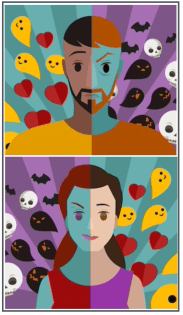
POSITIVE: Identify all helpful, kind, adult, realistic, mentally healthy thinking (“What she said had nothing to do with who I am // I’ve just reached my limit // I need help with this // that was a good meeting”…. )

✯   ✯   ✯   ✯   ✯
2. AND WHEN WE’RE WRONG  (see posts on “Being right“)

What kind of wrong(s)? First we need to distinguish between defects of character, what’s our responsibility & what’s S-H.
a. DEFECTS (same as shortcomings) can be defined as “a fault or failure to meet a certain standard….” They are basically defense mechanisms (unhealthy patterns) that all of us develop in response to a painful childhood & outside traumas

** IMP: in 12-Step ‘work’, lists of defects always include emotions. This is WRONG! Emotions are never defects – only some thinking (CDs), AND some behavior patters (abusive actions) – which together are used to deny painful emotions.

b.  RESPONSIBILITY is simply a frank acknowledgement of what we think, do & feel – or not, without judgement or self-abuse.
We can still ‘feel bad’ about hurting someone & need to make it right if possible, but it does NOT cause shame or self-abuse

c.  SELF-HATE is blaming ourself for causing ANY hurt or fear we feel, & projecting abandonment, especially if someone ignored or harmed us, or if we’re not perfect!

We also need to Identify our rights, so we know what a wrong IS or is NOT. Just because someone doesn’t like what we say or do – does not mean it was ‘a wrong’! SO, look for:

🔻 Something that was NOT ‘a wrong’ at all, but actually:
✒︎ someone else made it sound like it was. This can be from :
⚬ projecting their own disowned defect
⚬ a way to deflect blame from themself
⚬ we having pushed one of their buttons
⚬ being caught in a defect of theirs (lie, error, abuse….) which they’re ashamed of

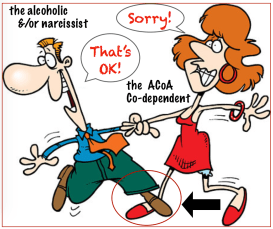
✒︎ someone hurt us & ⏫️ WE made it our fault – typical of codependents. We apologize in knee-jerk fashion, as if we caused the other person to say or do something inappropriate

✸ While this reaction is deeply ingrained in ACAs, it will most often show up when we’re around anyone who is oblivious to the effect of their actions, or who doesn’t care.
This is the WIC taking responsibility for someone else’s narcissism.
✧ It’s what we were trained to do by family & religion
✧ It’s carrying the guilt for them, since they won’t
✧ It’s as if we could teach them how to be responsible for their actions – like the alcoholic’s spouse who thinks they can ‘show’ the active drinker how to be moderate by example.

Also NOT ‘a wrong’ :
🔻 Something we were often punished for / made fun of…. as kids (family, school, religion…). It may have been normal child behaviors, or some inabilities, omissions, expressions of emotions….

This left us with a deep sense of Shame now re. expressing any imperfection which we then label as a character defect.
This emotion prevents us from thinking clearly, it silences us, makes us want to slink away, hide under the carpet, to die – the pain is so great, like a punch in the stomach!

NEXT: 10th Step, #3

ACoAs being ‘RIGHT’ (Part 2)

IF I’M NOT RIGHT,
then
who am I?

PREVIOUS: Being Right (#1)

⬅ “ARROGANT BOSS” by DMT


🟧 WHAT’S WRONG With Being ‘Right’?
Unhealthy (mild): The narcissist in us (& every ACoA has one) will think or say “If I can see this so clearly, why in the world can’t you? // If I can do that task, what’s your problem? // If I love that, I assume you will too. If not, why not?!”
This attitude makes no sense at all. Even identical twins are different in some fundamental ways. One person is not automatically better or more correct than another – just different. (See “Symbiosis & ACoAs #3“)

UNHEALTHY (severe) Addicted to being right (aBR)
🖤 This character defect (a cognitive distortion) applies TO :
— some adults we grew up with, AND
— those of us who have copied them , &
— anyone we’re ‘stuck to’ as adults who is like that

A Closed System – The state of a person or thing being isolated from its surrounding environment.
a : Any one person so rigid in their opinions that they can’t let in anything which differs from their own determined ‘correctness’

b 2 people, a Dominant (D) & a Submissive (S) personality, who interact in an ongoing feedback loop, constantly exchanging limited, often distorted, info – characterized by coercion/compliance, co-dependence, sameness & symbiosis (like Mrs Bucket & husband)

For the D – there is no concern & equality for others, or desire to change, and –
For the S – there is no autonomy, questioning, rocking the boat, separateness, speaking up or taking a stand . (More….)

● GROUPS: (family, academia, church… )
Groups who assert they have the only right answer – discourage change, differences, disrupting the status quo, equality, independence, objecting, questioning, or taking a stand.
They tend to promote factions, gossip, immaturity, repression, secrets & triangulation. It makes members reactive & anxious, even if this is hidden from each other. They don’t feel safe to question or disagree leadership or the official rules, feafulr of disapproval, punishment or rejection. (MORE…)

🔒 At the extreme ‘right’ we find the ‘Right-ists’.

RIGHT-ists are in a world of their own, extremely self-absorbed & arrogant – The accuracy or importance of whatever point they’re pushing is not as relevant as their need to be agreed with.
Their rigid thinking is used in a power struggle to bring everyone else to their knees – psychologically, mentally & emotionally. They want to capture other people’s thoughts – even in situations truly & totally beyond their control, such as with the active addicts .(Serenity Prayer backwards“).
Ingrained Right-ists truly feel justified in their position, rarely if ever seeing the arrogance & selfishness of their attitude. Sure of themself & comfortable in their superiority – so there’s no internal cognitive dissonance.

NOTE: Some right-ists camouflage their compulsion by seeming concerned for others’ welfare, sounding reasonable or just giving ‘helpful’ suggestions. But all the while they’re trying to control their environment – to make it conform to their world-view.
One hint: they consistently make unsolicited & often unwanted suggestions, give advice & offer help – there version.
DO NOT be taken in by the presentation. If your own opinions & needs are often or always ignored or over-ruled – you’re dealing with a sneak-narcissist.

Re. SELF,  RIGHT-ists:
• are rigid & controlling, so they don’t work well with others
• can become quite aggressive in order to eliminate the threat to their (secret or unconscious) weak self-image
• experience anyone who opposes or simply has differing opinions – as a direct threat to their sense of well-being
• lack empathy, have no patience with others & are often snide
• need the world to revolve around them

Re. OTHERS
., RIGHT-ists :
• alienate others without realizing it, OR of they do, they wonder why, then assume it’s the other person’s fault
• can end up isolated & deprived of companionship, love, affection, …. unless they find a passive person who uses the ‘Right-ist’ to think for them!
• can’t imagine that other people actually have different needs & opinions from their own (NPD mother = “Put a sweater on, I’m cold”)
• may push good info from ‘good intentions’, without considering that they’re discrediting another’s process, boundary invading, & being arrogant (“others NEED me”)
• regard others’ ideas or viewpoints as inferior or worthless, often losing out on new info, & wonderful opportunities or relationships.

NEXT: Being Right (Part 3a)