SYMBIOSIS & ACoAs (Part 3)


PREVIOUS: Symbiosis & ACoAs (Part 1)


SEVERE version of Symbiosis

CONTROL, CONTROL, CONTROL – is all about keeping someone or something in a symbiotic lock. For many ACoAs, the early wounds are so deep that we’ll symbiose with a wall, because at least it will hold us up! Or with a book, a chair, even the corner of a sofa – if it makes us feel cozy & safe – for a little while

Fantasy can serve the same purpose – the one person in the office who doesn’t notice you, a movie star, professor, guru, …. AND of course we can be in fantasy about the person we’re currently with, assuming they have qualities that will soothe our anxiety

• The hunger for a connection with someone who is our carbon copy & therefore can’t leave us, is so great that NO differences are tolerated. When the other person has their own need, taste or opinion, they’re not mirroring us (perfectly) & without that we don’t know who we are. Without that reflection it feels as if we’re going to die – that we’re invisible & therefore non-existent hole in soul

The WIC is absolutely sure that our very life depends on that false bond, because the HOLE inside (scroll way down)where the Good Parent should be – is so great.

We experience any ‘differences’ as a betrayal, & if the other person tries to leave, the profound loss can make our reaction quite severe:
–  chasing (an ACoA favorite!), stalking, kidnapping….
– we get very ill, threaten or try suicide, but usually not ‘serious’
– threaten harm, verbally or physically attack, or otherwise punish
– whine, cry, accuse, manipulate, to get then back with us

MILDER 
People with less severe damage, or a fair amount of Recovery have less extreme ways of trying enmeshment. These are often garden-variety forms of controlling actions or statement. It still has more than a whiff of narcissism, but indirect – so it doesn’t SEEM as bad. We have to be more awake for this type, because It looks like they’re including you, but they’re not. EXPs:
When someone (you?) likes or hates something & assume others will too:
• “Don’t take your bag / that coat / this paper… – you don’t need it!”
• “Here, try this on / We’re going to this restaurant / Kids, we’re moving to …. I know you’ll love it!”a little shove

• “You just have to see that movie / read this / go to that shoe store…”

• “I don’t see why you’d want to go there / do that / be with them…”
• “I just don’t understand her /him… I would never do / say that!”…..
• “Are you sure you want that dress, pen, car, class….?” (I can’t stand it!)

RELATIONSHIPS
SIMILAR: Sometimes kindred souls, looking for the ultimate bond, will find each other – as a friendship, but more often a mating. With similar interests, perhaps a sexual attraction & always a shared traumatic background, they link up & are ‘loyal forever’

It may be a kind of love, but really it’s the love of 2 wounded children trying to provide for each other what they barely have for themselves. It’s not uncommon for such couples to isolate & insulate themselves from the rest of the world

OPPOSITES: More often it’s when a needy, ES person (the ‘Stayer’) chooses to marry, become best friends with or go into business with  a ‘Leaver’ type, although terrified of being swallowed up, also wants to be taken care of

They seem to be a right fit – for a while! Eventually, the Stayer’s dependency becomes too much for the Leaver & a rupture occurs. It may take years, but it’s inevitable. The Leaver finally has to get away, & the Stayer is devastated!

• WHEN we rely exclusively on others to hold us up, they will eventually become exhausted. And when that person, group or institution we’re too reliant on needs to save themselves – from us, OR go away for some other reason (divorce, death, a kid going off the college or getting married…),
the loss of symbiosis brings up abandonment panic. Then the unhealed ACoA can :
✑ become almost immobilized by depression
✑ increase familiar addictions or take up new ones
✑ have panic attacks // end up in the hospital // try suicide

MILD: Naturally there are degrees, & all wounded people are afflicted with the longing to be cocooned, to some extent. With long-term recovery / sobriety, our day-to-day life may not reflect this issue, but once in a while some big stressor may  trigger that old terror in the pit of our stomach

HEALING: The best case scenario for anyone, but especially when losing a long-term symbiotic connection, is that it drives us into Recovery, via Al-Anon, therapy & other appropriate groups, often with the help of some medication, & hopefully with spiritual guidance & support.

NEXT: Separation & Individuation – #1
AUTONOMY & ATTACHMENT (Part 2)

I CAN CONNECT WITH OTHERScat/dog friends
and still be myself!

PREVIOUS: Autonomy & Attachment (#1)

SEE ACRONYM Page for abbrev.

AUTONOMY (Part 1)

ATTACHMENT

ABOUT.com – …. attachment “may be defined as an affectional tie that one person or animal forms between itself & another specific one – a tie that binds them together in space, & endures over time.”
“Attachment is not just a connection between two people, but a bond that involves a desire for regular contact with a special person, & the experience of distress during separation from them.” says psychologist Mary Ainsworth

💛 Healthy attachment is NOT fueled by anxiety, low self-esteem, fear of abandonment, weak boundaries or neediness.  RATHER, it’s grounded in the opposite:
• A clear sense & acceptance of our CORE personality, based on heredity, personal qualities, character, education, accomplishments, experience, tastes, & talents  – as well as lacks, limitations & defects
5 o'clock B.
• Having reasonable expectations of ourselves & others, in order to have mutually satisfying relationships, & not be devastated when others can’t be what we want them to be

• Having good boundaries – knowing what our needs are, how we’re the same or different from others, how we want to be treated. & be able to clearly state our needs & wants, when appropriate
THEREFORE :
• we can choose emotionally available people who are reasonably healthy, are generally compatible & don’t need us to take care of them
• can accept differences, limitation & imperfections in others

loss• know it’s OK to be attracted to people who have some traits like our family (it’s normal to connect with the familiar), but choose those who can treat us better
• when people act in ways that trigger us, we don’t react as intensely & can respond from our Healthy Adult (not from the WIC or PP)

• are able to tolerate disconnections with others, even outright losses, while keeping a sense of our own identity, knowing that no matter what, we are OK, lovable, strong, capable of taking care of ourselves & being on our own, if necessary.

INTER-DEPENDENCE
Symbiosis ——> Autonomy ——-> Attachment —–> Inter-dependence
As ACoAs from wounded families – we need to slowly
🔪DETACH from the damage we brought with us from childhoodcut damage, in order to —
🧲 ATTACH to the many gifts Higher Power has given us as our birthright, which makes it easier to identify & connect with peers !

Growing successfully thru the previous stages allows us to become more Inter-dependent. 
Of course, most of us are in flux, sliding back & forth between stages. The goal is to keep working at the process, & not get stuck for too long in any one.
(Article: Attachment & Adult Relationships”) 

SimilarMinds.com
Inter-dependent people tend to see themself as basically good. THEY :
ARE – More likely to be content, emotionally expressive, positive, trusting
ARE – easier to get to know, open & relationship-oriented, comfortable with or love birthdays. Less ‘in their head’, less rigid

TEND TO:  be traditional & value society, like some guidance, take advice & learn better with others, like to be part of a group & do things with others, feel grateful to parents.

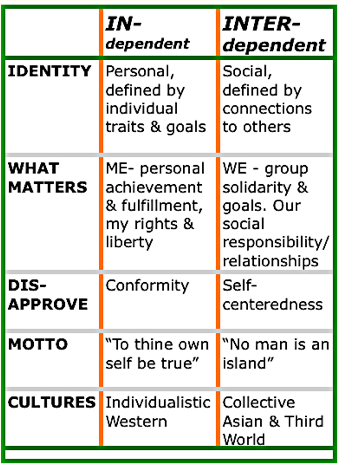
inter-dependenceWikipedia ….(interdependence) is being mutually & physically responsible to, & sharing a common set of principles – with others…..

✶ INdependent thinking is not suited to inter-dependent reality.
Independent people who don’t have the maturity to think & act inter-dependently may be good individual producers, but not good leaders or team players. They’re less likely to succeed in marriage, family, or organizational life.
(Stephen Covey, ‘The 7 Habits of Highly Effective People’, 1989)

✶ INTER-dependence is & ought to be as much the ideal of humans as self-sufficiency. Humans are social beings. Without interacting with society we cannot realize our oneness with the universe or suppress our egotism. Social inter-dependence helps us test our faith & prove ourself on the touchstone of reality. (2020 updated version of 1929 Mahatma Gandhi)
Need we say more?

NEXT: SYMBIOSIS & ACoAs  –  #1

AUTONOMY & ATTACHMENT (Part 1)

gain autonomy
SERVANT or MASTER of YOUR CASTLE
Who’s the boss of you?

PREVIOUS: Being Visible (#3)


ACoA SYMBIOSIS   (see Post)
It’s an unhealthy attachment to others as a way to:
• compensate for emotional abandonment in childhood
• cope with deep anxiety of being a separate entity
• escape having to face the struggle of growing up emotionally
• mask self-hate & fear of abandonment

In the process of healing the past, we move thru layers of growth with the ultimate goal of being free.
Symbiosis ——> Autonomy ——-> Attachment ——> Inter-dependence

AUTONOMY
1. GENERAL – As part of the human life cycle, the normal, healthy psychological goal of adulthood is to become our True Self, be inter-dependent with others & contribute positively to society.
• A reasonably healthy family encourages children to be an accepted part of the family group, as well as developing as a separate individual, & then be able to function successfully in the larger world

• However, as ACoAs we were:
☼ not allowed to fully develop our own identity
☼ forced to stay in emotional & sometimes physical bondage to the family
☼ so ignored, neglected &/or tortured we couldn’t form a stable bond with anyone.  See  Attachment Disorder site

2. REQUIREMENTS woman w/ lotus
a. S & I  (Separation & Individuation) is required to connect successfully with others, the opposite of co-dependence & symbiosis, BY knowing:
• ourselves & being comfortable in our own skin
• what our needs & tastes are, & provide for them
• we’re OK, which is self-esteem & not arrogance or superiority
• we can be safe & at ease when dealing with others by having strong boundaries

b. Motivation
A hallmark of Personal Independence is being our own motivator** — not from egotism, but from being responsible for ourselves.  Spiritual & psychological teachers tell us that we need to look inside for the answers to our problems – that it’s an ‘inside job’, not what we have, but what we are. (‘Process, Part 2, b, iii’ )

in charge**Self-Motivation means we want to do things – for ourselves. It’s the reason behind our actions, our guiding principles.
NO – It does NOT mean ignoring or disrespecting our family, the needs of others or our spiritual connections
YES – It DOES mean is that, as adults, we’re not waiting for someone else to give us permission or a reason to act

➼ Pre-FoO Recovery, ACoAs can take many actions FOR others or because OF others, but rarely just because WE want to. (‘Responsibility’ )
Without someone pushing or pulling us, we’re like dormant trees in the forest or hibernating bears, waiting for the sun to shine on us, warm us up, give us a reason to move. This is the essence of co-dependence

Past motivators – Normal: Our parents & family, school, teachers, friends, peer groups, religion, our countryour damage

• Present day motivators

negative: PRIMARILY our damage – hidden from us in the subconscious (the Shadow side) – old unresolved pain, toxic beliefs, our allegiance to our wounded family system, our resentments, fears… all expressed thru the WIC’s behavior

SECONDARILY: by other people’s opinions, the needs & wishes of friends, relatives, mates, children, bosses, our community, a punitive religion, & a distorted view of God

☆ positive
: a loving H.P. & Ourself. All other reasons to act need to come second, evaluating them based on mental health, common sense, Recovery (not from the WIC or PP bad parent) – ie. emotional maturity

c. TOOLS to get to KNOW OURSELVES:
• a variety of psychological inventories & personality tests
tools• dreams, visualizations, prayer, spiritual literature
• feedback from reliable sources / meetings, therapy, body work
• listening to ourselves, mindfulness, staying in the now
• listing things we’re good at, ask others about our good / excellent qualities
• observing our behavior patterns, slowly over time
• noticing our emotional responses to every situation
• talking with the IC thru the day, listening to our intuition/gut
• written inventories, journaling, morning pages, I.C. writing

NEXT: Autonomy & Attachment, #2

‘GETTING TO KNOW YOU’ Stages (Part 1)

ARE WE MOVING FORWARD?
I never want to let go!

PREVIOUS:
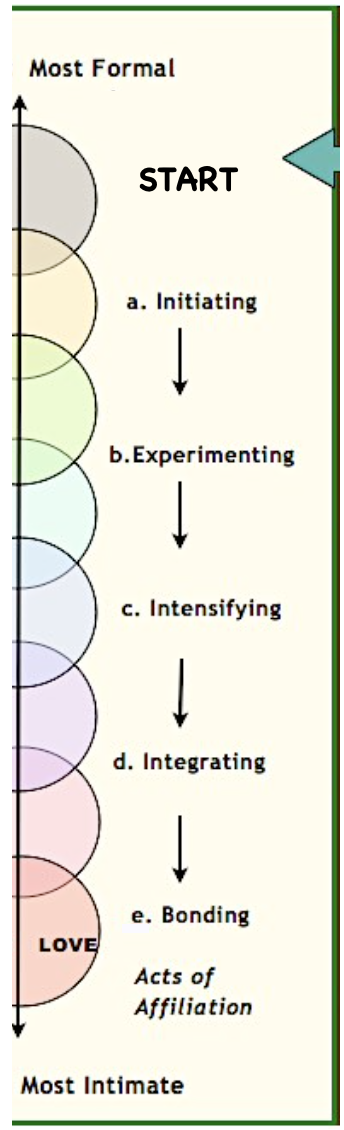
‘The Relationship CONTINUUM– 8 stages


Communication Indicators of ATTACHMENT
 This series of posts deal with verbal & psychological markers of progressive attachment or dissolution, ie. moving toward or away from intimacy.  It covers all types of one-to-one relationships (friends, lovers, co-workers, additions to family…)
Each Cycle consists of INFO which is: 1. received 2. absorbed & contemplated  3. understood   4. replied to

• There are several theories about how people grow together over time, including ‘peeling the onion’ of each others’ personalities the more time we spend with them
• The NORMAL section for each level is based on the work of Mark Knapp & Anita Vangelisti (2000), from the Communication field
• For Section A there’s an additional term, in parenthesis, from the Inter-Personal Psychology field

ACTS of AFFILIATION ♥ indicated by types of Communication

1. INITIATING (Non-existent – beginning)1st level
a. Normal : With people we’re vaguely aware of – communications will be rote formulae:
“How are you?” <> “Fine, & you?” , “What’s with this weather?” <> “Too much!”

Hallmark: interest & curiosity.  If we notice someone we want to know more about – we use polite, socially appropriate statements to show interest:
“Hi my name’s George. Is this your first time here?” , “Would you like to dance?
– waiting to see how the other responds.  If it’s positive, we have time to form additional first impressions & evaluate each other.

Initial interest is governed by:
Self-concept, which includes sexual orientation, socio-economic class, race… (we rarely move toward someone too far ‘out of our league’)
Proximity, in person –  where we work, shop, live, go to school or church, MeetUps, meetings, dances… or in cyberspace, using social media, dating sites, forums, chat rooms ….
Similarity – studies show people tend to form connections with others of similar attractiveness, interest, intelligence values….

b. ACoAs –  Although some of us find it hard to initiate conversation with strangers because of fear, many ACoAs have learned to open a dialogue in similar ways, but as usual bring our own twist to it.

❄️ In any group setting, we unconsciously scan the room & without even realizing it, will be pulled to the ONE person who is the most damaged, usually angry, narcissistic, the least likely to be nice to or interested in us – another ACoA & probably an addict of some sort. We may not even have heard their voice – but we KNOW! & can’t wait to ‘make friends’ !

This is more likely to happen with Extroverts. The Introverts will also focus on that one unavailable, but at the other end of the room.

🏋🏼‍♂️ ACoAs also claim to hate the dreaded “Small Talk” in any social setting.  But that’s what this stage is all about! You’re sure you don’t know how?
Actually, our refusal to even try is:
• about our self-hate, disguised as Social Phobia (everyone is judging me!)
• and we’re bursting with complains & internal drama, so we despise chit-chat as a waste of time — too much like our shallow, drunk, distant family, who never expressed a deep thought in their life!

We want depth! Translation: just let me talk about all my aggravations & worries! & don’t bother me with trivia.
We don’t realize it’s mainly our narcissism (“see me”), which includes the belief that symbiosis is the only way to connect (be like me / stay with me), which we both long for & are terrified of.

✶✶ In early recovery one young woman decided her temporary rule was: “If I like him, he’s bad for me!” As she grew, her ‘picker’ got a lot better.

NEXT: Stages – Part 2 Experimenting, Intensifying