Family INVENTORIES – Purpose (Part 1)

LOOKING AT HOW IT ALL STARTED is not always easy!

PREVIOUS: Personal Responsibility-#1

See ACRONYM page for abbrev.

QUOTE re. the need for S & I
“It is not possible to live too long amid infantile surroundings, or in the bosom of the family = without endangering one’s psychic health. Life calls us forth to independence, & anyone who does not heed this call because of childish laziness or timidity is threatened with neurosis.” Carl Jung
🎯
DEF: INVENTORY – To evaluate & make an itemized report of abilities, assets, or resources. To take stock of one’s life and accomplishments.

1. IN 12-Step TERMS
a. Doing our 4th Step – to write out as many of our qualities as we can – both positive (gifts) & negative (defects), as well as a list of all actions throughout life (to identify our Being and our Doing)

b. Taking someone else’s inventorya big no-no, & for good reason, when understood correctly, is an unhealthy defense mechanism. This can mean recounting someone’s faults to all who will listen, or using a sharp tongue to tell someone off who we’re angry at.

NOT doing this is a valid rule in general for everyone, & specifically – geared toward addicts & co-dependents, because:
• we copy our parents’ habit of always finding fault with everyone & everything else, instead of owning our own thought & emotions (likes & dislikes….)
• of the compulsion to blame others for all our woes, instead of taking responsibility for our part in any situation (but not in the form of S-H)
AND
•  our character defect of using any upset as an excuse to gossip
•  our fearful avoidance of dealing clearly & honestly with anyone we’re currently having a problem with, using the Adult ego state
• the fear-driven habit of avoiding very hard decisions, making small or major changes, leaving toxic people, standing up for ourselves …..

2. LEGITIMATE EXCEPTIONS to this rule :
a. Re. Safe People: To identify the healthy characteristics we find in positive role models, which we then can look for in everyone we associate with, so we can ‘Go where it’s warm’ – toward people who are reasonable (T), kind (E) & functional (A)

b. Re. Unsafe People: to break thru our denial.
ignoringACoAs deal with abusers – either :
• by having thick blinders on, denying the character defects & emotional damage of unhealthy people, while only see our own flaws – even where they don’t exist. OR
• by being terribly judgmental & critical of everyone – including ourselves (S-H), while not trusting anyone with genuinely good qualities. BOTH types tend to shy away from healthy people!

That way we can be angry at anyone for not giving us what we want & need, just like our parents, but stay with them so we don’t have to notice of the many ways they abandon us, & then face having to do something about it (leave?)
AND we can stay loyal to the dysfunction, continuing to long for but never receive the love & acceptance we believe we’re not allowed.

✳️ As we know, people tell us something about themselves all the time – their pluses & minuses – which we miss all together & could see if we paid attention, knew what to look for, & be willing to respond appropriately
OR we do notice but ignore or excuse. Then it bites us in the butt later!

Sadly, as kids ACoAs were brainwashed to deny much or all of our experiences, intuition & perceptions, so it’s particularly necessary to do this type of inventory for all of us who:
• are genuinely ignorant of, or in deep denial about, the harmful effects that addicts & other damaging people we spend time with (family, lovers, bosses, friends…) have / have had on us

• are surrounded by unhealthy communities (family, religious, social, work….) where everyone is continually bombarding us with a distorted reality about us, themselves & the ‘right way’ to do things

• are by nature so idealistic that we only want to see the good in others, as a defense against the dangers of life, to our great detriment
• know there’s something wrong with certain people & situations in our life, but are not allowed to believe our intuition & knowledge.

NEXT:  Family Inventory – Purpose
“FEELINGS AREN’T FACTS” (Part 1)

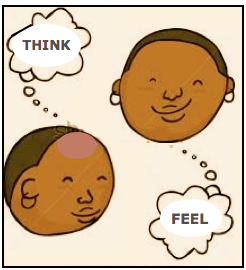
think or feelTHOUGHTS vs EMOTIONS
I’m confused! What are you talking about?

PREVIOUS: Recovery Thoughts


This is a familiar phrase used in 12-Step Programs, but not exclusively. It contains an intrinsic truth and an intrinsic lie.  We have to examine both words – ‘feelings’ and ‘facts’ – to understand.
1. FEELINGS
a. CONFUSION:
• In our language, the word feelings is used in almost every context to mean either thoughts, emotions or sensations, without distinction.
• The main problem is that most of the time people use ‘Feel’ to mean Thoughts, not emotions. This causes confusion for both speaker & listener.

confused• This triple usage may be a clever ploy in our culture – likely unconscious – to suppress Emotions! We’re taught to live in our head & only focus on actions (“Just do it”), which we gladly embrace as a defense against facing our deepest pain.
So, along with many other sources (family, media, male culture, war, sport…) our language encourages cutting us off from an essential part of ourself

b. CLARITY:  We’re not going to change how we talk, but we can understand the 3 uses of the word FEEL, so we can be accurate.
i. Sensations – ‘Feel’ as a Physical experience : I feel hungry, tired, thirsty, sexual…
ii. Emotions: If ‘feel’ as indicating Emotions –  followed only by a single words : “I feel…… sad, glad, mad, anxious, pleased…..”.
AND we can have more than one E at the same time, even contradictory ones.
“I’m happy to see you, but disappointed that Ted’s not here too.” (Posts: Use THINK, not feel)
iii. Thoughts :
 The word “Feel” should never be used to mean Thoughts / Opinions / Beliefs.  Thoughts are always in sentence form, always more than one word. 
When “Feel” is misused, it usually leads with ‘that‘ or ‘like’:
•  “I feel like he wants to talk about something”
•  “It feels like you’re not supporting me”
• “I feel that we should leave soon”
• “I don’t feel that we’re communicating”
•  “I feel like going to the movies”

Stated as such, none of these are about emotions, only ideas – ** even though emotions are implied but not acknowledged. It’s subtle & at best unintentionally, at worst it’s manipulative & dishonest

c. INDIRECTness : Another mix-up occurs when thoughts are expressed in a round-about way. Such statements are clearly sentences, but couched in terms of feeling, which makes the speaker sound unsure of themself. They’re not actually expressing confusion, but rather insecurity by asking for permission to have a voice.

ACoAs are ‘notorious’ for talking around an important point, leaving out crucial info, adding too many qualifiers, justifications & apologies! This misuse comes from not being allowed to own our personal power.
We say:
• “ I hope you don’t mind if I tell you…”
instead of
  “I’d like to tell you something / I need to talk to you about___”

• “Is it alright if I___ , Will you be upset if___ …”
instead of (with a smile, perhaps) “I won’t be able to____ , I need to____ , I’d like to___ , I’m not available for___”

• “I feel like I’m doing better”  instead of “I’m doing better”
• “I feel like I can’t trust them”  instead of “I know they’re not trustworthy”

☑️ Unfortunately, for many ACoAs, being direct is not just considered impolite but actually aggressive! which it is not IF statement are accurate & made without anger.
Sadly, women are more likely to be indirect as a way to not be pushy, which makes staying connected easier, but at a personal price. (BOOK : “He & She” by Chris Evatt)

YES, there is a time & place for careful wording, being respectful of others’ time & space, or for apologizing.
HOWEVER, the above examples of waffling have to do with ACoA shame, S-H, fear of being seen, of punishment or being cut off.

The BEST, clearest way to communicate combines emotions + thoughts in the same sentence : be clear
• “I’m scared you won’t stay with me”
• “I’m so happy that you got the promotion”
• “I feel sad that she’s ignoring me”
• “I’m worried that he won’t like this gift”
• “I’m excited for you & curious about what you’re going to be doing”
• “I’m concerned that you’re going there alone”
This of course implies that we know what we’re feeling (emotions) and have permissions to own & express them.
🔴 Practice verbalizing your thoughts & emotions using declarative sentences, so they come out of your mouth more easily. And repeat, daily: “I know what I know”!

NEXT: “Feelings aren’t facts”, Part 2