
 PREVIOUS: SAY Think, not Feel #1
27 POSTS: “Emotions….” (in 2011 + Jan 2012) – in case you mistakenly think Emotions are being minimized 😱
THINKING
The human brain is built for language – mainly on the Left side – the mental tool that allows us to formulate ideas, & the cognitive rules for linking them together. Being able to think clearly & accurately needs a healthy, well developed top part of the brain.
The frontal lobe, particularly the prefrontal cortex, the area furthest forward – is involved in sophisticated inter-personal thinking skills. Both left & right sides are used for interactive social competence, & the mental skills needed for our emotional well-being.
USING Accurate LANGUAGE accurately
For members of 12-Step Programs or faithful practitioners of a spiritual path, Spiritual Principles tell us to be honorable in all our ways – as much as humanly possible. One of those ideals is to be Trustworthy, & one way to do that is to be sure we “Say what you mean & mean what you say – but don’t say it mean.”
This allows others to depend on us, without being co-dependent, as long as we’re speaking from our Truth. To do that implies that WE:
• have internal permission to find out who we are, a day at a time
• are capable of & willing to be honest with ourself about what we truly think & feel, AND can tell them apart
• have the right kind of language to figure those out, & then express them
Mental vagueness makes knowing that impossible, & inaccurate speech creates misunderstanding, so we stay isolated, & hurt others.
Instead, we need the right kind of info about such things as :
 HOW TO
⚬ deal with disagreements & conflict
⚬ communicate emotions
⚬ develop healthy boundaries, to know when to talk or not
⚬ distinguish between rescuing & helping
⚬ say things from the Adult ego state instead of from the WIC or PP
⚬ talk to ourself with kindness & patience
KNOW :
⚬ what level of communication we’re dealing with ↗
⚬ who we’re talking to (sick family, loving mate, dumb boss….)
⚬ what’s appropriate to say in various situations, like when it’s ok to get personal, & when we’re over-sharing
 🌟 GROWTH
Consciously, consistently practice saying “I THINK…..” instead of “I feel…” will greatly help to figure who WE are, contribute to our ‘sanity’ & improve our connection with others. Only use FEEL if deliberately meaning to refer to body sensations or emotions.
The easiest way to know the difference:
❇ Sensations & Emotions are ONE WORD each, as many as we are experiencing at the time: “I feel tired & achy, but relieved & happy / I feel hungry but I’m too excited to eat / I’m so jumpy – I can’t relax…..”
✳ Thoughts are always MORE than one word (any sentence). “I think it’s time to ask for a raise / How long do you think it’ll take? / I think you’re a pain-in-the–!”…..
NOTE: Thoughts —-> lead to —-> emotions (Es), but we rarely actually say the Es in conversation. “I feel like you don’t like me” does not actually state any emotion, although it’s implied .
💡 More accurately : “I’m angry / sad / frustrated / lonely / afraid…. because it seems (I think / observe) that you don’t like me”
And we don’t have to be limited to the word ‘think / thought’. Here are others that fall into the M category of PMES, ( Mental = cognitive)
• “I assume you know what you’re doing”
• “I believe it’s time to end this affair”
• “I concluded she was angry at me”
• “They didn’t consider that a legitimate option”
• “I’m convinced my neighbor is spying on me!”
• “I figure they’re going to be half an hour late as usual”
• “I gathered this is your favorite restaurant”
• “I can’t imagine anyone being willing to help me”
• “I know now that I can trust you”
• “Did you notice the way she were looking at you?”
• “I observe that he never finishes anything”
• “I can’t stop obsessing about that mistake I made”
• “I’m projecting that no one at the party will like me”
• “Don’t even speculate about that!”
• “He suspected them of lying to the cops”
• “Did you think I was insulting you?”
• “I keep wondering how soon I can leave – politely!”
• “Did you understand that lecture?”
NOTICE – they’re all sentences without any E words
EXERCISE: Write out (T) how you’d (incorrectly) say any of these sentences using “I feel that…. / I feel like….” EXP: “I feel like I can trust you now”
Regularly including one of these THINKING words ⬆ in your sentences – instead of FEEL – is a hard habit to break, but well worth the effort!
 «
«
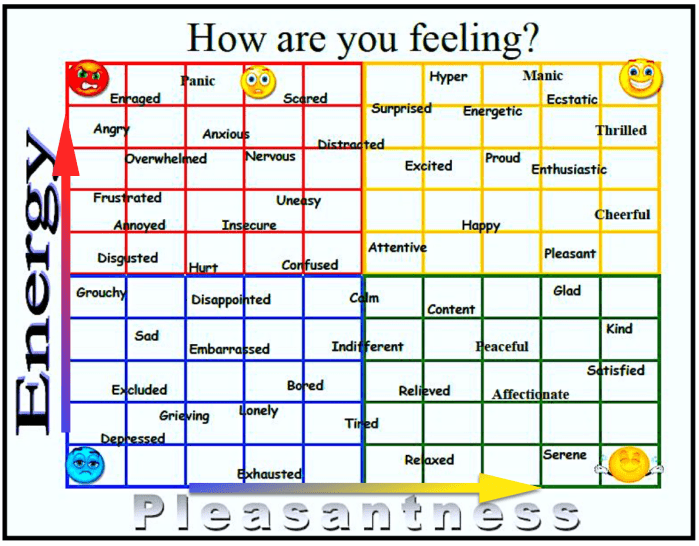
PS: This Chart identifies a wide range of Es, in 4 groupings. See how many you are aware of throughout your day. Stay aware for how they’re not thoughts.
NEXT: Al-anon Step 10, #1














 HEAL & GROW for ACoAs