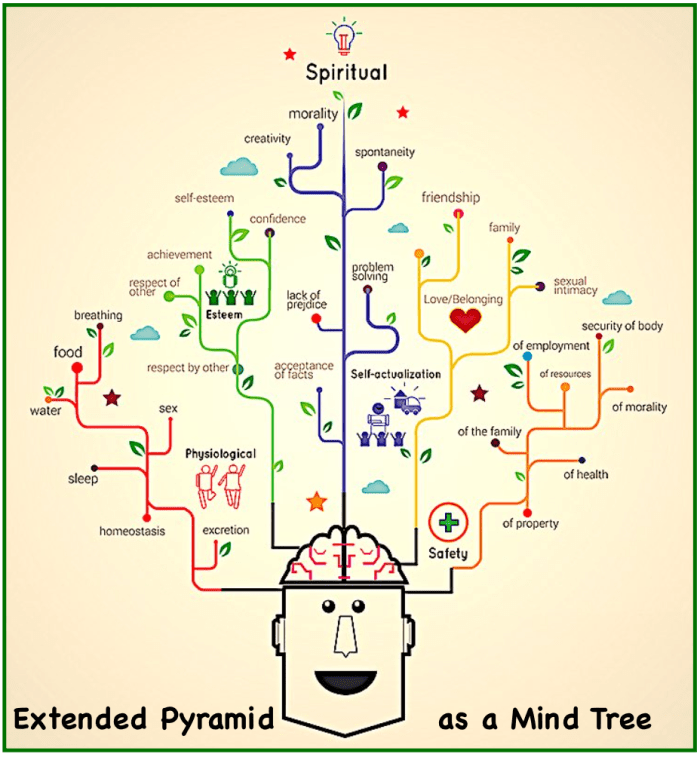
MASLOW – UPDATED (Part 2)

PREVIOUS: Transcendence & the brain

SITE: “What is Self-transcendence?” 6 EXP

MODERN
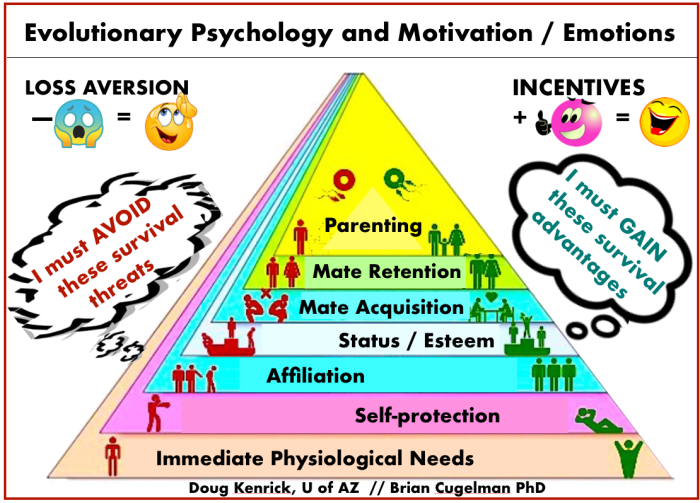
InRenovating the Pyramid of Needs: Contemporary Extensions Built Upon Ancient Foundations” Kenrick, Griskevicious, Neuberg, & Schaller, (2010) modified Maslow’s pyramid to reflect a controversial, more ‘up-to-date’ approach, based on findings from neuroscience, developmental & evolutionary psychology —> which assumes that everything in human nature is in our genes, & can only be there if it helped our Paleolithic hunter-gatherer ancestors to survive & reproduce.

😴 These sciences claim that Maslow’s Pyramid is old-fashioned & needs revamping because it missed some very basic facts about human nature not well understood in his time, but have since been emphasized by ongoing research & theory. (Arizona State U.)

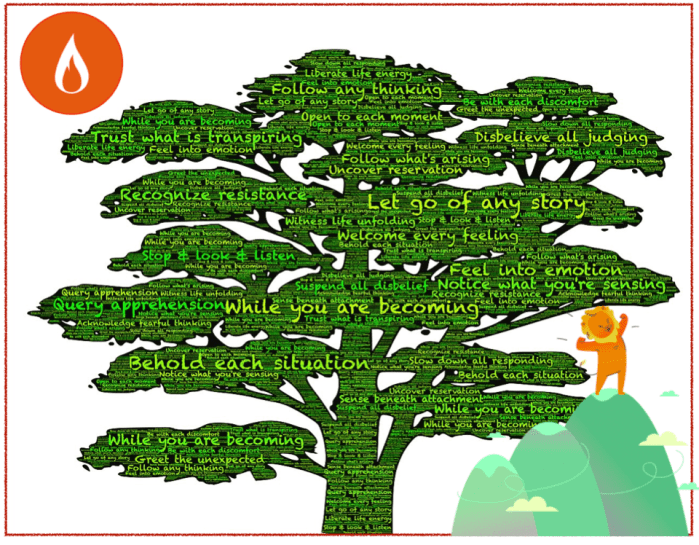
In the new pyramid, reproduction of our genes is considered one of humankind’s most fundamental drives. Self-actualization may be an important concept, but is no longer considered an evolutionary requirement, & so has been eliminated. Replacing it are 3 motives researchers believe Maslow did not account for: mate acquisition, mate retention, & parenting. Kenrick et al. pointed to universal human efforts to create & maintain family bonds, & the parental investment in raising young. (Explanation of each TREE ⬇️).
In addition to this dramatic change at the top, researchers add need- overlapping. This replaces Maslow’s initial idea that once a need is met it disappears & the individual moves on to the next level.
Kenrick et al. explained that this is not accurate. The reality is that even if a person had fulfilled a level & then gone on to the next – they may have to revert to earlier ones.

This is because there’s an ongoing interplay between our internal motivations & environmental situations, either by opportunities or threats, determining which needs capture our attention at any point in life. “Cognitive systems (the human mind) are biologically prepared to learn or have evolved a vigilance for stimuli relevant to fundamental goals. Neither the stimuli nor goals exist in isolation – the psychological system has co-evolved with features of the ecology.”

HOWEVER, other researchers – such as those in the emerging field of Existential psychology, & the subjective well-beingness of Positive Psychology – have called for retaining the emphasis on personal meaning & self-actualization.

▶︎ Lonnie Aarssen (Ontario, Ca) suggests that Kenrick’s version is also missing something important.
He offers a revision, where: ” …. the exalted pyramid cap represents gene transmission success – not a motivation as such, but the overarching functional (adaptive) consequence of all of the underlying needs / drives.”

He combines Kenrick’s levels 1-3 into the Survival Drive, 4-7 into the Sexual/ Familial Drives. Between them he proposes a “…. greater emphasis on a ‘narrative of the Self’, involving motivational elements that include & expand on the idea of self-actualization…. important requirements because they help people deal with – & mask – the human reality of impermanence (we all die.)

Different ‘sub-selves’, defined by pyramid goals, are activated by environmental cues. So we might expect activation of the ‘Legacy-Drive’ subself vs. the ‘Leisure-Drive subself to be based on local ecology and culture.
One recent study of responses to mortality salience provided an intriguing example of this: European Americans tended to focus on achieving symbolic immortality (legacy), while East Asians generally wanted to engage in & enjoy life (leisure).
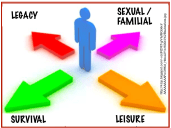
There can also be a blurring or blending of the various drives. For example, Legacy functions (2) also feel good, which satisfy the Leisure Drive (3), and can gather resources or earn favor in one’s social group, reaping advantage for the Survival Drive (1).

OR combining all 4 levels: Accumulation of wealth ensures survival, but also earns status (legacy), allowing for conspicuous consumption (leisure), & can attract romance (sex). (More….)

Aarssen notes that the evolutionary roots of Survival & Sexual/Familial Drives (1 & 4) are supported by a large body of literature. However, Legacy & Leisure Drives (2 & 3) are mostly hypotheses yet to be tested with more research. The assumption is that they served our ancestors well by masking consciousness of our limited life-span, (a potentially incapacitating ‘curse’) – at least until we reach reproductive maturity, so we can pass on our genes.
He believes such research can lay the groundwork for a new view of the evolutionary roots of human nature & social life.

NEXT: Modern Pyramids #2
MASLOW UPDATED (Part 1)

PREVIOUS: Personal Growth

SITE: HUMAN WELL-BEING

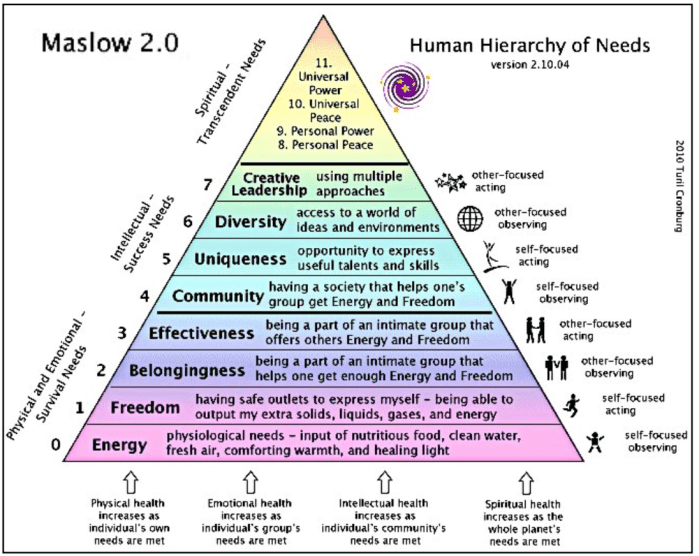
★ “Maslow 2.0” post by Turil Cronburg, 4/18/10
Fulfilling human needs can be thought of as the matter & energy requirements of each developmental stage, created by giving & receiving interactions. Each pyramid LEVEL ⬆️ of needs indicates what a person’s motivations & behaviors are generally like – the combination of personality traits.

😴 Physical : needs of one’s own body, 0-1
🧡 Emotional: of all members of one’s intimate group, 2-3
🔎 Intellectual: of members of one’s community, ie. society, 4-7
🔆 Spiritual : the broad spectrum of needs of all living things, Apex

Consciousness is complex because it’s based on what someone is most focused on at any given time, fed mainly by the various arts of  the cerebral cortex, the outer surface of the brain. At first, as a baby, we have only a very limited awareness of our environment, but it’s still real & valid. With growth, we can pay attention to more & more PPT (people, places, things).

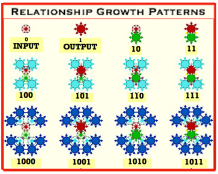
Cronburg visualizes human development as FRACTAL diagrams ⬇️, in binary form, showing the complex process of consciousness-growth, starting with pre-birth.
It’s a combination of input & output interactions between the Self (red) and family & close friends (green), human society (light blue), & all the species of Earth (dark blue).  Article: “Is Consciousness Fractal?

0 = fetus to birth : AWARE of self-input
1 = birth to 9 months : aware of self-output
10 = 9 months to age 2 : how others’ (family/friends) outputs meet internal needs
11 = 2-3 : how self & others’ outputs combine to create new things (connections, experiences)
100 = 3-7 : how self & others’ needs are met by society

101 = 7-13 : self-outputs + society’s needs, used to meet those of others
110 = 13-19 : others’ outputs + society’s, to meet self-needs
111 = 19-35 : how self, others & society’s outputs combine to make new things (community, projects, art….)

1000 = 35-60 : aware that the planet’s outputs meet self, others & society’s needs
1001 = 60-102 : aware of how one’s own outputs can meet the planet’s needs!

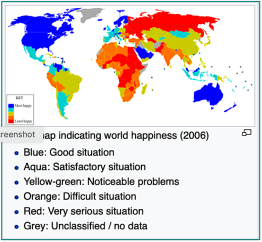
SATISFACTION with LIFE INDEX‘ by Adrian G. White,  (U of Leicester, Eng).
It was a collection of data from a metastudy, wanting to show life satisfaction in different nations, by directly asking how happy people feel, as well as considering social & economic factors.

Subjective measures of well-being correlated most strongly with health, wealth, & access to basic education.
In 2006, Denmark ranked #1, USA at #23, & Burundi the lowest

📌Edward Diener (U of ILL) helped create a Gallup poll survey on well-being, with 60,865 participants from 123 countries (2005-2010). Qs covered:
▪︎ Basic needs (food, shelter) /  safety / social needs (love, support) / respect / mastery / & autonomy.
▪︎ 3 measures of Well-being : life evaluation (a person’s view of his or her life as a whole) / / positive feelings (day-to-day instances of joy or pleasure) / / & negative feelings (everyday experiences of sorrow, anger, or stress).

Responses clearly indicated that Maslow’s basic list of needs does apply to everyone, regardless of culture. Diener commented that while our most basic needs tend to get the most attention when we don’t have them, we don’t need to fulfill them all before benefiting from higher level needs.”
EXP: Even when we’re hungry, we can still be happy being with friends (#4 over #1)

The human brain is a complex system with parallel processes running all the time, so that many different drives can be active at the same time.
However, it’s important to keep in mind that not all activities lead to well-being, which are called ‘pseudo-needs’. They’re unhealthy drives leading to behaviors which never bring mature, permanent satisfaction (addictions, people-pleasing, rescuing, isolating, being controlling….. ).

Diener’s study suggests that only when looking back on the quality of our lives do the basic needs become important indicators of well-being.
— Re. Troubles:  they come mainly from lack of esteem (3), lack of freedom (2), & lack of nourishment (1), in that order
— For everyday Satisfaction: interpersonal needs – such as love & respect (3 & 4) – are most important.
Healthy human needs work independently, & like vitamins, all are necessary…. “Since each of them correlates to certain aspects of happiness, all are important – all the time.”

Martin Seligman, (U of Penn) says governments should “focus away from monetary measures, especially in light of Diener & Tay’s findings – that income has little impact on day-to-day happiness, & is significant for well-being only in so far as it allows for basic needs to be met.”

NEXT: Maslow updates #2

MASLOW’s Pyramid – Personal Growth

PREVIOUS: Spiritual Transcendence (Part 2)


NOTE:  While the value & ‘legitimacy’ of the Maslow’s Pyramid in general & the Self-Actualizing level in particular are being debated by researchers, behavioral scientists, anthropologist & psychologists, (see evolutionary theories of Human Needs: “Renovating the Pyramid of Need“, and “Updated Maslow“), we can still use the original level #5 as a way to improve our life.

Self-development –To be actualized means living up to our true potential, & Maslow suggested ways to work towards this goal – not so different from current mental health ideas. It includes not taking things personally & being less defensive. Using our steadily guided by the True Self as a stable guide gives us the best chance of becoming & staying ‘in the zone’ .

Becoming self-actualized is not an end-state, but rather a life-long process. Maslow talked about it as ‘working to do well – the thing that one wants to do’. He also talked a lot about Transcenders’ ‘peak’ experiences, as ‘transient moments‘ of self-actualization. They’re times when we feel truly at peace & in harmony with our environment & the universe, marked by feelings of euphoria & deep joy.

Behaviors leading to self-actualization:
✩ Experience life as a child can, with full absorption & concentration
✩ Listen to your own feelings in evaluating experiences instead of the voice of tradition, authority or the majority
✩ Avoid pretense (‘game playing’) & be honest
✩ Try to identify your defenses & have the courage to give them up
✩Try new things instead of sticking to safe paths
✩ Be prepared to be unpopular if your views don’t agree with the majority
✩Take responsibility & work hard

♦ MSW Peter K. Gerlach‘s suggested that we can significantly improve our serenity & relationships by remembering that:

• At every moment, each of us are trying to fill a fluctuating pile of PMES needs (physical, mental, emotional & spiritual)
• Some needs are currently more important (intense) than others
• Each of us will identify, experience, & rank current needs differently
• Conflicting needs cause “problems” inside & between people
• To promote personal & social harmony, it’s useful to identify our current primary needs, rank them, & then fill the most important ones as best we can.

♦ From the Conscious Aging Institute:
In Western societies, we tend to want much more of the lower level needs in order to be satisfied, compared to Eastern peoples. Therefore, Western egos & desires for more objects & status often slow our progress toward self-actualization & transcendence, even are inhibited by them altogether.

♦ The Peak Performance Center had some suggestions to counted this trend. Maslow believed that educators should respond to the potential an individual has for growing into a self actualized being.  He recommends ways education can switch from its usual person-stunting tactics to person-growing approaches. If we were taught to recognize our potential from our earliest years, we could achieve our dreams.

EDUCATORS can help / teach everyone:
• to see that our basic needs are satisfied, including safety, belonging & esteem
• to discover our vocation, calling, fate or destiny in life, especially focused on finding the right career & the right mate

• to accept ourselves as we really are, based on our inner nature. To be authentic, & hear the inner-feeling voice. From accurate awareness of our aptitudes & limitations we can know what our true potential is & what to build our life on

• that life is precious, that there’s joy to be experienced in life, & if we’re open to seeing the good & positive in all kinds of situations, it makes life worth living
• to refresh our consciousness, by appreciating beauty & all good things in nature & life in general

• to be good choosers, & given practice to make the best possible ones
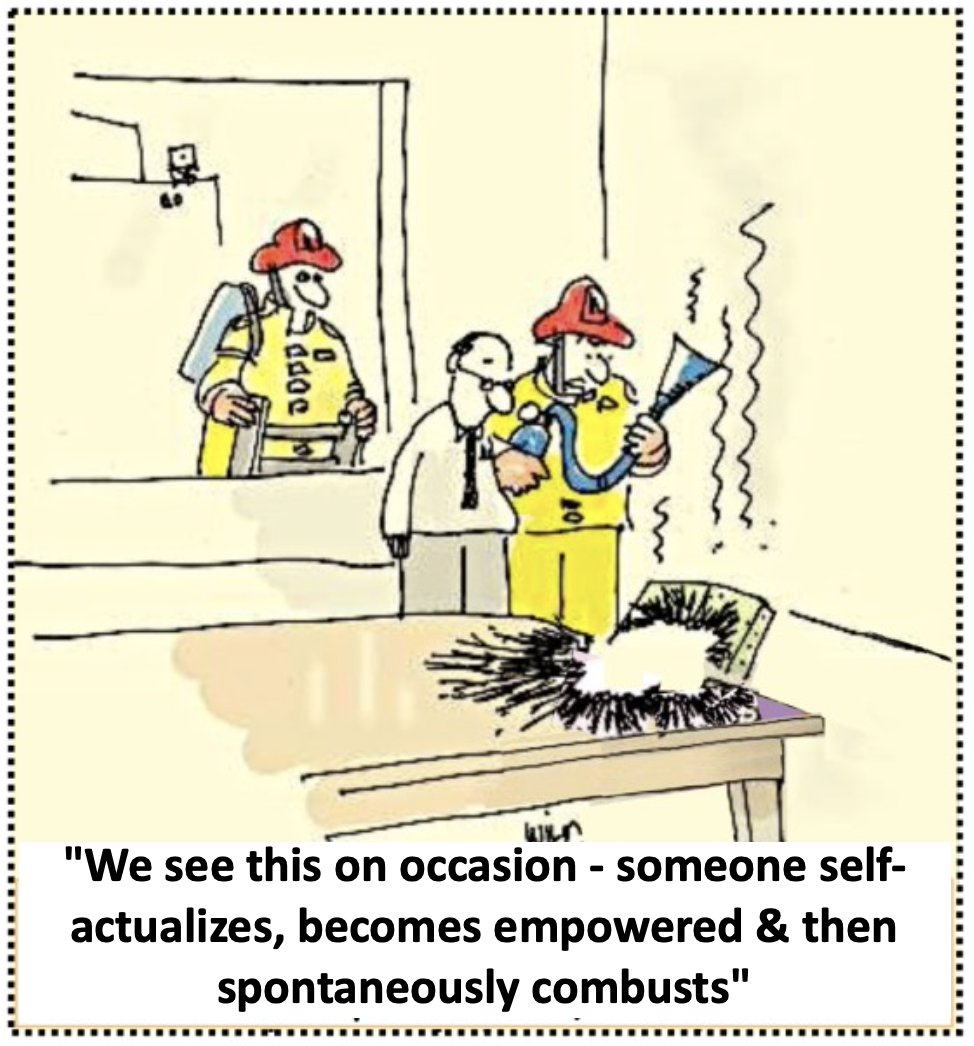
• that controls are good, & complete abandon is bad. It takes healthy self-control to improve the quality of life in all areas (Cartoon: Chris Wildt)
• to transcend our cultural conditioning & become world citizens
• to transcend life’s trifling problems, & grapple with the serious ones, including injustice, pain, suffering & death.
(from “Psychology – Search for Understanding”, Simons, Irwin & Drinnien)

NEXT: 

MASLOW – Spiritual Transcendence (Part 2)

PREVIOUS:Spiritual Transcendence #1

SITEs
: Of 2 minds – Is the brain wired for faith? (Catholic focus)


REVIEW: Transcendence is identified as an emotional & mental connection with a Higher Power, or as experiencing cosmic unity

RESEARCH: For decades scientists studying the brain mainly focused on mental illness or physical injuries. Now advances in Neuroscience are beginning to identify  complex mental processes & brain activity. EXPs:
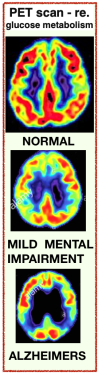
▪︎ Scans of normal vs Alzheimer’s brains —->
▪︎ The effect of child abuse & PTSD, which parts respond to music… where emotions, memory, facial recognition show up…. ALSO,
▪︎ Some spiritual moments are tightly linked to “fight-or-flight” regions related to survival impulses

Researchers are also finding a neuro-psychological basis for spirituality, & like any emotionally intense human experience, it involve multiple brain systems. EXP:
When Carmelite nuns were asked to remember their most intense mystical experience (bliss), neuro-imaging noted activity in their:
— RIGHT medial orbito-frontal cortex, middle temporal cortex, caudate, inferior & superior parietal lobules
— LEFT medial prefrontal cortex, anterior cingulate cortex, inferior parietal lobule, insula, caudate, brainstem.

▪︎ Other studies found that when nuns meditated on a Bible verse – their language regions lit up, & for monks focusing on a sacred object, it was the visual areas.

▶︎ Scientists at Columbia & Yale believe there’s a universal, cognitive (mental) basis for spirituality – as opposed to cultural grounding. They chose to do a study that “sought to directly examine spiritual experiences, particularly when using a broader, modern definition that may be independent of religiousness.”

Participating psychiatrist Marc Potenza stated that finding “the neural bases of spiritual experiences may help us better understand their roles in resilience, & for recovery from mental health & addictions.”
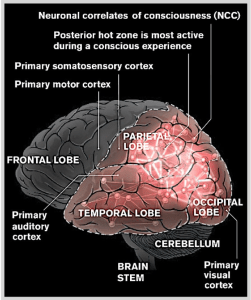
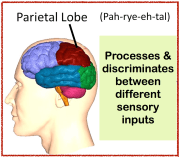
In this study (published 2018) participants were given fMRI scans while listening to recordings based on their personal spiritual experiences. All of them showed changes in the parietal cortex, specifically less brain activity in the left inferior parietal lobule, which minimized sensation, attention, spatial orientation & language – differing from responses to other forms of relaxation.

This shift may explain how spiritual experiences can reduce or even eliminated altogether the barrier between oneself & others. It showed that transcendence is a real, measurable phenomenon, whether it involves communion with God (church), nature (trees), or humanity (at a music concert, sports stadium)….. Although we definitely need good boundaries for protection & to manage reality, removing the barrier every so often is also valuable.

▶︎ Brick Johnstone Ph.D (with the interdisciplinary faculty at U of Missouri) asks: “What is it about humans that allows us to experience Spiritual Transcendence?”
Their 
answer: “Spiritual experiences are based on the neuro-psychological process of “selflessness.” 

It’s known that the precuneus portion of the parietal lobes on both sides of the brain are involved in episodic memory, visuo-spatial processing, & aspects of consciousness. This area defines & focuses ‘self-orientation‘.
Proof:
when a person looks at a picture of themself, the right parietal lobe (RPL) lights up, seen with the help of electrodes placed on the scalp.

IN CONTRAST
▪︎ Studies of Buddhist monks in meditation or Franciscan nuns deep in prayer – showed a minimization of their RPL.
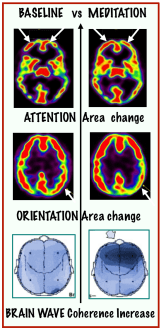
▪︎ Andrew Newberg (U of PA) discovered that the frontal lobe, associated with focus & concentration, lights up at the same time as the parietal lobe, integrating sensory info, goes dim. (Meditation Scans)

▪︎ Reports of brain injuries at U of Chicago & of tumor patients in Italy showed that injury to the RPL is associated with increased reports of an altered state of consciousness. Therefore, when that part is suppressed, by injury or during religious rituals, we focus less on the Self as a separate entity, making it easier to notice things outside & beyond oneself.

This does not mean one must be brain-damaged to have such experiences, nor that there’s one spot in the brain that makes us believe in God. Rather, both religious practices & injuries/ disorders can minimize a focus on the self, increasing spiritual transcendence.
Research does not claim to know spiritual truths, but it does show how the brain allows for different kinds of spiritual experiences – what Christians call God, Buddhists Nirvana, & atheists being connected to the earth.

NEXT: MODERN Pyramid #1

MASLOW – Spiritual Transcendence (Part 1)

PREVIOUS: Transcendence #2

BOOK: “The Spiritual Brain: A Neuroscientist’s Case for the Existence of the Soul

▪︎ Living with our Spiritual Brain

BACKGROUND: Maslow’s parents were first generation Jewish immigrants from Kiev (living in Brooklyn, NY), & he experienced anti-Semitism from teachers & schoolmates. Coupled with a troubled relationship with his mother & no childhood friends, he become a loner, spending hours in libraries.

As an adult – he was an atheist & so found it difficult to accept religious experience as valid, unless placed in a positivistic framework. Rather than ascribing peak experiences to God (as did many people he interviewed), Maslow argued that the basic experience is human, & that we use the language of “God” to describe it because that’s the only language available in most cultures to discuss such things. Accordingly, his “God” was the description, not the cause.

In contrast to Maslow, Victor Frankl – founder of Logotherapy & Existential Analysis – was deeply religious, & considered religious-spiritual experiences an important part of human nature. This in spite of what he suffered in Auschwitz, & where he lost his wife, his mother & brother.

Frankl criticized Maslow’s Humanistic Psychology movement for overlooking the transcendent nature of human experience.  He said: “Religion is the search for ultimate meaning…. not about ensuring the accomplishment of a relaxed life conduct, or the lack of conflict or some other psycho-hygienic objective. Religion offers more to human beings than psychotherapy, & indeed expects more from us.”

Their contemporary, Carl Jung, was luckier than Frankl – as a Swiss citizen he was spared the hell of war. Even so, the mental/emotional instability of his mother & the experience of poverty in his early years also caused psychological injuries. Yet he too was profoundly spiritual, delving into its many forms.

And the French philosopher Pierre Teilhard de Chardin said:  “We are not human beings having a spiritual experience. We are spiritual beings having a human experience”.

3 Intelligences – IQ = Mental  //  EQ = Emotional // SQ = Spiritual
SQ says that human beings are essentially spiritual creatures, driven by a need to ask fundamental / ultimate questions. It allows us to be creative, seek answers & play an ‘infinite’ game. Spiritual experiences can be communing with God, for humanists – a feeling of oneness with nature, embracing humanity, or as simple as being elated during sporting events.

BENEFITS of enhanced SQ = resilience:
• live an energetic & balanced life
• effectively manage emotions
• become more reflective & introspective
• build capacity to face life’s ups & downs
• reluctance to cause unnecessary harm (also slide #46)

BLENDING – In a 2011 article, Dr. Melvin Morse wrote: “Recent scientific advances in Neuroscience & Information Theory have triggered a profound shift currently rippling through all areas of society – the long-awaited reunion of Science & Spirituality.  The New Paradigm embraces consciousness as a primal component of the Universe, no less than the mathematical laws which are also embedded in it.

Like prior shifts, ‘Consciousness Comes First’ does not overthrow our current knowledge of material reality. It simply adds a deeper level of understanding, that our Universe is made of ‘Vital Dust’, as Nobel Laureate Christian De Duve described it.” (More….)

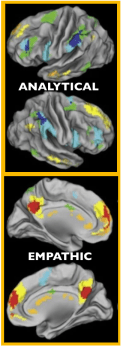
Tony Jack & Julie Exline (Case Western Reserve U.) have studied the pragmatic conflict between science & spirituality/religion. They used neural imaging to shed light on the divide, finding that the differences come from the brain’s wiring.

Humans have 2 mutually exclusive & distinct neural pathways, so when one is activated, the other shuts down:
— an Analytical mode, ie. task positive network, which kicks in when we need to solve a task,  AND
— an Empathetic mode, ie. default mode network, which helps us understand other people’s emotions, & to identify with them.(More….)

Exline reminds us that our analytical mind sometimes comes up short on answers to life’s problems. Her research shows that when people dealing with spiritual struggles avoid tackling the big existential questions, their mental health suffers. Science & spiritual inquiry, says Jack, are like breathing in & breathing out. “You can’t do both at the same time, but you need both to stay healthy & well.”

A 2012 study which followed 114 adults for 10 years, showed that those with strong spiritual convictions had only one-fourth the risk for major depression, compared to their opposites. Researches stated : “Spiritual experiences involve pronounced shifts in perception, buffering the effects of stress on mental health.”  (American Journal of Psychiatry).

In addition to strengthening intellectual abilities, cultivating spiritual experiences can help people lead emotionally richer lives, & develop more open minds.
Surprisingly, it’s science that’s telling us to be more spiritual.

NEXT: Spiritual Transcendence #2

MASLOW – Transcendence & MEANING

PREVIOUS: Transcendence (#2)

SITE: Some thoughts about “Meaning

HUMAN TRANSCENDENCE
DEF:  
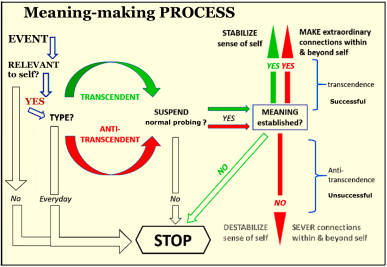
An experiential meaning-making process to form extraordinary connections within, & beyond the self with others – in time & space.

♦ In his Spiritual Awakening Blog – Jim Tolles defines Transcendence as the a conscious ability to choose how we respond to any situation – about walking through the fire (of life & Self), not away from it. ‘Achieving’ spiritual transcendence is NOT about:
– running away from oneself, or being free of ego
– that we’ll somehow be better than everyone else
– never feeling pain or facing adversity again. Life still brings hard times.

Transcendence is the OPPOSITE of reactions from the ego state, choosing something we think would get us the best result or would get us away from uncomfortable feelings. These are driven mainly by fear, aggression, or anything that’s heart self-protective, where we react & then later have to clean up the mess it made.

Tolles continues: Transcendence is like going to a new floor in the building (the Earth). Awakening is the elevator, but you still live in it, & have certain rules to abide by (our body, dealing with others…). All these things make an ego a useful tool. BUT it’s erratic & out of control…..

Transcendence doesn’t think the ego-way. It doesn’t exactly think. It’s an intuitive knowing that allows you to see a bigger picture, and from that awareness, you can choose actions that allows you to see where you’re out of alignment with love & kindness, & then consciously re-align yourself.

♦ In “Transcendence & Spiritual JOYCabrini Pak, (U of Chicago), sees transcendence as a process rather than a specific event or continuous state of being, which allows for various possible outcomes:
1) Stabilizing a sense of Self, to better answer: “What am I?”

2) Making extra-ordinary connections within & outside the Self, with space-time moral connections to specific meaningful events, which can then be used for future reference

Anti-transcendence
, the reverse, is the end result of someone not being able to make positive meaning from a personally relevant extremely negative event, (see Post above). This inability is accompanied by markers such as profound shame or guilt, or a lack of valued support, which then overshadow future experiences.

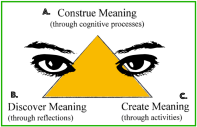
Transcendence requires enough personal growth (actualization) to extract positive meaning from difficult & painful situations in life. Here are 3 ways:

A
. Understanding / figuring it out – by thinking
B. Discovering it for oneself – by reflection, pondering, letting the unconscious work, meditating….
C. Create it – by taking actions, trying something & observing the outcome

EXAMPLE re. Illness
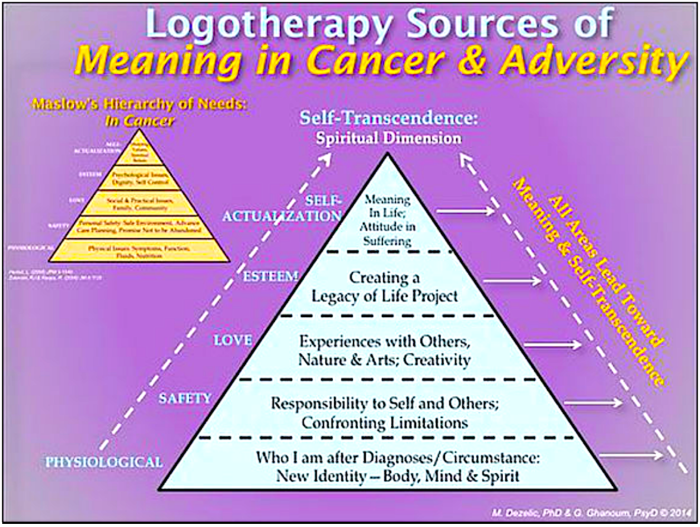
Dr. Marie Dezelic, Living with Meaning, applies Victor Frankl’s Logotherapy & its techniques to ‘Meaning in Illness’. The idea is that regardless which specific needs may be thwarted, each patient has the capability of “becoming”, even in the face of the unsatisfied ones. (Frankl)

Goethe stated: “If we take people as they are, we make them worse. If we treat them as if they were what they ought to be, we help them become what they are capable of becoming”. And from Niklaus Graber (2004): “The resources of inner strengths are to be found in the spiritual dimension”.

Dr. Dezelic: “With cancer, or any terminal illness, many of the basic lower level (D) needs are missing, or are changed altogether”…… Suffering can take over one’s identity, & while higher level needs (B) may be longed for, they’re hard to pursue, so existential value & meaning are ignored.

Logotherapy can help diagnosed patients construct a new way of seeing themselves, focused on “Being” & “Becoming,” rather than on what was lost, changed, or on any limits the person is faced with. So while the needs caused by illness are addressed, ‘Meaning’ can also be worked on

As shown on this pyramid, not all lower areas of meaning have to be met or progressed through in order to reach transcendence. Instead, all meaning-making opportunities can lead toward it to form a new self-understanding.

NOTE: People who have a solid faith in God / Higher Power already have a clearer sense of Meaning / purpose / reason, giving them a strong foundation to rely on in the face of any adversity.

Helpful CHARTS re. : Hope, Processing Grief & Healing

NEXT: Maslow “Modern”

MASLOW – Transcendence, Level #8 (Part 2)


PREVIOUS: Transcendence #1

SITE: Applying Self-Transc. to Nursing

CONVERSATIONS: Personal Journeys of Transcendence and Healing


TRANSCENDENCE – Level #8 (cont)

NOTE: This level can be considered in 2 overlapping parts: Self-transcendence and Spiritual Transcendence.

In a study by Schnell & Becker, they considered S-T in the:
▶︎ Horizontal, as the Self connecting with health, reproduction, care for others, social commitment & unison with nature
▲ Vertical, as the Self relating to explicit religiosity & spirituality

Transcendence combines a psycho-social-spiritual drive toward personal maturity, distinct from the more self-absorbed striving for self-esteem & intimacy (Levels 3 & 4), by finding greater goals & ideas that serve as a backdrop for one’s whole life.

Strengths of Self-transcendence (S-T)
Appreciation of beauty & of excellence in every experience, & value the excellence in oneself & others
Gratitude – leading to contentment (31 Benefits )
Hope – making difficult tasks & goal-attainment easier
Humor & playfulness – helps to cope with life’s stresses, & facilitate healing wounds in self & others
Spirituality – finding one’s life-goal & positive self-story to give one’s life meaning, greater than just getting through the day.

Spiritual transcendence is the perceived experience of the sacred that effects one’s self–perception, feelings, goals, & the ability to transcend / overcome one’s difficulties. HERE meaning comes from connecting to other people, to universal energy & to a Higher Power (of one’s understanding)

Barbara Hanfstingl’s research lists 3 Measures of spirituality – Implicit self-regulation, Meaning in life & Mysticism, with the latter including:
– Timelessness = feeling at one with the universe
– Good power = feeling moved by an ethereal, heavenly force
– Spiritual insights = which cannot be put into words, too sacred to describe

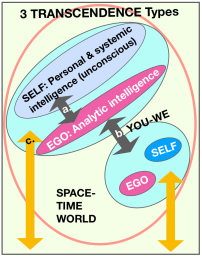
3 TYPES of S-T (review of Julius Kuhl‘s life & work – scroll UP)
Kuhl & Fuhrmann postulated that human personality is a composite of inner processes for regulation – focused on maintaining the individual’s intended goals:
a. Ego transcendence – self beyond ego = overcoming the barrier between explicit & implicit self-regulation (thinking vs. emotions) – such as deliberately switching between analytic & holistic information processing (intention vs. extension memory).

Implicit self-regulation includes:
▪︎ Positive self-perception ✳️
▪︎ Self-motivation ⬆️ & self-calming ⬇️
▪︎ Action oriented failure management ➡️

b. Self-transcendence
– beyond self toward the other = connecting the I & the You, the capability to get & stay involved with another. NOTE: it’s the opposite of narcissism, where the self & the ego are fused

c. Spiritual transcendence
 – Generally, religious people show higher levels of emotional well-being than nonreligious ones, while also striving for high standards. Transcending experiences go beyond the space-time world that surrounds us, & includes a perception of divinity. (MORE….)

TIME & SPACE
DEF:
Transcendence – An experiential meaning-making process to form extraordinary connections within, & beyond the self – with other, in time & space.

Pamela Reed’s
 Self-Transcendence Theory’s assumptions:
a.  Human beings are integral to their environment
b. Self-Transcendence is a developmental imperative

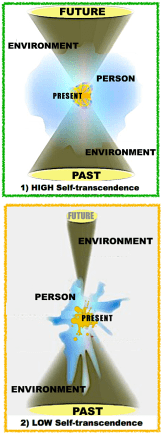
Figure 1 shows a “healthy, open & multidimensional entity, with continuously fluctuating imaginary boundaries, existing within time.”
Past, present & future interact with the person. With transcendent development – their perception of boundaries becomes less distinct, so they can identify Self well beyond the physical & present moment….. and time can become less obvious to them, so everything, including boundaries (separateness), seen less affected by the passing of time.

Figure 2 represents one of an infinite number of possible scenarios for people who are unable to successfully develop self-transcendence. They have more distinct but constricted boundaries & a limited relationship to the external environment. The future is not well integrated into the present, & there’s too much identification with the past.

There is a strong sense of self, but it’s mainly focused on their physical presence, without any real connection to others, the world, or intangible truths (intuition, spirituality….) – ie. narcissism.

Our BRAIN’s GPS can help track time & distance, using grid cells – (originally done with rats). These cells “lay down the sequence of time & space that provide a framework for unfolding events” (a critical aspect of memory) says Howard Eichenbaum, at Boston U.
☆ Grid cells that act like a spatial map in the brain have been identified for the first time in humans, in new research by UCL scientists in the UK (MORE….)

NEXT: Maslow & Meaning

MASLOW – Transcendence, Level #8 (Part 1)


PREVIOUS: Additional Levels

POSTs: ‘Spiritual Resilience – 1 & 2′


TRANSCENDENCE – Level #8
DEF:
To rise above or go beyond the limits of a situation
▪︎ To triumph over negative or restrictive aspects of something
▪︎ A state of being or existence above & beyond material experience

Most Self-actualization traits involve making everyday life more enjoyable.
Self transcendence (SC),
on the other hand, is not about competing with others for basic (B) needs, but a personal journey of self-discovery. It requires personal effort – the willingness to change – with an awareness that succeeding is a combination of the personal “little I” & the bigger, universal “I”. Mystical experience is a particularly advanced state of self-transcendence, in which the sense of a separate self is temporarily abandoned altogether

As one of the developers of Humanistic Psychology, Maslow had an extremely positive view of humanity – valuing man’s goodness, dignity & intelligence. Spirituality is then mainly about personal development, connecting with other people & the world of nature.

Maslow’s systematic works, like The Psychology of Being, didn’t focus on the treatment of various pathologies (as Freud did), but rather on understanding & defining humans in their optimal state, especially regarding ‘peak’ experiences & self-fulfillment. Ordinary human unhappiness was ‘too easy’ to find. He wanted to encourage the healthy core of people achieve self-actualization, with which the highest spiritual good is realized.

“The fully developed (& very fortunate) human being, working under the best conditions, tends to be motivated by values which transcend his Self…. My satisfaction with achieving or allowing justice…. is equally outside & inside: therefore, it has transcended the geographical limitations of the self.” (1969)

Maslow believed striving for these highest needs is instinctive – beyond self-interest, considering wider holistic principles for the greater good, in service to others, & the pursuit of causes bigger than any individual

He thought Transcenders would be highly religious – regardless of which type, indicating his theory had a broad social application: “Culture is absolutely needed for their actualization, but it can also fail to actualize them, & indeed this is just what most known cultures actually seem to do, & have done throughout history.”

He pointed out that, if successful, self-trancenders often crave peak experiences. Beyond the routine of fulfilling deprivation (D) needs (#1-6), some people have extraordinary deep moments of understanding, love, even rapture, making then feel more alive, whole & empowered, yet a part of the world. They’re more aware of goodness, harmony, justice, truth….

Peaks are exciting & elaborate situations which become the most important things in their lives – the most precious & validating – their high spots. It could explain why some people gravitate to jobs such as policeman or firefighter, putting their lives at risk for others. (“PEAK” in biz)

Maslow believed such states are mostly emotional & temporary but not always flukes – there are people who can access them easily. He also thought that some self-trancenders may be saddened by realizing that others don’t have such hight moments. While he said that mature people (self-actualized) are most likely to have peak experiences, he felt everyone had the potential.

From Students’ Peak Experiences (1985), James Polyson found that most :
— occurred during athletic, artistic, religious or nature experiences
— during intimate moments with a friend or family member….
— when students achieved an important personal or collective goal….
— overcame some adversity or danger — or by helping someone in need

💙 However, Maslow eventually noted that with age, the intensity of the highs gives way to a gentler, more lasting state of quiet between the “orgasmic peaks of the mystic gone wild”. This he called high plateau experiences (more mental), which can be cultivated through conscious, diligent effort.

At the end of his life he cautioned against the ‘‘Big-Bang’’ theory of self-actualization, recognizing the need to value ‘patience for the awesome elements in ordinary existence’, combining miraculous & normal consciousness (Maslow, 1970), a state said to be the true & final goal of the mystic’s endeavors

“With today’s ‘fast food spirituality’ there is a pressing need to understand both the positive & negative poles of self-transcendence. Ferrer (2002) points out that Western transpersonal psychology’s emphasis on experiential processes & peak states…. have often neglected the proper preparations, maturity, & ethical scaffolding long-standing spiritual traditions usually provide” (Nicole Gruel, AU)

NEXT: Transcendence  #2

MASLOW – Pyramid ADDITIONS (Levels 6 & 7)

PREVIOUS: Maslow Level 5c

 2 MORE LEVELS
♦ Instead of focusing on what goes wrong with people (psychopathology), Maslow formulated a more positive account of human behavior which focused on what goes right.  Originally his Level #5 was: Self-actualization needs – realizing personal potential, self-fulfillment, seeking personal growth & peak experiences. (1943)

In his later years, Maslow changed his understanding of this level. He came to believe that the Self only becomes actualized by pursuing a higher goal outside itself – the need to connect to something beyond the ego, by helping others find self-fulfillment & realize their potential – & therefore transcendent in nature. But he also pointed out that it can go hand-in-hand with Level 1, because Belief is a great motivator.

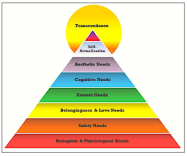
In the 1970s he gave an expanded version of the Pyramid. Stages 1-4 remain the same, which – when provided for – help us develop “better life choices.” Between 4 & 5 he added 2 new ones, & a last one called ‘Transcendence’ – which Daniels (2001) thinks may be one of Maslow’s most important contributions to the study of human behavior & motivation. William G. HuittValdosta State University, GA

ADDED
#5. Cognitive  – (mental) Maslow observed that humans have a hunger to increase their intelligence, for meaning, predictability…., which motivates them to chase knowledge. It’s basically the need for truth, made up of the needs to know & to understand (both required for survival). 

It comes with a curiosity to learn, explore, discover & create – to better understand the world around us, which requires an openness to experience. This type of growth – when not fulfilled – leads to confusion & identity crisis. Maslow considered it a defining aspect of psychologically healthy people, & the unhealthy were people who had their truth needs thwarted. (More….)

#6. Aesthetic  – (artistic) The need to appreciate & actively search for inherently pleasing forms & balances, aesthetically new things , & opportunities to express oneself in many creative ways.

Maslow believed that humans are refreshed by nature, forming an intimate oneness with it by carefully observing their surroundings, to absorb the beauty that the world has to offer – all part of the path towards Self-Actualization. And just as with other missing needs, when people with strong aesthetic needs are deprived of them, they can experience stress & sickness.

STANDARD
#7. Self-Actualization  – (psychological) realizing personal potential, self-fulfillment, seeking personal growth & peak experiences (previous posts)

At this level, the obvious question is: ‘If someone is already self-actualizing, what then motivates that person? In looking for an answer, Maslow (1969) came up with “motivation by intrinsic values” that go above & outside personal self-interests. Self-Actualization and Transcendence are considered Being qualities, or B-values, whereas the previous ones are Deprivation Needs (D) which must be filled in order to function.

#8. Self-Transcendence (spiritual) – made up of universal values such as Excellence, Fairness, Goodness, Justice, Perfection, Truth…..& can include aesthetic, altruistic, mystical, religious, sexual, scientific…. experiences  (More in next posts)

Peter K. Gerlach, MSW has proposed YET an ADDITIONAL level: 
which could be called “Recovery” needs

Much has been learned about human behavior & motivation since Maslow created the original pyramid in the 1940s. He & his clinical contemporaries seemed to be unaware of childhood trauma or about Grown Wounded Children  – (Explanation + video. GWCs = ACoAs).

The cycle of inherited wounds + low parental nurturance + lack of self-awareness = can keep both adults & children stuck in levels 1-4, which blocks them from thriving.  Like ground fog obscuring a mountain peak, such damage can prevent living with purpose, & even shorten life.  People with significant unhealed wounds often lose clear focus of purpose & prioritizing ability that the True Self would be able to provide.

The one Gerlack suggests would go between levels #3 (Belonging) & 4 (Esteem), using a list of basic human needs – to Reduce early-childhood Wounds, & free our inherent True Self to make its own life decisions.
“This is required in order to develop…..
• a clear personal identity (who am I?),
• genuine self-respect & self-worth (vs. shame & guilt), & to grow a …..
• ….. stable sense of self-love, self-respect & self-confidence (vs. self-neglect, shame & self-doubt)”

“People guided by their True Self & clearly aware of their primary needs – are more likely to make core attitude changes where necessary, bringing permanent behavioral shifts.”
Editorial comment: YEAH for him!

NEXT: Pyramid Growth

MASLOW’s pyramid of NEEDS – Actualize (Level 5b)


PREVIOUS: Level 5a

SITE: 5 Way to Self-actualize

Maslow’s Original PYRAMID (cont.)

Level 5. SELF-ACTUALIZATION — KEY CHARACTERISTICS (Western-culture biased)

Self-actualizers (S-As) are people who have shed much of their unhealthy attachments & expectations, liberating them to enjoy flexibility & spontaneity. And because they focus more on their inner-guided purpose in life, so are able to leave wonderful & beneficial legacies.

SAs are not so concern with taking credit or casting blame. They don’t waste a lot of energy judging others, since they’ve come to understand the beauty & suffering of the path everyone is on.

While achieving SA goals is not ‘required’ for normal psychological development, it is required to be ‘fully-realized’. And even though these needs can never be totally satisfied, any gratification that is gained from ones efforts can spur people to keep on trying.
When motivated people do reach a specific big goal, they usually come up with a new one to work toward. But it’s also important to savor each success before setting off on a new adventure

Maslow noted that Self-actualizers often feel saddened, exasperated, even enraged by the shortcomings of the average person, which can be such a nuisance that it sometimes makes S-As bitter (1970)

Accept Reality: S-As can correctly evaluate & have an easy acceptance of Self, others & nature – without complaint, guilt or shame about limitations or shortcomings, & so are able to be gently honest with everyone. They aren’t confused by any disparity between the truth & an idealized self-image

• Appreciative: S-As have a sense of appreciation, wonder & awe about the world – the innocent way happy children do. Even simple things can be a source of inspiration & pleasure, so they don’t get jaded or bored with familiar experiences.
They can get very absorbed by & extract deep richness from subjective experiences, which can involve music, sexual enjoyment & appreciating beautiful things in nature

 Autonomous : S-As are self-contained, & confident in their own judgment, without having to lean on others or the outside world. Because SAs are driven by growth rather than deficiency needs, their sense of satisfaction comes from continually improving their life, as a result of their efforts  (⬇️ a SA goldfish 😄)

Having grown strong enough to be an ‘inner-individual’, they don’t need others to keep providing the normal human requirements of earlier levels, because they already they have enough & can add to them whenever things change.
They make up their own mind, having more free will than most people, & don’t need to convert others to their way of thinking or doing

• Creative : Altho this is part of every human interest & activity, level 5 creativeness is a special type – like the inborn, naive imagination of children – the sky’s the limit! While most adults forget to use this natural talent, S-As keep trying new things instead of getting stuck in a rut

Democratic : S-As are friendly toward & interact with just about anyone, without concern for differences in class, education, race, color, religious or political beliefs. They’re likely to protest against evil & tend to be less ambivalent or confused about their own righteous anger

• Discerning: S-As rely on their own judgment & intelligence to form opinions about people, situations & things, & are not easily influenced by external social trends or pressures

Ends, not means: S-As focus on where they want to end up, rather than getting caught up in means – the ‘how’. Most adults can’t seem to choose a goal before listing what resources & skills they have in order to move forward. These become screening devices used to decide what goal to try for – which severely limits their options

This is the opposite of how children operate – they want something & then figure out how to get it!
That’s exactly what SAs do – being open-minded, goal-focused, & willing to risk trying, the ‘means’ evolves in the process of doing

Ethical: S-As are confident in their evaluation of what’s right & wrong,   knowing the difference between good & evil, so are not confused or inconsistent about moral issues – not hypocrites. They’re aware of the ethical implications of all their actions

Growth oriented : S-As are always looking for opportunities to improve themselves & their environment. They know it’s a life-long process, have the courage to tackle the hard parts & try new ways to resolve obstacles

NEXT: