BEING LOVED – Parents (Part 3)

PREVIOUS : Being Loved – Kids (#2)

SITE : “5 Ways to be a Positive Role Model

 QUOTE: “They say that what you love doing most before the age of 10 is the best indicator of what your life’s passion will be….

↗️ Seasons exist for a reason. There’s a huge difference between holding & clinging. We can hold on in good faith to relationships, beliefs & attitudes that have served us well, even through challenging times
but when we cling to them with a death grip – when they no longer serve us – we can’t receive or embrace anything new & wonderful.” ∼ Beth Briggs

ACoAs:
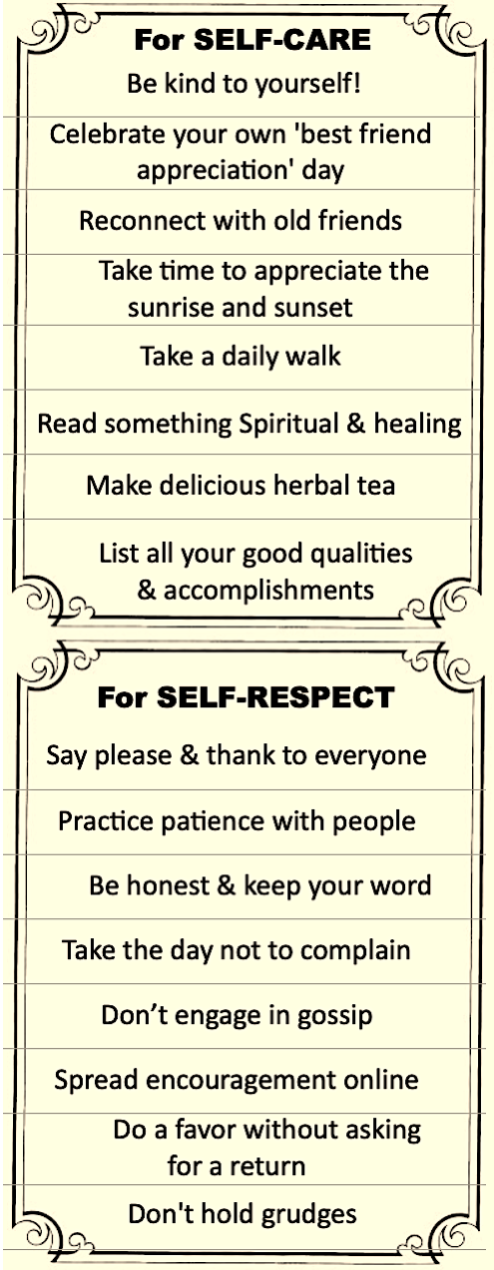
It’s likely that none of us received the love & safety we needed from our family – regardless of the reason.  The following lists identify what we had a right to – not because we’re better than anyone else but just because we’re here & are God’s creation. And God doesn’t make junk!

Now we can apply this info to how we treat ourselves – being our own Loving Parent & Healthy Adult (the UNIT) to heal & nurture both our Healthy and Wounded Inner Child (the WIC).
Then can we have these attitudes toward our external children, grandchildren & others in our life.

CAVAT: Although this list is in the form of Promises – as wounded Recovering people, we’re not in touch daily with our Inner Children, the way we need to be for the best growth outcome.
So promising the WIC that ‘everything will be OK’ & we’ll ‘take care of it’ – but then we forget to do it – is not being truthful & dependable, no matter how good our intensions. Un-kept promises tells our INNER that we’re not trustworthy – just like our parents. So then it won’t rely on or believe us.

It’s better to use this list as conscious ACTIVE WILLINGNESS, working toward incorporating the principles slowly one-day-at-a-time, without self-judgment.
• Posts: “Why RESIST Talking with the Inner Child?”
• Use WORKBOOK : “The Recovery of your Inner Child” ∼ Lucia Cappacchione

💞 How many of these qualities have you already made a part of your life?  Give yourself credit
for those, & work on adding in the others, slow & steady.
«

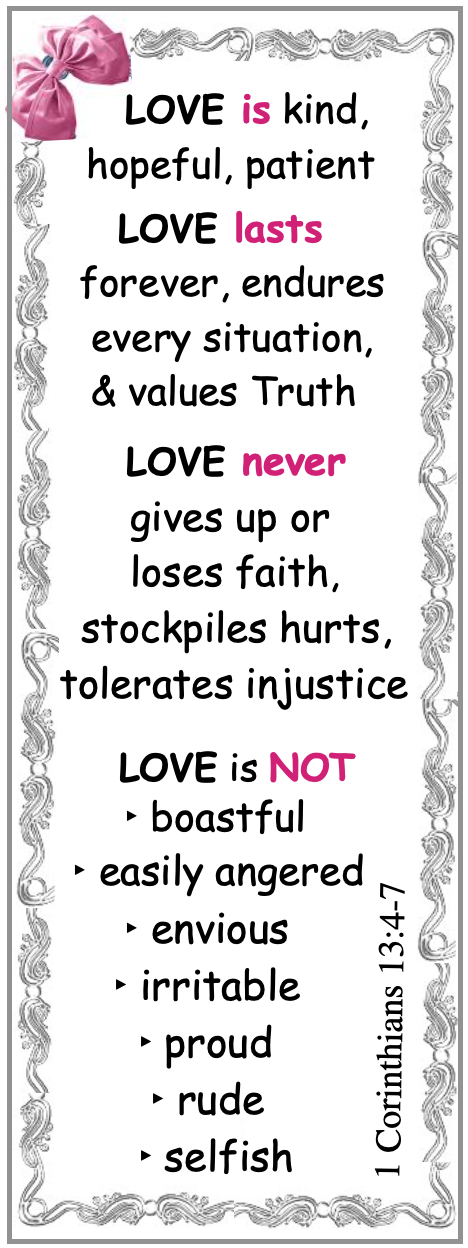
💞These verses are a great way to deal with all life’s stresses, no matter what our age.
«


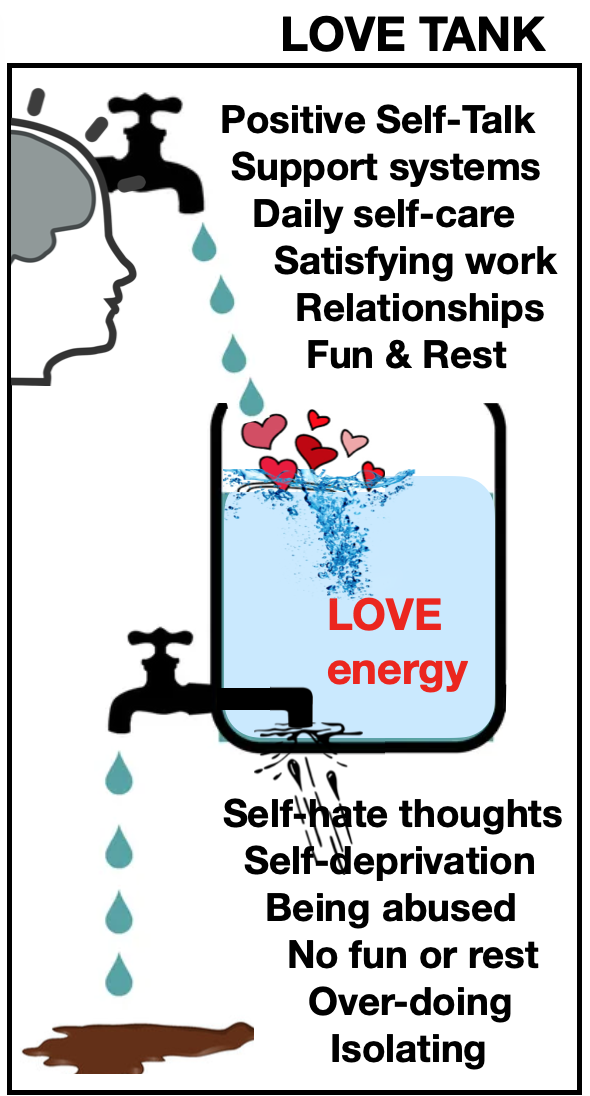
NEXT: The Love Tank

BEING LOVED – Kids (Part 2)

PREVIOUS : Being Loved – #1

SITEs : ESSAY – a Parent’s love

🙏🏼 God’s love as Parent unconditional, sacrificia


The #1 job of a parent is to meet their child’s need for LOVE. And children spell love T-I-M-E.

A child’s tank filled up with love is a happy, emotionally stable child. But because of internal & external pressures, many guilt-stricken parents misinterpret the kind of love that kids need, trying to make up for lost time by not enforcing boundaries or appropriate expectations.
However, the outward expression of authentic parental love is a skill that can be learned.

BRAIN Growth
Research from Washington U in St. Louis, showed that a mother’s love helps her child’s brain grow – as much as twice the rate as that of a neglected child.

SPIRITUAL Growth
Love is a physical need for children. Authentic parental love helps them develop an awareness of being a beloved child of God, one who has the capacity & responsibility to share that love with others.

SECURITY & BOUNDARIES
Kids don’t like boundaries – they actually crave them. True parental love allows them to feel safe & secure by providing limits (if age-appropriate), even though a children’s desire for immediate gratification can get in the way.
But even if they won’t admit it, children thrive in a home with loving, clearly defined boundaries.

ADVERSITY
Kids from loving homes tend to be more adaptable. This gives them the roots needed to develop resilience & a healthy perspective for facing life’s issues.
When they get honest encouraging & supportive words from parents they’re better able to develop perseverance, self-control & patience.

SELF-CONFIDENCE
Kids become self-confident when they feel a genuine, unconditional parent-love. They able to enjoy positive experiences in life, instead of worrying about what the future holds.
Family environments where love is regularly expressed prepare children to boldly face much of what they’ll be dealing with as adults.
(From Danny Huerta, MSW, LCSW, LSSW at Focus on the Family)
💕   💕

The 5 LOVE LANGUAGES – for KIDS
Gary Chapman & Dr. Ross Campbell introduced this idea in “The Five Love Languages” & later in “The Five Love Languages of Children”. They pointed out that it’s common to have different love languages in a family, which can be tricky to navigate if unknown. But once parents learn each child’s style, & are willing to implement it, it makes a big difference in their relationships, including with siblings – all for the better.

Being loved unconditionally by others helps children TO:
– express their capacity to love, & allow themselves to accept love
– develop a realistic sense of who they are, as well as being part of a unit
– learn to trust their own experiences & opinions, because they feel safe
– cope with delay & frustrations, an inevitable part of life
– experience a range of emotions & communicate what they think & feel.

The following preferential styles don’t have to be exclusive – but rather – are the overall way each child feels seen, heard & given to.


NEXT: Narcissism – Overt #1

BEING LOVED (Part 1)


PREVIOUS : ACoAs as Narcissist  #3

SITEs :   Characteristics of Parental Love
What Is Parental Love & How It Can Change People


NOTE:
Narcissist posts will continue on 5/8/2021

🥰 POSITIVE ideas & emotions broaden an our thought-action repertoire, & solve problems during personal growth & development.
EXPs:
🤍 LOVE sparks a recurring cycle to pursue healthy urges – within safe, close relationships

💚 INTEREST & CURIOSITY spark the urge to explore
💝 JOY & HUMOR spark the urge to play
💛 SAFETY & CONTENTMENT spark the urge to savor & integrate

⬇️ 8 TYPES of LOVE, using Ancient Greek names which they chose from their studies of this subject. These categories still apply today. (Explanations…

NEXT : Being Loved #2

ACoAs’ Narcissistic Attitudes (Part 3)

 PREVIOUS : ACoAs an Ns (#2)

SITEs: NPD Statistics

💔 “Understanding Fear of Abandonment”  (+ the signs)


ADULT narcissism
is a failed attempt to make up for what we never got as kids, by trying to force the world into a carbon copy of ourselves – or of what we want it to be – with no genuine regard for others as separate being with their own specific personality (not ours) & their own back story.

💔 IMPLICIT in all ACoA narcissism is our intense, all encompassing FoA – Fear of Abandonment. So, whichever Toxic Role we ‘favor’, the underlying motivation for all unhealthy behavior is FoA. This fear causes ACoAs to never feel safe anywhere or with anyone, UNTIL we apply daily self care in whatever PMES ways are possible, to heal ODAT, (scroll to paragraph 2….) & when necessary – OMAT = one minute….
(41 Clingy girlfriend cartoons)

Other Signs of ACoA Narcissism
Childish grandiosity: insist we can change / fix / heal a loved one, as if we have god-like powers. This is never possible, & even more so when the other person has made it clear they’re not interested in changing, although we beg, cajole or demand it of them. (POST…..)
OR:
“I want to do that, so I will” (visit a dangerous location, ride a moped without a license, swim alone in the ocean, date a married man……), even though we don’t actually know how, or have no idea of the possible negative consequences to ourself & others

Clinging : specifically to someone who is no longer interested in continuing a friendship or love relationship, OR keeping up a fantasy connection with someone who was never with us in the first place.
This is N on your part because you think your needs are the only ones that count

Codependence : using other people to tell us who we are & how to behave, instead of finding the True Self were were born to be

People-pleasing : the motivation is completely selfish – doing or ‘being’ what we think others want of us but not for their benefit.
We’re trying to control others to prevent them from abandoning us, as if it’s their job to be there for us (it’s not), & as if we’re still an infant or mentally retarded (we’re not)!

Rescuing : trying to do for others what they can or should be doing for themselves – not from generosity but to make us feel important, feel needed, not alone…. & is actually arrogant & presumptuous.
(Post : “Healthy Helping“)

✴︎ Overvalue, then Undervalue (re. thoughts) : we imagine that someone we’re around is wonderful (all good), attributing qualities to them we wish for. As soon as we test them & they fall short of our ideal, we trash them – making them all bad.

Unrealistic expectations (re. actions) :  Over or under, we expect everyone to behave in a logical, appropriate, rational way, no matter who they actually are. We’re making them up to suit our own needs or fears. The expectations have nothing to do with who the other person actually is.

Victim role : While we truly were victims as children, we have options now we never did in the past. This includes isolating (not introversion), which comes from : Fear of abandonment, Lack of personal boundaries, Obeying Toxic Family Rules & Self-hate.

Continuing the pattern of deprivation in many parts of our life is a self-destructive, rebellious way we keep hoping for someone to magically come & rescue us from having to take care of ourselves.
It’s also a way of depriving the world of our natural talents & help.

🌈 RECOVERY from our narcissism comes from continually providing the WIC with all the care & love we never got as kids, so we can connect with others without an ulterior motive.

NOTE: The next 6 posts are a break in the current Narc series, to be resumed mid-June.

NEXT: BEING LOVED (Part 1)

ACoAs’ Narcissistic Attitudes (Part 2)


PREVIOUS : ACoAs as Ns (#1)

SITEACoNs – Surviving the N. Parent (Adult-children of Ns)


REMINDER : The goal of Recovery is to teach our mind that choice is always a possibility. It’s only when we refuse to think outside the box that our parents, abusive partners, bosses & ‘friends’ will be able to keep us in the Victim Role. Not being willing to consider new & better options (no matter how scary) keeps us from moving forward in our life.

“Small ns” = These versions of N expressions & behavior may be lesser evils, not as deeply harmful, but are emotionally abandoning, even in the best of cases.
NOTE : To be actual small-ns, comments or actions usually refer to 2 or more people who know each other, & usually for a long time. When dealing with rare acquaintances or strangers, we can ASK for info before responding or reaction to a situation

 EXPs of everyday ACoA narcissism :
Starting any sentence with:
“I just don’t understand how — he / she / they — can’t get it / thinks that way / wants to do that / wears that / wouldn’t want to try this ____ …..”,
as if only your point of view if right or makes sense

✿ Your good friend enthusiastically shows you a Journal Writing entry using a new pen, but it’s such a pale color that before you can think, you say : “Can you actually see that?” – meaning that it’s too light for you (but obviously nor her)

✿ Telling someone who you’ve observed has very different tastes & opinions from you – that :
“You have to read this book, Go to that great new shoe store, Try that ____ restaurant, Go to my healer…..- you’ll love it!”,
when in fact the person you’re talking to wouldn’t be caught dead following your suggestion, because it’s soooo not them, AND you did know that!

✿ Truly believing that because you know the ‘right’ way to do something (even if you are correct), everyone should also, no matter how different they actually are, or how incapable of following that prescription.
You just want everyone to make your world a safer place. (Like demanding a cripple run a marathon).

✿ Buying any gift for someone you know well – or should – which is only your taste, but which doesn’t actually suit the other person (MORE…. ➡️)

✿ Over-reacting to real or imagined criticism as a ‘Vulnerable’ N – with shame, fear of abandonment, self hate & over-explanations, OR
as a Grandiose N – outraged & in a rage, feeling humiliated & wounded pride, with verbal or physical attacks

3 most PERVASIVE signs of ingrained ACoA Narcissism
❗️Taking everything personally – This can be about the weather, the news, an unavailable item in a store, being put on hold, having to wait for a text – or anything, a boss being controlling, the way someone looked at you or didn’t notice you – even not being able to find something in your home, as if the object is deliberately hiding….

Our secret motto is “ME, ME, ME….it’s all about me!”
— which always & only refers to others’ responses – that no matter what they do or don’t do, you think it’s about you, and
— we do not want to know that 99% of the time other people (whoever) are not thinking about us – being busy doing their own thing – because that would feel like abandonment! (Post: Keep the focus on yourself)

❗️❗️Self-Hate – blaming yourself for causing all the disappointments experienced, & any pain you feel now. This is not reality, especially when the original source of your pain (family) is / was totally out of your control!
Remember Al-Anon’s 3 Cs: “I didn’t cause it, can’t control it, can’t cure it.”

❗️❗️❗️Symbiosis : you know – it’s that high you get from being with a new friend or lover, spending every day & night wrapped up in their aura. The feeling of absolute ‘union’ you’ve been waiting for all your life!

Problem: what we really want is a carbon copy of ourselves – the infant’s connection with mom – we never got!
Now – when we start finding out the other person is not us, we feel deeply disappointed, betrayed, & then whine, attack or dump them.

NEXT: ACoAs as Ns (# 3)

ACoAs’ Narcissistic Attitudes (Part 1)


PREVIOUS : N Types #2

SITE:  “The Human Magnet Syndrome: a refreshing study of narcissistic abuse and codependency”


ORIGIN of NPD – it’s nothing new!
At its mythic heart, narcissism is a story of disappointment. The ancient source is the Greek tale of the Beotian hunter Narcissus, a beautiful young man who arrogantly spurns the love of the nymph Echo & the youth Ameinias. No one is good enough. In reaction, they’re so devastated that each kill themself.

Nemesis, the Revenge aspect of Aphrodite, observing these tragedies decides to teach Narcissus a lesson. After a long day of hunting, she leads him to a clear pool. When he bends down to drink he seen a perfect image, & falls in love  – with his reflection. But he doesn’t realize it’s himself! 

Captivated by his ideal, Narcissus vows never to leave the object of his desire. But the image, forever outside his embrace, fails to reciprocate. The arrogant man’s inconsolable disappointment is that he cannot consummate his love – for himself. As a result Narcissus melts away, a victim of his hopeless passion.

In contrast, real-life narcissists manage to take their eyes off themselves just long enough to find out if others are looking at them. And if the N has admirers, this makes him/her feel great – temporarily! (More…..)
❗️   ❗️    ❗️   ❗️
ACoAs: Because we grew up drowning in NPDs – we have a legacy of :
1.  incorporating their distortions into our False Self, and
2. compulsively being attracted / addicted to other Ns, hopelessly trying to have a genuine, intimate relationship with someone who’s not capable!

ACoAs tend to deeply resent being told we’re narcissistic, especially those of us who identify mainly as co-dependent. We do NOT want to be like our N parents! so end up hanging on to our Victimhood or Hero status, rather than see how much of their patterns we inevitably absorbed.

CRUCIAL to remember: DO NOT use these posts as more fuel for Self-Hate! The purpose is to identify our damaged False Self, so we know what to work on to HEAL & GROW! 🌈

REVIEW 4 posts “What is Emotional Abuse?”

All flavors of ‘damage’ are by definition narcissistic – because they emanate from the WIC (wounded INNER CHILD) & all children start out as Ns. But as adults, ACoAs still think we’re the center of the whole world & everyone in it is always reacting to us!

Narcissism is on a continuum, from mild everyday comments to the severe malignant NPD type. Ns also have core co-dependent symptoms of shame, denial, control, dependency (unconscious), dysfunctional communication & weak boundaries, which all lead to intimacy problems. 

Although most narcissists can be classified as codependent,  the reverse is not true – most co-deps are not Ns, because they don’t have the Grandiose N’s traits of exploitation, entitlement & lack of empathy.

❣️ACoAs who are in the process of recovery AND are actually progressing slowly-but-surely out of their False Self into their True Self – start out with a less rigid form of NPD. (⬅️ CHART)

This is contrast to NPDs who may try various types of therapy & ‘spirituality’ or physical treatments – but will never go deep enough to truly outgrow their narcissistic attitude.
And of course these are the even more severe, who never even try to heal, because they don’t think they need help. What identifies any PD is that it pervades the whole system, not just some area of life, as with Neurosis. (See posts in in “Psychological Disorders“.)

For those ACoAs who have some physical & emotional sobriety (in AA, Al-Anon, ACA, CODA, DA, OA….), there will always be some level of old N. reactions. It’s OK to accept being human & have limitations, since it’s not possible to reach perfection – at all!

NEXT: ACoA as Ns

ALCOHOLISM & NARCISSISM Overlap

PREVIOUS :
N. Mind Games #7

POST: “ACA Laundry List” See #4)

NOTE:
The following 3 posts will be about how ACoAs express our narcissism. In case you object to the idea (many do) or wonder how that can be – here is a list of the parallels between alcoholism & narcissism which we grew up with. 

1) Denial
N : Narcissism (N) is characterized by iron-clad denial. From their point of view, they have no problems & can do no wrong. Bragging & a damn-the-consequences-swagger are essential parts of many N personae

Al: Denial also keeps addiction in place. The Alcoholic’s (Al) denial shows up in many ways, like saying they can stop drinking anytime they want, lying about when they drank, or refusing to acknowledge the consequences of their drinking.
That’s why AA members say  “I’m ____ & I’m an alcoholic.” It breaks denial.

2) Lack of introspection
N : NPD narcissists are not interested in self-reflection. Doing so would risk facing their character defects & emptiness

Al : Addiction can also mask inner conflicts, a low self-image & painful emotions. As long as an addict uses, those problems go unaddressed. They pile up & get harder & harder to face

3) Entitlement

N : Ns are also defined by entitlement – feeling superior to almost everyone. Not caring about others (lacking empathy), they give themselves full permission to do whatever they want, in spite of social & spiritual rules, or the cost to others.

Al: The alcoholic’s sacred entitlement is drinking. Many are willing to lose everyone & everything in their lives before give up alcohol

4) Self-absorption
N  / Al : For both – its all about ME. Their needs are primary. While both may seem to function normally in many settings (when not drunk or triggered by loss of supply), their self-focus always shows up

5) Self-destructiveness
N : Ns are trapped in a non-stop compulsion devoted to preserving their image, & preventing anything that will make them feel small & unimportant

Al: Without help, alcoholics also will sacrifice health, well-being, reputation, relationships & self-esteem

6) Refusal to take responsibility
N : Ns are quick to blame others for “making me act” the way they do. They almost never apologize or promise to change. That would show weakness, which is unbearable to Ns, sullying the image they desperately hang on to

Al: Active alcoholics are also quick to blame PPT (people, places & things) for “making me act” the way they do. While some apologize for their behavior & promise to turn over a new leaf, their continued drinking & abusive ways eventually are seen for what they are – as empty as their bottles

7) Behavior can switch rapidly
N : Ns can go from charming <–to–> threatening in a heartbeat. Feeling slighted or ‘disobeyed’ can send them into full battle mode

Al: Alcoholics’ mood & actions can also swing drastically, especially when under the influence. Alcohol lowers inhibitions, leading to outrageous, dangerous or abusive behavior

8) Superficial relationships
❧ The N’s dysfunction & the alcoholic’s active addiction make it impossible for them
to form & nurture deep, meaningful relationships
N : Trying to have a reciprocal, honest conversation with a N is a hit-or-miss proposition, & impossible with NPDs. It’s their way or the highway.

Al:
Similarly, trying to make a meaningful connection with someone who’s drunk is a fools errand. And they won’t remember it later!

9) Manipulation of others
❧ Both will use anybody they can – to get their fix.
N : The N’s fix is attention & self-gratification. They only see others in terms of what they can get from them

Al: The alcoholic’s fix is a drink. Others are viewed as either enabling their drinking or as potential threats to their freedom to drink. They need enablers as cover

10) Behavior is at others expense
N  / A : Those close to both Ns & Als experience being used, emotional abandonment, deprivation & rejection, creating feelings of rage & shame. Loved ones of both may withdraw or eventually leave the relationship

11) Shame
N : Avoiding shame drives much of narcissists behavior. Instead, they cope by dishing shame out to others

Al: 
Alcoholics carry immense shame, but their drinking numbs or masks it.
(This List modified from Dan Neuharth PhD MFT)

💘 Some people are both NPDs & active addicts, which makes them doubly hard to deal with. ACoAs had to cope with both types in childhood, absorbing many of their traits, but using our native personality as filter to ‘reinterpret’ their patterns.

NEXT: ACoAs as Narcissists (#1)

Narcissist MIND GAMES : s-w (#7)


PREVIOUS: Mind Games #6


MIND GAMES (cont)

√SHAPE-SHIFT
To keep their audience of ego-strokers, Ns are great at morphing into whatever persona will get then the most points for charm & desirability. These shifts are dictated by the circumstance & environment they happen to be in, to maintain good will, & ‘accommodate’ the person or group they can use.

Interesting: If you belong to a group where the N behaves a specific way (the pious goody in church, humanitarian of the year…. ) and then accidentally run into them in a totally different setting (drunk in a night club, bully boss at work….) you may be shocked & confused. Don’t be. They’re just a N shape-shifter.

√SLY DIGS
Many Ns love slyly putting you down in the form of joking. The point is to make an insulting comment you can both laugh at, but which will also make you feel bad about yourself.
EXP: Saying to a very thin woman “Be careful in the shower that you don’t slide down the drain” or “You’re so thin the wind will blow you away” HaHa….

It may be a funny jab at a physical characteristic (weight, bad at sports…) or mental quality (not having a higher education, trouble with math….). Even if you ask them to stop & explain politely why it’s hurtful, the N will keep at it. If they stop then, it’ll happen again, especially in front of others. Then – accuse you of being too sensitive or a cry baby – if you’re upset.

SMEARING 
Toxic Ns will slander you to family, friends & co-workers – to hide their own abusive behavior, by projecting it onto you. A smear campaign tries to sabotages your reputation so you’ll lose whatever support network you started out with, & then you won’t have anyone to fall back on if you decide to cut ties with the N. (More in the posts about Flying Monkeys)

TRIANGULATION
It’s when the N brings a 3rd person into your relationship to keep control, by only communicating through the extra voice. It’s most often used when there’s a problem in your relationship, & the N has no intention of facing & solving it. To convince you that you’re the cause, the N will find someone who’ll have their same perspective & get them to ‘explain it’ to you.

This 3rd person may compare you negatively to the N’s ex, a coworker, or another friend who’s better …. to reinforce the N’s goal of shutting you down.
OR the N can bring in a potential rival as a threat of abandonment, to ‘bring you in line’.
— In a family it can be pitting 2 people against a 3rd, to undermine that one’s power (EXP: mother & son against father).
— To divide & conquer, the N is the outside force who pits 2 other people against each other, to gain an advantage over or destroy perceived rivals

WITHHOLDING SEX &/or AFFECTION
Ns know that if they don’t give humans enough of something they need, they’ll long for more.
Any rare substance is usually highly valued. Unfortunately, your brain can misinterpret the deprivation as pining for the N.
Since they consider themselves a great prize – to maintain this delusion they ration themselves out to always leave you ‘hungry’.

This includes sex & affection, & with some Ns it’s even rationing their time, disappearing for weeks, then suddenly reappearing That way these Ns can enjoy the grandiosity of tossing you a bone every now & then, as a reward for ‘good’ behaviors. And most Victims hungrily devour these scraps.

WORD SALAD CONFLICTS
If you ever disagree with a N, want something different, or challenge them in any way – expect circular reasoning, mis-direction, projection & gaslighting. Distorted & nonsense talk often erupt into arguments – to confuse, discredit & frustrate. It’s meant to distract you from the main topic.

It can make you feel guilty for questioning the N’s behavior & (non-existent) integrity, & the nerve for having independent opinions & emotions. To the N, you are only & always the problem.

(Posts : “Narc-Speak #1“and “Conversational Narcissism“)

NEXT: Alcoholism overlaps with N

Narcissist MIND GAMES : p-s (#6)


PREVIOUS: N Mind Games #5

SITE: Top 10 Best Video Game Narcissists of All-Time!


MIND GAMES (cont)
√PROVOKING JEALOUSY
Many Ns will use sexual charm to get attention, in any situation. So even when in a romantic relationship, they flash it around whether you’re with them or not.
EXP: Befriending a flesh-&-blood person who could be a potential lover, romantically flirt online, keep track of &/or contact exes, turn their head to stare at any attractive person on the street, talk at length about a new person a work, openly flirt with others right in front of you…..

The fact that disrespecting you in these ways is degrading & hurts your feelings is dismissed as irrelevant. The N wants you to feel jealous, & to complain – so they can criticize you for being unreasonable. Also  –
✦ your jealousy is seen as a great compliment, basking in the ‘glory’ of what they imagine are two people fighting over them
✦ once you’re labeled insanely jealous, they can continue their bad behavior, since any objections from you will prove YOU are the problem, not them.

VARIATION : SUBTLE FLIRTING
Because it’s indirect, you bound to be confused, wondering if what you think you’re picking up is real. You know something’s off, but can’t quite put your finger on how, & certainly can’t ‘prove’ it. Of course they’ll deny it, accusing you of paranoia. And if they’re acting flirty when drinking, they don’t mean anything by it & well, what do you expect?

It can be right in front of you :
– stand slightly closer to another person than is socially acceptable / normal
– gaze into someone’s eyes a split second too long,\
– place their hand on someone’s back too long when walked then to the door
– turn the other person’s innocent comment into a sexual innuendo, saying things like “I look forward to seeing you again soon”
– exchange phone numbers, texting a ‘friend’ while on a date with you…..

√PSYCHIC DRAINING
The N’s hunger for constant Supply for attention & adoration make them “emotional vampires” who deprive Sensitives / Empaths of energy, a sense of emotional safety & the ability to do self-care.
Being with a psychic drainer for any length of time will leave you in pain – anxious, confused, depressed & frightened. It will affect your productivity, the ability to focus, & your overall PMES well-being.

√SHAMING
Ns use shame to diminish you, so is very damaging. It’s especially confusing when done by a N you trust & adore. In any N relationship, the N wants to be seen as the adult & the other person as the child.

a. One form of this sadistic tactic is to use your insecurities & personal problems to always be ‘one-up’ by making you ashamed of the things you’re the most insecure about, to destroy any value you may think you have

b. Another form is by condescending & constant belittlement, talking down using “baby talk” at you, calling you immature & saying you need to grow up. Also, ‘talking over‘ you, being ‘the authority’ (I know best), & physical posturing. The implication is that only they are psychologically ‘developed’.

SILENT TREATMENT
A form of ghosting in person! It’s passive-aggressive emotional abuse, to indicate how angry they are at you for some infraction. It’s another way to convince you how ‘bad’ you are, triggering feelings of abandonment & rejection. AND you’re powerless to fix it, because according to the N it’s “the real you”.

It shows displeasure, disapproval, & contempt in a nonverbal form – saying you’re not worth being acknowledged.  It can include physical signals like glaring, making a ‘disgusted’ sound whenever they see you, deliberately walking past without eye contact, not responding to comments or questions….

If the N withdraws long enough, you can become love-starved. Then eventually they can be magnanimous & reinstate you in their good graces, creating in you an even deeper slave-bond, so you’ll do whatever they want to insure they won’t withdraw again. But of course, they’ll aways find something to stir their N-rage, & you’ll be in the dog house again. UGH!

NEXT : Mind Games #7

Narcissist MIND GAMES : o-p (#5)


PREVIOUS: MIND GAMES (#4)

SITE: Playing the victim 


MIND GAMES (cont) 

√ ONE-UPMANSHIP
Ns absolutely need to think of themselves as the best at everything. If you’ve built a lean-to, then they’ve built a lean-3….. Even Coverts believe they’re above the crowd, just hide their ambitions better than Overts. Ns see what others have & expect to have more – not because they’ve done more (or anything) to earn it – but because they assume it’s their birth right (like an English peer of the realm!) .

What’s most important to an N will vary with their personality & background. For one it’s money & material things, while for another it’s more about being attractive & desirable. Whatever it is, they’re fiercely competitive about it.
Ns often focus more on looking successful than on actually succeeding. To keep up the facade, they’re get deeply into debt, or pick a younger trophy mate, who bleeds them dry.

√PHONE GAME
The phone is an imperative tool for Ns, a weapon to manipulate & create chaos. They can easily Idolize, Devalue & Discard you with just text messages – all from the comfort of their home. Some uses:

🤐 subject you to silent treatments with the flip of a switch – change their number without notice, put the phone on airplane mode….
🥸 a way to juggling multiple relationships, so they don’t find out about each other – & block you to buy time, or when trying to hide their new Supply
😧 will pretend to have lost their phone, say it’s broken or the “battery died,” rather conveniently – when out with “friends” or other Supplies

But Ns also know that their clever strategies could backfire – if caught & confronted after you’ve snuck a look at their messages & texts. They’re angry that you violated their privacy & ‘hurt’ that you don’t trust them. So they create more chaos by provoking a fight, arguments or excuses – anything to make you the “bad guy/gal”.

 √ PLAYING VICTIM
One way to set the honey trap is by tricking you into thinking that poor little them ‘needs you’.  It’s designed to exploit your good will, guilty conscience or protective nurturing instinct. They use the mask of being weak & powerless to dominate, with an implied demand that “You must not let me down”

It’s particularly twisted because their real opinion of themself is ‘bigger than life’, but they’ll gladly act needy & weak – temporarily – if it’ll play on your weaknesses. If a N can make you feel sorry for them, they can usually get whatever they demand. Who wouldn’t help a down-trodden friend?

Keep in mind they’ve got you all figured out. Pretty soon they’ll subtly bring up a subject they already know is hurtful (an insecurity, unhealed wounds….) , then innocently say they really “didn’t mean it”.

This ploy has many benefits. However some Ns become perpetual victims – always having a major problem, always needing your endless caretaking. This becomes exhausting, especially because they totally ignore or dismiss your needs.

√ PRETENDING IGNORANCE
Ns love to act like they don’t know what they’re doing, so they can get away with bad behavior. (Refer to previous mind game)
In ‘Games People Play”, Eric Berne calls it the “Schlemiel” game. In his version of the Jewish folk-stereotype, the schlemiel deliberately does destructive acts & sabotage, disguising them to look like accidents.

The purpose is to elicit sympathy & compassion from those they’ve duped, called schlamazels. It has a definite psychological payoff – for the N – but with damaging real-world effects. Schlemiels often end up as criminals, playing their “game” with judges & police, after having outgrown parents,  teachers, friends…. who are sick of all the chaos they cause. (MORE….)

√ PROJECTION (not ‘Projecting‘)
This is about placing their own undesirable thoughts, emotions, or actions onto someone else, to keep up their self-created grandiose self-image. Ns consciously or unconsciously see flaws in others that are not in them – only in themselves, because they can’t bear to think of themselves as bad, angry, difficult or responsible for anything.  EXP: Accusing the V of cheating when they are actually the one cheating.

NEXT: Narcissist MIND GAMES (#6)