
 PREVIOUS : ATT Adult-Child #1
SITE : “How to Understand Your Child’s Temperament”
MAIN FACTORS for identifying different temperaments – HOW :
💠 strongly children react to people & events
💠 easily children approach new people or new situations
💠 well children can control their attention, emotions & behavior.
Temperament DIMENSIONS (Kristal, 2005)
☀︎ Activity – is a child’s general level of motor activity when awake & asleep
☀︎ Adaptability – how easily a child adjusts to changes & transitions
 ☀︎ Approach/withdrawal – the child’s initial response to new places, situations, or things
☀︎ Distractibility – the ease with which the child’s attention can be diverted by a variety of external stimuli, or conversely its level of concentration or focus.
☀︎ Intensity – the strength of the child’s expressive-reactions, such as happy, sad, angry….
☀︎ Mood – the basic quality of emotional state – more positive (happy, cheerful) or more negative (cranky or serious).
☀︎ Persistence – “stick-to-itiveness”, the ability to continue an activity when it’s difficult, or when faced with obstacles
☀︎ Rhythmicity – determines the predictability of bodily functions such as appetite, sleep/wake cycle & and elimination patterns
☀︎ Sensory threshold – the level of stimulation necessary to produce a response (See each one expanded)
Thomas & Chess also described 3 constellations of a child’s temperament that influence parent-child relationships & family life. (Also research at UCLA, Keogh, 2003).
♟ EASY – children are typically adaptable, mild or moderate in activity & intensity, positive in mood, & interested in new experiences.
♟ DIFFICULT – children tend to be intense, have low adaptability, & negative mood
♟ SLOW-to-WARM-UP — children upset by change, are generally ally-reluctant & withdrawn in new situations, shy with new people – although given time they adapt well 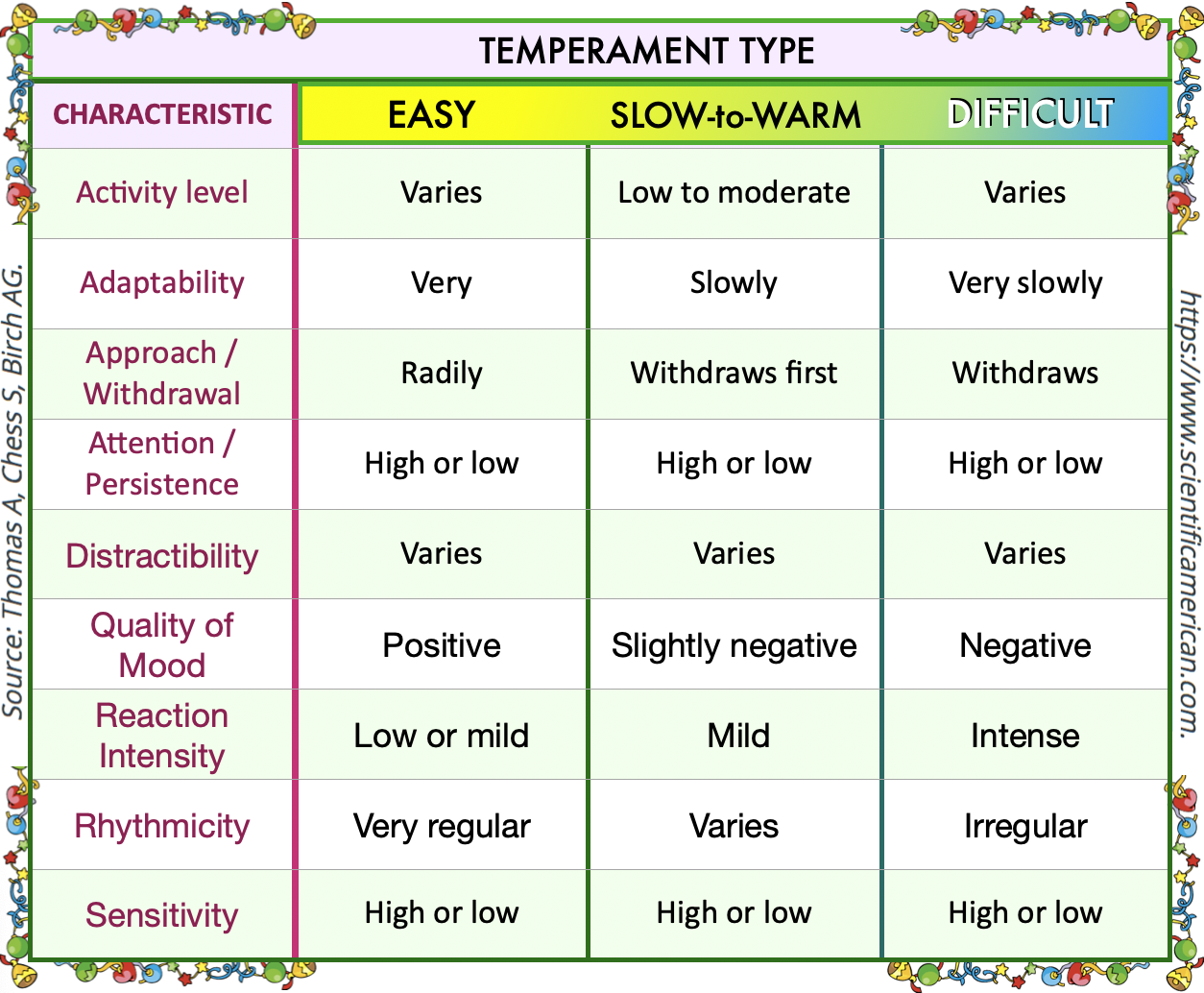
Children who are slow to adjust, ‘naturally’ shy or irritable – are likely to experience conflict with parents, & so receive less acceptance or encouragement which can make the child feel inadequate & unworthy.
If your child is highly active & so is the mothers, that’s a great match! However, if she is a withdrawn type who likes to limit new experiences, but baby loves stimulation, they may end up with a conflict – if mom is not willing to adapt yourself a little.
However, the influence of children’s temperament or other attributes may be mitigated if parents adjust their caregiving behaviors to better fit the needs of the particular child.

How temperament influences family life (See ALSO…..)
Individual differences in temperament & behavior styles affect how family members interact. The ‘mix’ between them has a strong effect on family life, sometimes leading to positive interactions, sometimes to frustrations & then to conflicts
“Goodness of fit” refers to the matched or mismatched temperaments between a child & various family members.
EXP: A certain reaction – such as high activity, intensity & persistence – may be tolerated & valued in boys but not in girls.
Conversely, shyness & sensitivity may be viewed as acceptable in girls, but not in boys.
CHILDREN – Some adapt quickly & easily to family daily routines & get along well with siblings.
Others, especially highly active, intense or“prickly” ones have a harder time adjusting to everyday routines & expectations, so interactions with family members often lead to friction & upset.
EXP: an impulsive child can bother an older sibling trying to finish a school project, or a distractible child, low in persistence, can frustrate parents’ efforts to get them to do homework or a household chore.
PARENTS also differ in temperament. Some are quick-reacting & intense, while others are quiet & slow to respond. Some are flexible & ‘fair’, others are rigid & perfectionistic.
AND they differ in the expectations they have about their children’s behavior, & how they view & tolerate differences in temperaments. If disruptive behavior is labeled as deliberate, parents are more likely to be irritated & angry, & easily responding with verbal & physical abuse.
EXP : A high-activity, intense child may upset & irritate a quiet, slow-paced, reflective parent.
An active, quick-responding parent may be impatient with a slow-to-warm-up child, who the parent may consider as lazy or indifferent. Or, sparks may fly when both parent & child are intense & quick reacting.
REFRAMING : A parent’s response is affected by how they interpret the child’s behavior. When seen as temperament-related rather willful misbehavior, they can reduce their negative reactions.
EXP: The parent might see an active, energetic, approaching child who is into everything as “exuberant,” rather than as “hyper” & intrusive.
OR – see a shy & slow-to-warm-up child as “sensitive” & thoughtful, rather than as unfriendly or unmotivated. (From : Greatschools.org)
NEXT : ATT
 HEAL & GROW for ACoAs