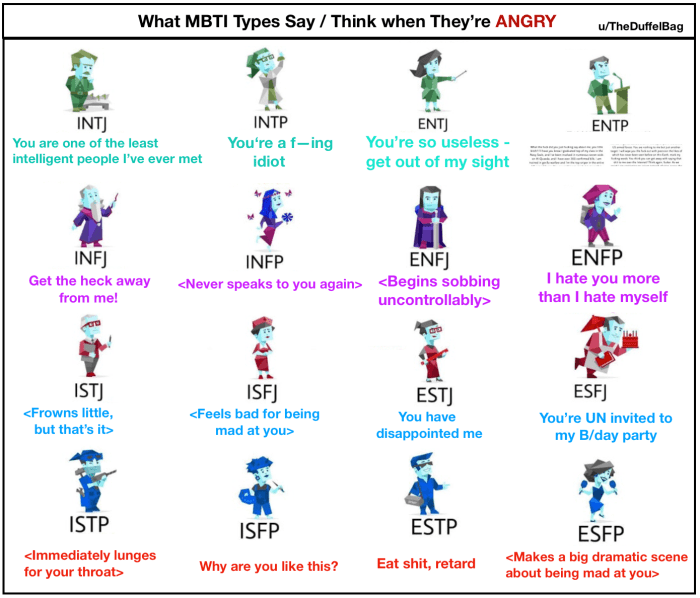
MBTI – DESTRUCTIVE Types (#1)


PREVIOUS:

🙋🏻‍♀️ SENSATE / THINKING Types (MORE for the healthy version of each)

▪︎ Destructive ISTPs are cold, self-destructive & indulgent. They can be ruthlessly logical in pursuit of their own pleasure & at the expense of anyone in their way. They ignore their moral compass & have no concern for the welfare or feelings of others. They keep to themselves & scorn attachments to others, only wanting to get ahead or enjoy sensational thrills, even if it harms themselves or others. They’re calculating & selfish, easily angered by anyone who tries to connects with them. Evil ISTPs make perfect mercenaries.

▪︎ Destructive ESTPs chase thrills, opportunities & pleasure, at the expense of anyone in their way. They’re excellent manipulators, who don’t hesitate to swindle, cheat or lie to get what they want. They have no regard for the feelings & values of other, & ignore all moral standards that may cross their mind. Their code is: Life is for taking advantage & living to the fullest, even if it means leaving a trail of broken hearts & wounded souls. They get a thrill out of negative or positive attention, & enjoy bullying or annoying others for the rush it gives them

▪︎ Destructive ISTJs have usually been raised in a corrupt family or societal system, accepting its unethical values & traditions without question, & have no problem forcing others to accept those same principles. Any question, skepticism or defiance is instantly squashed, since there’s only one way to do things – their’s. They’ll destroy people they see as threats, including those who are completely harmless. They want control the outside world, & will try to force it to conform to their routine or set of rules. Their own security outweighs everyone else’s welfare, & they have no empathy for emotions, ideas or rules other than their own. They’re harsh, aloof & hyper-critical of any procedure outside their set routine

▪︎ Destructive ESTJs are dictatorial, aggressive & controlling. They’re convinced they know what’s best for everyone, & it’s the only way. They deny having any moral compass, disregarding the feelings & values of others in favor of their own rigid views, only trusting their own experience. They push hard to achieve their goals without thinking thru their choices, so they steamroll everyone to get things done, never considering alternate viewpoints or the moral implications of their actions. They may be loyal to a corrupt system or authority, & suppress anyone who questions or stands up to that authority. They make fun of others’ emotions & beliefs, but are free to have temper tantrums & emotional overreactions.

= = = = = =

💙 SENSATE / FEELING Types 

▪︎ Destructive ISFPs are self-serving, judgmental & indulgent. They can easily get lost in self-pity & bitterness over all sorts of imagined or misread slights, flipping from passive-aggressive coldness to self-righteous indignation. They live for the moment & are extremely reckless – habitually over-eating /shopping/ drinking/drugging…. without considering how it’ll affect themselves or others. They’re easily enraged by people who don’t understand their ‘intense emotional reactions’, even tho they’re never actually verbalized. Anyone they let in is at the mercy of their ever-changing moods, & they can decide to shut people out entirely if they can’t get their complete approval. They’re never swayed by logical arguments or reasonable discussion.

▪︎ Destructive ESFPs are impulsive, vain & self-absorbed, chasing attention & sensation at all costs. They hate anything or anyone that can upstage them, but react passive-aggressively toward someone they think may steal their spotlight. Their life is ruled by subjective emotions, & logical arguments or constructive criticism are dramatically avoided. One minute they’ll be madly in love, the next they can ditch a partners or cheat on them, because they ‘feel trapped’. They jump from one exciting thrill to another, without concern for the people they harm along the way
▪︎ Destructive ISFJs believe everyone must instantly conform to their own form of traditions & values. They may seem friendly at first, but behind a soft-spoken persona they’re manipulative & passive-aggressive. Anyone rebelling against tradition or interrupting their rigid routine will get shut out without a second thought, or sneakily get the ‘offending’ person punished in some way. They only do nice things for people to be validated & praises, but hateful when they don’t get the positive reaction they were expecting. When anyone questions them, they retreat into self-pity & guilt trips. They’re hard workers, relentless in their sense of duty, even if it’s to undermine authority or corrupt social structures

▪︎ Destructive ESFJs are manipulative, controlling & prone to gossip. They take on the beliefs of those around them, & bully people who function outside that value system. They’ll mock, ridicule or gaslight anyone who doesn’t follow their traditionally accepted views or doesn’t follow ‘the rules’, even those that are corrupt. They’re “teacher’s pet”, constantly trying to get praise from everyone, especially someone they respect, & will have a pity-party whenever they don’t get it. They easily get enraged about any imagined slight, or anything that takes attention away from themselves. They love to spread rumors if it helps gain approval from authority, being passive-aggressive, two-faced & dishonest.

NEXT: Destructive types #2
MBTI Types & the ENNEAGRAM


PREVIOUS: Attractiveness /Ennea

SITE: From ENFP Mod (scroll way down)


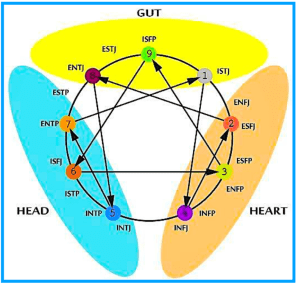
REVIEW: Enneagram is split into 3 centers for a reason. Each group represents an emotion & body part.

How we respond to everything indicates our “core center” location.

Heart / ‘love’ types (2-3-4) are all about how others react to them
They’re the most “needy,” always wanting something from someone else – admiration, attention, devotion, empathy, inclusion, love, praise, to be needed. Yes, even the 4. It’s all about how they are rejecting me. They bristle when their reputation is attacked or are accused of doing something, & defend their actions with what a ‘caring’ person they are

Head / ‘fear’ types (5-6-7) chronically over-think everything
They process new information by taking a step back to think about it They’re fear-based, though they may not realize it. Driven by apprehension about things – even the 7, who’s running away from fear of being trapped in a situation that’s not “fun”

Gut types / ‘anger’ types (8-9-1) live & react by gut-instinct
“I just knew what to do” is their most common comment, because they have a literal physical reaction to the world that keeps slamming into them. It’s an instinctive sense of NOPE or I MUST ACT. No hesitation, they just launch into a reaction (attack, numb, fight)

COMBINED

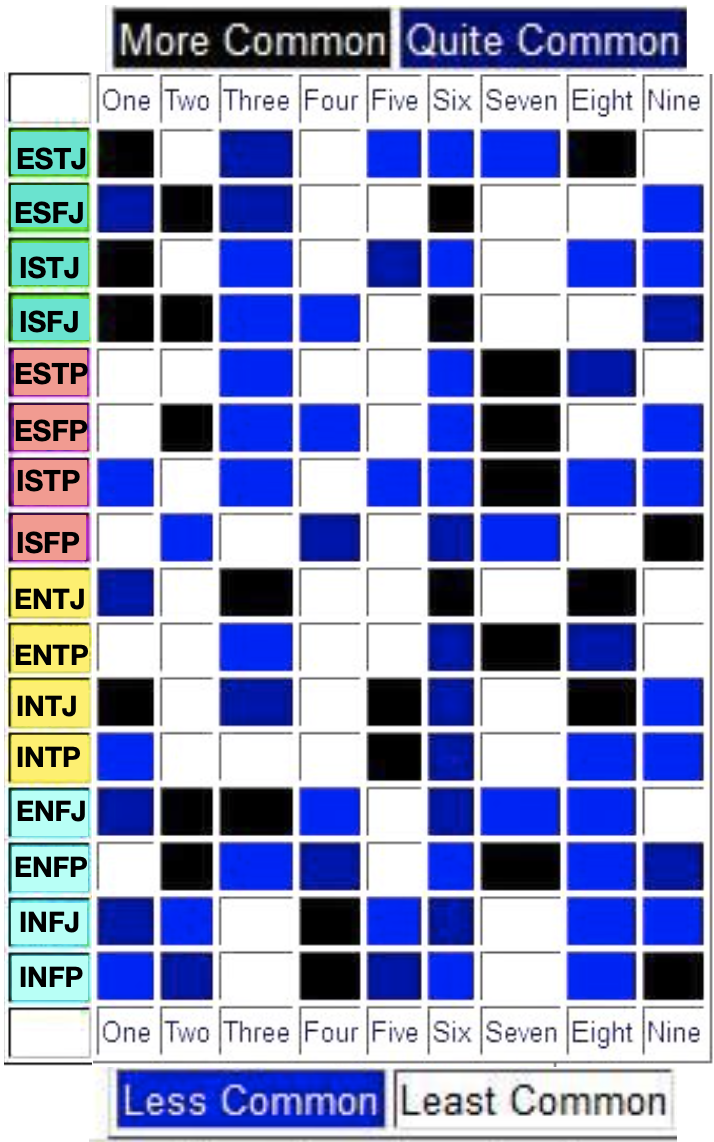
Enneagram 1: Most likely TJs, by far the most typical being ISTJ, since the ‘duty’ of the 1 pairs naturally with its duty-driven mentality.
IXFJ is somewhat less common but also possible. INFJs are likely, because Ni is prone to the same high idealism (too-high expectations) like the 1. 

Enneagram 2: Most likely EXFJ, because the parental aspect of #2 has a natural similarity with Fe-dom.
IXFJ is next, & then EXFPs. IXFP 2s are possible but rarer, since 2 & Fi are somewhat at odds 

Enneagram 3: EXTJ, EXFJ  / EXTP, EXFP / IXTJ.
The emotional detachment of the 3 fits best with Te-Dom, but can also be effective with a Fe-Dom core.
3s create an ambitious & flashy IXTJ. IXFJ is possible but less likely than EXFJ, since the 3 is a workaholic, & Introverts find it harder to maintain the energy it requires

Enneagram 4: IFP by a mile, because 4 is the embodiment of Fi – taken to emotional extremes.
INFJ is also common, Ni & 4 being a natural combination. Sometimes EXFJ or INTJ.
EXFP is a little less likely but still possible, especially with a 3 wing & an sx subtype.

Enneagram 5: Definitely INTP, since it’s almost exactly like the 5 – analytical, detached, objective, secretive, unemotional).
EXTJ, because frankly it goes with any high thinking function.
IXTJ,  ENTP & ESTP are ‘iffy’ since Se wants to engage with the outer world & 5 would rather watch from a bench

Enneagram 6: Goes well with every single type. Also, factor in the statistics that say 6 is one of the most common type, so the odds of it being a core or a fix are high.
6w5s pair naturally with thinking types, 6w7 is most common in EPs, but again… possible for anyone

Enneagram 7: ENXP, ESXP / ISXP.  The stereotype for EXFPs & 7s is that they’re both easily distracted, avoid pain, never finishing anything, are thrill-seekers, adventurous, & fun-loving. If a 7 thinks they’re an INFP, they’re probably a mistyped ENFP. 7 & Se are a natural mix, so only MAYBE an ISFP

Enneagram 8: EXTJ & INTJ / ESTP, ENTP, ESFP / ISTP. Rarely NF & never SFJ.
8 cores are unemotional, aware of power dynamics, bluntly assess others, earthy & sensual, with severe problems figuring out their more vulnerable feelings. This doesn’t mesh well with NF types (a rare ENFJ-8 might be an exception), & never IXFX.

Enneagram 9: Can be any type, like the 6  – it’s common all across the board.

⬆️ Long chart: ONLY one person’s opinion. EXP: This blog writer is an ENFJ – Ennea 8, but this is considered rare.

NEXT:

ATTRACTIVENESS – MBTI & Enneagram

attractioon

PREVIOUS: M vs F Brains #8

REVIEW: Relationship stages // Continuum

SITEs : ATTRACTION & BEAUTY

FACE Reading, Personality, & Attractiveness

WHAT makes us ATTRACTIVE?

1. Sanity – The ability to distinguish between reality & fantasy
2. Psychological health – A person with good psychological health is more stable, positive & easier to live with

3. Assertive boundary (B) – a form of Personal Bs, expressed in actions
EnneaType: 1s & 8s have the strongest active boundary function, with an internal reference frame of reality, good at pushing their beliefs into the external world
MBTI: T + J gives strong assertive Bs (ENTJ & ESTJ, INTJ & ISTJ)

4. Non-reactive boundary – also a form of personal Bs, but it’s to not take on the fight. Instead, it’s being able to ignore the whole thing (big or small) & move on. It’s expert at conserving energy by not reacting – a preservation mechanism.
EnneaWings: 5w4 & 5w6, 8w9 & 9w8 – are the strongest
MBTI: I-TP (ISTP & INTP) are the strongest

5. Human Depth
We are complicated & easily insulted. Most people seem to think there’s so much more to them than others realize OR that everyone’s just like themselves. However, MBTI shows that –
• Thinkers have more depth in the world of the mechanical
• Feelers have more depth in the world of the living
• iNtuitives are better at abstract, imaginative thinking
• Sensers are better at taking in & processing information through the 5 senses

6. Intelligence – women want a smart partner more than men do
• Men are more visual, so care more about looks than women (proven scientifically)
• Some men are very proud &/or dominant types,  so need to feel smarter than their woman. If a potential partner is much smarter, it could be a deal-breaker
• Women go more by personality, which includes intelligence. so a smart man is never a deal-breaker

7. Brain-side orientation
Opposites attract – someone who mostly uses the Left brain is strangely drawn to someone who mainly uses the Right side. It doesn’t have to be an exact 1-1 correlation, it just needs it to be decent. People who are balanced, with only a slight left side domination (say 55%), can be with a wider range of people.  (Right vs Left sides)


8. Speed
: of action, decision making, physical movements & thinking.
Enneagram Instinctual Variants: – Sexual (sx) brings massive speed,  Social (so) gives some, & Self-preservation (sp) slows things down

HIGH: 2w1, 2w3 / 3w2, 3w4 / 4w3 (burst quality) / 6w7 / 7w6, 7w8 / 8w7
MODERATE: 1w2 / 4w5 (burt) / 6w5 / 8w9
Burst quality depends a lot on the persons’ mood or mental stateattractiveness

9. General physical attraction
• good posture, good skin
• right ratios in face & body
• slim, tall (usually, not always)
• muscular, + other signs of health &/or fertility

10. Personal physical attraction – its purpose is to even out one’s own extremes of some characteristic. The farther away from the “preferable average” of a given trait is, the more compelled a person will be to find a partner that cancels out that extreme, so their combination creates a “healthy average”

11. Genetic smell (immune system switches)
A collection of genes called The Major Histo-compatibility Complex (MHC) coordinates our immune system, & also decides how we smell.
Here too, opposites attract. We like people who have different ‘switches’ in their immune system from ours, & we can tell that by their smell. Our opposites also help to produce healthier offspring. This preference might prevents incest, since we’re less attracted to ‘like’ types

12. Ns and Ss mostly attract each other
This is the exception the opposites-attract rule. Normally, people with these opposing functions are not drawn to each other.
However some Ns & Ss do form a successful relationship that last a life-time, BUT only if they match each other very well on other criteria (OR if the N is used to having their S/N side discounted or abused – as so many ACoAs do!)

NOTES 
Points 4 & 9 are directly related to MBTI type

Points 1 & 3 / 10 & 12 are not. (Though “Sanity” is weakly correlated, since more neurotic types like Ennea 4′s often have mental problems)

• Points 1 & 9 are about the brain / 10 & 12 are about the body
• Points 1, 2 & 3 are ‘invisible’ things unknown to humans, but incorporate some commonly known things

OTHER influences on attractiveness, commonly known & also impossible to scientifically pin down or define:
— character / confidence (big one!) / how funny someone is / how big
— honesty / maturity / street smarts / wit…..
(FROM a Swedish site no longer available)

NEXT: Function Development

Male vs Female BRAINS (Part 8)

  PREVIOUS: M/F BRAINS #7

SITE: “Are male and female brains really different?

Some SKILLS
F:
 tend to have more fully developed organizational skills, combining analytical & intuitive thinking.

M: are faster to absorb information, & are optimized for motor skills, so they react faster.  EXP: If a male sees a ball on the ground, he’ll probably kick it, while a woman is more likely to pick it up

M: tend to have better spatial abilities. Because they have a thinner parietal region of the brain than women, it’s easier for them to visualize rotating 3D objects

F: find it harder to mentally rotate objects – because of a thicker parietal region of the brain (More.…)

Research has shown that babies as young as 5 months can visualize an image, negating any idea these abilities were created by environmental influences

M: better at the exact sciences. They’re geared slightly more toward math because of much larger inferior-parietal lobules (IPL) which is thought to influence visual perception, math & geometry ability

PS: The IPL is the area of Einstein’s brain discovered to be abnormally large. Brain areas thought to control these skills mature in boys about 4 years earlier than in girls

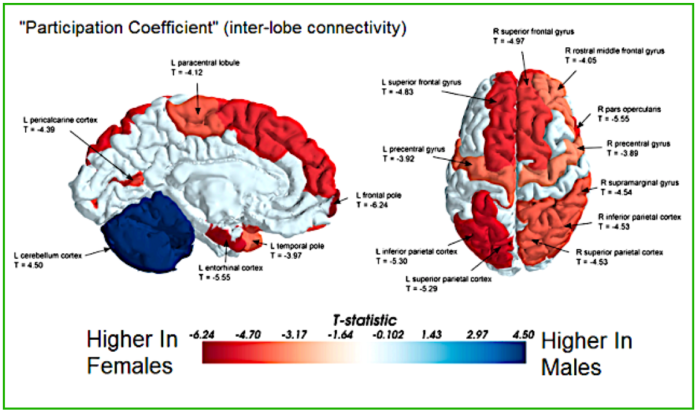
F: better at the social sciences. The IPL also processes sensory information, & the larger right side in women allows them to focus on specific stimuli, such as a baby crying in the night (IMAGE ▲)

Even at 24 hours after birth gender differences emerge:
M
: the male brain is adapted for understanding & building systems.
EXP: Male infants look longer at inanimate mobiles, & later gravitate to action toys

F : the female brain is adapted to ’empathy’
EXP: Female infants look longer at faces, & later gravitate to dolls

In other research, vasopressin in women increased peace-making behavior, & both oxytocin & vasopressin caused them to treat computer partners more like humans.
In men, vasopressin increased reciprocation of cooperation from both human & computer partners.

M: Male rats and male humans are more likely to navigate by dead reckoning – knowing which way is north, east, south and west.
F: Female humans are more likely to navigate through landmarks – go up to this 7-11, turn left…..

SENSES:

TEMPERATURE
F:
One study shoved that women’s performance on math & verbal tests is best at higher temperatures (More.…)
M: while men perform best on the same tests at lower environmental temps

SIGHT
F: Better at distinguish between subtle shades of primary colors
M: Far more likely to have some form of color blindness, usually genetic (rarely in women).
BUT are better able to pick up on sudden movements & identify rapidly changing images

TOUCH
In general – smaller fingers have a finer sense of touch (tactile acuity), with more closely spaced sensory receptors to pick up a wider variety of external stimulii. Research indicates it’s fingertip size, not gender that makes the difference. Because women usually have smaller hands, they’re better at distinguishing surfaces than most men, but men with small fingertips are just as discerning.

HEARING
M : Male hearing is weaker, in general. They’re 5 1/2x more likely to lose their hearing (may be partly from things like smoking, noise exposure & cardiovascular risk factors)

F : Women hear sounds that men can’t. At all ages, they have better hearing at frequencies above 2,000 Hz, but with age, are less able than men to hear low frequencies (1,000 to 2,000 Hz)

SMELL
Women smell things better that men. On average, they have 43% more cells & almost 50% more neurons in their olfactory centers than males. (Originally it may have helped women choose the best mates for reproduction)

TASTE
Women tend to have more sensitive palates, with more taste buds. About 35% are “supertasters,” identifying flavors such as bitter, sweet & sour more intensely than others. (Only 15% of men are).
Also, women of childbearing age have stronger taste-sensitivity than younger or older ones, especially during pregnancy.


NEXT: MBTI

Male vs Female BRAINS (Part 7)


PREVIOUS: M/F BRAINS #6

SITE: “Your Default Brain Is Female”


COMBINED INFO (cont.)

THINKING
F: Women think in webs, constantly connecting ideas. Since part of their corpus callosum is 25% larger than Ms, they can easily bounce back and forth between feelings and facts. They will often define a problem in broader terms, examining a wide range of potential factors before considering solutions.
Women want to process & explore. Because they tend to personalize, they’re more inclined to talk through the issue to reach understanding

M : Men’s brains gravitate toward facts & logic. They’re more likely to think in straight lines, processing facts one step at a time. They want to define & clarify a problem, so they start by isolating & eliminating issues. They’re great in a crisis, constantly scanning for potential threats & then solutions

Ms tend to depersonalize & externalize issues or problems. They need time to think through solutions, often in solitude. This gives their brain an opportunity to explore, unwind & decide what to do next.

STRESS
One study found that when Ms – under stress – looked at angry faces, they emotionally disengaged. Brain scans showed lower activity in areas responsible for processing other people’s emotions (temporal pole) & facial expressions (Amygdala – re. fear / Insula – re. empathy), by measuring cortisol levels.
Stressed Fs showed more activity in those brain regions.

Both Ms & Fs release the hormone oxytocin during stressful events.
M: tend to have a “fight or flight” response to stress. Adult men’s brains (& adolescents of both genders) – show a much weaker neural response than Fs. Under stress they produce high levels of testosterone, which reduces the effects of oxytocin, making them angrier & more violent

F: Adult women tested had a strong neural response to unambiguous visual threat-signals, & generally better at evaluation it. In stressful situations they cope with a “tend & befriend” strategy – taking care of themselves, children, & forming strong group-bonds

However, their cortisol levels are 2x higher than men’s at work, but 4x higher at home. If they can’t process or collaborate with others, they don’t produce enough oxytocin, making it hard to recover from stress

ILLNESS
Gender is a critical determinant of mental health & mental illness.….such as  depression, anxiety & somatic complaints…… Differences have been reported in age-of-onset symptoms, frequency of psychotic symptoms, course of disorders, social adjustment & long term outcome” (MORE….)

: Male brains synthesize serotonin much faster than Fs. Common male-biased conditions include autism, ADHD,
conduct disorder, dyslexia & other language impairment, retardation, Tourette’s & schizophrenia.
Re. Alzheimer’s shows in up to 90% of older men, & show significantly larger heart ventricles than healthy men

Also : Men are 3x more likely to be diagnosed with Antisocial Personality Disorder (APD).
Their lifetime prevalence rate for alcohol dependence is more than 2x higher than Fs.  In developed countries, it’s MEN – about 1 in 5, & WOMEN – 1 in 12.

: Fs are far more likely to suffer from dementia, mood disorders, PTSD after a traumatizing event, & anorexia nervosa. But if they have dyslexia, they’re more able to compensate for it than men
Unipolar depression, predicted to be the 2nd leading cause of global disability by 2020, is 2x more likely than in men

Re. Alzheimer’s, it’s found in only 8-10 % of age-matched women
Re. Schizophrenia – no heart ventricle enlargement is seen in women with the disease

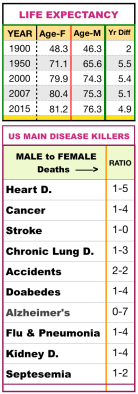
#1 CHART ➡️ National Center for Health Stats
#2 CHART ➡️ CIA World Factbook (2009)
Longevity gap: more than 1/2 of all U.S. women over 65 are widows, by 3-1 = for every 100 women, there are only 77 men. By age 85 they outnumber men 2.6 to 1. Re: health : “WHY do MEN LAG BEHIND? 13 FACTORs & remedies

IMP: As of 2019, the average U.S. life expectancy has been declining for 3 consecutive years. A baby born in 2017 is expected to live to age 78.6, down from 78.7 the year before (F / M averaged)
CAUSES:  Rise in drug over doses, liver disease / cirrhosis, & suicide.
Also, in the U.K. lifespan is projected to be shortened by about 5 mths.

NEXT: M/F brain #8

Male vs Female BRAINS (Part 6)

PREVIOUS: M/F BRAINS #5

SITEWhat Science Really Says about the Differences between Boys & Girls

COMBINED INFO (cont.)
EMOTIONS
Brain Activity :
F: have far more natural blood flow throughout the brain’s white matter at any given moment, & the cingulate gyrus (for concentration) – so they will often revisit & ruminate on emotional memories

M : After reflecting briefly on an emotive memory, males tend to analyze it a bit & then move on to the next task. OR they may choose to change course & do something active & unrelated to feelings, rather than consider them at all

Brain Structures:
a. M/F hippocampal structural differences are related to spatial intelligence, working memory & executive control, but not to verbal intelligence, attention & processing speed

b. Using fMRI brain scans, M & F subjects who viewed ’emotional’ images showed a difference in how emotions were noticed & ‘understood’, based on the way they engage neurocircuitry when processing & “down-regulating” (blunting) emotions

M: a. Men have a harder time understanding emotional cues (unspoken) – since their hippocampus is usually smaller, while their amygdala is larger (regulating sexual & social behavior)
b. Men showed neural responses in the visual cortex, immediately activating circuitry that regulates shifts in attention to the world, moving the emotional impact of the images away from themselves (More….)

F: a. Women generally have a larger hippocampus (memory center) & deeper limbic system (regulating emotions) – with a higher density of neural connections into the hippocampus.
b. Women showed neural activity in the anterior insula cortex, which processes bodily sensations, so they felt emotions deeply in their bodies

Conclusion:
Fs intuit emotional cues more easily, absorbing more sensory experiences, feeling the full range & depth of the emotional spectrum – which promotes bonding with others
The down side is that it also opens women up to depression, especially with hormonal shifts such as after childbirth or in the menstrual cycle.

NOTE: A woman being hugged for 20 seconds improves her happiness & self-confidence.  (re. HUGS)

Patterns of cooperation
👬 A research study showed that pairs of men tend to cooperate better than pairs of women
👫 In mixed-sex pairs, women tend to cooperate better than men

SUBJECTIVE: In one study, M & F teens gave self-reports and had physiological measures taken while watching animated clips of people being hurt. Girls scored higher than boys on self-reported empathy, & this difference increased with age. But no physical sex differences were detected in blood pressure, heart rate or pupil dilation – all measures of emotional responsiveness.
This suggests that Fs & Ms feel the same thing, but report it differently.

SEX  “Understanding the sexual brain
The brain is involved in all aspects of sexual behavior, from desire & partner choice, to arousal & orgasm, even post-coital cuddling.
EXP: Orgasm shuts down the orbito-frontal cortex, the seat of reason & behavioral choices – in both genders. It’s what provides the out-of-control feeling that creates confusion, but also intense pleasure

M: Men have 2x more sexually specific neurons in their hypothalamus – than women – with significantly higher neuronal densities & amounts in their cerebral cortex (More….)
One study found that in an average one-week period, men had sex-related thoughts 18.6 x, vs. 9.9 x for women. (Doesn’t apply to people with various mental disorders)

F: During orgasm, women’s brains showed decreased activity in the amygdala & hippocampus, which handle fear/anxiety. Because the F brain is geared toward intuition & emotion, it may be why most women have a greater need to feel safe & relaxed in order to enjoy sex

Also, men have 50% MORE serotonin receptors than women, and Serotonin can only be raised externally, SO – women need twice as much:
love, affection AND sex – to get the same levels of serotonin & dopamine as men, & therefore to experience similar levels of happiness. (More….)

⬆️ INTERESTING:  Scientists found a signal encoded in the amygdala that suggests why young children have an aversion to the opposite sex (“cooties” effect), AND their growing interest in opposite-sex peers as they enter puberty.  (More….)

NEXT: F vs F brain #6

Male vs Female BRAINS (Part 5)

PREVIOUS: M vs F Brains #4

SITEs: ▪︎ Women wired to be Leaders  
info from “Unleash the Power of the Female Brain”, Dr. Daniel Amen
▪︎ “Study finds women use their brains far more than men do“, Dr. Amen (Also how men use their brain)

COMBINED INFO (cont.)
INTELLIGENCE
There is NO “smarter” gender. Studies & meta-analyses found that brain size explains 6–12% of variances in individual intelligence, & cortical thickness explains 5%.

: Gray Matter volume in the frontal & parietal lobes correlates with IQ.
In standardized tests, they fall at the extreme high & low ends of the IQ scale.

F
: the Gray Matter volume in the frontal lobe & Broca’s area (language processing) correlates with IQ. In standardized tests they mainly cluster in the mid range.
Women have greater cortical complexity, thickness & surface area (controlling for body size), which compensates for smaller brain size.

COMMUNICATION
F
: The female brain is geared slightly more toward language because their temporal & frontal lobes are larger , areas that encompass human personality & communication abilities. These lobes deal with the senses of sound & smell, as well expression of emotions, memory, language, problem solving, judgement….

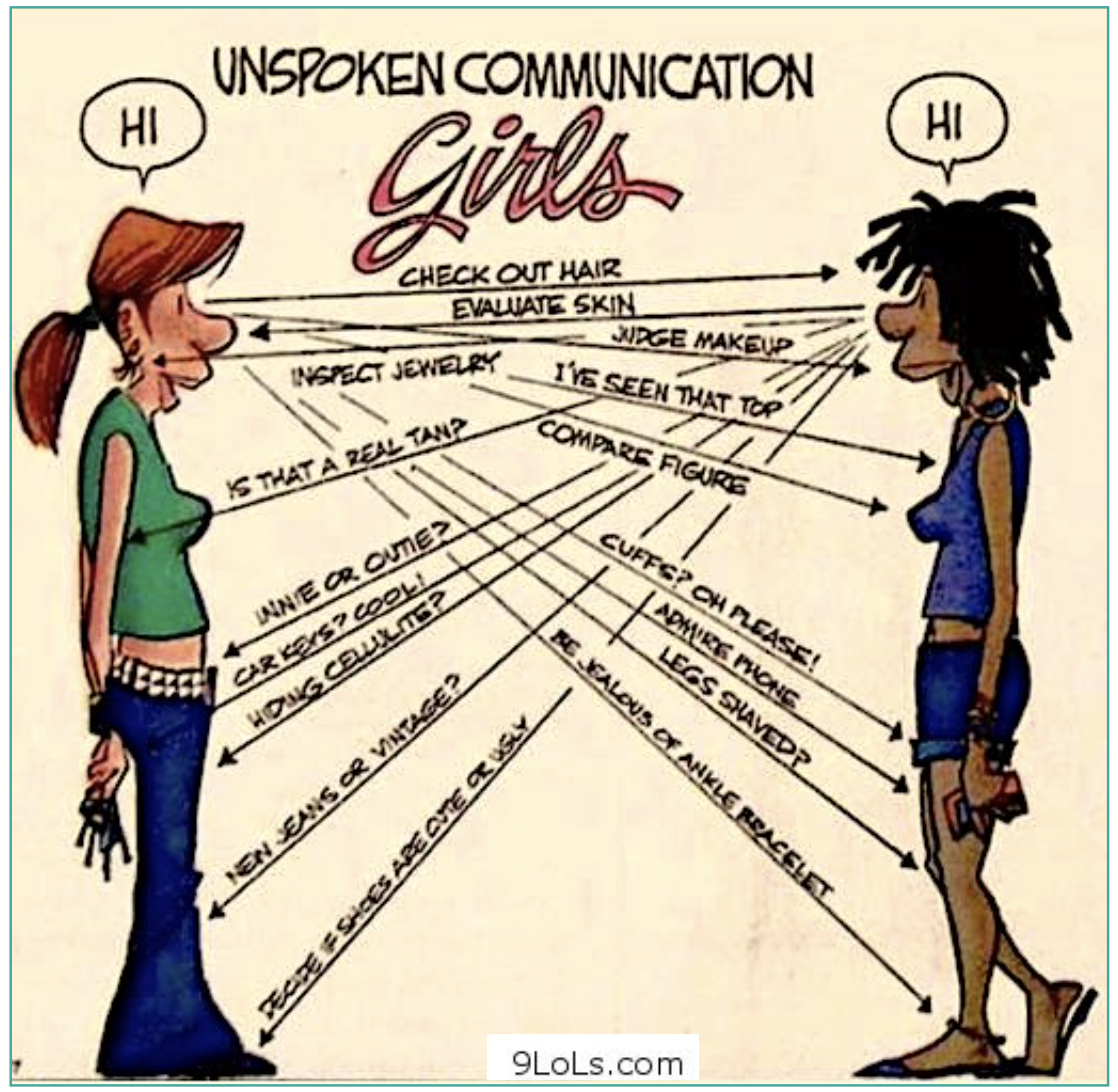
Women are better at communication because intuiting emotions & emotional cues helps them pick up indirect or hidden meanings in any situation – & are better at remember that type of information. They tend to use nearly 3x more words a day than men. Being naturally more sociable, they can get angry at men who can’t keep up a long conversation.

They focus on finding a solution that works for the group, by talking through issues, as well as using non-verbal cues, such as their tone of voice, emotional expression & empathy. Women usually like to talk while in a group where everyone is face-to-face. They might gesticulate, raise eyebrows, tilt their head & shrug shoulders.

Since women process language in both hemispheres, they have a bit more protection in case of stroke, so they may be able to recover their speaking ability more fully :
👄 Broca’s area, on the left side, is for speech & articulation….
👅 Wernicke’s area, critically necessary, is in the posterior superior temporal lobe, & connects to Broca’s area via a neural pathway.
– – – – –
M : Usually – men only process language in their dominant hemisphere (one side or the other). They tend to be more task-oriented, less talkative & more isolated, generally sharing ideas, suggestions & facts – while avoid expressing emotions.

But they do talk more at work, where they share ideas, problem-solving & communicating with a purpose. In personal conversations, men often use a relaxed, sprawled pose, keeping body language & facial expressions more contained. They prefers talking shoulder-to-shoulder in an angled pattern, where they can ‘take in the room’.

They use logic to ‘understand’ speech, so they prefer to sit quietly & focus on trying to hear exactly what someone is saying. They can get annoyed when women punctuate conversations with “OK” & “Uh huh” to let others know they’re listening. Men can experience that as an interruption.

♦ Such differences explain why men & women often have trouble  communicating, & why man-to-man friendships are different than those among women.

HUMOR
Ms & Fs use similar brain regions – both activating the temporal-occipital junction & temporal pole, structures implicated in semantic knowledge & juxtaposition, as well as the inferior frontal gyrus, likely involved in language processing.
(More…. fun contrasts)

M : They’re more focused on a cheerful outcome of a story or a show. In a study, men were prepared to laugh along with slapstick.

F : They enjoy the subtleties of humor in general, & the language of presentation. In the study, women responded more analytically (“Is this really amusing?”), so felt more pleasure when they decided something really was funny.

This may be because their left prefrontal cortex is stimulated, suggesting better executive processing & language-based decoding. They also had more activation of the meso-limbic & nucleus accumbens areas, implying greater reward-response & possibly less reward-expectation. (More brain scan differences)
«

 SITE: Laughter … is Integral to Mental Health

NEXT: F vs M Brains #6

Male vs Female BRAINS (Part 4)


PREVIOUS: M vs F Brains #3

SITE:  Serotonin, Males & Status

● “AI Uncovers Hidden differenced in Male and Female Brain Structures

MEMORY (in a Visual-Spacial study)
M : The left hippocampus lit up, the area associated with context-dependent memory.
Men usually keep the main point in mind.
EXP: if a man is lost while driving, he’ll remember the direction & the specific distance traveled

F : The 2 areas that lit up were:
– the right posterior parietal cortex, associated with spatial perception, motor control & attention
right prefrontal cortex, linked to episodic memory

Women tend to remember all the details. EXP: When driving she’ll usually remember reference points along the way, such as road signs & store windows.

☛ Re. the AMYGDALA
Memory for emotional events is generally better than for neutral ones. Some PET & MRI scan studies focused on the effects of emotional arousal on declarative memory (facts or events brought to mind by conscious, voluntary effort), during memory formation (encoding).

In one case, subjects watched either highly aversive films or neutral films. The level of amygdala activity at encoding predicted later emotional memory performance. Ms: the brain’s response was in the Right amygdala.
Fs:  the brain’s response was found in the Left amygdala.

M:
Generally, Ms tend to minimally analyze an emotional memory after a brief reflection, then move on to the next task. OR they may choose to go directly to an activity unrelated to feelings, rather than analyze their emotions at all.

F: The F brain is geared toward intuition & emotion. They can recall emotional memories more quickly & more of them in a given period of time, & report them to be richer, more vivid & more intense. This may also come from the cross-hemisphere wiring of F brains.

The down side is that Fs will often ruminate on & revisit emotional memories, & can contribute to anxiety & depression.. This is in part because of:
– far more natural blood flow throughout the brain at any given moment (more white matter processing) and in the cingulate gyrus, (concentration).

PAIN SENSATION
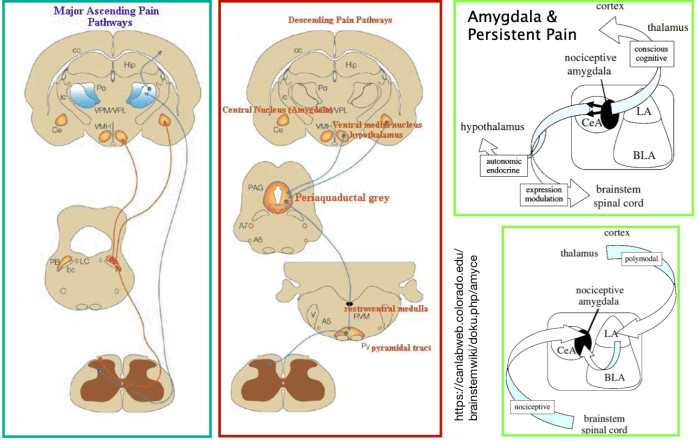
Imaging studies of the brain have shown differences between men and women in the spatial pattern & intensity of response to acute pain. One study found that mu-receptors are activated differently in healthy F & M brains (mu, delta & kappa are the 3 main types of opioid receptor in the brain & spinal cord).
It’s generally assumed the male brain is better able to tolerate pain. However, the female brain can raise its tolerance to pain when giving birth.  (More….)

«
M: When experiencing pain, their RIGHT amygdala is activated – which has more connections with physical (external) functions, & is expressed thru activities, rather than talking

F: When experiencing pain, their LEFT amygdala is activated, associated with emotional (internal) functions, expressed through anxiety, so need more morphine than men to reach the same level of pain reduction.
But they’re also willing to talk about it & ask for help.  
(MORE…. & charts)

UNPLEASNAT  EXPEIENCES
F: They respond from the LEFT amygdala, which leads to remembering more of the context of the unpleasantness (when, who, why) (The amygdala is important for processing emotional & social cues)

M: They respond from the RIGHT amygdala, which lead them to be drawn to the central features of the unpleasantness (what was important about it)

HARSH SOUNDS
Ms & Fs respond differently to harsh & irritating sounds. When listening to a recording of white noise interspersed with the sounds of infant crying, brain scans showed differences.

F:  Women’s unfocused brain activity abruptly switched to an attentive mode when hearing infant cries.
M: In contrast, the men’s brains remained in the resting state.(More)

However, other studies showed that babies with autism (ASD) usually have higher pitched cries, & pauses between cries are shorter. In that case, both men & women interrupted their mind-wandering when hearing those cries.

ALSO: Patterns of brain activity in both men & women changed when shown an image of an infant’s face.

NEXT: M/F brain #4

Male vs Female BRAINS (Part 3)


PREVIOUS: M vs F Brains #5

SITE: “The Male Brain and Vision Work : Demystifying the Divinely Devised Differences”
✓ Extensive INFO ➡️

NOTE: Articles / books have also been written to dispel the idea of M/F differences. One such from the UK is : “Sex and the brain: fruitless research?

REVIEW: In spite of the endless variations in human behavior in both males & females, modern brain-scan research shows broad tendency differences. 

COMBINED INFO (cont.)

GREY & WHITE MATTER
Research  
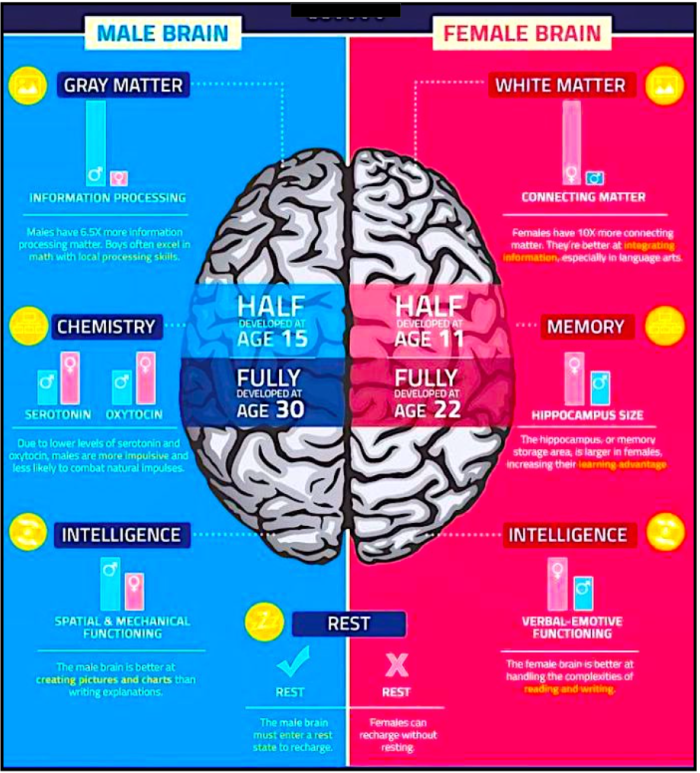
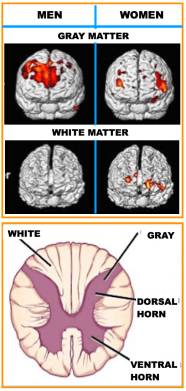
suggests that anatomical differences between Ms & Fs exist independently of brain size effects. Both genders have both W & G matter, but in different proportions.

Grey
matter (GM) makes up the information & action-processing centers of the brain, localized in specific splotches, in specific areas, ‘encouraging’ a kind of tunnel vision

M: slightly higher % of grey matter, (computational tissue) in most parts of the cerebrum, the left caudate (communication) & hippocampus (memory)

For task-focused projects – Ms use nearly 7x more gray matter than Fs
EXP: When deeply engaged in a task or game, they can ignore people & surroundings
——-
White matter (WM) is the networking grid connecting  GM with other processing centers, so Fs can transition between tasks more quickly

F: slightly higher % of white matter, (connective cables), containing myelinated axonal fibers, & cerebro-spinal fluid
For multi-tasking – Fs use nearly 10x more white matter than Ms

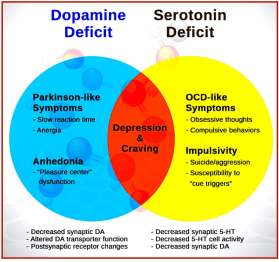
SEROTONIN / DOPAMINE diff (Serotonin)
M: their Serotonin levels are usually higher (than Fs), making them less susceptible to depression – but not immune.

They also have more Dopamine (levels can be raised by oneself, from activities), the hormone of competition, risk-taking & motivation – “Go, kill Wooly Mammoth”.

★ When men over-compete & over-push themselves, they deplete Dopamine, making them feel grumpy & in the ‘grey zone’. They may try to replenish it by high-risk activities such as driving fast cars, bikes & planes, or affairs, drugs …..

F: they have more ‘common’ receptors for Serotonin, (than Ms), but less of the protein needed to transport the chemical back into the nerve cells that secreted it (recycle). This may explain why they respond better to serotonin re-uptake inhibitor antidepressants (SSRIs) . CHART ⬇️ However, the serotonin system in healthy women differs from those with serious pre-menstrual mental symptoms.

★ Long-term over-focus on caring for others & worry inevitably depletes Serotonin, leading to depression, being weepy, sad & obsessed.  (MORE…. )

IMP: Serotonin levels can not be raised by oneself.  It has to be elevated by positive feedback from the environment. This is important because Serotonin levels INcrease Dopamine levels (motivation).

IMPULSE CONTOL
There’s increasing clinical interesting impulse-control factors because it’s associated with conditions such as delinquency, antisocial behavior, suicide attempts, aggression & criminal activity.

F:  Brain areas that control aggression & anger are larger in women than in men, & they retain stronger & more vivid memories for emotional events. They’re also more resistance to psychiatric disorders because of their ability to control impulsive behavior (prefrontal cortex is more active, so they plan more thoroughly & carefully before taking action). In reward-studies, they were consistently more punishment-sensitive, &  better able to delay gratification, compared to Ms.

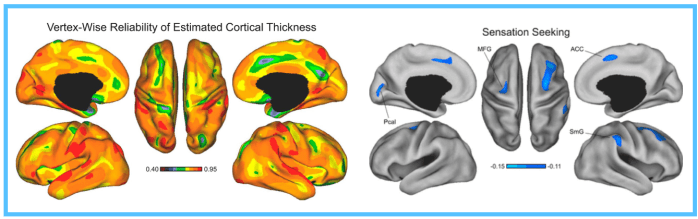
M: There’s evidence the serotonin (5-HT) system is more involved in male  impulsivity than in Fs. A questionnaire & a behavioral risk-taking task showed men being significantly greater sensation-seekers.
Impulsiveness is seen most graphically on the road (driving recklessly or when drunk, less likely to use seat-belts….). In reward-studies, Ms preferred a smaller immediate payment rather than a larger delayed one, & did not show greater reward-sensitivity.

😈 Another study correlated Impulsivity with cortical thickness, the area needed for self-control. The thinner the tissue in  the ‘front’ brain, the greater the sensation seeking. (More…. w/ images ▼)

NEXT: M/F brain #7

Female vs Male BRAINS (Part 2)


PREVIOUS: M vs F brain (#1)

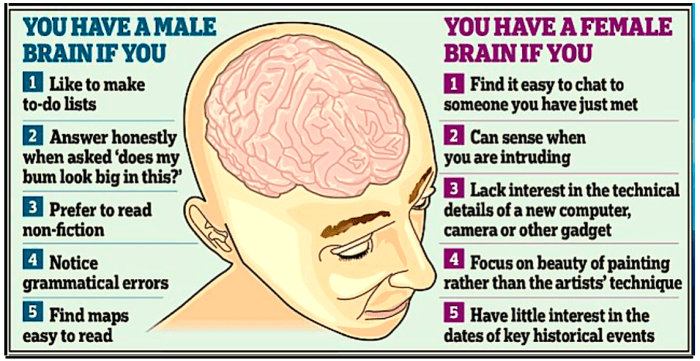
SITE: Questionnaire (64 Qs) –“Kind Of Brain – M or F? ”

Combined RESULTS

NO Differences?  : Researchers at the U of Tel-Aviv categorized brain structures into M or F zones, & one common to both – a mosaic – focusing on traits that showed the biggest gender disparity.
They noted that extremes are rare – only 6% of the subjects were more M or more F, based on analyses of several sets of data. Overall, results show that human brains don’t usually belong to just one type or the other, even though specific parts do show gender differences. (More….)

Many recent imaging techniques, such as studies at the U of Penn, confirm that Ms & Fs are indeed “hard-wired” differently. Scientists have discovered almost 100 variances, so this reality can not be over-stated.

HEMISPHERES
While all parts interact, each has a main focus. In general:
▪︎ FRONT part of brain handles action
▪︎ BACK deals with perception (aware of something via the senses)
▪︎ RIGHT provides intuitive thinking
▪︎ LEFT provides logical thinking

Brain CONNECTIVITY

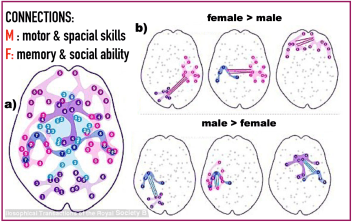
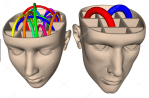
Male: Typical connections are between front & back areas, mainly confined to each hemisphere separately (blue). This is why men tend get irritated when having to do several things at the same time.

Exception: The only region they showed L-R connections was in the cerebellum, which governs muscle movement, providing good motor control.
So – males are wired more for perception & co-ordinated actions, while…..

Female: ….. processes are mainly back & forth across the meridian (corpus collosum) between the L & R sides (red)
So – females are wired for social skills, memory, & being more emotionally involved.

▪︎ Because L brain is logical & R is intuitive, Fs are hardwired for multi-tasking. Since they use both sides – when an activity requires both abilities they can more quickly transition between activities

And older Fs showed more widely distributed connections throughout the brain, rather than just in the frontal lobe.

NOTE: M & F fetuses start showing brain differences at around 26 weeks – when Fs usually start developing a thicker corpus callosum, which may explain why women tend to use both hemispheres.

RESTING BRAIN
IMP
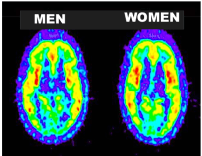
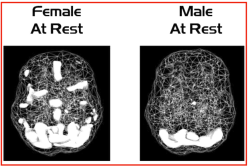
: Research (Slovenia, 2000) on 300 volunteers using EEG & hemodynamic principles, was based on resting eyes, ie. closed brain activity.

Results showed Ms & Fs differ significantly in the default mode, a complex pattern suggesting that variations in their behavior might come from the activity of the resting brain. (⬇️ Images from Amen Clinic)

Each person’s brain is an intricate & unique system of neural pathways connecting multiple networks in the cerebrum to several sub-networks in the cerebellum. The mysterious, powerful cerebellum is only 10% of brain volume, but houses over 50% of our brain’s total neurons (brain cells).

The Gurs’ studies on the resting brain found
— M activity occurred more in the amygdala, primed to react physically
— Fs’ comes from the cingulate gyrus, in the limbic emotional system, primed to react verbally

Brain SIZE
M – Typically, M brains are 11-12% bigger than women – (average weight = 3lbs) & have more volume in 14 sub-cortical regions – relative to overall brain size. This makes sense, since generally the M body is 10% larger, so it needs more neurons to control its greater bulk & muscle mass.
Also, volume & cortical thickness among Ms tended to vary much more than among Fs.  INTERESTING: With age, the M brain shrinks faster 

– Although women’s brains are 10% smaller than men’s, they use their brain more efficiently. And they have higher brain volumes than men in 10 sub-cortical regions. Average weight = 2.75lbs

CORTEX – the executive-function system
F: It’s significantly thicker & slightly more convoluted (more area), Neurons are more densely crowded on layers responsible for signals coming in & out. The prefrontal cortex is larger & matures faster in women, with fewer but larger neuronal units.

M: Their brains have more numerous but smaller neuronal units.
Larger: the parietal cortex (space perception) & the amygdala (sex)

IMAGE from another U of Penn study, ⬆️ which shows pronounced differences between the sexes during various activities, most obvious at ages 12-14.

NEXT: M vs F #3