
 PREVIOUS: Resilient Thinking – #2
SITEs: 15 Traits of Emotionally Wealthy People
POSTS: All about Es (June/July 2011) & Accepting & Accessing Es (2012)
EMOTIONAL RESILIENCE (E>R>)
Emotional (E) STYLE – the consistent way we respond to our experiences, governed by specific brain circuitry that can be measured scientifically. All stressors trigger emotional responses, so w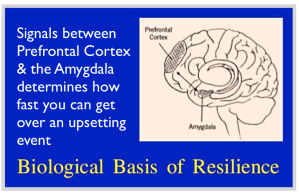 e need a solid mental & emotional foundation to help us cope.
Growth GOAL: To be in charge of our Es, & function from a tough-soft healthy UNIT (not from the vulnerable WIC nor the hard, bitter PP).
DEF of E>R>
• An emotionally flexible state allowing a person to return to a previous ‘even keel’, by making big or small adjustments in response to stressful situations, without loss of basic identity
• The capacity to bend or stretch without breaking, make meaning out of adversity & return to original condition
ACAs: Of course – what we would be returning to after another upsetting situation can hardly be called ‘an even keel’. The norm for us is some combination of depression, anger & isolation – fight or flight or freeze – or fawn! So we’re not looking to bounce back to that, but aim for P-TG – post trauma growth.
Process: A major prerequisite for gaining E.R. is lowering the anxiety level that’s left over from our damaged childhood. That comes with doing deep FoO work, sometimes aided by the right kind of meds. It includes:
• Correcting Toxic Beliefs, & changing defensive behaviors
• Finding the right combination of support systems
• Getting new, correct info about addictions & our human needs and rights
• Re-experiencing old painful emotions, & learning what comfort is, and comforting ourself (Secure Attachment #1,2)
 Frame-Reframe: Our E. are related to what we’re thinking about ourself & another person or event, related to our early experiences.
In a tough situation, ask which parts of the current situation are permanent & which can possibly change (see post Thinking #1)
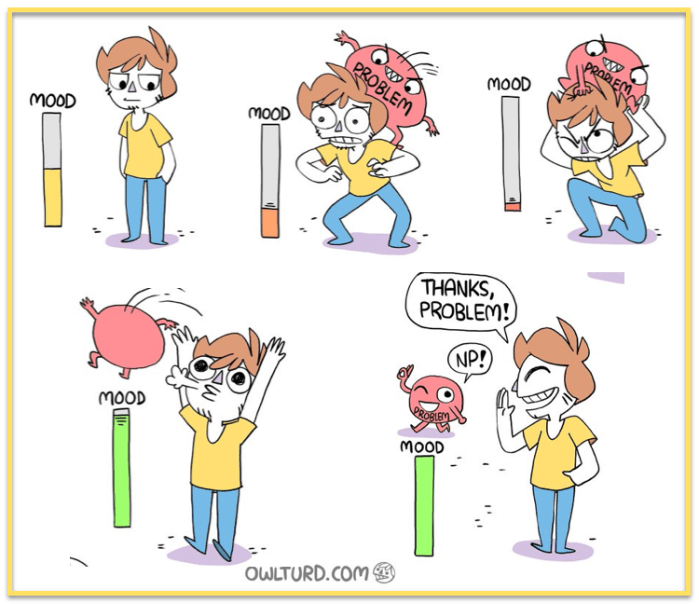
“Is my reaction colored by my wounded past OR seen thru healthy adult eyes? // Do I need to think about this differently, OR is my evaluation accurate?” (⏫️ CHART)
Pleasant Es: ACAs are addicted to painful Es – what we lived with day-in-day-out as kids. Healing allows us access to the pleasant-to-joyful ones as well, maybe for the 1st. time. All the literature refers to them as “Positive”, which implies we should not have the ‘negative one’. But we need a wide range, while not being stuck in old pain.
Research suggests that pleasant Es (amusement, awe, enjoyment, gratitude, hope, love, pride, self-respect, serenity….) provide many benefits. They :
• Increase curiosity, open decision-making, mindfulness, physical health (7-10 years longer) better peripheral vision, connections with people, combine ideas more easily, & turn hopeful dreams into practical outcomes
• Encourage emotional flexibility, healthy helping, the sense of ‘we’ instead of just ‘me’, tolerate ambiguity & uncertainly
Handling Es : In ‘R. ‘Individual #1‘, self-regulation was related to actions. Here it’s in relation to Es. Emotions also move us. Whether conscious or unconscious, all Es tell us to either Approach, Avoid, or Attack something or someone.
So, emotional resilience must include being in charge of our emotional responses, since they’re related to actions. Self-regulation is the capacity to manage strong feelings & impulses rather than ‘acting out’ inappropriately – the ability to calm oneself down when anxious or angry, & cheer oneself up when sad or depressed.
This doesn’t come naturally for young children because their emotions are bigger-than-life, their brain not yet fine-tuned, being programmed to be aroused (up) rather than to dampen (down). So it’s a skill all children must learn from adults – as their role models – if the caretakers are usually in control of their own Es & willing to actively sooth their children, when upset.
For those of us who got little or no soothing & had depressed or volatile parents – it takes time, consistent effort & lots of help – to develop this ability now. We need:
• new role models – available, fun, kind, reasonable, sober, & with boundaries
• AND daily communication with both our healthy AND wounded Inner Kids
(POSTS: resisting dialoguing)
NOTABLE Internal Experience
 ❤️ In a comfortable space my reality will be agreed with, validated & unchallenged. I don’t have to explain myself to be understood, or justify my feelings, because we all share them.
💛 In a safe place I can ask Qs without being judged. I can say what I think & know it will be validated as my Truth. Others can disagree, but it’s OK because that allows shared understanding & growth. (with boundaries)
💝 True dialogue happens where everyone is safe but not always comfortable. (from Seattle Girl’s School)
NEXT: R- emotions #2
 HEAL & GROW for ACoAs