

I CAN’T HELP IT if I’m afraid of everything!
PREVIOUS: Psych Disorders (#3c)
POSTs: EGO States – summary
SITE: Re. PSYCH terms used as swear words
HUMOR: Hollywood PDs, as “Cars in the parking lot”
1. NORMAL // 2. NEUROSES
3. PERSONALITY DISORDERS (PDs)
They are a group of 10 PMES mental/emotional illnesses, consisting of internal maladaptive – thinking (Ts), experiencing (Es) & behavior (As) – that deviate from norms & expectations of the person’s culture. These PDs make it very hard for the sufferers to accurately understand or relate to other people & situations.
PDs are pervasive & inflexible (unlike neuroses), have an onset in adolescence or early adulthood, are stable over time (consistent, persistent), & lead to emotional distress & impaired ‘normal’ functioning. Skodol, 2005 :
— PDs are about 15% of the US population, 10% worldwide
— They are usually chronic, & difficult to treat
— A person can be diagnosed with more than one PD, usually from the same cluster.
— Identifying a person’s specific PD (Axis I of the DSM) can help clinicians evaluate the risk of suicide & other psychological problems (any on Axis II) often accompanying PDs
This category fits into the hierarchy of mental states – Highest to Lowest functioning:
1. Healthy —-> 2. Neurotics —-> 3. Personality Disordered (PD)—-> 4. Sociopaths/Psychopaths —-> 5. Psychotics (who are not at all in reality)
● All human traits range from
healthy & adaptive <—> to unhealthy & maladaptive.
PDs fall into the orange & red sectors, because the dysfunction affects every part of a person’s life, usually as a result of an ongoing traumatic childhood. PDs tends to severely limit success in school, relationships, social encounters, work.
OVERVIEW – Main Symptoms of PDs
a. Distorted thinking patterns (CDs)
b. Over / under – regulated impulse control
• Odd / eccentric behavior patterns
• In some cases, periods of losing contact with reality (dissociations)
c. Interpersonal difficulties
• Avoid other people, feel empty & emotionally disconnected
• Trouble sustaining stable/close relationships (partners, children, professional helpers)
d. Problematic emotional responses
• Overwhelmed by distress, anxiety, anger & worthlessness
• Trouble managing uncomfortable/painful emotions, especially without self-harming – use self-cutting, promiscuity, belligerent, withholding, chemical abuse… in order to ‘cope’ – but rarely harm others physically. Exceptions : bullying people, torturing animals
CLUSTERS – CHART
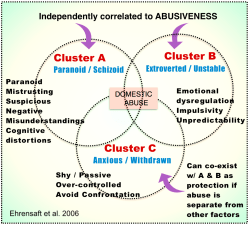 Based on similarities, PDs are grouped into:
A – 3 “odd, eccentric” types: social awkwardness & withdrawal (MORE….) . Dominated by distorted thinking, & extremes, they go:
— from eccentricity to fantasy
— from lonely to schizoid hiding
— from distorted thinking to delusion to paranoia
— from projective identification to projecting guilt on to others…..
Paranoid (2%) “The world is hostile, so don’t trust anyone, & deal with people by being angry & attacking.”
Schizoid – “The world is scary so I withdraw from it (people), & don’t show any emotion or other needs/feelings”
Schizotypal – “The world is too scary, so I withdraw from it (people), & being a bit crazy, I don’t think clearly”
B – 4 “dramatic, emotional, erratic” types
UNDER- controlled: People in this cluster share the pattern of little or no impulse control & have trouble emotionally regulating themself. This can include failure to plan ahead, or to consider the long-term consequences of their actions. At the extreme they can end up getting into trouble (like breaking the law), & hurting others.
 Antisocial (3%) “You can’t trust anyone & life’s unfair, so I take advantage of people & do whatever I like”
Borderline (1-2%) “Relationships & life are very unreliable, so I frantically do anything to keep people around”
Histrionic (2-3%) “I must be the center of attention, so I will be dramatic, flirtatious & highly emotional”
Narcissistic (1%) “I’ve always been told that I’m very important & the best, so I agree & act that way”
C – 3 “anxious, fearful” types
OVER- controlled: This group shares a pattern of social inhibition, a deep sense of inadequacy, & hyper-sensitivity to other people’s negative opinions. They’re afraid to try new things lest they embarrass themself, & get ridiculed or outright rejected. They hold back around others, so can come across as uptight & snobbish. They lack spontaneity, since every action must be considered for its potential to cause themself emotional pain
Avoidant (1-10%) “Life is scary & rejecting, so I feel worthless & withdraw ”
Dependent (0.5%) “I’m worthless & can’t cope with life, so I cling to others & do what they tell me”
Obsessive/compulsive (1-8%?) “Everything around me is chaotic, so I have to be in control of myself & everything in my life, by being orderly & perfectionistic (MORE….)
 Other PDs not in DSM IV
— Cyclothymic: Mood swings from Hi to Lo, with evenness in between – not as extreme as Manic-Depression
— Masochistic (self-defeating): A need to fail, deliberately putting obstacles in ones own way to cause themself frustration, grief, setbacks & suffering
— Passive-aggressive: See POSTS
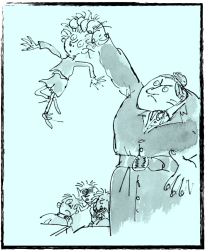
<— Sadistic: Derive pleasure from harming or humiliating others, using aggressive, cruel, demeaning & manipulative behavior
NEXT: Personality Disorders (Part 4b)
 HEAL & GROW for ACoAs
Reblogged this on empowermentweb.
LikeLike
Thanks.
LikeLike