
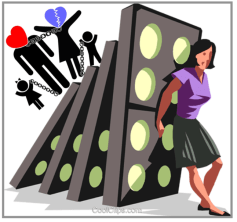
 I HAVE TO HOLD THINGS TOGETHER, or we’ll all implode, & then what?
PREVIOUS: TFR (Part 1)
See ACRONYM page for abbrev.
1. NORMAL HIERARCHY
2. DYSFUNCTION (cont)
Toxic Family ROLES (TFRs) develop in a dysfunctional family when healthy emotional bonds are weak or missing. They are defense mechanisms to help each person adapt to a difficult environment they can’t fix or escape.
• TFRs are Rigid : assigned not chosen, fixed not flexible, not created or maintained by a single member, & have little to do with each person’s fundamental personality
• TFRs are formed & perpetuated because they keep the system from complete disintegration. They develop gradually, unconsciously, so most members don’t realize they’re hooked, becoming a deeply ingrained part of each person’s False Self. While there’s an internal ‘logic’ keeping the mobile pieces in place, they reinforce dysfunction, which is passed down the family tree
Such families revolve around a serious problem – not only chemical addictions, but also a mentally or physically impaired person, someone in jail, infidelity, physical & sexual abuse, a parent who has left, disappeared or died……
This addict or perpetrator is a severe burden on the family – taking up so much time, emotional energy & resources – that the rest of the family can’t get enough of their needs met to thrive. Children get pulled into parents’ personal or sexual problems, become a spousal substitute to one parent, & often force an older child to be physically & emotionally responsible for younger ones or a mentally ill parent….
ROLES provide a sense of purpose in the chaos, TO :
☞ deflect the addict’s blame away from themself
☞ manage anxiety, minimize blowups or complete dissolution
☞ protect family honor from disgrace by presenting a ‘good’ image to the world….
For Roles to work, the entire system is forced to participate. To TEST this, try taking on someone else’s role in your family, or refuse to play your own. Immediate, intense pressure will come down on you to get back to your ‘job’!
1. ADULT Roles
a. The Addict – Can be parent, teen or adult-child. They get all the attention as the center of the family ‘universe’. Al-Anon says: “The sickest person in the room wins!” & “The alcoholic has their arms wrapped around the bottle, while the co-alcoholic has their arms wrapped around the alcoholic.”
 Once this ‘dance’ is set in motion, all that’s left is for everyone else to automatically fill in the rest of the roles, completing the mobile.
• Internal prerequisites for addiction are : genetic inheritance, being differently-wired (neurodiverse), personality traits / attitudes / beliefs, history of trauma, inability to cope with life’s challenges & an unwillingness to be responsible for themself
• Externally – addiction is impacted by important relationships : family & friends, cultural beliefs, social influences & pressures
b. The Caretaker (Co-Dependent, Enabler / Rescuer, Martyr)
This person, usually a spouse but often ends up being an older child, makes all the other non-addict roles possible. They have to keep the family together, keep everyone going, keep the addict from injuring or killing themself…..
They make excuses for bad behavior, irresponsibility & emotional abuse, avoid any mention of the addiction or the possibility of Recovery, & try to present a problem-free face to the world. But Al-Anon says: “You’re only as sick as your secrets.”
 • As the long-suffering martyr, Enablers take on the addict’s problems & self-blame for failures, living in reaction to the highs & lows of another person. That’s why addicts consciously or unconsciously attach to them.
This Role allows the co-dependent to ignore their own low self-esteem, gives them a sense of purpose & staves off fear of abandonment.
So, giving up their Role & interrupt the codependent cycle – which could actually lead to healing – is not their 1st choice. Besides, they don’t believe anyone who’s healthy would want them, not admitting it even to themsef, so why bother.
ARTICLE: “Being addicted to the Addict” by K. Capell-Sowder
2a & b. The CHILDREN : Hero, Scapegoat, Lost Child, Mascot (next 2 posts).
NEXT: TFRs (Part 3) – Categories for ACoAs
 HEAL & GROW for ACoAs