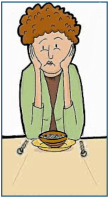
ACoAs – OVER-Trusting (Part 1)

being conned THE WORLD IS ONLY SAFE –  if I pretend to not notice the bad stuff!

PREVIOUS: Trusting #2

SITE: 10 Warning Signs of being too trusting

QUOTE: “Never trust anyone completely but God.” ~ Lawrence Welk

OVER-Trusting  (OT) – as ADULTS
DEF: Ignoring information you already know about a person or situation (or a potential one you’ve been told about) that screams:  “I’m NOT safe. I’ll get you as often as I can. Don’t trust me” AND that everyone else – except you – can see!

📌 A therapist suggested to a client why she needed to be more discerning & less trusting:  “Some people you don’t let in the bedroom, some people you don’t let into the living room, & some you don’t let in the front door!”

🔷 WRONG reasons for trusting:
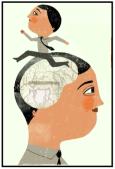
Impulsiveness : chasing something or someone the WIC very badly wants, putting all our inappropriate hope & trust in how it will turn out (the way we ne-e-ed it to), without admitting what we know, & not considering the consequences – including thinking through possible danger to ourself or others

Masochism : We tend to search out confirmation of prior expectations. ACoAs expect abandonment.
For abuse survivors with little or no Recovery – reinforcing the pain of unjustified hope & unfulfilled trust (PMES abandonment) is often chosen over safety & pleasure.
We repeatedly trust the wrong people, guaranteeing disappointment, by fulfilling our self-destructing assumption – that there are no positive outcomes for us.

Risk-taking : Being desperate, or as an adrenaline junkie, we pursuimpulsivee a situation or person even knowing that the danger of going ahead is great (re. love, money sports….).
If we subjectively think the possible gains far outweigh any possible loss (coming from the WIC), we’re willing to take the gamble, sometimes even with our life.

All of us ACoAs experienced years of trauma in childhood – at home, at school & in our neighborhoods.  We were deeply scarred by those experiences, but each of us handled it in our own way, depending on our basic personality AND our Toxic Family Roles.abuse / fantasy
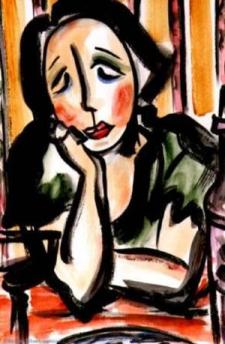
Those wounds were beyond anything we could bear, so we developed our own defensive posture:
• some have become overtly tough, angry, bitter
• others hide away from everyone
• some try to rescue & fix others to feel safe
• others escaped into a world of fantasy & have stayed lost, needing to see everyone thru rose-colored glasses!

THIS last defense mechanism is a thick blanket of vagueness to soothe the ache in our heart, BUT it makes us endlessly vulnerable to emotional, mental & physical vultures who can smell our ‘out-to-lunchness’ a mile away!

ACoA IRONY : Regardless of which protective style we act out, we’re trapped in another dilemma. Trying to mask how afraid we really are of everyone underneath, some of us carelessly trust everyone, especially the most damaging people! It’s so automatic we don’t even realize we’re being too credulous because we need it as a safety blanket, & because it’s passive.

EXP: Josie hears a new acquaintance say she has trouble with friendships – they usually end in serious disagreements. Josie is starving for companionship & overlooks this vital information. Unconsciously her WIC is thinking: “She wouldn’t do that to little ole’ meeee – I’d never hurt her or make her feel bad, I care too much, I’m so sweet…..”

Yet, sure enough, at some point Josie says or does the ‘wrong thing’ & the friend gets mad at her – attacking, accusing, withdrawing ….. Josie is shocked, then hurt, confused & of course blames herself for the problem (as if this outcome wasn’t totally predictable!)

We excuse our blindness by saying:blind-see
• I’m just trying to be a good person, I’ll give them another chance
• it’s wrong to judge others, & besides – they’re trying
• ‘they’ don’t mean to hurt me / can’t help how they are
• you don’t know their ‘good’ side, their good qualities
• …but they say they love me, give me money, ne-e-ed me
• I can’t make it without them
• & it’s my fault anyway, I deserve how they treat me  …

NEXT: Over-Trusting (Part 2)

ACoAs & PLAYING (Part 3)

rain on meI DON’T KNOW HOW TO PLAY –
only to be compulsive, never relaxed

PREVIOUS: ACoAs & Playing (#2)


💠DEFINITION (Parts 1 & 2)
   

💠 ACoA LAUNDRY LIST’s False Self related to PLAY

• One of the many sad results of having a traumatic childhood is that we were & are still deprived of the joy of relaxing thru playing & having fun. As a result of our damage we fall into several categories (lifestyles) which seem very different, but underneath each has the same problem – our WIC listening to the Negative Introject, believing the Toxic Rules:

“Life is hard / you have to suffer / you can’t play until all your work is done / no one wants to play with you anyway / if you don’t like it you have to stay / don’t be yourself / the world is a dangerous place / you always have to struggle, but never get there!…..”

a. ACoAs guess at what normal is
Here ‘Normal’ means healthy, as opposed to ‘average’. We don’t realize that playing, relaxing & having fun are a legitimate & important part of being healthy, happy & well-balanced. “All work & no play makes Jack a dull boy”.

There’s a tribe in Papua New Guinea that frowns on sex, & bans play. For years anthropologists have considered this tribe too dull to study, but finally someone did. Scholars still don’t know why the tribe developed this philosophy, but it’s certainly not one we should emulate! MORE…)

b. ACoAs have difficulty with intimate relationships
Everyone needs a certain degree of connection with other people, but the amount depends on one’s developmental stage, personality & on their current situation.
And while it’s perfectly normal & acceptable to play alone, playing with others requires a certain capacity for intimacy** to be ‘legitimate’ – since being in authentic play-mode means able to express the True Self without embarrassment or reservation.

This is not easy for ACoAs because our True Self got shrouded in shame & self-hate, making it hard for us to ‘let loose’ & let others get emotionally close to us.  ACoAs are more likely to put others in double binds: “I hate you – Don’t leave me!” OR “I need you – Don’t touch me!”

**INTIMACY: (IN-TO-ME-YOU-SEE) refers to a level of closeness where you feel understood & validated. Genuine intimacy with someone requires honesty, communication, vulnerability & reciprocity.
In relating to others, it’s the ability to connect our ‘deepest nature’ with safe & appropriate others, because we know there’s nothing fundamentally wrong with the Real Me, so we’re not afraid of letting it be seen

c. ACoAs take themselves very (too) seriouslytoo serious
While other children were busy learning to relate, compete, play & develop social skills, we were learning the tough lessons of survival. Many of us never heard our parents laughing, joking or fooling around (unless drunk!)
The air was heavy, filled with the invisible energy of suffering. Life was a hard business & the tone in our house put a damper on anyone enjoying themselves.
So if we did try to play or have fun we were guilted for wasting time OR punished for being frivolous & attacked for being ridiculous, making it stressful & terrifying.

d. ACoAs over-react to changes they can’t control
Genuine play allows us to be in the moment, not knowing the outcome, not having to win, be right or perfect, & not “forcing solutions”.
EXP: when children play, they often change the out of control‘rules’(which they made up in the first place) anytime they feel like it

Adult play doesn’t always have to follow pre-set rules either, sp they can be thrown out the window if it’s more fun to not use  them. This is hard to allow ourself.

Children do need things to be stable & predictable in their every-day life, with clear rules & boundaries, something in very short supply in most dysfunctional homes. Chaos was the order of the day for us, so now we try to keep everything under tight control, which doesn’t fit in with playing. But PLAY is free-form.

NEXT: ACoAs & PLAY #4

Family ROLES – Normal

fit in HOW DO I FIT IN,
& still be me?

PREVIOUS: ACoA Poem

See Inner Child MOVIE :
“If you believe


1. NORMAL HIERARCHY

• Most organizations still function is a hierarchical system, with clearly identified Roles** for their members, as in governments, corporations, sports, law enforcement, social groups, most religious congregations, schools (esp. if students are under-age) ….. and of course, families.
Yes, it is possible to have consensus or democratic rule in some of these, BUT ONLY when made up entirely of rational adults.

** Roles are ‘social expectations & norms held regarding an individual’s position & behavior within a group’ (Simon, Stierlin & Wynne, 1985)

• To function properly, family systems need to organize themselves to carry out daily challenges & responsibilities, as well as adjust to the developmental needs of its members.  But to understand the dynamics of any family unit, it takes more than just listing who the individuals are – we need to know how they come together & interact. The family system
exists √ in paradox : it has to be stable enough to provide continuity over time, while being able to adapt to fluctuations
√ as a balancing act : too much change – the system breaks down, too much stability – it atrophies & dies

• All families organize themselves into hierarchies & then into subsystems, which may be grouped by generation, age, gender…., to accomplish their tasks & goals. These smaller groupings can be grandparents, aunts & uncles, parents & children, males & females, the older & younger, the skilled & unskilled, the sick & well…… Naturally, individuals & the subsystems are influenced by & dependent on one another, so what happens to one affects the othergood fences

• Hierarchies need Boundaries, TO:
☞ have a line between subsystems
☞ control the flow of info – into, out from & about the family
influence the flow of people allowed in & out of the system

• According to Family Systems Theory, all families strive for a sense of homeostasis (balance), in an effort to find equilibrium between life’s challenges & the family’s resources to handle them.
New patterns of interacting with each other will have to show up to keep inevitable changes from getting out of hand.
When this doesn’t work, additional family rules or dynamics have to be added or adjusted to restore balance. This happens in both healthy & unhealthy systems, but the solutions will be very different!

• This balancing act has EITHER:
🕴morphostasisa system’s ability to hold its shape & structural stability – by trying to conform ‘perfectly’ to a situation, keeping strictly to its rituals, allowing only those changes that do not threaten the existence of the family…. in the face of all types of stressors
OR
🕴morphogenesis (creation of life) – a systems’ ability to change its form, grow systemically over time & adapt to the changing needs of the family
• To keep the group going & make things harmonious, each family member needs to have an age-appropriate role, which should be stable but not rigid. Ideally, members have specific jobs, governed by rules & strategies
parents provide✶ PARENTS are expected to fill a wide range of needs for themselves such as financial stability, mental stimulation, relaxation & hobbies, community participation, a satisfying sexual relationship….
.
ALSO  provide children with :
the Basics – Daily maintenance, provision of food, clothing, shelter & health care
Emotional needs
• a genuine feeling of safety & security, a sense of home, nurturing, warmth
• fulfilling the need for love & belonging, inclusion
• esteem, giving self-worth, personal value, support, encouragement

Mental & Social needs
• Age-appropriate discipline, correcting & guiding, setting boundaries
• Help with homework, how things are done, how to be social, handling finances, valid information
• Privacy, respect for each member’s autonomy & separateness
• Recreation, opportunities to have fun together
• Understanding, having the right to make mistakes & learn from them
Spiritual needs
• encouraged to have meaning & purpose in life, suited to the child
• gain a sense of the larger community & their place in it
• allowing development of a relationship with a Higher Powerchild obey

✶ CHILDREN are expected to learn from, cooperate with & respect their parents (must be age-appropriate) BY:
☞ attending school, keeping up with homework
☞  expressing their intellectual & artistic gifts
☞  helping with tasks around the house
-☞ trying out new & interesting skills, games & social settings

• People play many social roles,  such as — parent, sibling, worker, student, lover…. each with it’s own set of requirements & functions.
This is normal & healthy as long as they have a positive core identity to underpin their role, & are free to express many different aspects of themself.

NEXT: Toxic ROLES – #1