Double BINDS – Positive Use (Part 11)

DBs - contrast


THERE’S ALWAYS A WAY AROUND
if I only knew how!

PREVIOUS: Double Binds (Part 10)

SITE:Talking to Toddlers: Double Binds in Parenting Young Kids”
BOOK: ‘Covert Persuasion’ + comments)

Kindle BOOK: “Double-Binds: The DNA of Emotional & Mental Problems, & How to Make use of Their Positive Potential” – John Lentz (DNA = Double Negative Association)

SURPRISE: After all these post on the ‘evil’ of D. Messages & D. Binds – would you believe there are actually ways to use DM for good?
On the one hand they can cause untold suffering.
On the other – the pain can motivate us to transform ourself, if we’re willing to do the work.

• The POSITIVE use of DBs was instituted by Dr. Milton Erickson, as a therapeutic tool. He first learned the art of the DB from his father, who would ask, “Do you want to feed the chickens first or the hogs, & then do you want to fill the wood box or pump the water for the cows first.” The elder Erickson gave Milton a choice of which chore to do first, but the boy was not free to leave the chores undone. Erickson admitted he consented mainly because he chose the order in which he did them.

Erickson & Bateson used positive DBs for spiritual growth, & to confront patients with the contradictions in their life, to help them heal. DBs allow a person to have a set of injunctions which support them in many situations, whichever choice they make.
EXP:”Get enough sleep for your health” AND “Don’t sleep your life away”

PURPOSE: to help people release painful emotions & get past resistance to positive changes. Sometimes they don’t want either choice of a positive bind, even though both are to their benefit. But DBs are one of the most effective indirect language tools for inducing trance, as a way to loosen stuck-ness.

“Invaluable leaps in learning & personal development involve Including positive DBs & Transforming / Transcending negative binding patterns. Often our greatest strengths come from being doubly bound to express both sides. EXP: Steve Jobs could not not innovate.” (From What are Double Binds?)

» It can also induce us to be “completely present” at a difficult time in a relationship, letting go of past situations that resembles this one, in order to consider what our partner needs right now.
The double bind is an opportunity to communicate more effectively, & possibly to become wiser. (MORE…. )

Clinical Hypno-therapist Dr. Jay Stone uses double & triple binds to subtly aid his clients. CHART ⬇️  re. Self-care.
You can apply it to any specific issue you want to work on.
◆  In two-level communication, the conscious mind gets a choice, but the unconscious mind does not

◆  In the triple bind, the person’s conscious mind is allowed to choose how often to apply the lesson, but the unconscious mind has agreed to self-care as soon as the conscious mind made its choice of frequency.
★ ACoAs:
This way of using DBs is very effective with toddlers (see ‘SITE’ above) and is worth learning to use with our WIC, who is usually resistant to more direct forms of change.

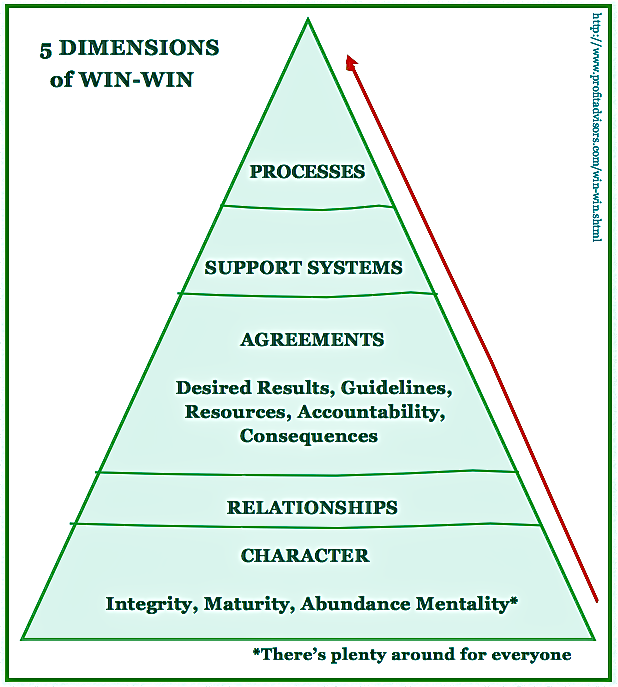
WIN-WIN We can learn to create win-wins for ourselves & others, using positive DBs to encourage a desired outcome. This makes both Sender & Receiver right, no matter what they do or say, which is empowering rather than living in anxiety. There are 5 dimensions of the Win/Win model: Character, Relationships, Agreements, Supportive Systems & Processes ⬇️

In Business &/or Parenting Screen Shot 2013-09-08 at 4.29.04 PM
a. In a competitive situation OR in an unhealthy one, where making a safe connection is not possible, Win/Lose is a valid option. (MORE….)

b.When forging a positive relationship is the main focus & goal, Win/Win is the desirable outcome

• In that case, the “Purpose frame” is applicable -the NLP frame used for Chunking Up – to discover the motivation for doing something. It is a way to give the other person what they want (actual need), but not what they asked for (request).

NEXT: DBs – Part 12

Double MESSAGES – Styles (Part 5)

DMS all tied up

THERE ARE SO MANY WAYS

I can mess with your mind!            

PREVIOUS: DMs, Part 4b

See ACRONYM page for  abbrev.


NOTE: Do not confuse DMs with changing your mind, or ‘going back on your word’ : “I said I would, but now I can’t. Sorry.”. It can anger or disappoint someone, but it is not presenting them with 2 contradictory statements or command, which the person must try to make sense of & ‘honor’ EXP:  “I love you, I hate you /  Be good,  be bad / Help me, don’t help me”…. at the same time.

VERBAL AMBIGUITY is also not a form of DMs, which are single statements having 2 or more possible meanings – perplexing, sometimes leading to mistakes & embarrassment, but not usually harmful. EXPs:
> “I saw John with binoculars.”  Who had the glasses – me or John?
> Consider “The HORTA” episode from the original Star Trek, when Cpt. Kirk finally encounters the rock-creature mother reacting to crewmen smashing her eggs, & she etches on the wall in acid: “NO KILL I”.
> Or the alien cookbook “To Serve Man” in the 1962 Twilight Zone episode

STYLES of Double Messages (DMs)
1. Two opposite VERBAL declarations, sometimes together, often at different times which makes it much hard to catch.  EXP:DM re. alls
A – Sam says to Jane:  “Let’s get together. Call me anytime” (I need to connect – I’m lonely).
SO Jane calls, but no answer. She tries a day later & he answers, but is curt.

She tries again in a week & he gets angry:
B – “Why are you calling so much?” (I feel suffocated by you neediness / pushiness).
MESSAGE: You’re a commodity AND a nuisance! (Come here/go away)

EXP : The computer HAL in “2001: A Space Odyssey” was programmed with a D. Message, forcing him into a D. Bind :
A – “Always process information accurately” (never lie) – AND
B – “Keep the true purpose of the mission a secret from your fellow crew members” (in this case – you must lie)
OUTCOME = a ‘mental break’, leading to the only solution HAL could come up with – murder the crew.

2. A hostile communication (verbal abuse) WITH an endearment
sweet covers sourEXP: “Don’t be so stupid, darling / My dear, you’re a pathetic moron /
I hate you, don’t leave me! / Baby, you know I can’t live without you! Why do you always let me down?”

3. One verbal WITH one physical (tone of voice, facial expression, body position or style of interaction…). What is said doesn’t match how it’s said
EXP: • Your brother says you’re really smart, but with a smirk
• Someone says “Your hair looks great” with a frown
• A co-worker looks angry & stiff, but says: “I’m fine, nothing’s wrong”
• A wife spends less & less time at home, but says: “I’m not avoiding you”
• A husband says: “Of course I love you”, in a flat tone & looks away

4. Both non-verbal : Bateson’s famous EXP – a hug given stiffly = OSTENSIBLY an act of affection AND/BUT with emotional distance. Note the legs on the stiff-hugger – not quite ‘in’.
It leaves the recipient wondering – Which is it, are you happy to see me or not?

5. Verbal ‘encouragement’ inside a negating event
EXPs: “Of course I want you to get better”, as the husband hands his newly recovering alcoholic wife a beer
• Boss to new bank MBA employee: “Here’s a important project to cut your teeth on. Lets see how good you are”.
BUT unknown to the young man – the ‘project’ is an unsolvable accounting mess specifically designed to fail.

PS:
Only an ACoA would drive themselves crazy actually trying to work it out – afraid to look dumb & get fired!
★ Unlike young Lt. James T. Kirk, who solved the ‘unsolvable’ Kobayashi Maru dilemma – by changing the rules – one legitimately way to deal with DBs!

CHART : Typical DB relationship between a co-dependent & a narcissist.
PINK wants a ‘one-way symbiosis’ without being vulnerable.
GREEN needs to have boundaries, but is willing to forgo them in order to keep the relationship, no matter how harmful.  MORE…)
NOTE that here the healthy win-win options are not used – ‘whited out’ .
Screen Shot 2014-02-09 at 8.00.17 PMNEXT: DMs (Part 6)