
 I LOVE OPEN SPACES
inside & outside!
PREVIOUS: Multiple intelligences (Part 4)
SITE: “The Heart’s Code – tapping the wisdom & power of our hear energy”
~ Paul P. Pearsall
MULTIPLE INTELLIGENCES (cont)
6. MUSICAL/RHYTHMIC (musical-smart)
7. NATURALIST (nature-smart) – respond to the natural environment.
This group is sensitive to all living things (plants, animals) & other features of the natural world (clouds, rock formations, minerals) – due to a highly developed sensory perception. This ability was clearly of value in our historical past as hunters-gatherers & farmers, and continues into today for chefs, horticulturists, scientists….. Also used by consumers to make choices from the overwhelming variety of brands in the marketplace.
As young people they enjoy shows & stories about animals or natural phenomena. May show a strong interest in astronomy, biology, botany, geology, meteorology, paleontology or zoology. They feel most alive when in contact with nature, & so are interested in exploring, nurturing & preserving the environment.
The repetition & boredom of office, factory & other workplaces can stifle creative thinking. This is because the brain-area that stores routines / patterns based on daily activities (basal ganglia) does not encourage new thinking. To give imagination a boost, we can tap into our latent Naturalistic I. whenever /wherever possible – like sometimes going barefoot . Nature helps stir insights & connections, to nurture our mind & encourage sensory awareness!
They:
 — are bothered by pollution, sensitive to weather
— automatically categorize or collect things
— collect natural things (rocks, feathers, shells….)
— enjoy studying plant parts & reading about nature
— have a green thumb, garden, photograph landscapes
— highly aware of surrounding, even subtle changes
— keep notebooks, dry flowers, create specimens
— like to learn names of all kinds of living things
— like to play in/live by water, be in the wilderness
— love walks in the woods, follow animal footprints
— passionate about animals, pets, zoos
— prefer being in nature preserves, parks, forests
ENJOY: being outdoors & with animals
LEARN: By using the senses, watching animal behavior, experiencing, identifying & recording ecological principles
TOOLS: binoculars, magnifying glass, microscopes, telescopes
CAREERS: Scientist, ecologist, animal trainer, farmer, traditional medicine man using herbal remedies (MORE….)
INCREASE ability : be in the great outdoors: plant a seed, volunteer at an animal shelter, take a walk with a naturalist, read about animal classifications . Study relationships in the natural world, compare/contrast groups or make connections to real life issues
TECH ideas: Discovery Education, online encyclopedias, Google earth, virtual explorations, iMovie, digital cameras, iPods, video cameras
FAMOUS People: Charles Darwin, John Muir, George Washington Carver, Rachel Carson, J.J. Audubon, Jacques Cousteau
* * * * * * * * * * * *
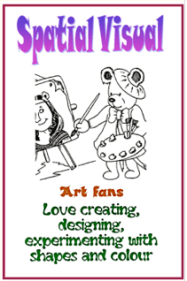
8. SPACIAL/VISUAL (picture-smart) – think in images & pictures.
This group has the ability to think in 3 dimensions – imagine, understand & represent the visual-spatial world. They can orient themselves in their environment with either vision or touch, navigate the world as well as determine the perspective of others.
As young adults they may be fascinated with mazes, jigsaw puzzles, or spend free time drawing or daydreaming. Compared to Auditory-Sequential learners, they tend to be late-bloomers.
Core capacities include mental imagery, spatial reasoning, image manipulation, graphic and artistic skills & an active imagination. EXP: know exactly how furniture will fit into a room without measuring, or buy a scarf that beautifully matches/complements the blue in a blouse you have at home (perfect “chromatic pitch”).
Includes street smarts & common sense, by making decisions based on matching a variety of situations & contexts. This requires learning & remembering almost simultaneously (fluid & crystalline), possible because of a switchboard in the brain.
 They:
They:
— build interesting 3-dimensional objects
— can rotate, transform & otherwise manipulate objects
— daydream, imagine & pretend more than others
— enjoy art & other visual activities
— good at formulating hypotheses
— have good hand-eye coordination
— like machines, drawing figures
— need to doodle or draw
— notice details, good with maps & directions
— prefer geometry over algebra
ENJOY: art, designing, drawing, imagination games, illustrated books, movies, puzzles, trips to art galleries / museums, visualizing
LEARN: visually & by organizing ideas spatially, verbal & physical imagery. Need to see concepts in action to understand them.
TOOLS: charts, 3-D modeling, drawings, graphics, photographs, TV/ video, multimedia
CAREERS: architect, film director, chess player, painter, pilot, sailor, sculptor (MORE…)
INCREASE ability: change main color of work or home environment, be a backseat driver & provide directions for a trip, fit groceries in back of car, do jigsaw puzzles & mazes, sculpt clay, play chess. Capture ideas on video. Take an architecture course. Use PechaKucha to stimulate & challenge (embraced by all types of designers)
TECH ideas: Kid Pix, Draw and paint programs, Excel, Create A Graph, United Streaming, Visual brainstorming, organizational tools, charting, diagramming, bubbl.us, gliffy, YouTube, Discovery Education, Comic Life, Quicktime, add music to presentations and movies, Podcasts, iPhoto, Photo Booth, Read Write Think: timeline
FAMOUS People: Winston Churchill, Einstein, Picasso, Stanley Kubrick, Anatoly Karpov (chess master), Georgia O’Keefe
NEXT: Multiple intelligences (Part 6)
 HEAL & GROW for ACoAs