🟠Enneagram : Subtype Details (Types 4, 5, 6)

PREVIOUS: Subtype Details (1,2,3)

BOOK : The Complete Enneagram : 27 Paths to Greater Self-Knowledge by Beatrice Chestnut


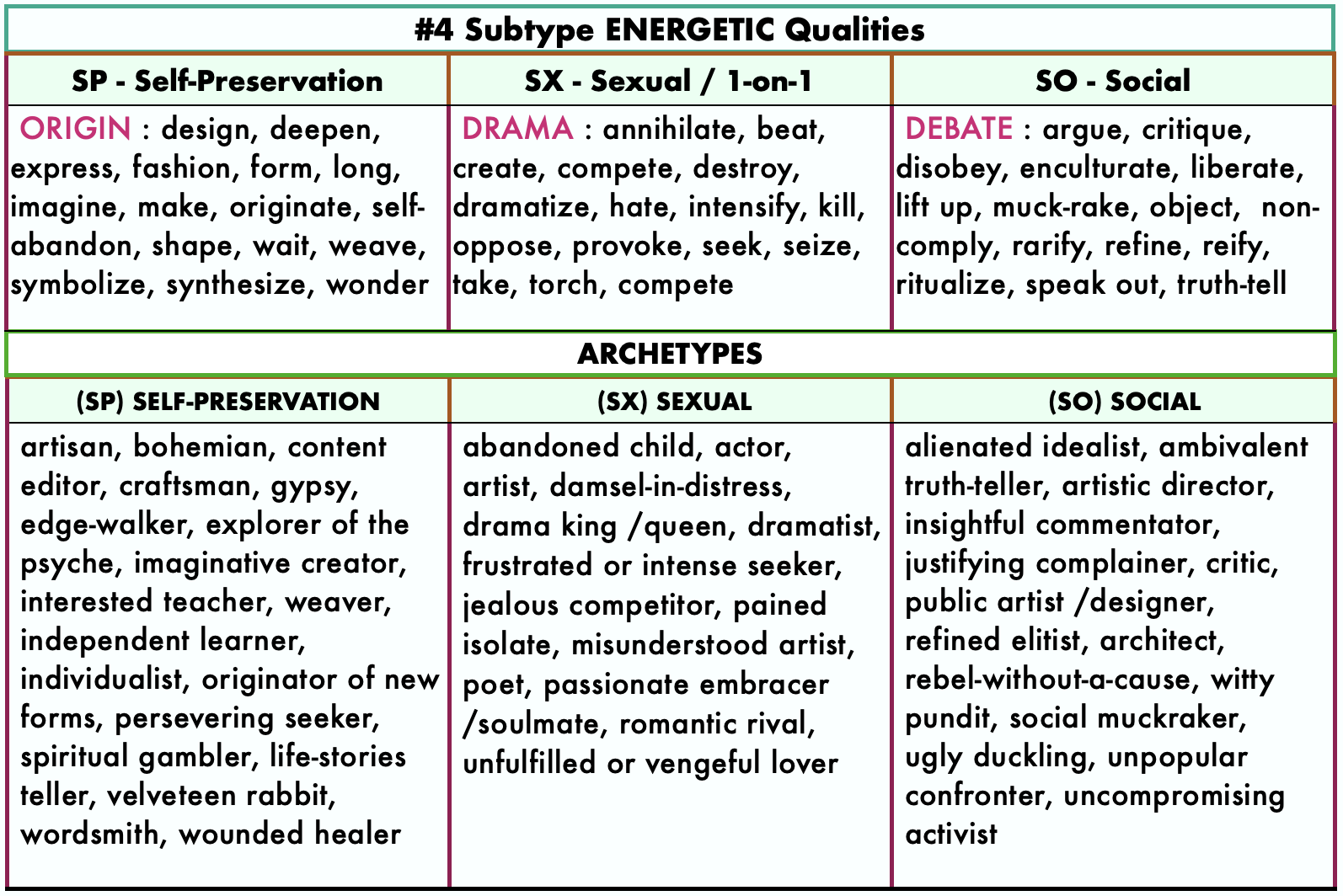
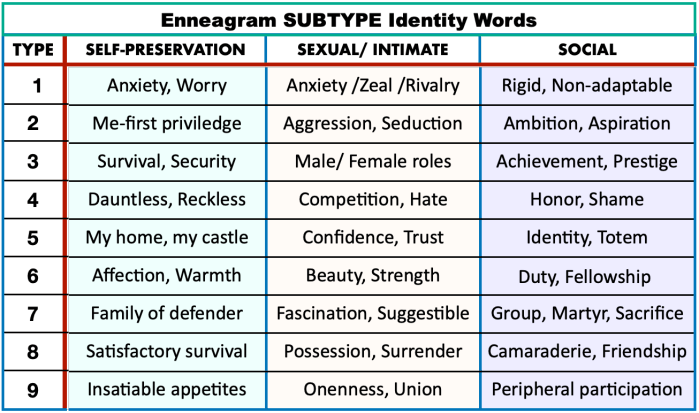
COUNTER instinct of TYPE 4 – Tenacity
Self Preservation 4s are long-suffering, stoic in the face of their inner pain, not share it with others as much as the other two 4s. They learn to tolerate discomfort & ‘do without’ – as a way of earning love.
Instead of sitting in their envy, SP 4s act it out by working hard to get what others have & they lack. More masochistic & less melodramatic, these 4s demand a lot of themselves, have a strong need to endure, & have a passion for effort.
«

«
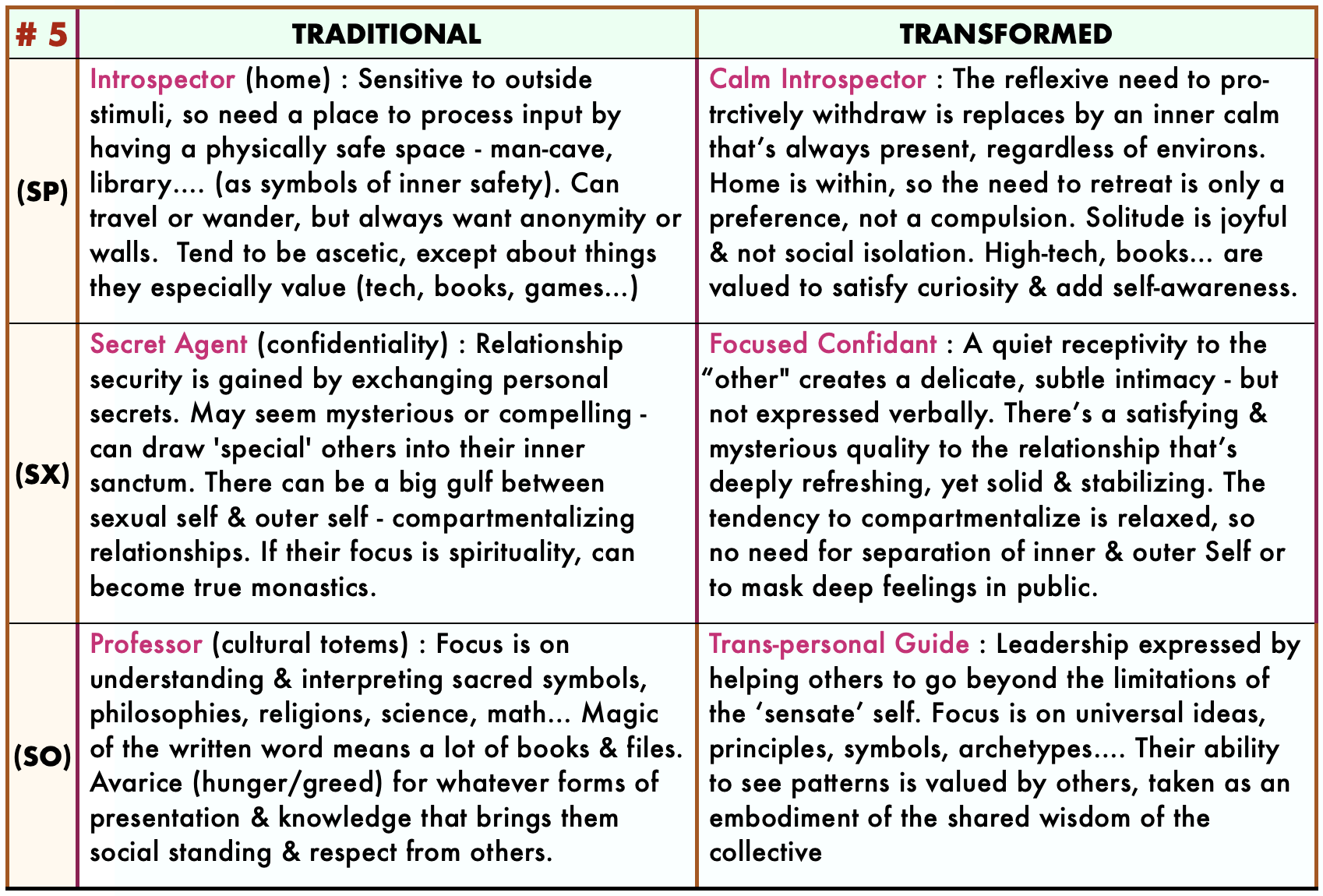
COUNTER instinct of TYPE 5 – Confidence
Sexual 5s have a romantic streak. The most emotionally sensitive of the type, they suffer more, resembling 4s that way, & have more visible desires.
They express avarice (greed) by searching for fantasy-images of absolute love, with the need to find a partner who fulfills an ideal of trust. They have a vibrant inner life that may be expressed through artistic creation, but are still cut off from others in many ways.
«

«
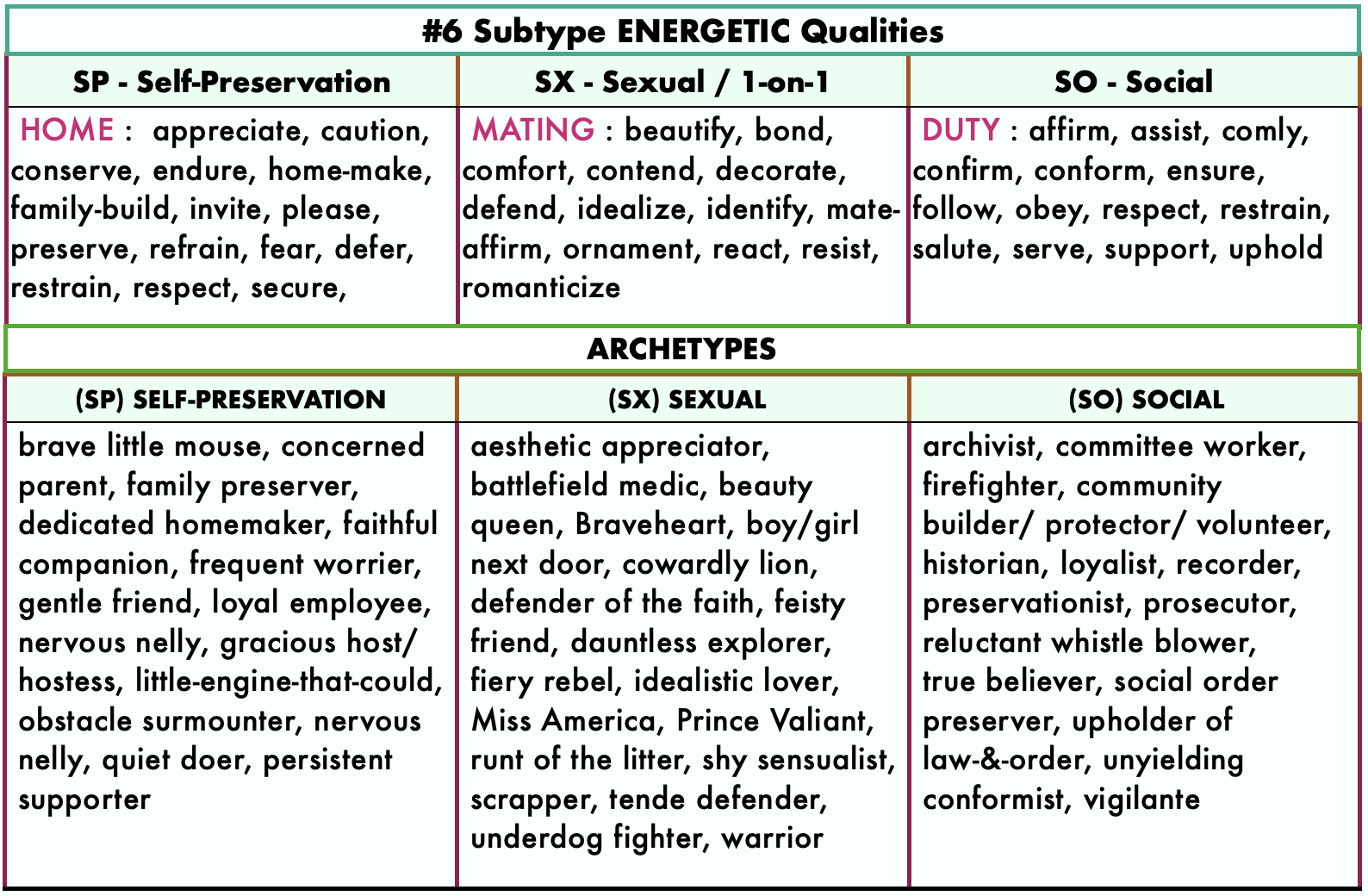
COUNTER instinct of TYPE 6 – Strength/Beauty
Sexual 6s express fear by going against it – by becoming strong & intimidating, trusting themselves more than the other two subtypes. So when they’re afraid, their inner programming follows the idea that “the best defense is a good offense”.
They take on a powerful stance both in what they do & how they look, as a way of holding the ‘enemy’ at bay. Their anxiety is quieted through skill & readiness in the face of real or potential attacks.
«

«
NEXT : Subtype Details (7, 8 ,9)


🟡Enneagram : Subtype Details (Types 1, 2, 3)

PREVIOUS : Enneagram


Review
🔸 Instincts
tell what our needs are.
🔸Our type indicates how we get those needs met, how we go about it.
🔸The variants (focused on the outside world) represent our priorities. Further down the levels of health, use of the instinct is more compulsive, & less a response to the actual need of the moment.

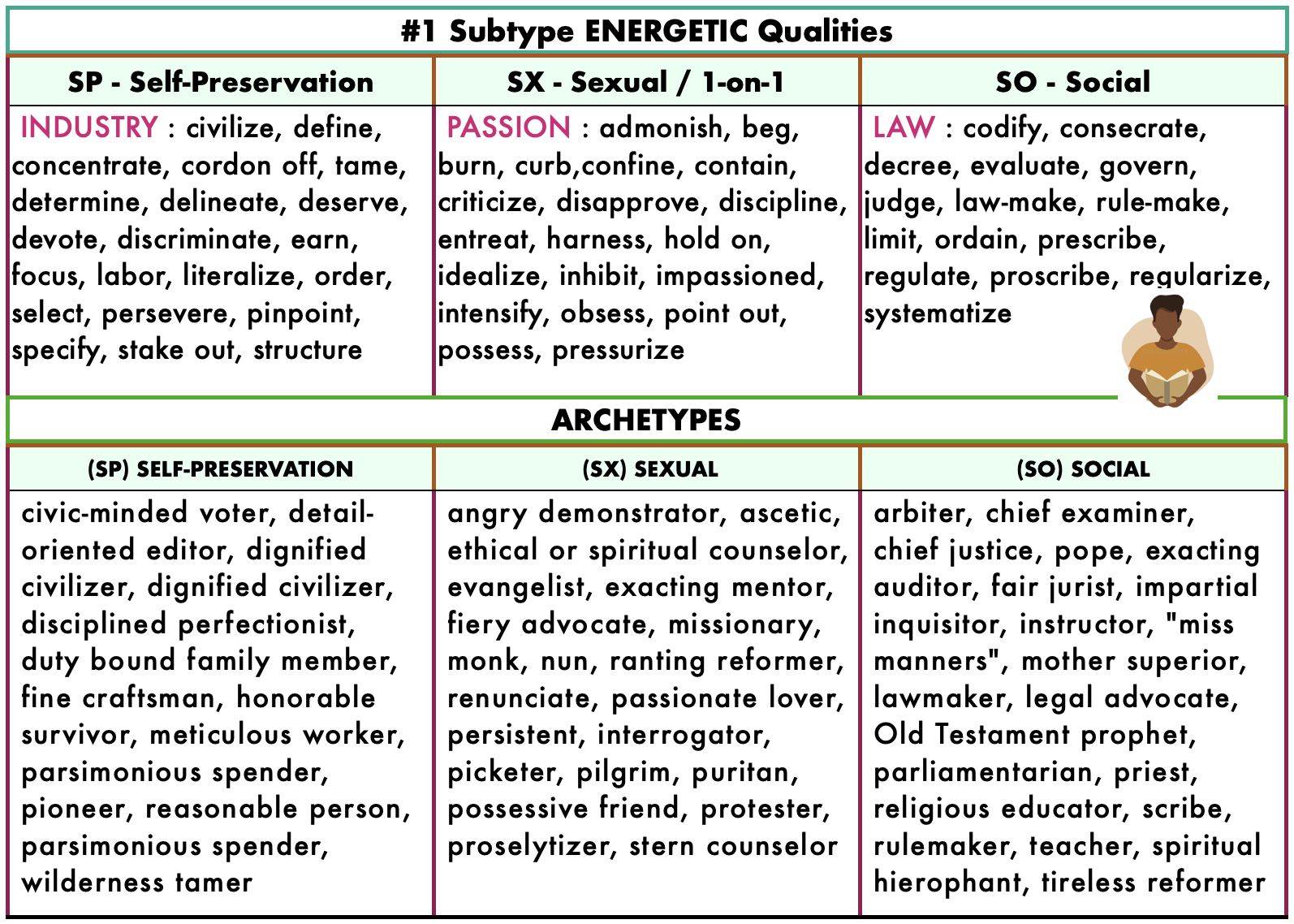
COUNTER instinct of TYPE 1 – Zeal
Sexual 1s
are “counter-instinctive” to the 1’s normal tendency to repress emotions, being more impulsive & outwardly angry, which they act out through an intense desire to improve others & get whatever they want.

They’re more reformers than perfectionists, feeling entitled in the way zealots do, from the belief that they have a higher understanding of Truth & know the reasons behind “the right way to be.”.
«

»
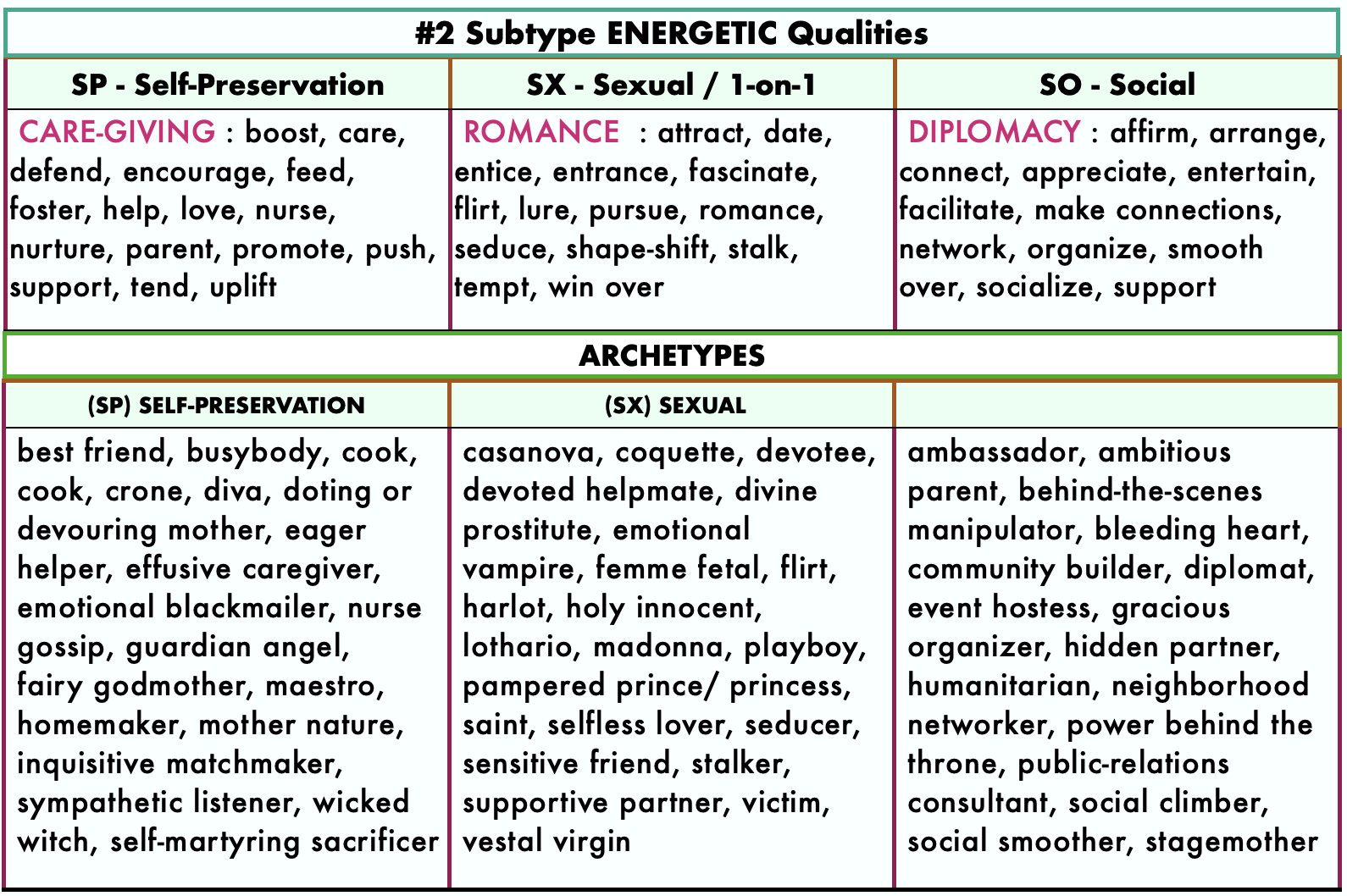
COUNTER instinct of TYPE 2 – Privilege
Self Preservation 2s “seduce” others (like a child around grown-ups) as a way of unconsciously inducing others to take care of them. Assuming that everyone likes children, SP 2s take on a youthful attitude to get special treatment well beyond childhood – acting charming, playful, irresponsible.

As the countertype, it’s harder to see Pride (‘normal flaw’) because they’re more fearful of & ambivalent about connecting with others. “Privilege” reflects this 2’s desire to be loved & prioritized just for being who they are, not for what they give.
«

«
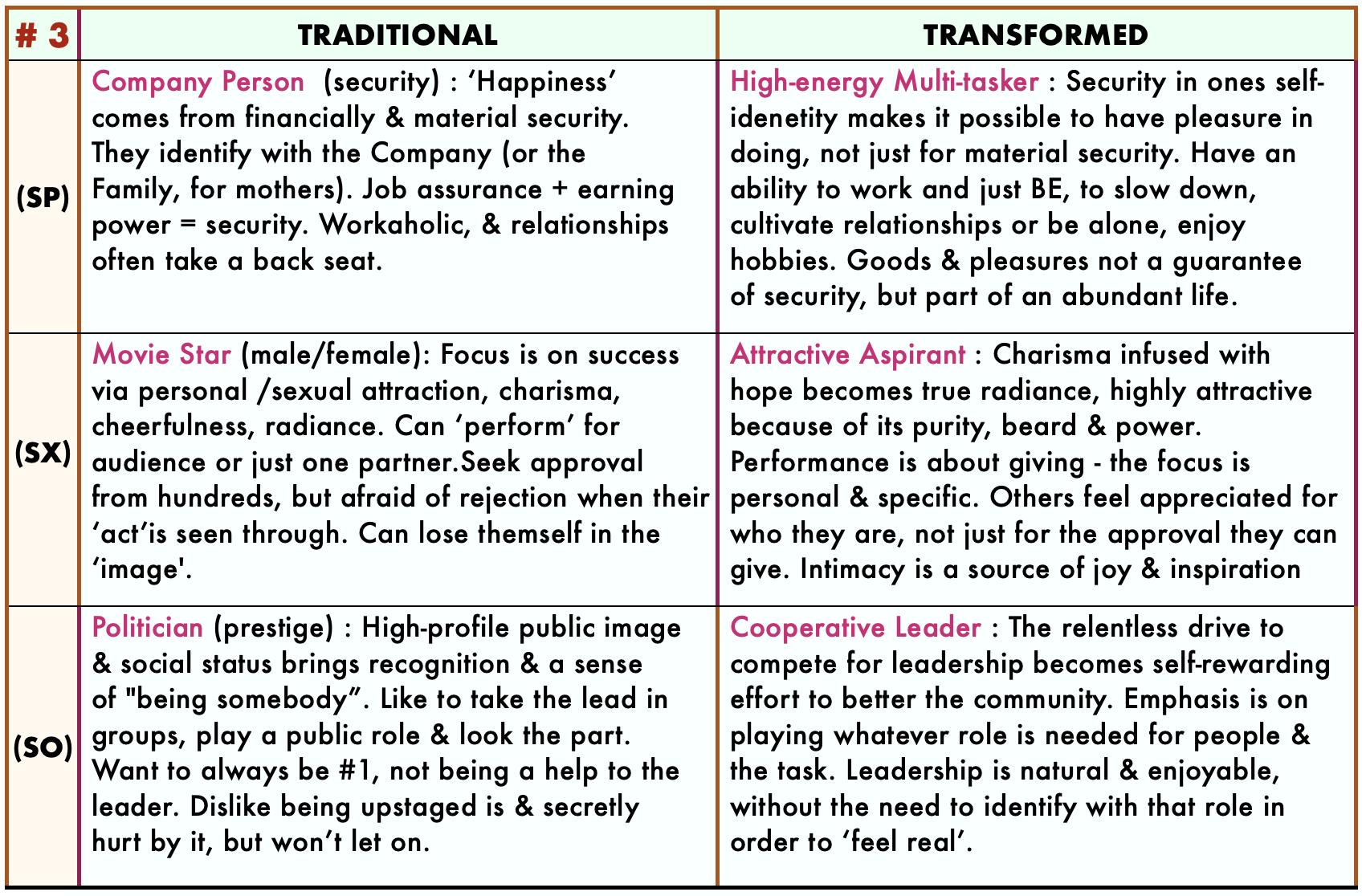
COUNTER instinct of TYPE 3  – Security
Self Preservation 3s are vain about not having vanity. They too want to be admired, but avoid openly going after recognition. Not just satisfied with looking good, SP 3s strive to BE good, determined to match the perfection model of how a person should be – which implies being virtuous, & virtue implies a lack of vanity. SP 3s try for a sense of security through being good, working hard by being effective & productive.


NEXT : Subtype STACK Details

Enneagram – 27 Subtype ATTITUDES

PREVIOUS : Subtypes – motives

BOOK27 Paths in Life & Subtypes in Relationship ∼ Peter O’Hanrahan
POSTS :  EnneaType EMOTIONS

2,3,4s = Grief, Shame // 5,6,7s = Fear, Anxiety, 8,9,1s = Anger, Rage 

Each Type handles it’s primary emotion differently:
❖ The first Type in its triad (blue) is overt & “externalizes” – 2 its shame, 5 its fear, 8 its anger—->

◆ The second Type in its triad (pink) is covert or “represses” – 3 its shame, 6 its fear, 9 its anger

✦ The third Type in its triad (lavender) is neutral or “internalizes” – 4 its shame, 7 its fear, 1 its anger (From : Enneagram Central Blog)

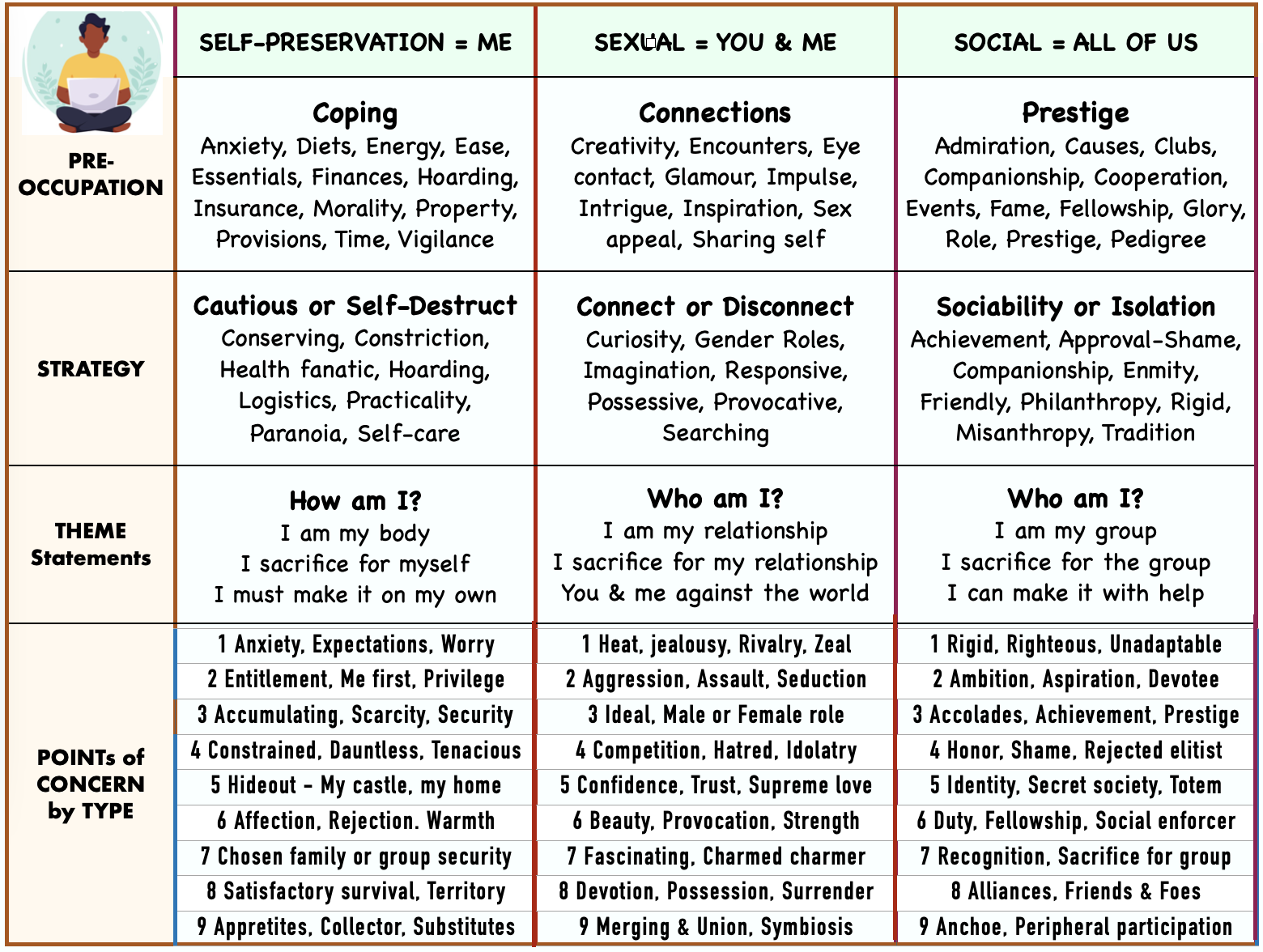
☆ Psychologically – the subtype instincts are closely associated with 3 crucial developmental stages of early childhood . Studying instinctual subtypes can help identify life-long patterns, and recover from early losses & insecurities.
1. Self-Preservation (SP) : infant bonding & grounding = our right to exist
2. Sexual / Intimate (SX) : growing awareness of self vs. other in the first “dyad” (mother or primary caregiver) = our right to be loved
3. Social (SO): entering the larger community of family, friends & peers = our right to belong

☆ Archetypally – subtypes can be described as the central patterns of human consciousness. Each has a special role in our society & in the history of our culture. Each has its major strengths & drawbacks.
For anyone interested in personal or spiritual growth, on the S & I path of “individuation,” it’s vital to come to terms with these powerful archetypes & the part they play in our life.

Enneagram as ONION LAYERS

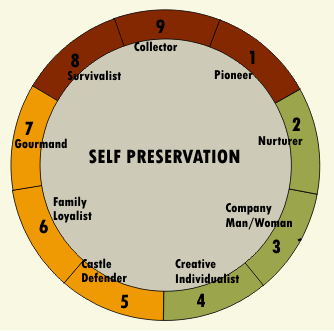
SELF-PRESERVATION Subtype ATTITUDES
2Nurturer – feel privileged, & earn approval through caretaking
3Company Man/Woman – achieve success & financial security
4Creative Individualist – reckless in pursuit of authenticity
5Castle Defender – home as refuge, or having a “womb with a view.”
6Family Loyalist – seek safety through kindness & affection
7Gourmand – enjoy fun, food & family
8Survivalist – protect the space & the family
9Collector – appetite for food & possessions
1Pioneer – overcome anxiety with hard work

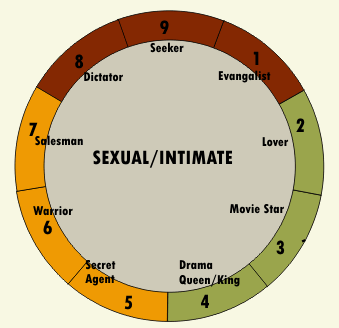
 SEXUAL / ONE-TO-ONE Subtype ATTITUDES
2Lover – use seduction or aggression for attention
3 Movie Star – have best masculine or feminine image
4Drama Queen or King – beat the competition through power or style
5Secret Agent – keep things confidential
6Warrior – overcome fear by maintaining strength or creating beauty
7Salesman/woman – fascination & suggestibility with ideas, people & products.
8Dictator – drive for possession, & maybe surrender
9Seeker – sexual or spiritual union & the urge to merge
1Evangelist – over-zealous or jealous

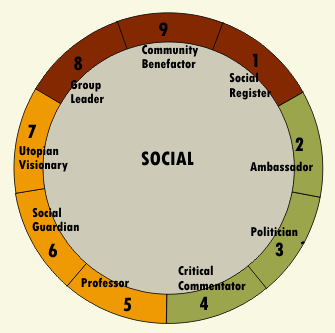
SOCIAL Subtype ATTITUDES
2Ambassador – seek recognition thru ambition
3Politician – achieve social success & prestige
4Critical Commentator – overcome social shame
5Professor – use social symbols & systems
6Social Guardian – do one’s duty
7Utopian Visionary – limitations, & make sacrifices for the cause
8Group Leader – fiercely committed to friends & social causes
9Community Benefactor – strengths & problems with participation
1 – Social Registrar – socially correct but non-adaptable
(P. O’Hanrahan)


NEXT :

Enneagram : The 3 SUBTYPES – Intro (#2)

PREVIOUS : SP instinct

SITE : Your next PLANT purchase by Ennea-Type” 


SUBTYPE INSTINCTS (cont)

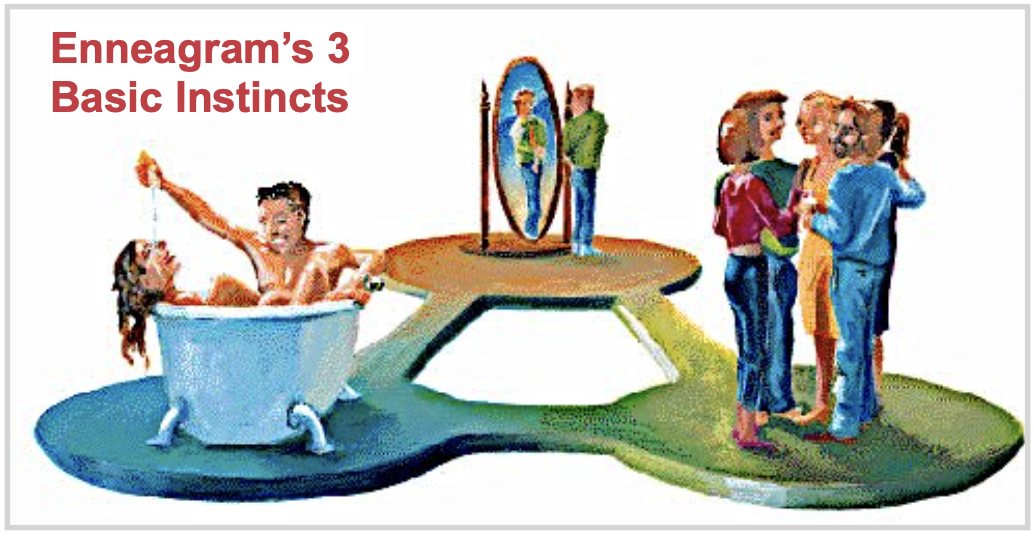
🔷The SEXUAL Instinct (SX) = SNAKE
NOTE : SX is about “attraction”, NOT “one-on-one”, which romance, a heart issue.
In Nature, sexual reproduction helps genetically diversify the species, for survival. This instinct is aggressive, competitive, single-minded, on display, smells, stimulation. Use of energy is intensely creative, fiery, go-get-it, a life-and-death matter.

Humans have a drive to project ourselves into the environment, form alliances & extend ourselves through the generations, to leave a legacy – either by passing on our DNA, or more symbolically through ideas.

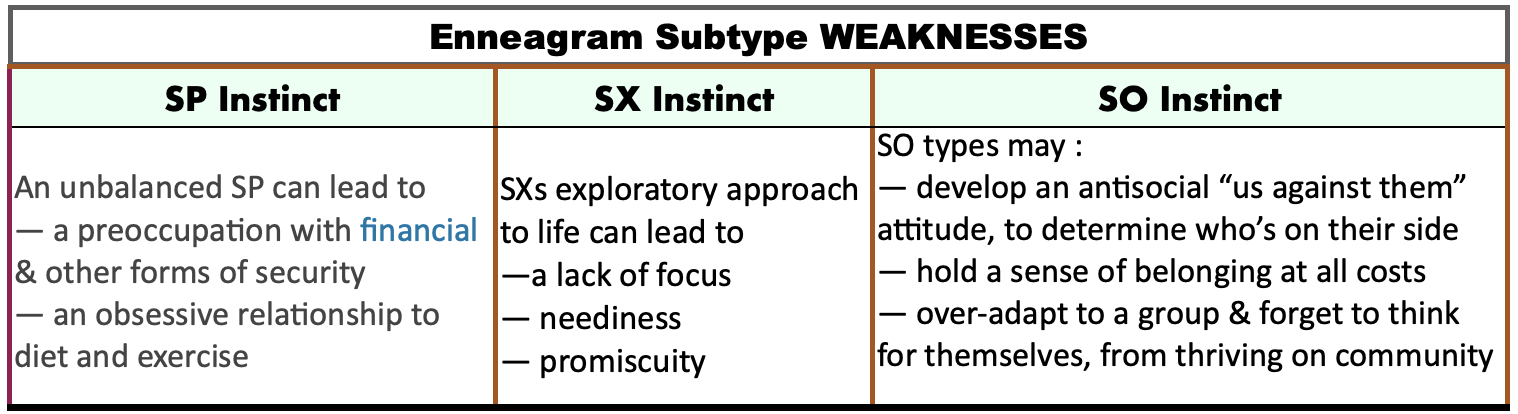
SXs types are the most “energized”, most emotionally charged. They fear incompleteness, loss of attachment & attractiveness. It explains why some people are more interested in intensity & shared experiences within special-others, rather than career, fame…..

They look for stimulating objects in their world & need a strong energetic charge in primary relationships, with attention on coupling, & having “chemistry” with others. Without it they stay dissatisfied. They enjoy deep involvement, even merging with others, & become disenchanted with partners who can’t meet their intensity.

SX energy is ‘The World experienced as a mating dance,’ broadcasting the Self as a beautiful object, attempting to allure with the ‘art of me’ (my aesthetic, my music, my art, my taste),
It throws out a net (pheromones) for that certain someone to complete an electrical circuit, a nose for the individualized scent of the soul we long to burn our imprint into, & theirs into us.
It’s Chemistry, not Intimacy. Involuntary attraction & repulsion :
— the sense of being a half-something on the hunt for the other half
— being ‘in heat’ (psychologically), exploring for ‘electrical juice’, the narcotic of attraction
— fanning out electric-colored peacock feathers
— pouring through the keyhole for a peak at something special. but also pushing the envelope, out on the edge
— exposure to potential self-destruction in the other 2 realms of Social & Self-Preservation.

SX energy is a raw narcotic of wanting, untethered by ethics & morality. It’s Reckless, a live wire longing to burn – & be burned to death.
The classical image of Eros’ arrow (erotic attraction) shot through the heart accurately indicates the danger : potential ruin & destruction under the guise of Love.
♥️

The SOCIAL Instinct (SO) = ROOSTER
SO explains a person’s patterns & behaviors which prioritize socializing & the good of the group, the instinct to get along with others & form secure peer-bonds. Attention is on the social structures in our community, with a need to belong, be accepted & therefore feel safe. It emphasizes a high awareness of social norms & status positions / levels, with energy put into a shared purpose or the greater good.

SOs tend to warm, more open, engaging & socially responsible. They want partners who can share their social activities & get involved in projects & events along with them.
They fear alienation, inferiority & loneliness. SOs lose their sense of identity & meaning when not involved with others in activities that go beyond individual interests.

Paradoxically, they tend to avoid long periods of exclusive intimacy & quiet solitude, which feels too limiting.

SOs want to be involved with both a special someone or some group – affiliating, co-creating, participating, contributing.  This is the parenting instinct, the bridge or link between instinct & the same broad-view emotions that inspire animals to care for their young.

SO is the physical sensation of not being a closed circuit (“No man is an Island”). Bonding & relationship-building belong in this category, not with the Sexual Instinct.  “Social” gives the ‘intelligence’ to read people & respond or adapt to them, communicating & interpreting subtleties. All language / words / verbal exchanges are part of this Instinct.

Lofty eternal principles & ideologies get their first push & continued attention from the Social Instinct. It expresses wholesome cleanliness & the ‘white light’ themes of order, law, history, medicine, higher education, government.  

The SO instinct is the connection to history, the participation in the collective human journey, the drive that animates our impulse toward
— the Humanities, altruistic vision, goodwill, the ‘higher good’, the concepts of civilization & religion.

However, It can also go low. It can spark the response that :
  burns witches at the stake
  exterminates populations that are deemed ‘diseased vermin’ or those that are lesser/lower in some way…
— or put too much attention on status, rank, respectability, pedigree, reputation, strata, provenance.
 

NEXT : Enneagram

Enneagram : The 3 SUBTYPES – Intro (#1)

PREVIOUS – Enneagram

BOOK : “The Complete Enneagram: 27 Paths to Greater Self-Knowledge” — Beatrice Chestnut

🟩 Enneagram SUBTYPES, from INSTINCTUAL VARIANTS
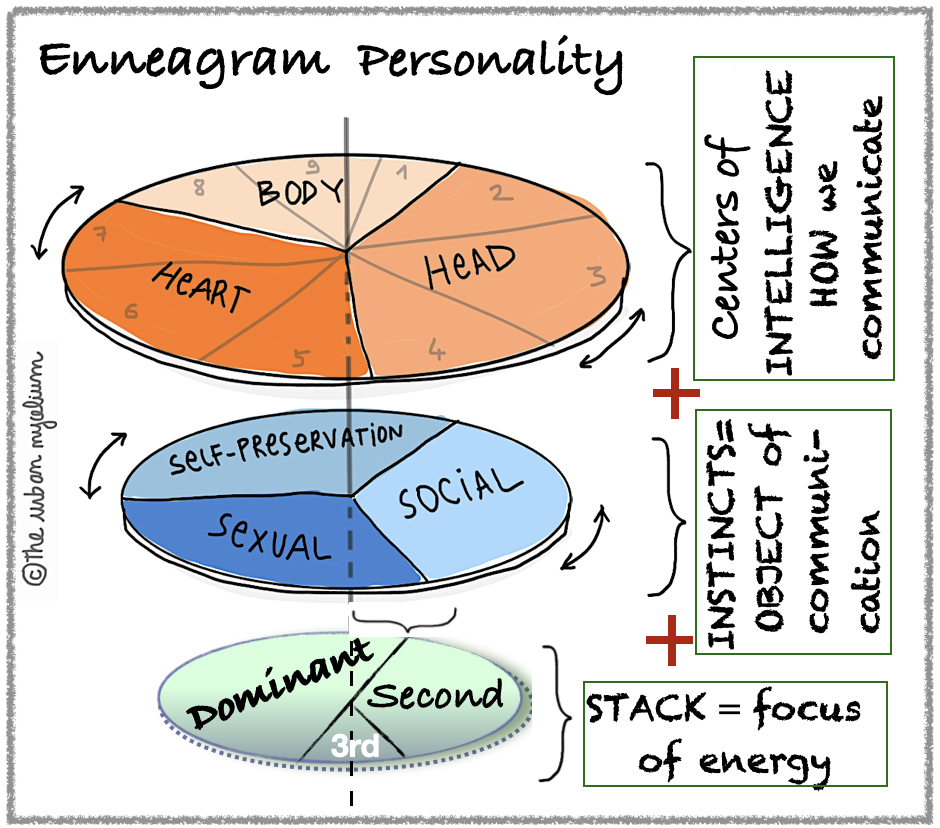
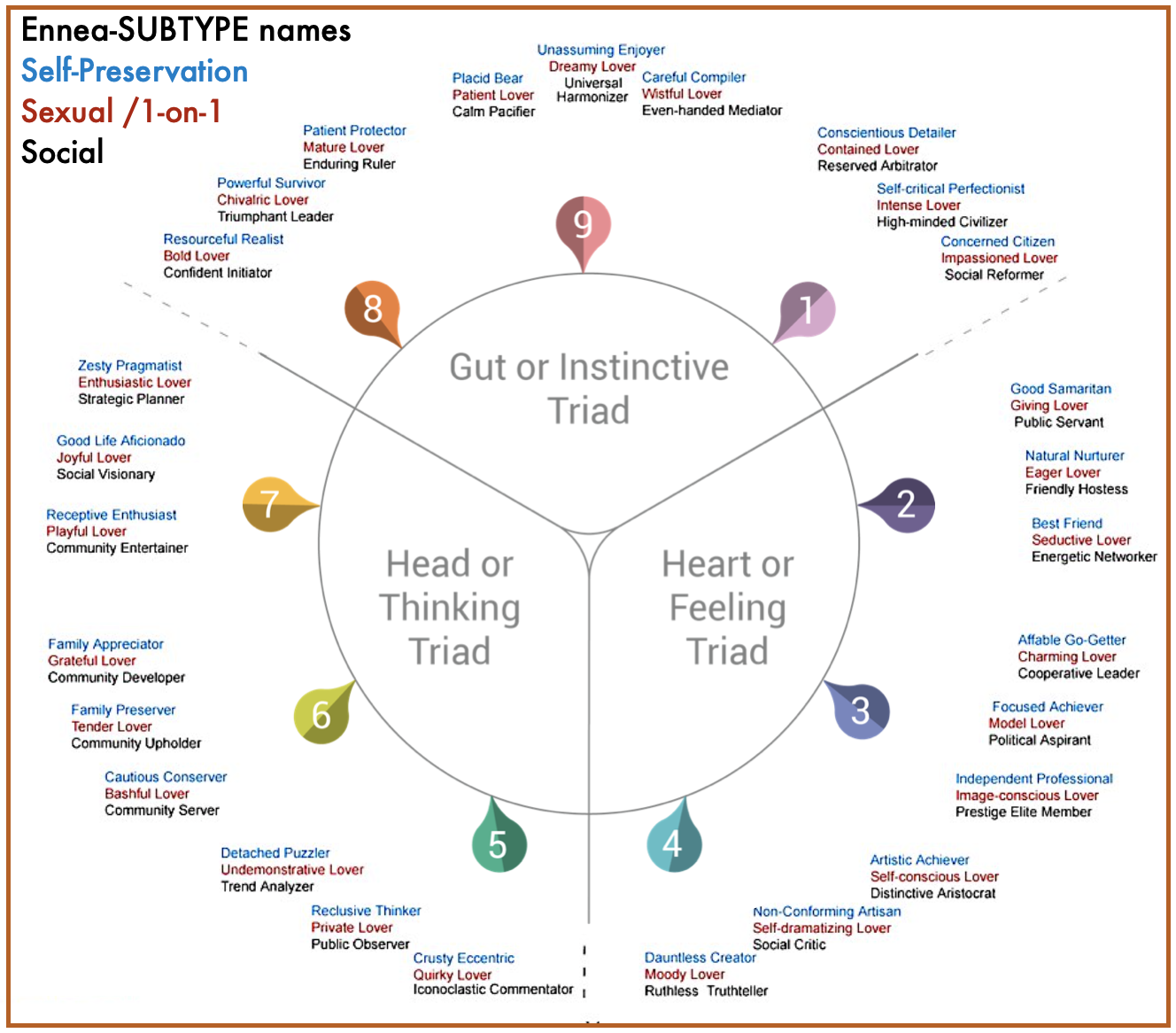
Several factors influence the traits & behaviors of each type.  The INSTINCTS (Self-PreservationSocial groups & Sexual / One-to-One bonding.) are variations on each core Ennea-type, called ‘Personality’, which is our unconscious ‘putting on a face’ to individuate ourself – ways we function, interact, & communicate with the world. Thus we get a minimum 27 variations of Personality. CHART ⬇️

As we grow through childhood, we typically develop one of them more fully, & the other two in lesser degrees. Just as all nine personality types are active in every number, all three instincts are active in every person. And as with the types, one instinct tends to be dominant.
Physical Source :
Self-preservation (SP) instinct is from the brain stem
Sexual (SX) instinct is from the mammalian brain
Social orientation (SO) instinct is from the neocortex.

Recognizing subtype nuances allow us to examining how our instincts affect the way we interact with the world around us, which provides basic survival strategies, & helps explain how people of the same Ennea-number respond differently.

EXP: A Sexual (“Intimate / 1-to-1”)  Type 6 person will likely not be as fearful as a typical 6. So much so that a SX-6 can seem like an 8, & even be mistyped as such! However, the 6’s core motivations are still there.

This CHART ⬇️ shows how 81 variations are derived. 


RELATIONSHIPS : Knowing our-and-their subtypes allows us to better meet our partner’s needs for security & identity, managing the rhythms of connection & withdrawal – without taking it all so personally.
‣ What do we expect of our partner for personal time & attention, & how does this fit in with their priorities?
‣ Who initiates physical /sexual contact,  how much, how often?
‣ Who cooks & cleans?
‣ Who takes care of the finances?
‣ How do we include friends & family?

IDENTIFYING : The main way to figure out which subtype influences you – is to notice where you consistently, automatically put your attention when in public or in a group.

▪︎ SELF-PRESERVATION (SP) = PIG
SP prioritizes a person’s security for themself, the instinct to preserve our body, its life & effective function. The focus on well-being, material security & comfort – while  minimizing threats to physical needs such as health, finances, food, shelter & family.
They fear not surviving – poverty, mortality, annihilation. If stress & anxiety combines with this instinct, it can drive a person to conserve or hoard energy & resources, in response to demands from the environment or other people.

SPs tend to be more grounded, practical, serious & introverted than the other two. They can have active social lives & a satisfying intimate relationship, but if they feel that their SP needs aren’t being met, they won’t be happy or at ease. SPs are “nesters”, wanting domestic tranquility with a stable, reliable partner.

Most of the World is SP-Dom. This overall global predominance is one reason we see the general public so easily is so easily upset by news of natural disasters & imploding financial markets.

This Instinct’s ‘eye’ if forever focused on every situation or condition affecting their physical self — all about the ‘me’. SP-Dom people can put too much attention on :
⚠️ day-to-day details such as food, shelter, health & finances
⚠️ their physical environment  (hot/cold, light/dark, dry/humid, clean/dirty, quiet/loud….).
how they experience the immediate environment (inviting/disturbing, familiar/haunting, enticing/disquieting….)
⚠️ tangible resources – money, tools of all kind, time, practical know-how, material provisions & useful objects…. stockpiling for future survival.  Particular value is placed on ‘getting things done’ & building or acquiring things that will last.

How satisfied their needs & wants are at any given moment ——> will decide how they feel emotionally.

ARCHETYPE animals of the Bhava-chakra (pig, snake & rooster) plus the Life-giving elements (fire, air, water, earth) animate & shape the ecosystem.

“All relationships between people are essentially social (Rooster). Human connections involve Sexual (SX-snake) & Self-Preservation (SP-pig) in varying ways, but aren’t the raw stuff that compels bonding & closeness.

∆ The snake has no friends, no bond, no romance.
∆ A pig will ‘eat anything,’ so we call someone a pig / hog when they take-&-take & never give, or take more than their fair share.
∆ BUT – Social (SO) – in part 2 –  is the ‘human instinct,’ differentiating us from animals, with complex verbal & written language, the animal-instinctual that bridges to our hearts, connecting in commonality &/or purpose, to find our place with others.
It gives the urge to achieve, befriend, compete, excel, illuminate, improve, learn, protect & teach.” (MORE…)
♥️


NEXT : 3 SUBTYPES – Intro (Part 2)

Enneagram : MIS-USING Strengths (#2)

PREVIOUS : Misusing Strengths #1

SITE : Learn About Your Enneagram Type”

IMAGES : ” I Don’t Know What I Don’t Know, but I DO Know This” (2019)

TYPE 5
☀︎ I dismiss others’ opinions because they’re supported by intuition or emotions rather than factual analysis

☀︎ I get so content that I miss out on good things that I may really enjoy
☀︎ I get so comfortable observing – that I don’t put myself in the ring (even if it can benefit me)

☀︎ I focus so intently on planning – that it’s all consuming – so there’s no room for spontaneity
☀︎ I keep researching to the point that I can’t make a decision – because I’ve just uncovered so many more things I don’t know
☀︎ I only rely on data – without considering how decisions or perspectives will affect my emotional state

TYPE 6
☀︎ I cling so tightly to my set of plans that I can’t enjoy them
☀︎ I feel overly responsible for all the little details, & for making sure things go well
☀︎ I’m so aware of what might happen – that I forget to acknowledge all of the good that’s currently happening in my life

☀︎ I overthink everything – to the point that I’m stuck in analysis loops
☀︎ I stay fully committed to a situation that is no longer serving me – because I’m loyal, & am more comfortable with white-knuckling my way through – than with stepping into the unknown
☀︎ I take on tremendous worry and concern for those I truly care about

TYPE 7
☀︎ I choose to only see what’s going well, & overlook important problems that need to be addressed
☀︎ I consistently chase the next jolt of excitement – so I miss the chance to cultivate something I already love doing
☀︎ I make everything into a positive – even when it would actually help to look at the big picture, including the minuses

☀︎ I over-focus on an exciting solution to a problem / task / situation – to the point that I forget to consider the practical action-steps that are needed
☀︎ I pressure myself to be the cheerful & supportive person in the room, even when it feels like too much for me to do
☀︎ I recognize that I’m doing too much & running myself into the ground, but continue full speed ahead – because I assume I can handle it all

TYPE 8
☀︎ I focus so intently on being competent – that I have *negative* patience for people who work slowly or don’t know what they’re doing
☀︎ I get over-zealous toward others when trying to get them to apply my helpful suggestions
☀︎ I’m so focused on reaching the end goal of a project or plan – that I overlook others’ opinions or feelings about it

☀︎ I over-work & “push through” – way past the point of exhaustion
☀︎ I take on too much of the workload (because I’m so capable) & miss an opportunity to empower someone else to us their talents
☀︎ I take on the responsibility of fighting others’ battles, sometimes without their permission or need

TYPE 9
☀︎ I get so focused on not offending others – that it’s hard to get my point across, even though I sometimes feel it’s really important to let others know I disagree
☀︎ I over-emphasize my understanding of others – that I blur the lines between empathy & enabling.
☀︎ I often sacrifice my own needs or wants – because it’s easier to go with the flow

☀︎ I prioritize supporting others – to the point that I leave myself behind
☀︎ I’m so good at making my own “comfy space” inside – that I mentally live there instead of engaging in the real world
☀︎ I’m so understanding of everyone’s perspective – that it’s hard to identify my own opinions

NEXT :

Enneagram : MIS-USING Strengths (#1)

PREVIOUS : Mis-typing #2


Intelligence Center DEFENCES
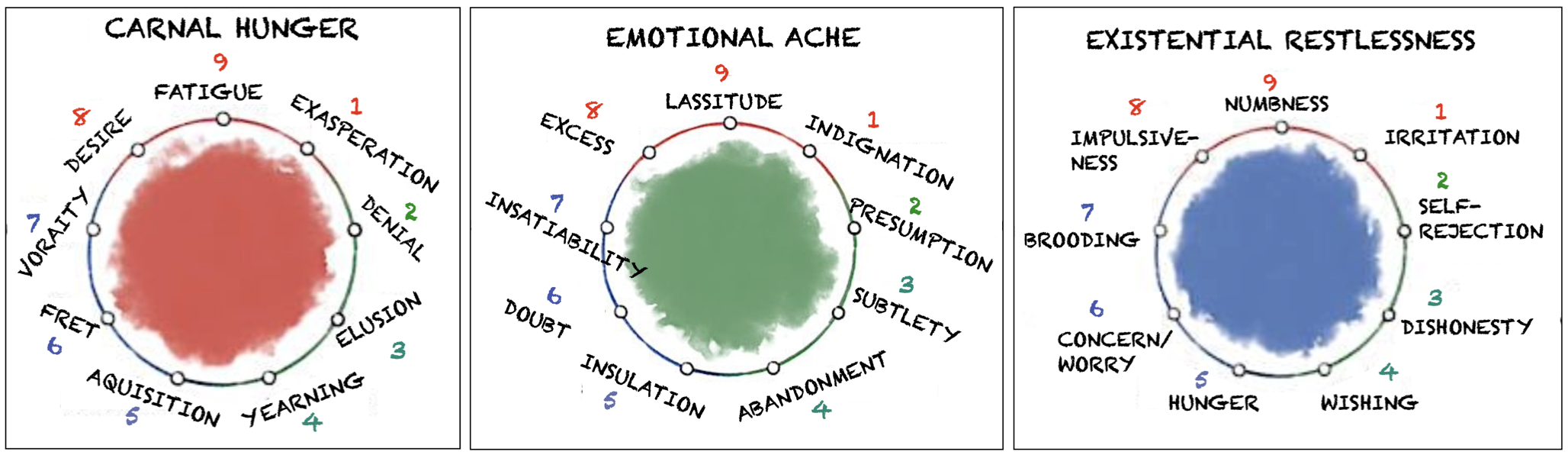
Enneagram coach Chris Heuerz has explored the meaning of the Enneagram Passions, which identify some of the clearest archetypal aspects of the human character.
“I don’t believe the Passions are mainly “sins” nor the shape of one’s tragic flaw, but rather more like Claudio Naranjo’s view as a “thirst for being, ultimately based on a loss of contact with True Self…. because of our original wounds & loss of innocence”.
The Passions are “… our ego’s basic coping tools to reconnect with essence … which we instinctually use in an unconscious attempt to find our way home…. “

So Heuerz makes use of the 3 Intelligence Centers, the primary ‘organs of perception’ about ourselves, the ways we try to explain our fundamental experiences.
(Body= 8,9,1) (Heart= 2,3,4)(Head= 5,6,7)

ULTIMATE GOAL : To integrate what’s been disassociated from our Center – whatever limits our ability to express True Self – first requires identifying the components :
🔸 Body’s Carnal Hunger + Heart’s Emotional Ache = Head’s Existential Restlessness
🔸 Heart’s Emotional Ache + Head’s Existential Restlessness = Body’s Carnal Hunger
🔸Head’s Existential Restlessness + Body’s Carnal Hunger  = Heart’s Emotional Ache.

Then we can understand the whole:
🔹Carnal Hunger + Emotional Ache + Existential Restlessness = the Passion (MORE…. w/ explanations)

MISUSED CHARACTERISTICS
TYPE 1
☀︎
I create unattainably high standards for myself & others
☀︎ It feels like the weight of the world is on my shoulders – because I can see problems all around me & feel responsible to fix them
☀︎ I get attached to a specific routine or structure, & don’t let myself or others step out of the box or be spontaneous

☀︎ I offer solutions & advice even tho’ the recipient may not want or need it
☀︎ I’m so focused on the details that tasks become more complicated or time-consuming than “necessary” – because something could always be better
☀︎ I take on excessive amounts of work – because I’m capable of doing it, even when it can be delegated to someone else

TYPE 2
☀︎ I completely take on how others feel (which can get quite heavy) &  pressure myself to take action to help them
☀︎ I connect to others faster or deeper than they may be ready for
☀︎ I give too much thought to how others may be feeling – that it interferes with my decision-making

☀︎ I feel like I know others better than they know themselves, & only lead them in ways I think is best for them
☀︎ I make myself indispensable to the point of exhaustion
☀︎ I taking on the responsibility of keeping the environment positive & happy, even though I may not be

TYPE 3
☀︎ I always present a sense of composure, even when occasionally it would benefit me to be somewhat vulnerable
☀︎ I keep striving to make a bigger & better difference, which can lead to feeling like nothing is ever enough
☀︎ I focus so much on solutions & action that I neglect important details, or input from others

☀︎
I over-focus on external growth & forget to slow down (or even pause)
☀︎ I subconsciously adapt so much – that it becomes hard to identify my sense of True Self
☀︎ I put tremendous pressure on myself (maybe too much?) to get things done & deliver results

TYPE 4
☀︎ I get stuck in my emotions after an intense experience
☀︎ I over-emphasize creating an authentic & vulnerable environment for others before they may be ready for it
☀︎ I over-focus on doing what looks & feels the best – even though it may be impractical

☀︎ I prioritize “never done before,” out-of-the-box solutions – to the point that starting the project feels so daunting /overwhelming that I can’t get started
☀︎ I’m so willing to be emotionally vulnerable – that it sometimes leads to regretful over-sharing (TMI)
☀︎ I stay in such a deep state of introspection & overthinking – that I neglect practical tasks

NEXT : MISUSING Strengths (#1)

Enneagram MISTYPINGs (Part 2)

PREVIOUS : MISTYPINGs (#1)

SITEs : Mistyping Podcast

☀︎” Which fictional character embodies your Enneagram Personality Type?”

On the path of self-discovery, it is utterly normal & totally expected that you will mistype yourself.  We might even say that it’s part of the process. Being human means that likely everyone will get it wrong at some point. This can happen for so many different reasons. —->

Here are some things that can be helpful when trying to figure the enneagram-number correctly :

1. LOOK at the number you think you are & research its Disintegration /Tension vs. Development/Growth arrows, and the 18 possible Wings. Become familiar with which behaviors those may exhibit, when healthy & when stressed. Which thought, feeling & doing patterns fit you best? Consider that you might actually be one of the Arrow numbers of the type you originally started with.
🔘 The Advantages of Mistyping in the Enneagram

2. Stances. Stances are the energy planes on which you
unconsciously live, emote & think.  They also relate to how you orient yourself to time.

Aggressive : 3s, 7s & 8s go out to meet the world with lots of
energy & force of will. They tend to do what they want and accomplish things with zest & passion. They’re future-oriented, because their thoughts & feelings often forecast what they think will happen, not what’s happening in the moment.

Sacred Delay – When Aggressives slow down & reflect on their pasts, they let their emotional center catch up with their heads & bodies, so they learn from past mistakes & difficulties, which
helps break out of unhealthy habits & repeating cycles.

Withdrawing : 4s, 5s & 9s find their equilibrium by removing themselves from the world to process or deal with the events that life throws at them. They are past-oriented, tending to dwell on memories or things that have just happened, often filtering the ‘now’ through the ‘then’.

Sacred Presence – When Withdrawers choose embodiment in the here & now, they become more aware of what is, rather than what was or what could be, helping them resist unhealthy retreating tendencies

Compliant (Dependent) :  2s, 6s & 1s move along with the people & events around them, not quite in touch with their own energy. They mold with either what’s expected of them, or what they assume is expected. They are present-oriented, having a grasp of the moment, but little thought goes to the future or remembering the past.

Sacred Vision – When Dependents lift their gaze to see beyond present circumstances, they become more open to a vibrant future beyond the tyranny of the urgent, helping them not be so focused on present tasks.

3. NOTICE how you move around in the world.
🔹Do you seem like a person who lives & breathes your feelings? Is everything about emotion & relationships? If so, a good place to start is the Heart Triad: Numbers 2, 3 & 4

🔹 Do you think, think, and think some more? Is everything carefully planned or researched? Then investigate the Head Triad: Numbers 5, 6 & 7

🔹Are you a do-er? Is acting from your gut second nature? You just know what to do, & go out and make it happen? Start
with the Body Triad: Numbers 8, 9 &1

SITEs: 3 Reasons You Might be Mistyping Your Ennea-Type

NOTE : Besides the reasons for mistyping listed in Part 1, another is that we may be living in one of our wings, while denying or minimizing the core number.
EXP : A ‘wounded’ insecure 8w7 who is afraid to express their power (8) – may spend so much of their efforts on “fun & distracting” activities (7) to avoiding deep trauma-pain – that they opportunities to develop their 8-strengths.
OR
⬆️ We may be picking up too much of the negative characteristics of our Core-Type’s “Stress Arrow”.
EXP: A depressed type 3’s Stress number is 9. Having trouble standing out in life using their native ambition, they’re more likely to procrastinate & ‘blend in’, to sidestep challenges.

NEXT : Enneagram – 3 SUBTYPES

Enneagram MISTYPINGs (Part 1)


PREVIOUS: Ennea –

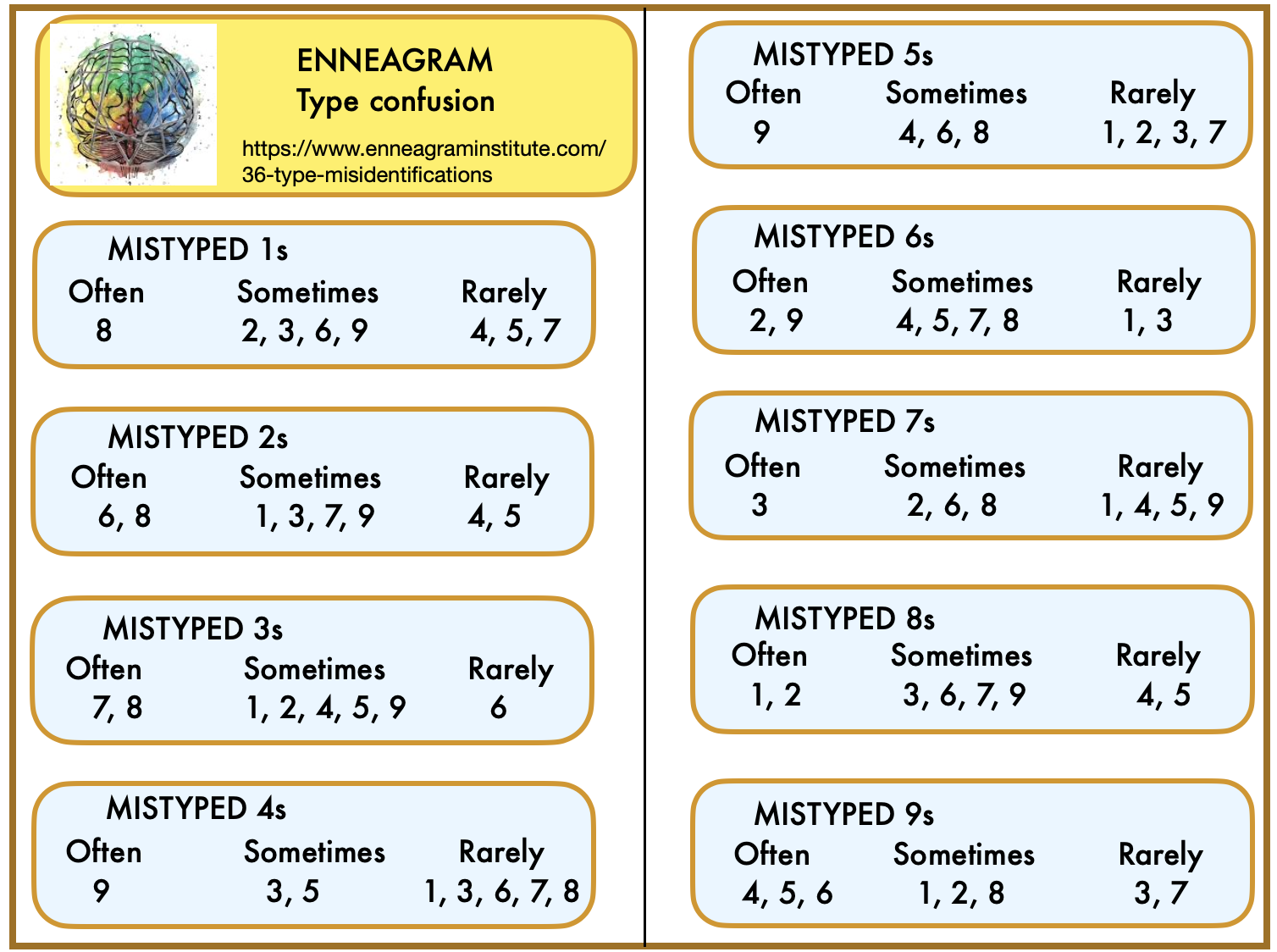
SITEs: “36 Mis-Types

☀︎ Comments, tests & Criticisms


Why Mistyping Happens
▪︎ The Enneagram is not simple
While the basics of the Enneagram are easy to learn, it also makes room for the complexity of human personality.  Learn more about it here.

▪︎ You don’t know the 9 Enneagram types well
People new to the Enneagram can easily confuse some types if they’re not yet know what type others are that you’re meet in real life. Learn about each type here.

▪︎ You’re not looking at the Why
If you only look at the actions of a type without being aware of their deeper motivations (SP, SX, SO….), you can easily mistake one type for another. Different ones may act in almost the same way in certain situations, but their reasons will be very different (See post on Subtypes)

▪︎ You pigeonhole yourself
Confusion can also result when types are seen too narrowly. EXP : Thinking that because #4s are creative, & you’re the creative type, you must be a 4.
While basic traits apply, they’re only a fraction of what each number is, so don’t stop at the summaries.
ALSO – you may misidentify yourself by believing what someone else thinks you are

▪︎ You don’t like what you’re seeing
Many people also mistype themselves because they don’t want to acknowledge the basic ‘flaw / ‘passion‘ which actually identifies their number. Study each types weakness first, then have the courage to admit what you know about yourself- with compassion

▪︎ You didn’t take all factors into account
Enneagram types aren’t one-dimensional or static. Each will be heavily influenced by your arrow, wing, level of maturity & current state of mind. Every type can act differently when under stress vs when they’re at peace.
Mature people can also access various patterns from other types, since they’re no longer fixated on their own. Learn about wings, levels of health and stress/peace behavior

▪︎ You aren’t aware of healthy vs. unhealthy traits of each type
No-one always shows every single characteristic of their type, especially not at the same time.
Very healthy people don’t act out the most unhealthy behaviors of their #, just as very unhealthy types won’t show the healthiest parts of theirs. People aren’t stable and neurotic at the same time. See levels of health in type descriptions.

▪︎ You mistype others
Typing others isn’t magic, but it’s not simple either. This is because you almost never have a full picture of the other person (missing other ‘inventories’), so you’re working with incomplete information. To correctly identify someone’s type is a skill learned carefully – & humbly. See how (not) to use the Enneagram.     ——— (MORE ….details)

3 Most Likely Mistyped
‣ Type Threes invest a lot of energy into projecting an image that allows them to them fit in & be popular – most often in their career. Depending on their chosen facade, they can seem to be another type instead of their own – because that’s the type they want to appear to be. The important Q to ASK :  “Is that really me, or is that merely who I’d like to be?”

‣ Type Sixes often connect very strongly to the values & motivations of the authority figures they look up to, even if those ideas aren’t genuinely their own. Because 6s incorporate multiple sources, their answers on tests aren’t always based on their own Truth, so scores will be all over the place.
ASK:  “Whose voice is answering on this test? My own, or  someone I trust a lot?”

Type Nine is without question the one that mistypes themself most often. This comes from their nature – 9s have the capacity to assume the views of other types because they have the least defined sense of self. They can take on a partner’s characteristics, or try to mold to cultural expectations.
Female 9s may assume they’re a #2 – associating ‘femaleness’ with helping & self-neglecting.
Male 9s often think they’re 5s because they mistake their own restrained or self-effacing attitude with the ‘thinking’ nature of the Five. Review Type Nine.

NEXT : Mistyping #2

Enneagram – CONTRASTING Types


PREVIOUS :
Improve 
Communication, #2

SITE : Type Comparisons (extensive)


NOTE
🔹Our external behaviors can look the same, yet have different internal emotional / energetic underpinnings.

🔸Our internal emotional / energetic underpinnings can be very similar, yet have different external behaviors or manifestations.

Type 1 & Type 5
Same: They’re look-alike types because they’re both intellectual, & can become withdrawn when trying to figure things out. Both deal with internal voices of criticism, so feel they’re not doing enough.

Different: In response, 1s pour endless energy into improving everything around them. 5s pick only a few projects, trying to silence their self-distrust with overzealous mastery.

Type 1 & Type 8
Same:
Both are are body center types concerned with rightness, justice, truth and fairness. They have an inner feeling that if they have a sense of control, all will be well.

Different: 1s exert super-control over themselves & the details of their environment.
8s care about the big picture. Their desire for power is to ensure they get what they want, & that everything stays in one piece

Type 2 & Type 4
Same: Both are heart center types attuned to feelings, & are friendly & magnetic. They’re used to others liking them, & seek out relationships that bolster their self-confidence.

Different: 2s genuinely believe they can get anyone to like them, to confirm inward image.
4s distrust their relationships, & inwardly distrust that they’re lovable.

Type 2 & Type 6
Same: They can be look alike because both can be externally warm & friendly, sensitive to others, disarming or seductive, & will defer to what others want or need.

Different: Internally, 2s cling to the love in their relationships, which gives them a sense of identity.
6s mistrust others internally, always keeping a watchful eye out for breaks in loyalty.

Type 2 & Type 8
Same: Both show active energy, assertiveness, generosity, intrusiveness, protectiveness toward others and attraction to power. Both feel angry, often because their boundaries or identity are violated in some way.

Different: 2s express their anger in explosive outbursts after trying to repress this emotion.  
8s show their anger more easily & consistently, & then move on from it quickly.

Type 3 & Type 4
Same: Both want approval & recognition, with a need to maintain their image. Both are often intense, competitive with a creative, inventive ability

Different: 3s push their true feelings aside to keep up momentum toward a goal.
4s lose external goal-momentum as their fluctuating emotions turn them back to an inward focus

Type 3 & Type 6
Same: Both are personable, practical, & highly active. They’re excited planners, working diligently toward achievable goals

Different: 3s are internally optimistic, believing everything will move smoothly & to great success.
6s tend to being pessimistic. They expect all kinds of problems to surface, so they develop a myriad of contingencies, just in case.

Type 4 & Type 7
Same: Both are intense and idealistic, wanting life to be highly stimulating & adventurous. Quickly shift jobs, projects, interests & relationships, often done unconsciously

Different: 4s are searching for a sense of identity with each shift. 7s search for fulfillment & satisfaction with every move.


Type 5 & Type 9
Same: Both can be internal, thoughtful & unobtrusive. They tend to pull back so they won’t be overly influenced by their surroundings. When needing to complete important tasks they externally procrastinate, filling their day with busywork.

Different: Internally 5s fear not being able to handle the task & having to ask for help.
9s internally fear that the importance of the task will upset their inner balance / peace.

Type 7 & Type
9
Same: Both want life to be pleasant & upbeat. They’re adaptable, inviting, & prefer to avoid conflict. they want to be liked and to get along, internally, want to avoid feeling any pain.

Different: Externally, 7s have a hectic, wild energy, & express their desires.
9s live at a more leisurely pace, are generally mellow, & easily mesh with the desires of others.
(From Melissa Kircher)

NEXT: