

IT HELPS TO KNOW
what the rules are
PREVIOUS: Comm. #4
SITE: “….How Relationships influence Behavior”
⬅️”BUSINESS MEETING”
designed & created by DMT
CATEGORIES of Communication (Comm) cont…
5. Who / 6. Structure / 7a. Mechanical Networks
7b. Re. HUMAN Networks (biz, academia, military, even family)
The form of an organization’s comm. networks dictates the method & speed that ideas flow between managers & employees (parents & children). Flow efficiency can be checked by looking at : Nature of task, Leader emergence, Group satisfaction, & Speed of work
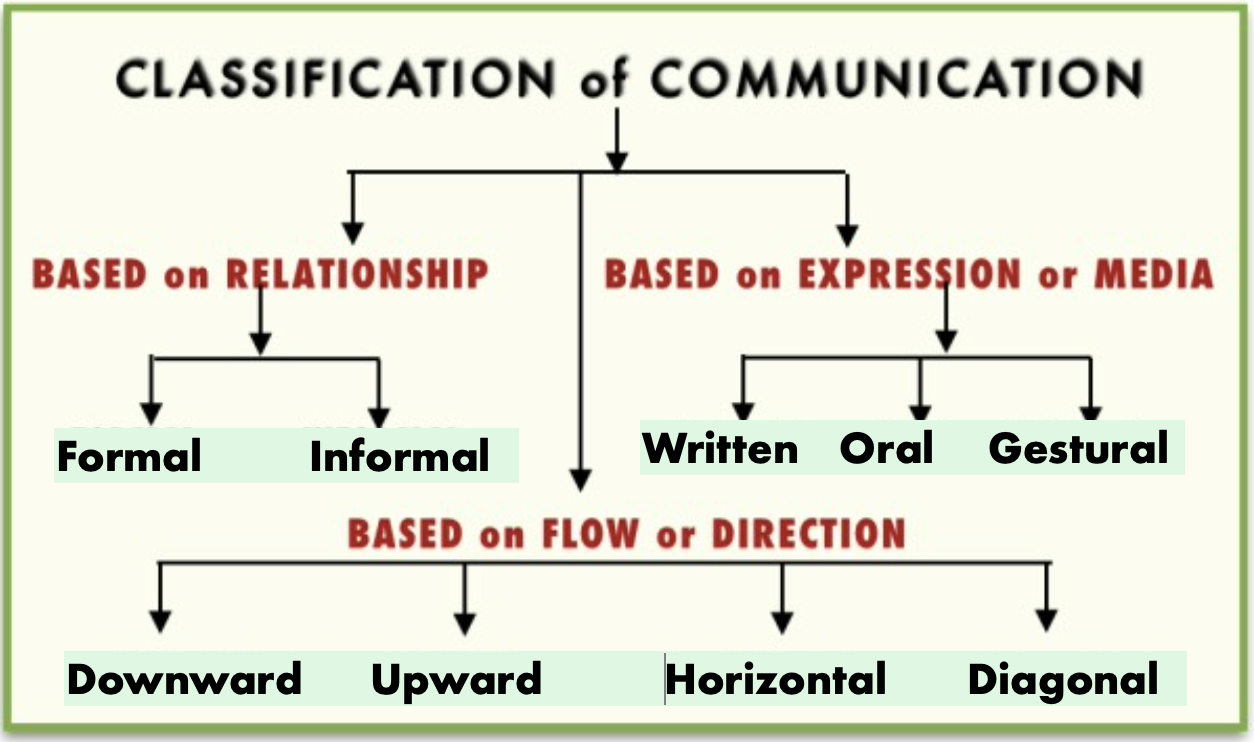 a. MEDIA – Written, oral & gestural. see Part 2
b. DIRECTION
• Vertical comm. – Info is passed between different levels of organizational hierarchy. Orders move down from the top through a formal chain of command, to the person or group who will carry them out. Responses (obedience) & collected info (research….) flow up to the top for review & decision-making
• Horizontal (lateral) – Comm. is between any two parts of the organization at the same level – between 2 people, divisions or departments – allowing a greater degree of informality. The purpose is to co-ordinate the activities of the various ‘units’
• Diagonal – Sharing info among different structural levels. This term was introduced to capture the new comm. challenges associated with new organizational forms, such as matrix & project-based businesses.
EXP: It’s when higher level management works with a lower level to tell them about a change in work/ goal objectives (we’re going to grandma’s instead of the mall)
c. RELATIONSHIP (channel)
i. FORMAL Networks
➤ CENTRALIZED
This is when one group member has access to more comm. channels than any other, & so tends to use more info than others in that group, sent out to others based on status & hierarchy. (Older sibling to younger)
EXP: The boss needs to deal with any negative grapevine comm., or employees will believe the rumors to be fact 
• Wheel – most centralized form, where all info flows from the leader, & other members have little or no comm. link with each other. Here, the boss deliberately controls comm., making sure their wishes reach everyone
• Chain (scalar): People comm. in a set sequence, via the line of command….. proceeding from A to B, B to C ….. or in reverse. This type is slow but carries the most authentic communication
➤ DECENTRALIZED
Here all group members have access to the same number of channels. Info is comm. by any person on the hierarchy scale & can be accessed by other employees. Research shows that decentralized networks or organizations perform better, & have more satisfied members (regular family group ‘conferences’)
 • Circle – Here the info is shared equally among all members. Each person gives & receives info from two or more others in the network
• Star – Comm. revolve around a central point. Each person in the outer branches of the star passes on a message to a central authority, who then distributes it to the other participants. A must for groups to promote teamwork, but can limit or inhibit ease of comm. between members
• Inverted “V” – Here subordinates are allowed to comm. with their immediate superior, as well as with that boss’s boss – but it’s effectiveness is limited
• Common (Free-flow / All-channel) – the most decentralized, where everyone is connected to each other, so info can flow freely from anywhere in the organization (a commune?)
ii. INFORMAL
Usually deals with interpersonal, horizontal comm. Traditionally it was considered a potential hindrance to effective performance, but that’s no longer true. However, leaders of modern organizations see it as an important way to ensure effective conduct in employees
Informal comm. is via the grapevine, represented by sociograms. These are important since they’re a large part of daily comm. Friendship, usage & efficiency are 3 important parts :
• Single strand
Info flows from one person to the next, until it reaches everyone ….. but generally a less reliable or accurate way to pass on the message. However, it can effectively for urgent / emergency news
• Gossip Chain
There’s usually a central person who looks for, finds & then passes on info to all other members directly (water cooler, lunchtime…..), often used when the topic is not job-related
• Probability Chain
Info passes randomly from persons to persons – when it’s interesting but not important
• Cluster Chain
The most common type – where a person who is the source of a message passes info to a pre-selected group, out of which a few individuals repeat it to other selected groups – until the whole network is covered, like a telephone tree.
NEXT: Comm #6
 HEAL & GROW for ACoAs