
I CAN CHANGE HOW I TALK
& also use it to own my True Self
PREVIOUS: Talk Types #5
REVIEW: Intro explanations 1-4
GROWTH for all Types
Everyone wants to be understood, yet in most cases both senders & receivers have built-in limitations they bring with them to any interaction, which includes their Enneagram Type.
• Listeners have ‘hearing distortions’ – prejudices in their way of thinking & feeling, that prevent receiving someone’s intended message
• Of course, Senders can distort their presentation, which interferes with how well they’re understood.
BOTH express themself from unconscious habits
√ Body Language: face, hand & body movements, voice & energy level…
√ Blind Spots : ways of acting & sounding we’re not ware of but others can be (clear throat, say ‘um’ all the time, don’t look others in the eyes…)
√ Filters : our own distorted listening, so our responses will be inaccurate, unhelpful, over-reactive ….
CORRECTIONS
We can start by asking trusted friends & co-workers what they think our communication style is. If possible – tape yourself giving a talk, or when just hanging out, & then listen to / watch it, alone or with others, to identify your patterns.
◆ Actively listen to yourself all the time (NOT critically) to identify tone of voice, & possible CDs (cognitive distortions).
When listening to others, paraphrase both the facts & emotions you hear from them, as a reality check on your accuracy
◆ Because most people tend to live in their head, improving your style of communication  can be helped by moving from most conscious to least conscious behaviors:
√ Observe & rework your Speaking Style —>
then notice your Body Language —>
then correct your Blind Spots —>
& clean up the Distorting Filters.
Once you’ve identified your bad (verbal) habits – review the Negatives of your EnneaType. Make a written list of them & periodically thru the day ask yourself: “Which action, belief or talk style did I just express – again?”
◆ Find a knowledgeable & trustworthy person as your ‘talk coach’ to give feedback & respectful suggestions for improvement.
SITE: Chomsky’s Theories on Language
MATCHING our Communication to others
In NLP-speak, the thinking patterns that influence our language & actions are called Meta-programs, the way we perceive & filter our experience of the world, rather than objective reality.
Our language patterns – the words we choose & the way we say them – are all expressions of our internal image & dialogue (emotions, beliefs & experiences), that add up to how we act & react to any current event.
◆ Some people use very ‘specific’ language (lots of words) when describing something, paying lots of attention to the details of a situation or location.
EXP: The dress was black, white & red, sleeveless, with a long skirt, a V neckline, buttons down the front…..
Others use ‘general’ terms, which convey an overview, with few words.
EXP: Her dress was sexy & brightly colored.
◆ Noam Chomsky found that most people modify & distort the information they’ve gathered – so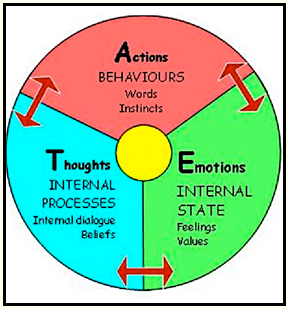 what gets passed on to others is only 1 or 2% of the original experience.
Roger Bailey’s “Words that Change Minds” LAB profile (Language And Behavior) shows how & why people make these transformation.
It teaches how to Listen, Reflect & Communicate effectively, developing the skill to match what we convey —> to another’s preferred way of receiving info, which then influences their response & behavior.
◆ No matter who we’re interacting with, but especially when dealing with someone who is psychologically unhealthy, matching has to do with understanding their thinking process & their language pattern, rather than being sucked into their negativity or falling into a fight.
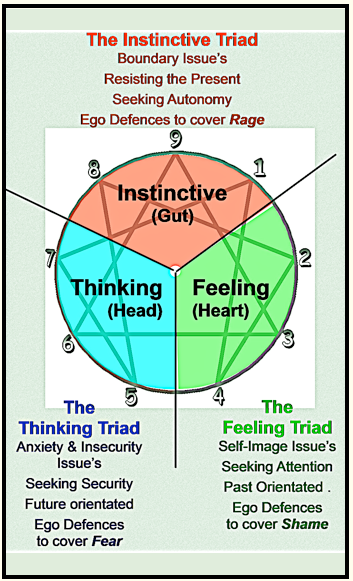 This can be done by taking careful note of someone’s TEAs ⬆️ – which follow the outline of the Enneagram’s main triads – as each has its own language peculiarities. Then we can use similar words & images to get our point across in a way the other person can ‘hear’ us. (Charts….)
EXP: Amy is a thin, blond, pretty AND fussy woman, very concerned with her image (a Leo & Ennea-type #3).
Her friend Elaine (fashion designer, F.I.T. graduate) is helping her look for fabric to make a new dress.
💜 Amy makes some inappropriate choices (for her physical type) & asks for an opinion.
🧡 Rather than saying those fabrics are ‘loud’, ugly or dowdy, Elaine says they are not elegant. Amy immediately moves toward a few that Elaine suggests. 🙂
NEXT: Language – GROWTH (#2)
 HEAL & GROW for ACoAs