
I GOTTA GET OUT’a HERE – but I’m stuck in YOUR mud!
PREVIOUS: B Distortion (#2)
The Family MOBILE
• All of us grew up as part of a larger generational inter-connected mobile – even if we were cut off from actually spending time with various relatives.
A mobile is a collection of objects that is in constant motion within a framework. A family is the most complicated, ever-changing one that exists, made up of human personalities.
The stability of a mobile depends on all the parts being in balance, in a specific relationship to all other parts. But balanced does not automatically m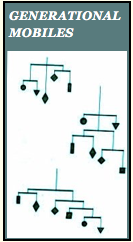 ean it’s beautiful, safe from falling apart, nor having lots room to move.
IN unhealthy families, everything may look fine on the outside, but the mobile is barely holding together, or is so rigid it can’t move at all. In the ARTICLE : “My 10-year-old says no one cares about him, and talks of suicide“ – the mother is shocked because she thinks everything is fine!
EXP: Addicts upset a mobile’s very delicate symmetry. Their unpredictability, violence, contempt & self-focus distorts much of the family’s interaction. To keep the mobile’s skewed ‘balance’ other members try to adapt by:
— absorbing the addicts anger, & suppressing their own
— denying the effect of the addict’s behavior on everyone in the family
— avoiding the addict, while trying to cover up the dis-ease to outsiders
—> forcing each one to become progressively more skewed to make up for the addict’s constant disruptions, causing long-term damaged & being co-dependently trapped in that state.
• Dysfunctional families are always crammed full of confusion &  chaos. But there are also rules that must be followed to keep the mobile from totally collapsing.
a. Equilibrium
On the one hand, no matter how distorted the mobile, each person has a part to play in keeping the status quo, called homeostasis. And just like an inanimate mobile returns to its normal state after being shaken up, so do families.
So if the addict goes into treatment to get clean & sober, their return to the family is often met with great resistance – & anger. They’ve changed too much – the role they originally played isn’t available, undermining the shape of the familiar structure, sending the whole setup tilting uncomfortably off its normal axis.
• If it’s the father – the most common way to regain the old balance is for the spouse, & even the kids – to manipulate the recovering person back into their original role by sabotaging their growth & getting them to drink or use again
• A better way would be to form a new mobile. But this is much harder, met with a lot of anger & may never work : every member of the family – still living at home – would have to face their own damage & make 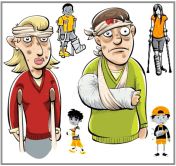 serious changes
EXP: Picture a broken arm that was never set professionally – it ‘heals’ crookedly & is only partially useful. To make it fully functional again it will have to be re-broken & set, then patiently wait for it to heal, maybe needing rehab & re-learning how to use it correctly!
It’s scary, painful & tedious. Broken lives & broken families are like that too, so people would rather keep to the twisted well-known ways than having to fix the problem in Recovery
b. Fragility
On the other hand, we learn how precarious the dysfunctional mobile actually is. Because members of a wounded family are bound by symbiotic needs rather than healthy egos – with self-hate, fear of abandonment & distorted boundaries – there’s little room for ‘error’ in the system (newness, difficulties, unexpected changes, expansion…). This mobile, with all its convoluted problems, has been jury- rigged, held together by Toxic Rules & Toxic Roles.
• While it appears solid & inflexible / rigid, it’s actually too fragile to withstand any major shift, such as one person becoming sober or another going into Al-Anon / ACoA Recovery.
Unless other members are also willing to grow & be supportive, like at least one of the adults doing some deep soul-searching…. the family unit will fall apart. This is particularly threatening when there are small children, so members will do almost anything to keep the (sick) status quo.
NEXT: DETACHING w/ Boundaries, #1
 HEAL & GROW for ACoAs