Attachment DYSFUNCTIONS (#2)

PREVIOUS : Attachment DYSFUNCTIONS (#1)


PERSONALITY DISORDERS & Attachment
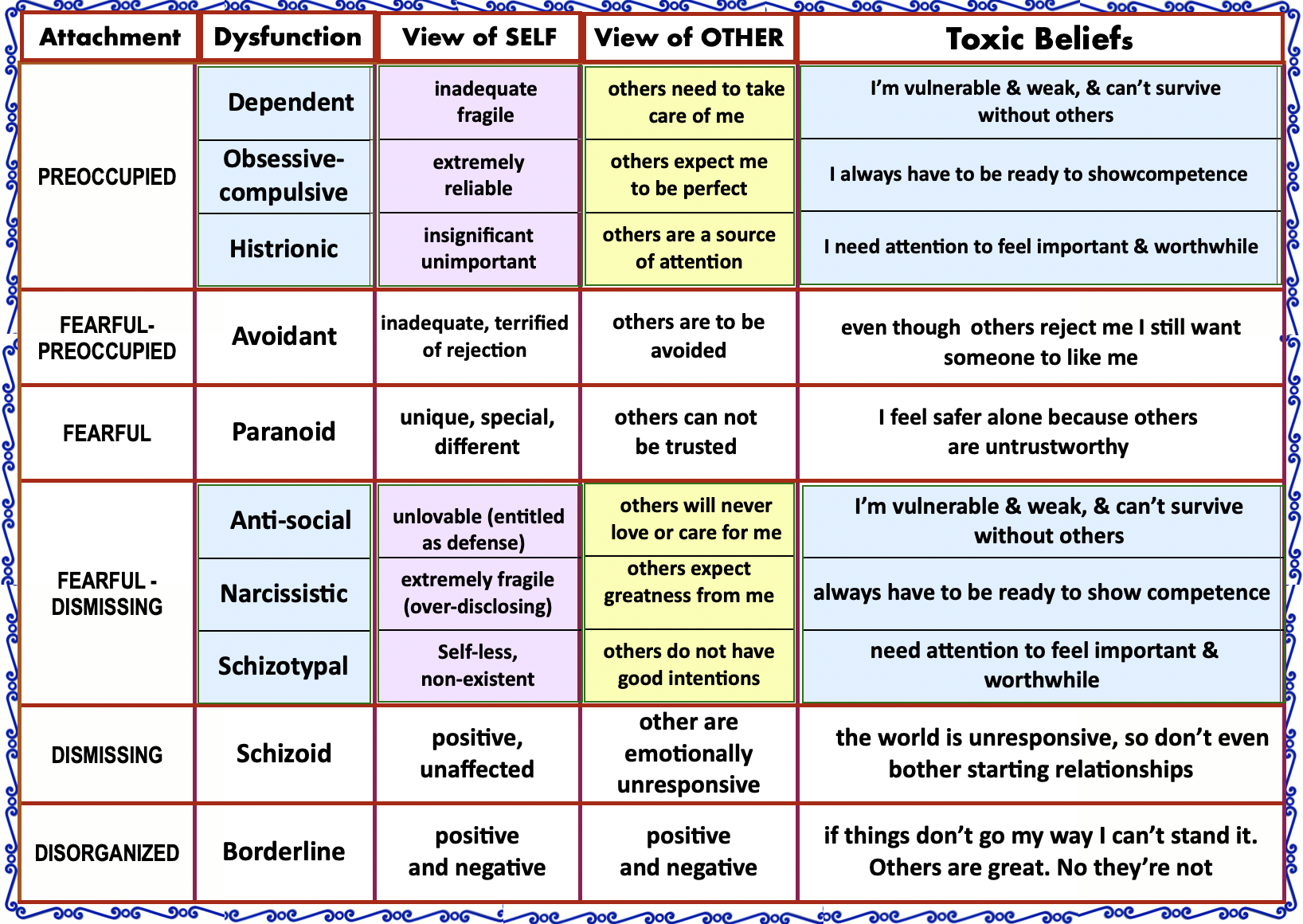
☂︎ Adults with a Preoccupied style, being anxious & more reactive to rejection, are prone to avoidant, borderline & dependent & histrionic PDs (personality disorders).

Based on a history of inconsistent parental support – they feel unsafe & wary, likely to be over-sensitized to possible environmental threats & therefore easily stressed.

☻ Conversely,
the hypo-activation of Dismissing attachment (desensitized) is associated with antisocial, narcissistic, paranoid & schizoid PDs.
Chronically lacking support from original attachment figures, Dismissives habitually deny or dismiss environmental threats, & have less ability to experience hard emotions or admit a need for connections.

☁︎ Most likely to have personality disorders, such as BPD,  are the Unresolved/ Disorganized individuals – the adult analog of disorganized/ disoriented infants – with abusive parents who had their own unresolved losses or abuse experiences. (MORE….)
 

«
ALCOHOLISM as an Attachment Disorder (POSTs….)
A study from Poland with 94 addicts & 94 non-addicts (pub 2014) showed that people with alcohol dependence significantly differ from non-alcoholics in terms of attachment style.
 
The ‘users’ had lower scores for Secure attachment, snd
higher scores for the Insecure types :
anxious-ambivalent & avoidant style – indicating mistrust in interpersonal relationships,  &
anxiety corresponding to fear of rejection & avoidance referring to avoidance of intimacy

This follows other studies which concluded that 66 to 95% of the alcoholics observed were identified as Insecure attached, while only 6 to 40% were Secure.  (See details & statistics….)

There is ample evidence that higher rates of substance dependence is found among emotionally wounded adults. Many alcoholics say they feel a “Hole in the Soul”, that something’s missing in their make up. Actually – all addictive behavior is an expression of the False Self, underpinned by Anxious attachment.

It’s about not having a clear sense of a positive identity. This ‘hole” is not a personality defect, but rather a lack of a safe Introject = feeling unloved by family. It comes with distorted thinking (S-H / CDs) & an inability to cope with overwhelming emotions accumulated from painful & dangerous childhood experiences.

Studies also note that addicts avoid being vulnerable, & are terrified of intimacy, more likely to show distrust & fear in relationships with loved ones.
Interestingly, the brain’s “love chemical” oxytocin – known for its role in bonding – is negatively linked to Insecure attachment, which affects all other neuro-chemicals involved in addiction.  Oxytocin is severely reduced by chronic alcohol use & stress reactions caused by fear-based attachment styles, which reduces the other chemicals as well.
😣 Active alcoholics try to replace them at the bottom of a bottle.  (Article : “Oxytocin could help treat alcohol addiction“)

Researchers from Hamburg, Germany (pub 2019) studied people with substance use disorders (SUDs).
Based on attachment theory, substance abuse can be considered “self-medication”, an attempt to compensate for missing Secure attachment strategies.
Longitudinal studies show that Insecure attachment is a risk factor for SUD, and continued substance abuse impairs the ability to form close relationships – which are needed to form Secure connections.

They also noted different patterns of attachment in different groups of users, suggesting different developmental pathways. EXP: — heroin addicts more often were Fearful–avoidant
— alcohol abusers could be more than one type
— SUD & insecure attachment was more strongly linked during adolescence than in adulthood
— Disorganized Attached people are at the highest risk for developing SUD (MORE….)
«

«
DOMESTIC VIOLENCE
Approximately 1 in 4 (24.3%) women have experienced severe physical violence by an intimate male partner. Compared to intimate partner violence (IPV) toward men, women experience more severe injuries & longer lasting symptoms such as PTSD, depression, & anxiety.  (Black, 2011)

In a study of 132 male partner abusers in Texas Researchers Lawson & Brossart (pub 2013) examined whether hostile dominant interpersonal problems (HDIP) plus antisocial & borderline features —> had an effect on the connection between anxiety or avoidance attachment styles and intimate partner violence (IPV).

They conducted a two path analysis, with Avoidant and Anxious attachment styles as predictors……. Both hypotheses were supported, but the Avoidant model provided the stronger evidence……. It showed that abusive partner men with predominantly avoidant attachment are most like to deal with domestic conflicts (HDIP) in coercive, controlling, & vengeful ways, using physical aggression toward a partner……
NOTE : In this study, the 2 PDs ⬇️ did not correlate with domestic violence.
«

«
NEXT : Attachment DYSFUNCTIONS (#2)
Attachment DYSFUNCTIONS (#1)

PREVIOUS :
Parent-Child – Insecure (4b)

⬅️ BOOK from Amazon UK

POST : Psychological Disorders (#2a):


Numerous studies have found that attachment anxiety & emotional dysregulation (out of control) are positively correlated (directly connected), which can contribute to maladaptive behaviors, such as  — various addictions, problem internet use, eating disorders, depression…..

Attachment disorder in adults usually starts in childhood, with symptoms that show up between 9 months & 5 years old.  Untreated they can affect everything from a person’s self-esteem to satisfaction in relationships. In fact, without available, consistent & responsive parenting, most children are vulnerable to developing attachment disorders.

When the primary attachment figure (Mom / caretaker) is unresponsive but also physically present, the distress that first makes a child hunger to connect slowly turns into doubting the possibility of attachment.  SO then secondary strategies are developed. EITHER:

👁️‍🗨️ Hyper-activation – If mom is sometimes responsive but unreliable, the child intensifies its efforts to force love & support from her

🔘 De-activation – In  this cases, mom disapproves of & punishes closeness, as well as any expressions of dependence & vulnerability. Need for closeness is suppressed, & the child tries to cope with dangers alone.

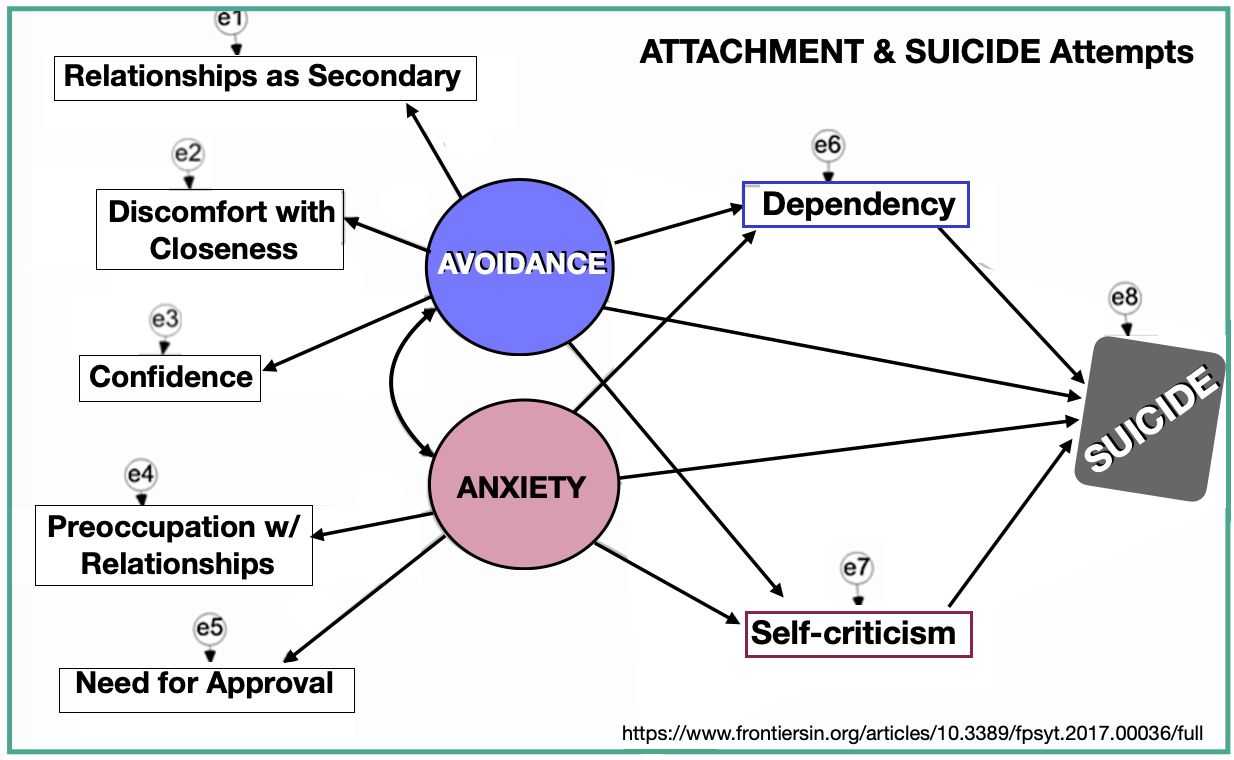
DEPRESSION & SUICIDE attempts based on Attachment deficits from RESEARCH studies in Italy (pub 2017).

MATURE personality is formed by an interweaving of two developmental goals, extended throughout life. In successful growth, individuals usually place more of an emphasis on one of these dimensions without ignoring the other :
a.Interpersonal relatedness (attachment, intimacy) —> which involves forming the capacity for mature, intimate, reciprocal & mutually satisfactory relationships
AND
b. Self-definition (identity, autonomy, achievement) —> which is about developing a realistic, differentiated & integrated identity of the Self (S & I).

Eearly disruption of the development process can result in a rigid, one-sided preoccupation with one style at the expense of the other. And the research suggests that the 2 main weaknesses resulting from an insecure attachment in childhood  — > Dependency OR Self-criticism <— create vulnerability to depression & suicidality in adolescents.

🔶  Normal : When Interpersonal Relatedness (a) is the choice, the focus is on a desire for harmonious, supportive & reciprocal relationships.
☀︎ Unhealthy : an over-emphasis on the need for connection is the basis of a pathological pattern labeled Dependent.  Such people are obsessed with and worried about having closeness, connections & bonding. They’re especially sensitive to separation, loss & abandonment – becoming depressed, feeling helpless & empty.

🔷 Normal : For those who emphasize Self-definition (b), the focus is mainly on individuation, achievements, & identity formation.
☀︎Unhealthy : an over-emphasis on this style is the basis of a pathological attitude labeled Self-criticism.
Especially concerned with perfectionism, these people obsess about experiences they identify as personal failures, leading to shame. 

Such highly self-critical types feel guilt & self-blame when they can’t reach their impossible standards, & are particularly prone to depression as a result of those ‘fat;ures’. They have a stronger suicidal intent (i.e., greater wish to die).   (Read whole study, URL above.)
«
 

«
ALSO, suicide gestures differ in the 2 groups, although the risk of suicide is similar for both.
Violato & Arato showed that Preoccupied and Disorganized attachment types were associated with suicidal behavior among adolescents in psychiatric treatment.
Also, Preoccupied and Dismissing attachment predicted suicidality among undergraduates with a history of suicide ideation or attempts

🔸 Dependents generally tend to act with impulsive gestures & attempts. Patients in the study likely made the suicide attempt as a response to an interpersonal stressor, their intention being to let someone / anyone know how distressed they were.

Researchers noted that adult participants with high Dependency scores used methods that made rescue more likely. Since developing Dependency is meant to ensure others’ availability & validation, dying would be the ultimate form of cutting close emotional ties, which they’re terrified of.

🔹 Self-critical types are generally less impulsive, more likely to plan acts of self-harm These patients’s suicide attempt was made in response to a personal or professional failure, their intention being to escape from the discrepancy between the actual event & their expectations. On the whole their attempt was rated as more lethal than the more dependent patients – ie. having a greater wish to die.
«

«
NEXT : Attachment DYSFUNCTIONS (#2)

ATTACHMENT : Parent-Child (#4b) INsecure

PREVIOUS : Parent-Child ATT, #2

SITEs: “Neurobiology of Attachment to Nurturing & Abusive Caregivers  (Scientific)  ✅ “Infant Attachment: What We Know Now

NOTE:
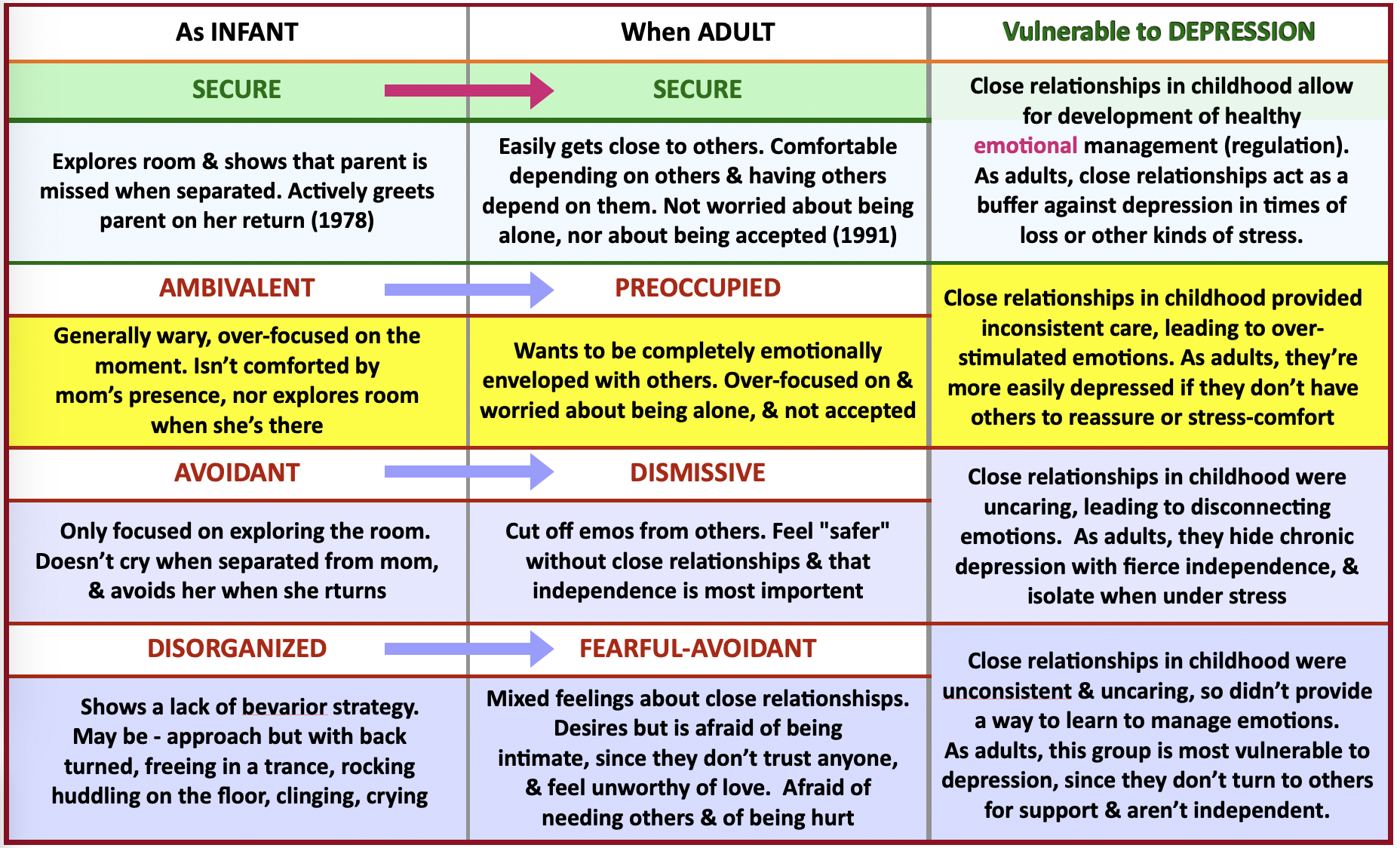
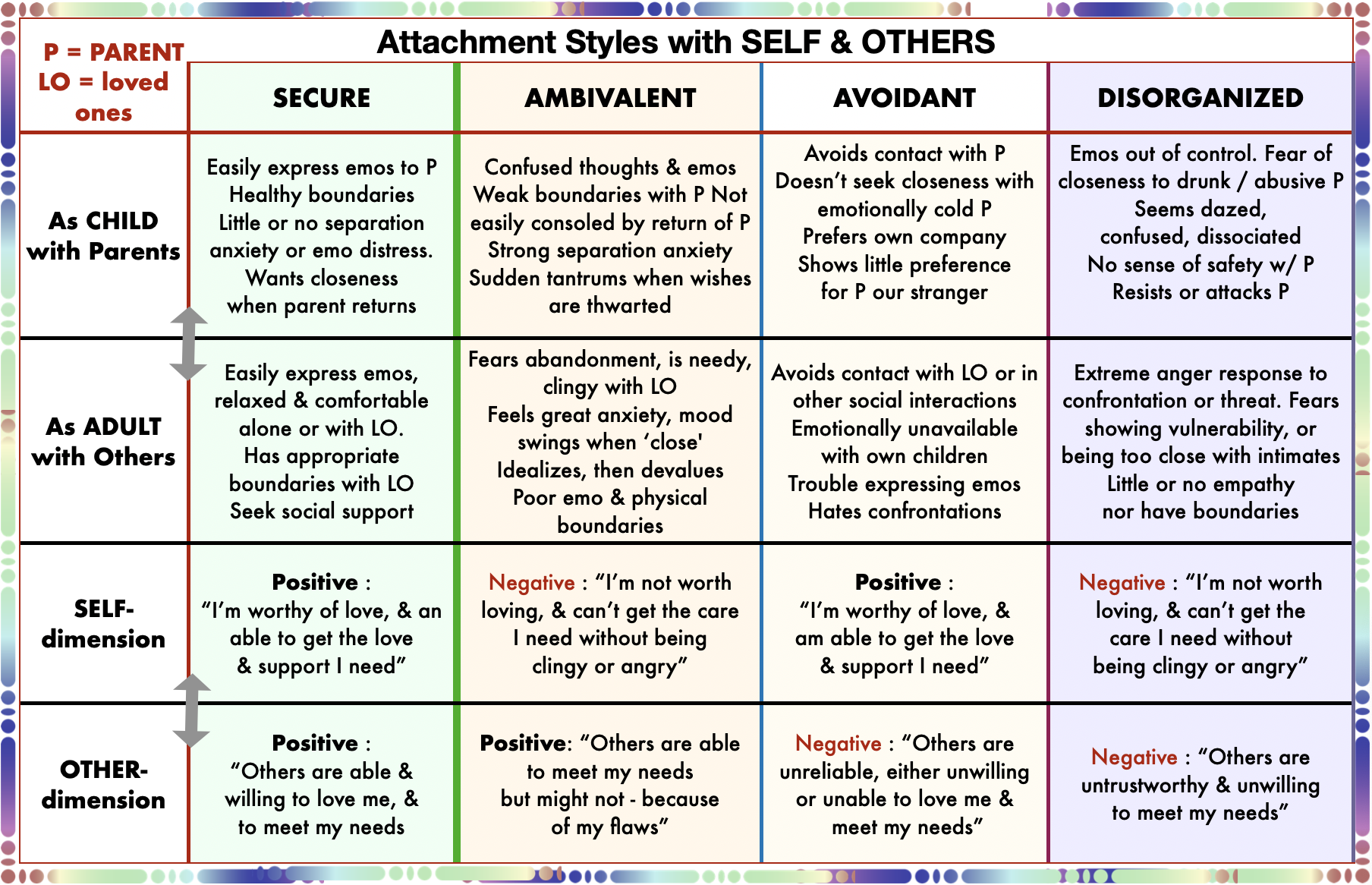
AMBIVALENT child will become PREOCCUPIED adult
AVOIDANT child will become DISMISSING adult

INSECURE Attachment develops when the mother continually FAILS to recognize when the child’s “attachment light” is on (arms reaching out, eye contact, crying, climbing on her, tugging….), OR deliberately ignores the signals . This is inevitably absorbed by the baby as a personal rejection.  

🖤 The mother who de-synchronizes with her child = produces serious damage to her child’s mental & emotional attachment circuitry.
This is PMES neglect, which creates immense distress in the child, the awful disconnect  emptiness is experienced as a “death”, forcing it ro make an intense effort to avoid the feeling of terror. Sadly, the “death state” corresponds to “rest states”, so the child avoids rest at all cost. – This is a common issue for ACoAs ! (See Parent-Child Part 2b Secure, scroll to Joy-building = mother signaling rest-time)

As time goes on, the agonizing pain of mis-aligned attachment is then covered up & disregarded as much as possible – with addictions & emotional dissociation. (Ignore it & it’ll go away or Run to keep ahead of the pain).
The insecurity caused by maternal rejection will continue to haunt the child into adulthood, going unchecked without Recovery & FoO work, so anything that resembles rest or relaxation will be avoided. (See “Toxic Rules“).


«
♨️ When
there is physical &/or emotional neglect, the baby will develop an insecure attachment (Avoidant, Anxious, or Disorganized). These styles are associated with persistent low self-esteem & relationship troubles – with a lack of trust, reluctance to commit, & all-encompassing fear of abandonment.

🚼 Avoidant-Insecure attachment (20-30% in low-risk ‘normal’ groups).  In the home, these parents were emotionally non-perceptive, unresponsive, unavailable & rejecting.

In the Strange Situation (SS – see Part 1), the mother was not available to the infants as a secure base from which it could explore its environment. When the mother started to leave the room, the infant might move toward her, but often did not. When she returned, the infant acted like she was not even there & just continued playing.

Some of these parents were responsive in non-emotional interactions, but very dismissive when the infant was emotionally needy, frustrated, or angry.  As a result, these babies often became clingy, demanding, & expressed random aggression.

√ The internal working model is likely, “Mom does not respond to my emotions, especially when I’m upset or angry, so I’ll shut down & try to become independent (not need her).”

The infants then protects itself from this ongoing terrifying environment by dissociating internally from their normal, legitimate need for connection, & generally repressing their emotions = a “de-activating” strategy.

🚼 Anxious-Ambivalent (insecure) attachment (5-15% of low risk samples)
In these homes, the mother was inconsistently available for the infant, & when she was paying some attention – she was often pre-occupied – so her responses to the infant were un-attuned or mis-aligned.

In the ‘SS’, while playing – the insecure infants were more alert to where the mother was. They were very upset when she left the room, immediately went to her when she came back, & became very clingy.
On reunion these children alternated between outbursts of anger & going limp, but either way they were not soothed by the presence of the mother, even if she seemed caring & emotionally available.

These infants respond with an “over-activated” attachment need, being the most anxious, needy & demanding at home.

√ The likely internal working model here is “Even if mom is available physically, she’s not warm & soothing.”

🚼 Disorganized-Insecure attachment (20-40% in non-clinical populations. And up to 80% from abusive homes)
These children often suffered physical &/or sexual abuse, with parents who were psychologically disturbed, &/or substance abusers. Inconsistent caregiving (come here-go away) became alternately a source of comfort & of fear

In the ‘SS’ scenario, these infants felt disoriented when the mother left the room. In response, they were not soothed even if they made physical contact when she returned .  The child’s behaviors were a confused mix – moving towards her, then away OR freezing & going into a corner

√ The inner working model is that the “supposed” source of soothing is also the source of danger – “fright without solution” – leaving the child’s mental & emotional state & behavior very confused.


NEXT : ATT

ATTACHMENT : Unhealthy PARENTING (#4a)

PREVIOUS : Parent-Child Types #2

SITE : ⬆️ “…Neuro-anatomical model of human Attachment

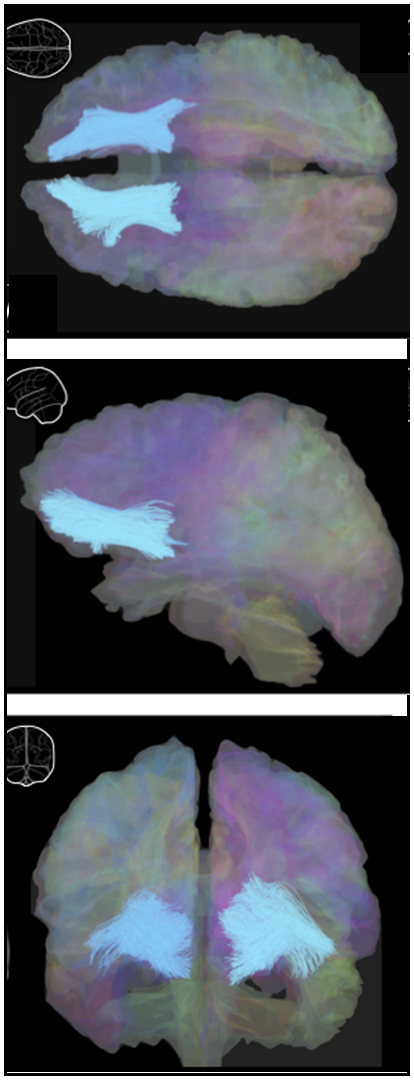
➡️ BRAIN IMAGING show some effects of early life adversity (ELA) re. white matter alterations. Nearly 40% of children in the US endure multiple forms of abuse & other stressors….

BAD PARENTING – see details for each

⬇️ 👥
💧 Uninvolved or Absent Parent or Poor Role Model

While an unavailable parent leaves a void about all the things a child needs for healthy development, a poor role model fills it with bad information to copy. Either way, the child will likely have immense hardships ahead on life’s journey.

💧 Lack of Respect for Feelings, Opinions, or Choices
Not respecting for your child’s feelings, opinions, or choices shows you have no faith in your child or their growing process. It is a selfish error. It says that their evolving ideas are not worth the time & effort to express them. This will create deep-seated issues that will be woven throughout the child’s life.

Children can only learn to express themself & find out who they are – by trial & error. So patient guidance can help them excel .  This will create deep-seated issues that may weave throughout the child’s life

⬇️ 👥
💧 Lack of Support, Encouragement, or Praise
This involves things like – not helping the child with homework, not encouraging them when they feel insecure, or not giving them praise when they’ve made an accomplishment. It may not seem like a big deal to a parent, but the negative baggage it creates for the child is significant.Belittling, Comparing, Criticizing, Demeaning, or Shaming
These cruel communications are used to push the child into conforming, behaving, or producing as the parent wishes.

Children listen. They follow their role models. Even the slightest murmur that diminishes a child’s identity or efforts can be detrimental, especially for a sensitive child.
˚
⬇️ 👥
💧  Over – or- Under-Reprimanding
Either styles is equally damaging, & they’ll carry these patterns into adulthood.Excessive scolding for making a mistake or poor judgment call is to signal that the child is only identified by the mistakes they make.
Under-reprimanding tells the child that their mistakes or poor judgment has no consequences, & so can go without guidance, direction, or correction.

💧 Publicly Shame or Discipline
Any open display of correcting a child in front of others is never a healthy option. It creates a victim mentality, making them vulnerable to being gullied, both as a child & later in adulthood.  Making the child a public scapegoat could eventually cost your child its life.
˚⬇️ 👥
💧 Lack of Rules, Structure, or Real Consequences
These adults are too lazy to enforce them, are too busy, or they simply have no interest in making the effort. Having little or no structure is chaotic, & is as bad as having overly complicated rules.

💧 Don’t Teach Respect for People or Animals
These adults are either not caring at all, or their own sense of entitlement is passed on to their kids.
EXP: loud, unruly, boundary-less kids running around a restaurant screaming & touching things they shouldn’t
˚
⬇️ 👥
💧 Physical, Emotional, or Psychological Abuses
No child should have to suffer through any kind of abuse. Unfortunately some forms are so subtle or passive that parents may not realize they are perpetrating it.
Long-term effects are often recycled, transferring the pain onto others who enter the child’s life

💧 Withholding Affection, Food, or Medical Care
This is only ever legitimate if a licensed medical doctor has ordered a temporary hold for medical reasons. Even with a ‘good’ reason, this can result in the child feeling they have to must go into survival mode to take care of themself.

Withholding affection is never legitimate or acceptable.

NEXT : Parent-Child INSECURE

ATTACHMENT : Parent-Child (#3) Temperament

PREVIOUS : ATT Adult-Child #1

SITE : “How to Understand Your Child’s Temperament

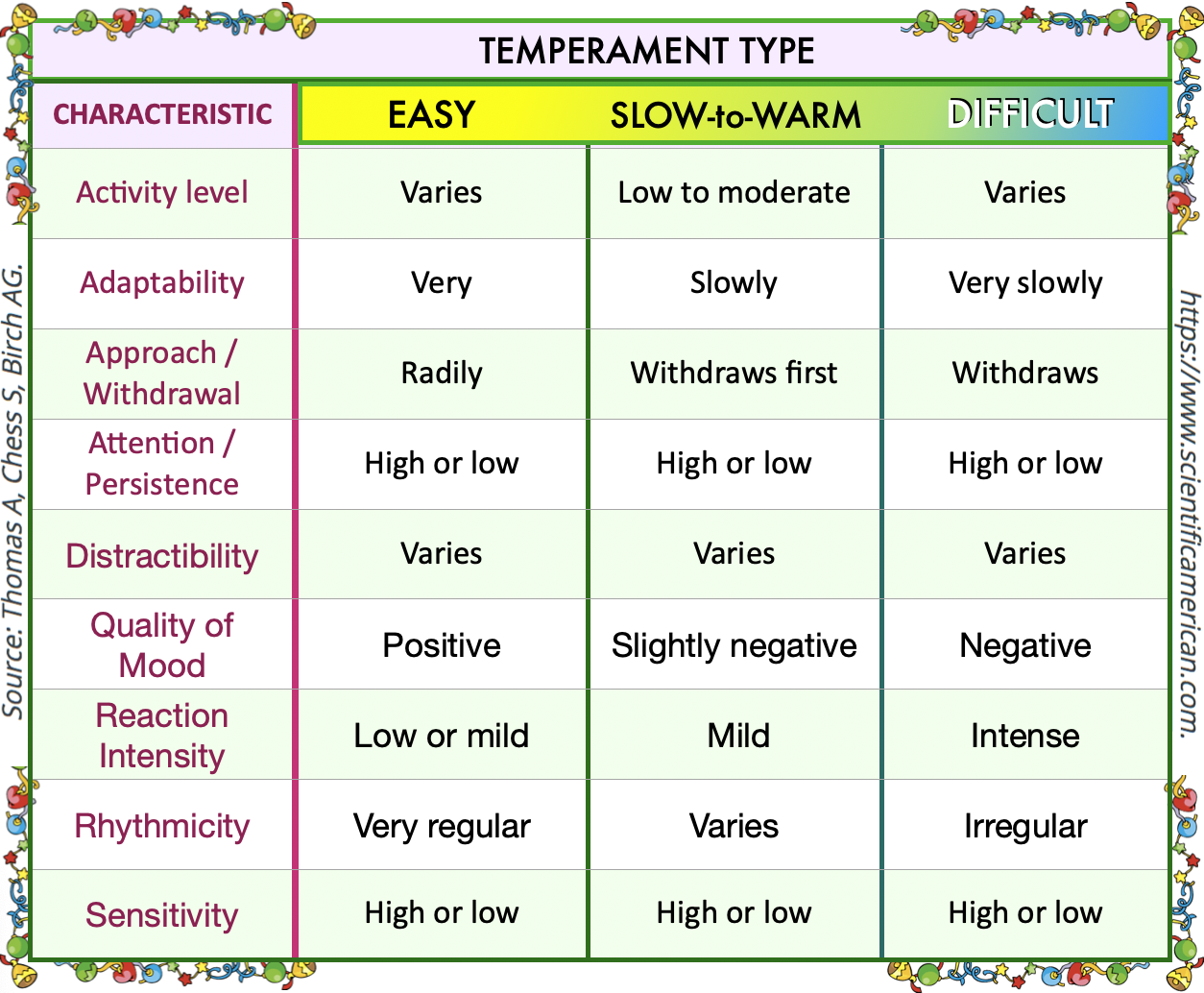
MAIN FACTORS for identifying different temperaments – HOW :
💠 strongly children react to people & events
💠 easily children approach new people or new situations
💠 well children can control their attention, emotions & behavior.

Temperament DIMENSIONS (Kristal, 2005)
☀︎ Activity – is a child’s general level of motor activity when awake & asleep
☀︎ Adaptability – how easily a child adjusts to changes & transitions

☀︎ Approach/withdrawal – the child’s initial response to new places, situations, or things
☀︎ Distractibility – the ease with which the child’s attention can be diverted by a variety of external stimuli, or conversely its level of concentration or focus.

☀︎ Intensity – the strength of the child’s expressive-reactions, such as happy, sad, angry….
☀︎ Mood – the basic quality of emotional state – more positive (happy, cheerful) or more negative (cranky or serious).

☀︎ Persistence – “stick-to-itiveness”, the ability to continue an activity when it’s difficult, or when faced with obstacles

☀︎ Rhythmicity – determines the predictability of bodily functions such as appetite, sleep/wake cycle & and elimination patterns
☀︎ Sensory threshold – the level of stimulation necessary to produce a response (See each one expanded)

Thomas & Chess also described 3 constellations of a child’s temperament that influence parent-child relationships & family life. (Also research at UCLA, Keogh, 2003).
♟ EASY – children are typically adaptable, mild or moderate in activity & intensity, positive in mood, & interested in new experiences.

♟ DIFFICULT – children tend to be intense, have low adaptability, & negative mood

♟ SLOW-to-WARM-UP — children upset by change, are generally ally-reluctant & withdrawn in new situations, shy with new people – although given time they adapt well

Children who are slow to adjust, ‘naturally’ shy or irritable – are likely to experience conflict with parents, & so receive less acceptance or encouragement which can make the child feel inadequate & unworthy.

If your child is highly active & so is the mothers, that’s a great match!  However, if she is a withdrawn type who likes to limit new experiences, but baby loves stimulation, they may end up with a conflict – if mom is not willing to adapt yourself a little.
However, the influence of children’s temperament or other attributes may be mitigated if parents adjust their caregiving behaviors to better fit the needs of the particular child.

How temperament influences family life (See ALSO…..)
Individual differences in temperament & behavior styles affect how family members interact. The ‘mix’ between them has a strong effect on family life, sometimes leading to positive interactions, sometimes to frustrations & then to conflicts

“Goodness of fit” refers to the matched or mismatched temperaments between a child & various family members.
EXP: A certain reaction – such as high activity, intensity & persistence – may be tolerated & valued in boys but not in girls.
Conversely, shyness & sensitivity may be viewed as acceptable in girls, but not in boys.

CHILDREN – Some adapt quickly & easily to family daily routines & get along well with siblings.
Others, especially highly active, intense or“prickly” ones have a harder time adjusting to everyday routines & expectations, so interactions with family members often lead to friction & upset. 

EXP: an impulsive child can bother an older sibling trying to finish a school project, or a distractible child, low in persistence, can frustrate parents’ efforts to get them to do homework or a household chore.

PARENTS also differ in temperament. Some are quick-reacting & intense, while others are quiet & slow to respond. Some are flexible & ‘fair’, others are rigid & perfectionistic.

AND they differ in the expectations they have about their children’s behavior, & how they view & tolerate differences in temperaments. If disruptive behavior is labeled as deliberate, parents are more likely to be irritated & angry, & easily responding with verbal & physical abuse.

EXP : A high-activity, intense child may upset & irritate a quiet, slow-paced, reflective parent.
An active, quick-responding parent may be impatient with a slow-to-warm-up child, who the parent may consider as lazy or indifferent. Or, sparks may fly when both parent & child are intense & quick reacting.

REFRAMING :  A parent’s response is affected by how they interpret the child’s behavior. When seen as temperament-related rather willful misbehavior, they can reduce their negative reactions.

EXP: The parent might see an active, energetic, approaching child who is into everything as “exuberant,” rather than as “hyper” & intrusive.
OR – see a shy & slow-to-warm-up child as “sensitive” & thoughtful, rather than as unfriendly or unmotivated. (From : Greatschools.org)

NEXT : ATT

ATTACHMENT : Parent-Child (#2b) Secure

PREVIOUS : ATTACHMENT – Parent – Child (#1)

SITE:  “Emotionally Intelligent Parenting”


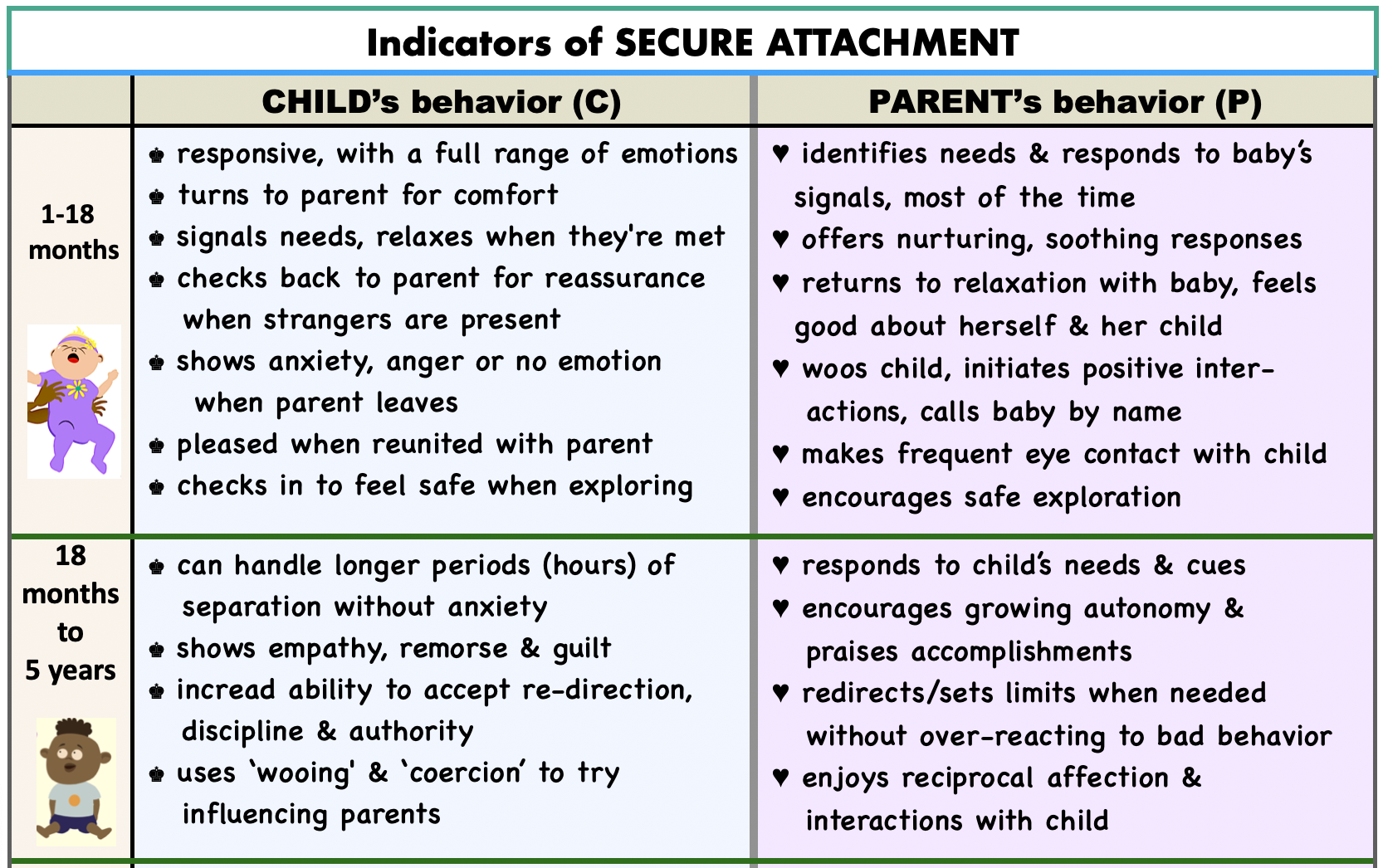
🚼 Secure attachment
  – 55-65% of ‘normals’ (non-clinical) samples.
In the home, these parents could understand / intuit the infant’s personality, & were able to accept & be available to provide baby’s physical & emotional needs

In the Strange Situation test (SS, see Info 1a) , the infants used the mom as a secure base from which to explore, very aware when she left the room, & protested the ‘loss’. When mother returned, the infant went straight to her to be held, was easily reassured, & then quickly returned to play.
In the home, these parents could understand / intuit the infant’s personality, & were able to accept & be available to provide baby’s physical & emotional needs.

√ The internal working model of these infants (mental image) incorporated these experiences. They assume they’ll be seen & heard, & helped t0 regulate their emotions, so they can safely explore their environment.

The 4 S’s of Secure Attachment
Children whose emotional & physical needs are consistently acknowledged & responded to appropriately – are most likely to form secure attachments, allowing them to become more resilient  & competent adults. When frightened, they’re comfortable seeking reassurance from safe caregivers.

1. SAFE
These parents provide the child with the sense that home is a haven, & make a commitment to not be a source of fear . This includes actively re-connecting after disagreements or an anger-flare up, & apologizing when the adult is mistaken or wrong.
Later on, being ‘safe’-as-kids means these Secures find it easier to openly express their emotions & needs, having developed trust in inter-personal relationships.

2. SEEN / KNOWN
“Seen” children know they’re acknowledged, because patents take the time to learn who they are & make an effort to understand when they’re going through something.

As adults, ‘seen’-as-kids people are more likely to form emotionally secure relationships. They feel comfortable being genuine, intimate, & vulnerable. Are less likely to develop codependence or anxious attachment style.

3. SOOTHED / COMFORTED
Soothed’ children are comforted at all times, not just when emotionally upset or  under stress. Caregivers help the child develop healthy coping strategies needed for the challenging times. The 5 main elements for this are “PEACE” : Presence /  Engagement /  Affection /  Calm /  Empathy
‘Soothed’-as-kids people become emotionally intelligent adults, who are better prepared to get thru difficult life-situations, can adapt to change, stay grounded, & offer support to others.

4. SECURE
These parents
cultivats security & trust with the child by consistently providing the other 3 S’s 🔼.
The Secure child can let their guard down, make mistakes, & voice opinions – without fear of punishment or rejection.  They’re encouraged to not be afraid of their emotions, by identifying, valuing & dealing with them, as well as as recognizing those in others.

“Secure”-as-kids people find it easy to appropriately trust others & be trustworthy themselves, being open & having empathy

Secure bonds provide an infant with a solid foundation to experience a wide range of motions = from most uncomfortable or painful and most comfortable & joyful ones. All states are important for the infant to safely experience them thru the mother’s capacity to ‘hold space’ for them – by her inner safely & personal strength. Gradually this allows the child to carry that ability internally, & so comfortably experience bonds with others.

Shared attunement is the alignment of emotional & mental states between mother & child, through facial expressions, tone of voice, body gestures, & eye contact.

Joy Building — Joy is produced when mom’s face lights up, expressing I’m delighted to be with you!   Joyful exchanges establish a secure bond with baby that will travel a lifetime.

❇️ As the child is ‘full enough’ of joy, mother will look aside. Breaking eye contact stops right hemispheric communication & says, ‘let’s rest!’ Healthy mothering understands the legitimate need for rest, & will respect the requirement. (See Parent-Child Part 4b Insecure, re “rest=death”)  SITE :  “How to really Rest

✳️ VALUED
Feeling valued needs to start in infancy, to develop healthy self-esteem. Loving parents repeatedly show their joy about who the child is rather than what the child does – on Being rather than Doing, but also express delight to the child about almost everything it does.  (POSTs : “Being Loved“)

VALUING children requires : (MORE on each)
🧡 Boundaries – for structure & control to know limits & feel safe
💛 Companionship – time spent alone with child builds closeness
💚 Conversation – for their sense of maturity & trust to ask for help
❤️ Expressed Love – they need to know they’re loved unconditionally
🤍 Respect –
appreciating the child’s mind, that they ‘make sense’
💜 Track record –
adults need to be consistent & dependable.
«

«
NEXT : Parent-Child ATT #3

ATTACHMENT : Healthy-er PARENTING (2a)

PREVIOUS : Unhealthy Parents

SITE: 23 Parenting Philosophies ….

4 POSTs : Parenting Styles”

PARENTING TIPS
Creating a healthy attachment in your children starts with understanding & facing how your own early attachment affects your current reactions to life, & correcting any problems. Do what’s best for your child, both with practical decisions & emotional ones.

❣️Let go of how your child “should” be & accept the child you have
❣️Develop compassion in the family by acknowledging & valuing the differences in personalities & preferences

❣️Give you kids the language of emotions by actively talking about how about how you, they & others are feeling. When reading a book with them, stop to reflect on how the characters might be feeling

❣️ Teach them from your experiences, & set a life example by being their role model
❣️You need to play multiple roles – parent, friend, mentor, counselor, friend, play companion….  to stay in tune with your child❣️Make sure that you correctly evaluate your decisions – so your children can trust you for all their needs & worries,  & feel safe to open up it you without hesitation

❣️Don’t let the differences between you & your spouse affect the bond with your child, as it can leave a bad impression on his / her emotional life

❣️ Realize that no one is perfect, so there’s always room for improvement. And with advancement in technologies, you need to keep up to date

❣️ Don’t hamper their private space & privacy. Even if they are children, they have their own life. It’s good to know what they’re doing, but it’s not advised to  constantly interfere

❣️Hold family meetings where each member can share what they think about what’s been happening, about upcoming plans, family schedules, major changes, painful events…..

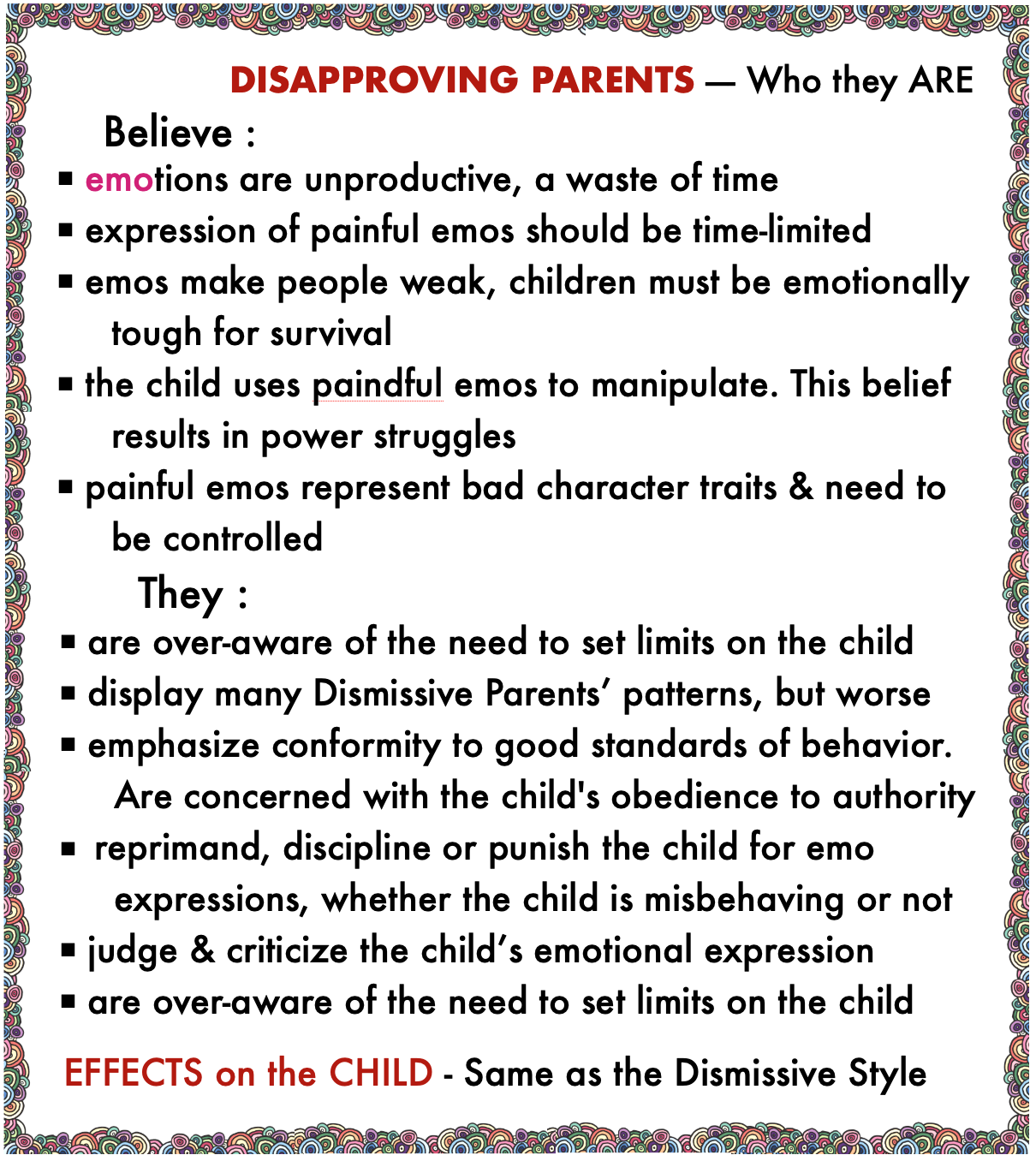
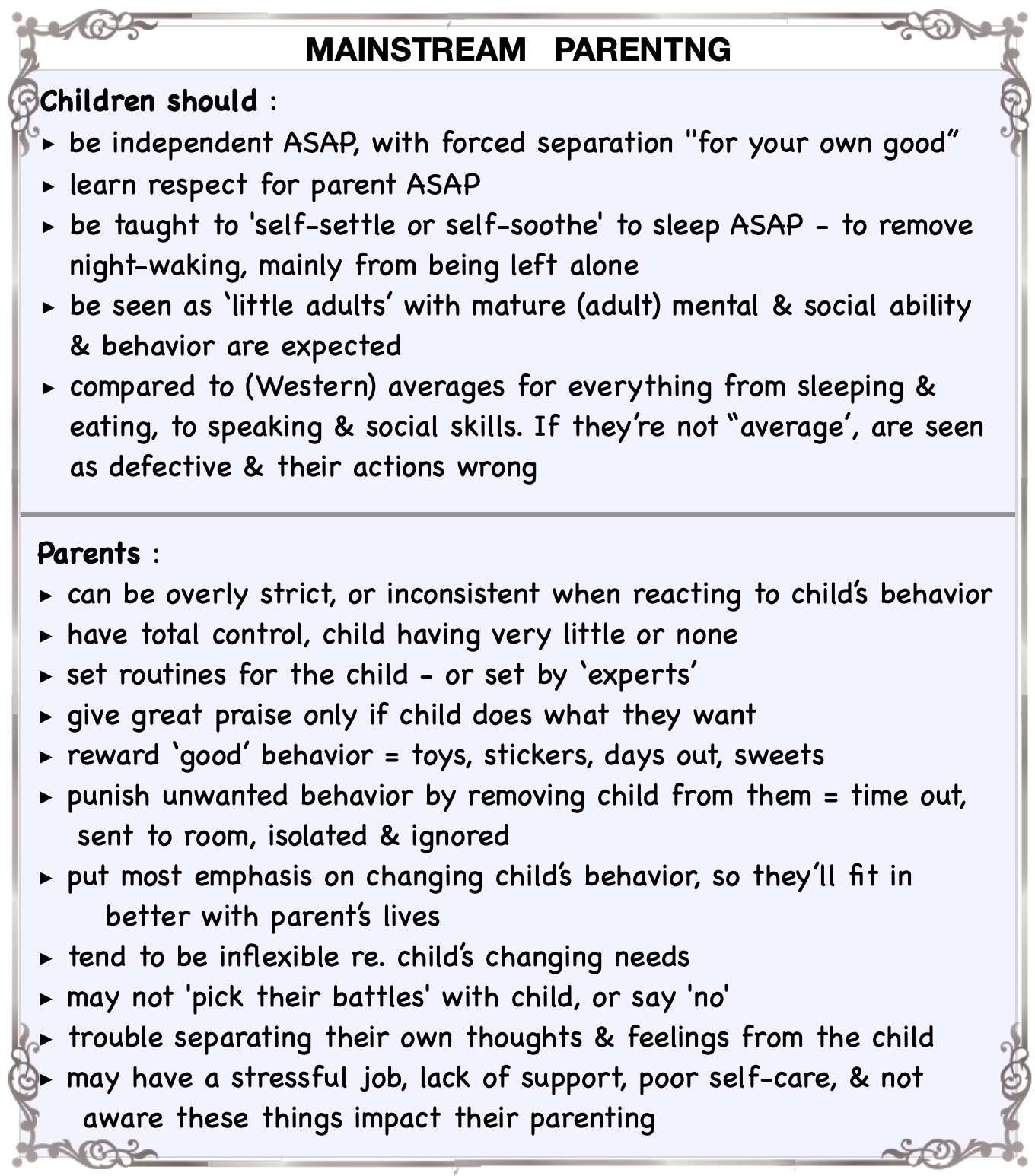
MAINSTREAM parents believe that children have the same capability for self control as adults – but without the same rights. To get children to behave the way they want, these parents use control & intimidation through punishments, spanking & yelling.  In this atmosphere, the complaint child will try to follow instructions slavishly, or another will become rebellious & eventually cut connections, directly or indirectly.

SITE: “Why Mainstream Parenting Risks Breaking our Children’s Spirit”
«

«
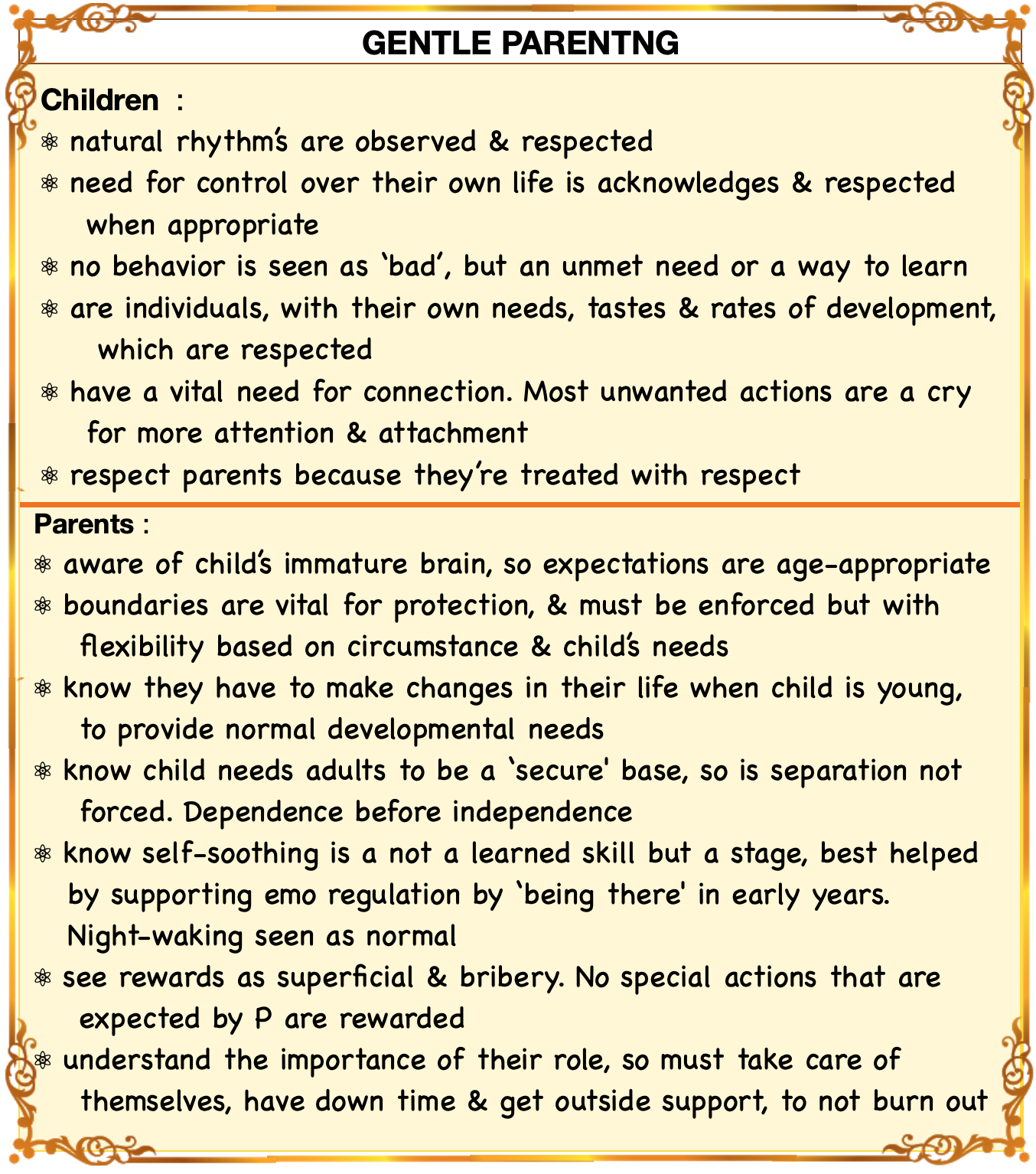
GENTLE Parenting is an evidence-based approach to raising happy, confident children – composed of Boundaries, Empathy, Respect & Understanding, It encourages the family to work together to teach the children to express their thoughts & emotions – in socially acceptable, age-appropriate ways. 

It focuses on developing positive qualities by being attuned & compassionate —-> while providing age-appropriate discipline, enforcing healthy standards & rules that will carry them thru life. Gentle parents behave around their children as a model for what they expect from the young ones. (Posts : “Personal Power ++


SECURE parenting style – includes emotional warmth, sensitivity, acceptance & their inter-personal accessibility. It paves the way for the child’s independence & secure adult relationships.
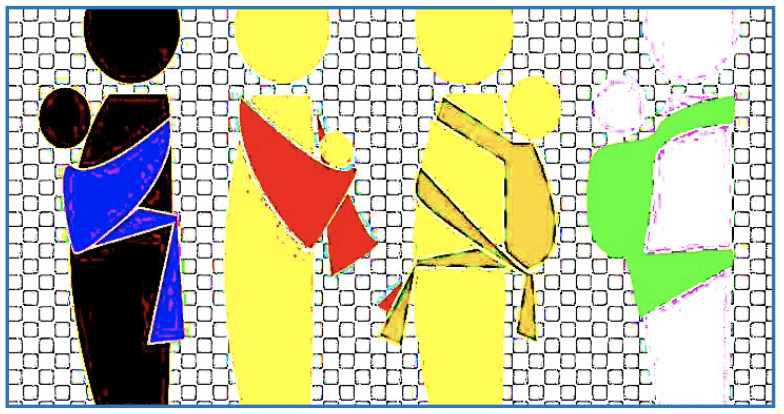
a. Attachment Parenting – promotes the bond between parent & baby through immediate bonding at birth (skin-to-skin for the first hour of life before any other medical procedures), breastfeeding, baby-wearing, co-sleeping (or another form), avoiding “training” baby, responding to their needs quickly…..

b. Gentle Parenting – is a long-term approach, intentionally looking towards the entire future of the child’s life, not just trying to make them more “tolerable” who doesn’t cry, complain, disobey…
T
he main emphasis is on kindness & respect, along with discipline strategies which consider & honor the child’s feelings. It does not endorse spanking, time out, rewards…. since these practices are considered unkind, disrespectful, & will not benefit the child in the long run.


🔺Don’t fulfill all their demands. Let them earn self-esteem once they’re able to do some things for themself. That way they can appreciate your sacrifices, & learn the value of money & hard work

🔺To love is to set free. You can guide them to the right path but do not control their footsteps. You can help, but let them choose for themself.

NEXT : P-C SECURE

ATTACHMENT : Parent-Child INFO (#1b)

PREVIOUS: Parent-Child Attachment – #1b

REMINDER  Based on the “Strange Situation”
🔹AVOIDANT child –
distracted by the environment & doesn’t want mother when she comes back <—-> becomes DISMISSING adult – who doesn’t open up emotionally to partner, & prefers to be on their own

🔸 AMBIVALENT (resistant) child –
who doesn’t interact with the environment much, & is very upset when mother leaves
<—-> becomes PREOCCUPIED adult – always afraid of rejection, obsessive about needing closeness
«
♥️ ATTUNEMENT vs DELAY in the Early Years
In his work with mothers & infants, John Bowlby challenged the idea of a ‘perfect mother’.  While a mother needs to be emotionally available to her infant, with two-way communication being built up —–> an equally important part of her role is to allow the infant to experience tolerable frustrations.

This can lead to a healthy development of independence & sense of Self. Bowlby said that a mother was not doing the best for her child if her aim was to immediately alleviate all distress, discomfort & frustration.  (Winnicott, 1965).

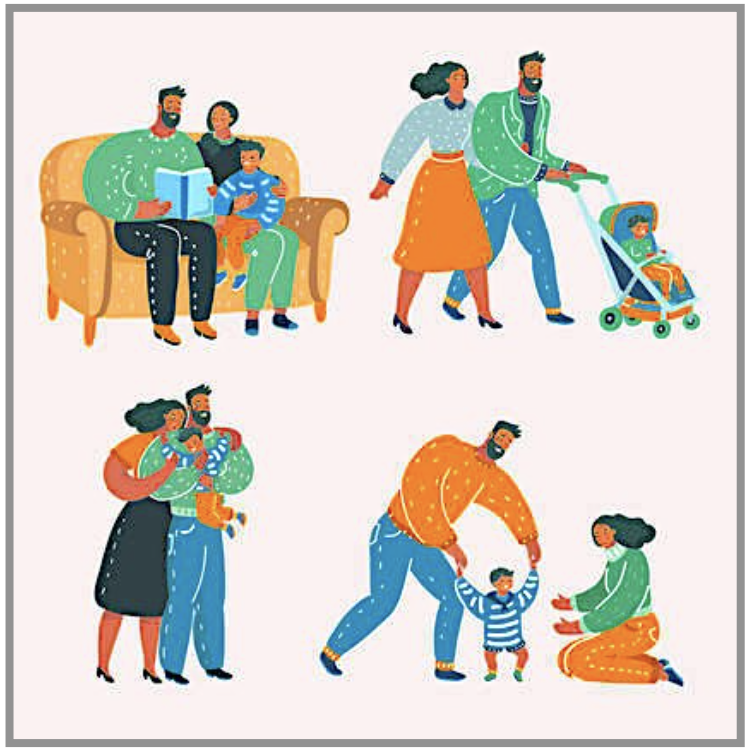
♥️ MOTHER – CHILD interactions

«
♥️ INDEPENDENCE through SCAFFOLDING
For a slightly older child = when an age-appropriate task gets tough, he/she will pleadingly ask you the parent / caretaker, melting your heart in a second – moving you to do the task for them.
No matter what prompted you to do that, the result is – the child’s independence is hampered.

The best way to handle the situation is through scaffolding. Provide just enough support for the child to complete the task on their own.
GIVE clear directions, reduce confusion, understand “zone of proximal development”**, and encourage the child to finish.
Soon they’ll develop the pleasure of doing the activity, not just focusing on results.
** “…. the space between what a learner can do without assistance & what they can do with adult guidance or in collaboration with more capable peers”
This lays the foundation for strong social & emotional skills that will serve them for the rest of life. An independently functioning child is also more stable in groups, interacting well with peers – because of a high level of confidence.
«
♥️ DISTURBATION of Attachment

«
♥️ GOOD vs BAD PARENT

«
♥️ Maternal COMMENTS
A UK study was made to test the links between attuned & non-attuned comments made by mothers – to see the effect on their infants’ mental states.  In a study of 206 mothers with their infants, these two types of comments showed marked differences on attachment security. (York U. Meins et al., 2012, ).

RESULTS :
☀︎ attuned comments = secure infant attachment
☀︎non-attuned comments = less secure attachment.
And a very high proportions of non-attuned expressions predict Resistant attachment, more than Avoidant.
«
♥️ Infant Attachment and SECURE BASE Provision
The Secure Base model is drawn from attachment theory, adapted to include an additional element, ‘family membership’, for children who are separated from their birth families. It provides a way for the infant to learn about a caregiver’s availability to serve as a secure base  — both when it needs comforting AND when it’s focused on exploring
(See Att. Dysfunctions #3 post)

«
The 5 dimensions of caregiving ⬆️ are each associated with a corresponding developmental benefit for the child. When the dimensions overlap & combine they create a secure base.
EXP:  A caregiver playing with a child in a focused, child-led way will be doing so with Sensitivity & Acceptance —> as well as demonstrating availability & promoting co-operation.

Both Sensitivity & Secure Base Provision (SBP) look at how caregivers perceive, interpret & appropriately respond to infant signals, Also, in both important infant signals occur at each end of the attachment-exploration continuum.
But SBP looks only at certain key infant signals & specific caregiver responses. It also focuses much less on prompt responses and more on crying resolution  – the ratio of infant crying episodes that end in chest-to-chest soothing until the infant is fully calmed, regardless of promptness. (MORE…..explanation)
«
♥️ OBJECT RELATIONS

«
♥️ CHANGING Parent-Child Relationship
In a large national study of Canadian families, interviews revealed that typically warm relationships between parents & preschoolers changed (diminished) as children became older. (Statistics Canada, 1999)
«
♥️ INTER-RELATING

«
NEXT : Healthy-er PARENTS

ATTACHMENT : Parent-Child INFO (#1a)

PREVIOUS:
SECURE Att. #2

SITEs :  “Children’s early social & emotional experiences matter”

◆  Parent-child Interactions Affect Social & Emotional  Development 


SOURCE of SECURE Attachment

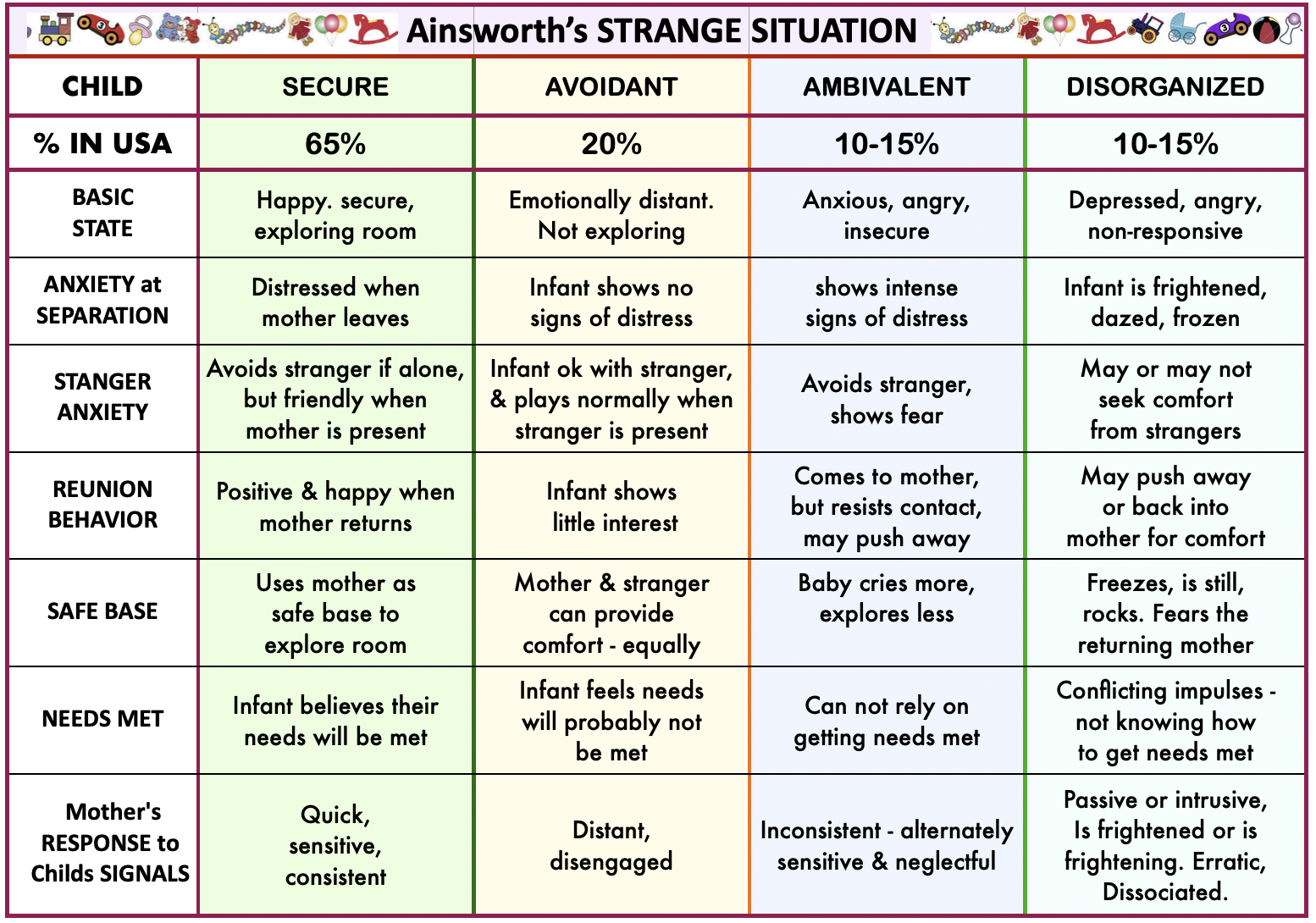
A strong Secure attachment bond develops when mom synchronizes with her baby from the very beginning – by regularly being sensitive to her baby’s need-signals & providing comfort & quiet. (See charts at bottom of post)

Synchronization involves reciprocated mother-child rhythms, matching their mental states & energy levels, alternating between periods of arousal & rest. Attunement is expressed through facial expressions, tone of voice, body gestures, & eye contact.

Healthy mothers synchronize to baby, while unhealthy mothers insist on getting baby synchronized to her own needs. The mother who de-synchronizes with her child seriously damages her child’s attachment circuit.

In a stable, loving home, the child intuitively knows it can use the caregiver as a safe base for exploration. Baby shows appropriate distress when the adult leaves, & is comforted when mom returns, which allows it to feel safe enough to then return to exploring its immediate environment. It may be comforted by a stranger, but shows a clear preference for the parent.

NOTE : There’s NO such thing as perfect parenting!
John Bowlby coined the term ‘good-enough mother’ who allows just the right amount of delay in meeting an infant’s needs  —-> to encourage both tolerance of waiting AND confidence in ultimate satisfaction – not as deprivation or from neglect!
Studies confirmed his work,  that – to have a positive impact on a baby – caregivers need only ‘get it right’ 50% of the time when responding to the child’s need for attachment. (Lehigh U. in PA, USA 2019)
Because children don’t have fully a developed persona, skills & self-esteem, it is important that the adults in their world actively work to increase their confidence. When kids feel valued, loved, heard, and respected, a positive identity develops based on being treated this way. Most children basically want to have a place in the world, and in the lives of those they love.

⬆️ The STRANGE SITUATION (SS) “Normal”
Psychologist Mary Ainsworth (1978) created an experiment in 5 stages to assess the quality of an infant’s attachment to their mother, designed to present children with an unfamiliar, but not overwhelmingly frightening experience
«

«
DEVELOPMENTAL STAGES
In a longitudinal study with 60 infants, researchers Schaffer & Emerson (Glasgow, Scotland) analyzed the types of attachment-relationships infants formed.
Children were observed every 4 weeks in their first 12 months, then again at 18 months.

In NORMAL Circumstances :
1) Asocial stage – usually the first 6 weeks after birth. Newborns tend not to discriminate between people, but do have a preference for humans over non-humans.
The infant’s signals, such as crying or fussing, naturally attract the attention of a caregiver, & the baby’s positive responses encourage the adults to stay close

NOTE : Baby’s EYES & Attachment –  Newborns can focus their eyes 7-12 in., just the right distance to make eye contact with mom when being held. This is a basic form of communication for attachment. The infant gazes into mother’s eyesreceiving powerful messages about her emotions & involvement, which influences the baby’s feelings of safety & security…..

2) Indiscriminate stage – from 6 weeks to 6 months. Infants are able to develop trust that the caregiver will respond to their needs. While they still accept care from others, they start distinguishing between familiar & unfamiliar people, responding more positively to the main one, & don’t yet show an aversion to strangers.

3) Specific Attachment– from 7 to 11 months. Babies show a strong attachment & preference for one specific adult & have separation anxiety when apart from this person (usually a parent). Babies also begin to have a fear of strangers at this stage.

4) Multiple Attachments – from around 10-11 months babies are already forming strong emotional bonds with other caregivers, showing an increased interest in father, older siblings, grandparents, friends, & other familiar adults.
«

«
NEXT
: Parent-child Att. #2

SECURE Attachment Style (Part 2)

PREVIOUS : Secure #1

SITE : Cartoon Videos from Circle of Security International


CHARACTERISTICS (cont)

♥️ “SECURES” – Socially THEY

= expect to be loved, trusting that support will be available. They form attachment-bonds more readily, are more successful at making friends & picking appropriate partners with longer & happier marriages

= have appropriate independent & dependent responses & inter- actions in relationships, neither desperately seeking nor avoiding connections

= are comfortable with closeness. Want the person they care about to be integrated into their life, with an exchange of family & friends on both sides – if possible
THEY
= love unconditionally & empathize completely. When the partner becomes part of their inner circle, they’re treated with love & respect (like “royalty”)

= freely & clearly communicate feelings to their partner. If they say something insensitive or harsh when under stress, they own it & apologize as soon as possible

= know their taste & will be clear – showing interest if interested, or decline to continue if not

= they tell their partner what they want, AND freely offer what they have to give, once a relationship is stable
THEY
= can speak freely about feelings & old experiences (memories), clearly explaining how they feel now or felt in the past 

= value their partner understanding who they are & accepting how they became that way 

= are confident in their positive beliefs about themself & others, therefore secure in their ability to bringing value to the relationship

= are appropriately concerned for their partner’s well-being, responsive to others’ needs – expecting others to be that way in
return

= enjoy sex, tending to view sex & emotional intimacy as one, not   needing to create distance by separating the two. They don’t misuse sex as an addiction to suppress emotions

= prefer sexual activity in a committed romantic relationship. Enjoy touching to express closeness, & positive sexual experimentingSECURES – DO NOT:
= have the fears & preoccupations (obsessions) of the other types
= numb out their emotional pain.
= afraid to ask for the truth, even when that truth might hurt. It’s the power of vulnerability

= play psychological games – withhold or manipulate to get what they want – because they want closeness & believe others want the same
DO NOT:
= get overwhelmed by a fear of being slighted (like Anxious) nor fear of engulfment (like Avoidants), so don’t struggle with envy or jealousy

= try to keep others from knowing them, nor live a compartmentalized life where others are not welcome in some settings (family, work, relaxation….)

= put up barriers or constantly talk of “boundaries” as a way to distance themself emotionally. “Secure” don’t mean ‘cool’
DO NOT:
= pile up secret stores of resentments their SO (significant other) will never be told about directly

= hold grudges—someone who is honestly angry at you for a good reason communicates their distress in a healthy way

NOTEIf the secure adults had an unhappy upbringing, they now understand the effect those painful experiences have had on them. They’ve also given up the ROLE of victim, having worked through enough of the trauma to speak about it without crashing

re. being with or being a secure partner – one great thing is that they have the power to lift up someone with an anxious or avoidant style to develop personal satisfaction & smoother inter-relating

♥️ How did some people become “Secures”?
= some children not born with a naturally secure disposition, achieve it by the attention of responsive but not overbearing parents within a relatively happy, stable family

BUT, with a less-than-ideal early life , some
= seem to be naturally resilient, & will find enough other nurturing role-models to overcome bad parenting

 = yet others grow into an adult Secure – out of an unsafe beginning – through therapy, along with Secure friends & a stable significant relationship with a Secure partner  (More….)

TEENS : those who can talk coherently & thoughtfully about their experiences with their parents —
= are better able to handle conflicts with both parents
= are more assertive, but also able to ‘hear’ their parents’ point of view
= less likely to act out dysfunctional, critical anger
= make an easier transition to college
= have fewer one-night stands, with more positive emotions during sexual activity

NEXT : Parent-Child, Part 1