
PREVIOUS : Food (#1)
SITE : access FREE
amazing worksheets in “Transforming the Living Legacy of Trauma”
RESOURCE : HELP LINE – National Eating Disorders Association
BOOK : “Attachment, Relationships & Food – From Cradle to Kitchen
Personal FACTORS
Some influences that contribute to a person’s food choices include individual characteristics such as = attitudes, beliefs & knowledge about food, ethnicity, taste preference & special diet requirements.
In the US – the order of importance has been reported as : taste, cost, nutrition, convenience & weight concerns.
In contrast, information compiled from 15 European member states listed theirs as : quality/freshness = 74%, price = 43%, taste = 38%, ‘trying to eat healthy’= 32% and ‘what my family wants to eat’= 29%.
Other determinants :
Biological = health status, hunger level, appetite, taste buds
Economic = availability, cost, personal income
Physical = access, education, cooking skills, time
Psychological = guilt / shame, moods, stress
Social = culture, family, peers & meal patterns. (More…. expanded)
PSYCHOLOGICAL Reasons INSECURE Attachers DEVELOP an ED
😱 Emotional dysregulation
Insecures tend to have a hard time regulating (coping with) painful emotions.
Strongly Avoidant people suppress or deny feelings, while very Anxious are ‘high strung’, with hyper-intense emotions (not the the same as being a “Sensitive”).
Insecurely attached people may try to lessen their inner turmoil by activities like dieting to get the “perfect” body, binge eating to improve their mood, or purging to avoid gaining weight. These are forms of escapism, but of course – it doesn’t work. The vicious cycle gets re-activated every time Insecures face any kind of upset. (“Window of tolerance” scroll down)
Without Recovery, they naturally use unhealthy strategies that try to sidestep those feelings – instead of learning how to manage anxiety & anger safely & maturely.
 😇 Perfectionism
In general, Insecure attachers are prone to perfectionism (especially Anorectics), in the form of self-criticism, based on believing the toxic family rules they grew up with. They hope to be accepted & approved of by family, mates & friends, if only they could reach their “perfect” image.
Some Insecures will develop an ideal aesthetic standard, such as unrealistic thinness or perfect musculature. So an unhealthy eating pattern may let them feel like they’re doing something to ‘fix’ physical flaws.
A 2023 study examining the connection between attachment to parents & friends and adolescents with ED, showed that trouble with trust, communication & alienation correlated with their body dissatisfaction. 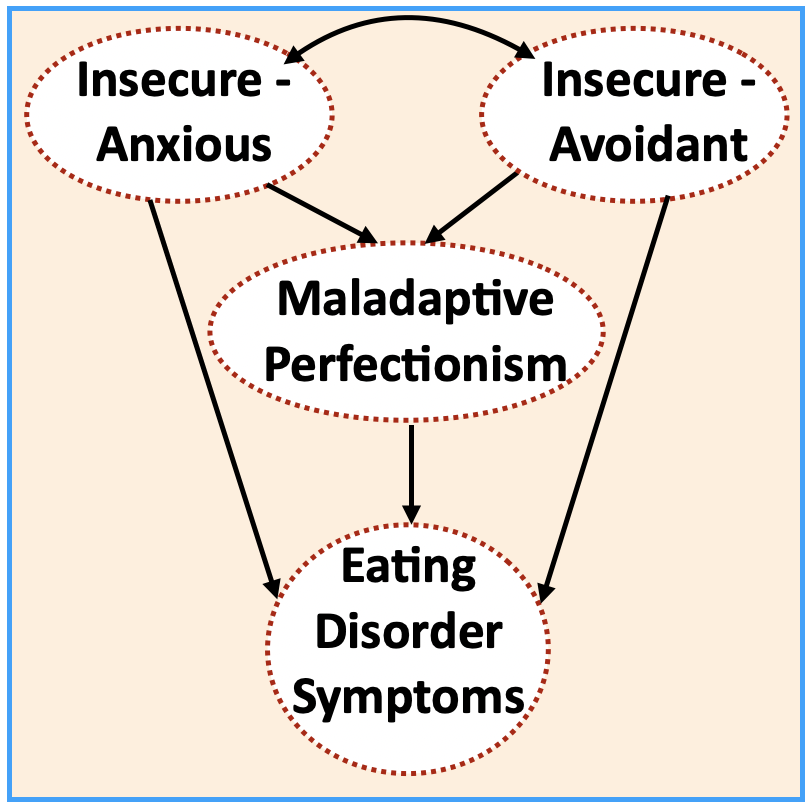
NOTE: Adaptive perfectionism includes high but achievable standards for oneself, a preference for organization & order, a feeling of satisfaction & effectiveness when tasks are completed.
Maladaptive perfectionism involves unrealistically high standards with critical self-evaluation (debilitating self-doubt about actions, intense obsession over mistakes, & feeling like a failure due to them (More….)
🥸 Inaccurate self-beliefs
Related to self-criticism, Insecures come to false conclusions about themself because of how poorly their needs were met in childhood, such as thinking they’re “worthless, less-than, unlovable” . One symptom is obsessively comparing themselves to others they see as “better.”
Not getting the right kind of parental mirroring as kids, they’re not able to see their body and Self accurately. Always coming up short, the negative comparisons keep eroding their self-image, which can encourage & promote disordered eating, in the delusion they’ll feel better about themself.
😎 Lack of Mindfulness
 Generally, people with Insecure attachment styles are less awake in the present moment, not aware of what they’re thinking & feeling. In terms of T.E.A., they tend to worry (E), obsess (T) & over-focus on a distracting activity such as tv & social media. (A). There are also pockets of dissociation in one or more areas of their life, numb to their needs & self-care.
Most defense mechanisms take the person out of the present – they’re either in the past (ïf only”) or in the future (:what if”). Not paying attention to ‘where they are’ throughout the day can strongly affect some peoples’ ability to recognize physical hunger or fullness, or accept their weight & body shape – especially relevant in bulimia & binge eating.
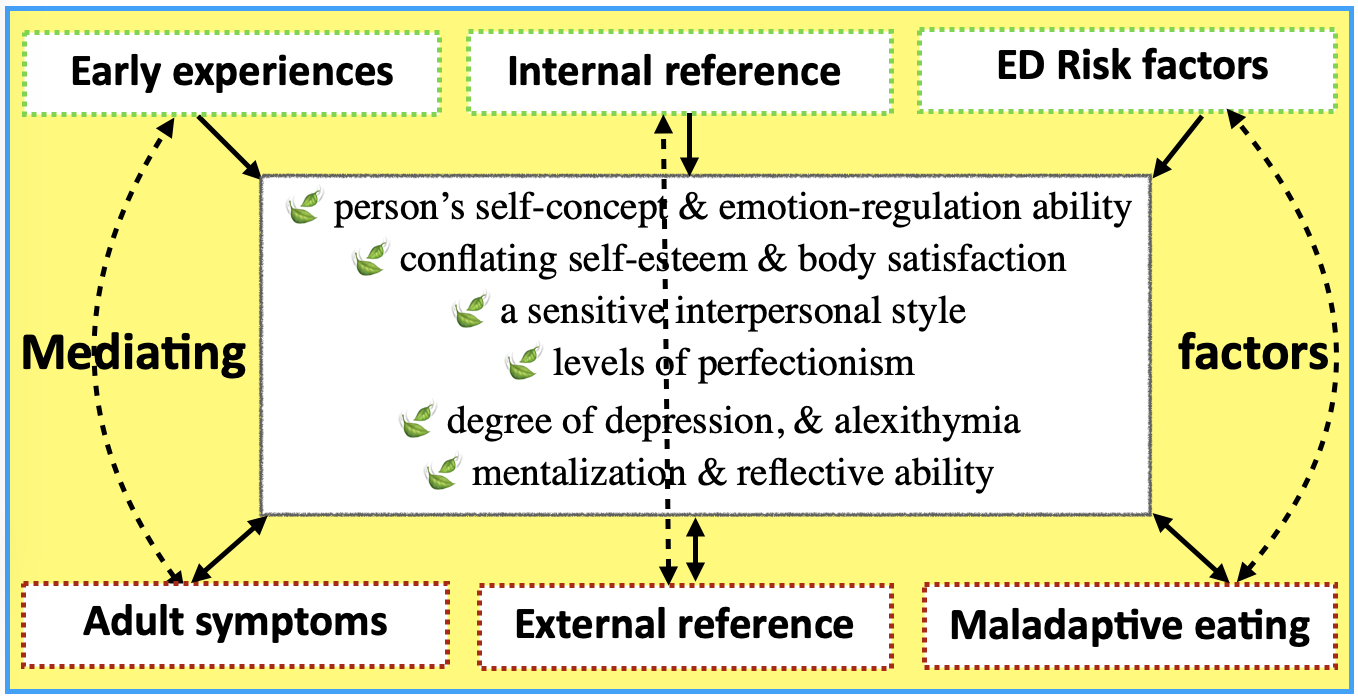
The connection between lack of mindfulness, dysfunctional attachment, & eating disorders can be expressed in several ways : via trans-generational transmissions, between intra- & inter-personal experiences, in the mediation of personality traits, the link between maintaining-mechanisms and risk factors such as mood disorders, between EDs & dysfunctional family traits (active parental addictions, discouraging autonomy, enmeshment, overprotection, rigidity, triangulation, suppression of conflicts ….)
«
«
NEXT : Food -#3
 HEAL & GROW for ACoAs