POWER : LEADERSHIP Categories (Part 3)


PREVIOUS :
Leadership (2b)


NOTE: “POWER / BIZ” posts will continue in JUNE 2022


Editor : The gender of the ‘Shoes’ icons next to each type are strictly my opinion, but realistically all styles can apply to either gender.

A LEADER’S  STYLE can be identified by how they makes decisions, especially the degree to which they involve employees

👞Autocratic (“Authoritarian”)
These people are mainly focused on efficiency & results. They often make decisions alone or with a small, trusted group, expecting employees to do exactly what they’re told to do – as from a military commander.

Autocratic style can be useful in organizations with strict guidelines or in compliance-heavy industries. Also where employees who have little to no experience need a great deal of supervision. In general, it stifles creativity & makes employees feel restricted.

👞Bureaucratic 
Similar to Autocrats, they expect team members to follow rules & procedures precisely as written. The bureaucratic style focuses on fixed duties within a hierarchy where each employee has a set list of responsibilities, with little need for collaboration or creativity. Most effective in highly regulated industries or departments, such as finance, health care or government.

👠 Coaching
Leaders using the coach leadership style are skilled at providing clear expectations & creating a positive, motivating environment. They can quickly recognize team members’ motivations, strengths & weaknesses. They can help employees set smart goals, providing regular feedback & challenging projects – so team members can improve & grow. While this is beneficial to both employers & employees, it’s also one of the most under-used, being so time-intensive.

👠 Democratic (“Participative”) 
Leaders using the democratic style combine Autocratic & Laissez-faire. They ask for input & feedback from their team before making decisions. Because members feel heard & that their contributions matter, these leaders are often credited with fostering higher levels of employee engagement & workplace satisfaction.
Excellent for companies focused on creativity & innovation, like the tech industry.

👠Laissez-faire
The Laissez-faire style is the opposite of Autocratic, focused mostly on delegating many tasks to team members, with little or no supervision. Because these leaders don’t spend much time managing employees, they can dedicate their efforts to additional projects.

This style works well if all team members are highly experienced, well-trained & self-directed. However, it can also cause a dip in productivity if some employees are confused about what’s expected of them, or those who need consistent motivation & boundaries in order to function well.

👞Pacesetter
The pacesetting style is one of the most effective for achieving fast results. These leaders focus mainly on performance, setting high standards & holding team members accountable for achieving goals.
While Pacesetting is motivational & helpful in fast-paced environments where members need to be energized, it’s not the best option for those anyone needs mentorship & feedback.

👠Servant
Servant leaders live by a people-first mindset, exceptionally skilled at building employee morale & helping them stay interested in projects. They believe that when members feel personally & professionally fulfilled, they’ll be more effective, & so consistently produce great work. This attitude tends to gain such leaders high respect. Servant style is excellent for any industry or size, but is most often seen in nonprofits.

👞Transactional
Transactional leaders are laser-focused on performance, similar to Pacesetters. They set pre-determined rules & incentives, mainly using monetary reward for success, & disciplinary action for failure. However, unlike Pacesetter, these leaders are also interested in mentorship – providing instruction & training to achieve goals that lead to rewards.
While this style is great for organizations or teams tasked with hitting specific goals, such as sales & revenue, it’s not the best for creativity.

👠Transformatonal
The transformational style is similar to Coaching, since it focuses on clear communication, goal-setting & employee motivation. But these leaders are committed to the organization’s objectives instead of employees’ individual goals.
Because most of their time is focused on the ‘big-picture’, this style is best for teams that can handle delegated tasks without constant supervision.

👞Visionary
Visionary leaders have a powerful ability to drive progress & usher in periods of change – by inspiring employees & earning trust for new ideas. They can create a strong organizational bond, able to foster confidence in both ‘direct reports’ & colleagues for their company projects.
Visionary style is especially useful in small, fast-growing organizations, or larger ones experiencing transformations or corporate restructuring.
(MORE about each style)

NEXT : Human Nature – Overview
POWER : LEADERSHIP – Skills (Part 2b)

 PREVIOUS: Leadership #1

SITE: The 5 Dysfunctions of a Team  

Leadership TACTICS / SKILLS

⚜️AlliancesThe executive system is made up of sponsor-protégé relationships. Wise administrators will make it a point to establish such associations with those above & below them

⚜️CommunicationInformation is an important tactical weapon, so it’s often best to withhold it, or time its release – especially about future plans, information that may create schism or conflict, or which would give an opponent a leg up

⚜️Change-management & Innovation – Organizational changes require forming & communicating a compelling vision to the workforce. Change needs strong leadership to drive it firmly forward, & make it ‘stick’ & to guide it through the process – so the organization won’t revert to old, unproductive ways

⚜️CompromisingExecutives need to use compromise as a way of settling differences – with tongue in cheek. While seeming to alter their view, they should continue to press toward a clear set of goals. They can give ground on small matters, to delay, to move off on tangents… but any concessions are more apparent than real

⚜️Desire to Lead – Effective leaders tend to have a strong desire for leadership roles & activities. Although most people are happier to let others the in charge, leaders want to do that themselves

⚜️Drive – Leaders are highly motivated. This inner drive is reflected in great ambition, working with great effort & energy. Striving for achievement, they’re often tenacious, & more likely to take the initiative rather than wait for someone else to push them

⚜️Maneuverability – Wise bosses stay flexible, & never completely commit themselves to any one position or program, & never leave themselves without plenty of escape hatches. They need transferable talents & inter-firm alliances, so they can move elsewhere, if need be

⚜️Negative TimingWhen a boss is urged (by their boss) to take an action they doesn’t agree with, but would be unwise to ignore – they’ll start implementing the order, but stretch it out. They’re always in the process of doing something but never finishing, or finally taking a ‘requested / pressured’ action when it’s too late to be valid

⚜️People Management – Company leaders are expected to Motivate & encourage subordinatess. They need tools & skills to work well with others, both one-on-one & in groups.This includes delegating, balancing workloads, & ensuring that everyone is given opportunities to develop. Also how to recruit effectively, & handle ‘normal’ as well as poor work performance. Creating a Motivational Environment .

⚜️Persuasion & Influencing – Leaders need tools to understand the way others behave, so they know how to successfully direct others, through positive interactions. This includes learning about Emotional Intelligence, Transactional Analysis, and the Myers-Briggs Type Indicators.

⚜️Planning & Delivery – The best vision in the world is no good without plans to turn it into reality. Along with strategic thinking, organizing & action-planning are essential for reaching goals. Good risk management is also important to help the prevent things going wrong, & being able handle them when they do.  (More…)

⚜️Promoting Healthy Failures – Corporate leaders need to navigate the threat of  constructive destruction – using Disruptive Innovation. Only businesses that can learn fast, fail fast & innovate – will survive. To do this, they need to build an environment that’s safe to make mistakes in & push boundaries, while considering customers’ expectations. How leaders respond to ‘failures’ will make or breaks an innovative culture

Good LEADERS can help CORRECT Team dysfunctions
#1 👍🏽Trust
Leader creates a safe environment for speaking up. Need to be genuine, showing their own vulnerability, sharing challenges & limitations (without self-judgement !!). Encourage members to help each other, using each one’s strengths

#2: 👍🏽 Creative conflict
Leader needs to confront issues quickly but with personal restraint. Model productive conflict resolution techniques & provide practical solutions. Minimize office politics, getting input from all team members

#3: 👍🏽 Commitment
Leader needs to make clear what goals & priorities are expect, making sure to keep the project on schedule. Tap into members’ perspectives & opinions. Help the team make decisions they can stick to, & push for closure about issues

#4: 👍🏽 Accountability
 Leader have ‘uncomfortable’ conversations about conflicts & problems, early & consistently. Encourage members to hold each other accountable for their performance, based on the same standards for everyone, but be the ultimate arbiter of discipline

#5👍🏽 Attention to results
Leader focus everyone on successful outcomes of projects, to maintain team unity, being selfless & objective. Work toward team-base results, curtailing any individual’s tendency to advance their personal agenda & needs – rather than the project’s needs. (MORE…..re dysfunctions)

NEXT : LEADERSHIP (#3)

POWER : LEADERSHIP – Qualities (Part 2a)

PREVIOUS: Leadership (#1)


LEADERSHIP – The most effective leaders show a high concern for both production (task) & people, as well as depending on their own expertise & experience. Also, a group can have more than one ‘leader’, where all members making contributions.
PERSONAL QUALITIES

⚜️Always the Boss – Creating too much of an atmosphere of social friendship interferes with the efficiency of an operation, limiting the manager’s power.  Executives should never become so committed to a subordinate as friend – that they won’t be detached  enough to deal with the other person objectively in important or stressful situations

⚜️ConfidenceExecutives always need to have an outward appearance of self-confidence – it adds to their power standing. Once a boss makes a decision, they must look & act sure – even if privately they’re not fully convinced, or find it hard to put into action

⚜️Extraversion – Most leaders are likely to be Extroverts – comfortable with a lot of people & activities, talkative & charming – which helps them be the initiators, especially to connect with & inspire others through relationships. Those who are Introverts have sufficient strengths to compensate for not being as naturally sociable. EXP : Bill Gates of Microsoft & Mark Zuckerberg 

⚜️ High Emotional Intelligence – A fundamental skill, this includes self-awareness, self-management, self-motivation, empathy & social awareness. Effective leaders recognize & validate emotions in themself & others, & can tailor their message to meet the audience’s emotional needs

⚜️Honesty / Integrity – Effective leaders must demonstrate high levels of moral rectitude. It’s essential for inspiring confidence & trust in employees and other followers. Dishonesty may not always be obvious at first, but will show up in time.EXP:  Martin Winterkorn became embroiled in ethical & legal problems after a period of big success as CEO of Volkswagen

⚜️Inspire Confidence – Effective leaders inspire confidence, helping employees & team members sail through crisis. By being confident, there’re open to try out new ways of working, not afraid to take risks (or make mistakes), because they know they can emerge stronger & better with every experience

⚜️Intelligence – While leaders are highly intelligence, some have more ‘street smarts’ than book learning. Pure cognitive ability is a “threshold” qualification, important for becoming a leader. However, Relational and Emotional intelligence are also important

PERSONAL P⚜️Knowledge of the Business – A key ingredient in the leadership trait mix is knowledge of the business. Even if someone has all the natural personality traits desired of leaders, a lack of accurate knowledge & practical experience is usually a deterrent to success. Leader must be competent in their field, & the most effective ones are experts with deep insight

⚜️Open-Mindedness – Effective leaders tend to be open to new ideas & experiences. They recognize that innovation can be valuable, and are available to consider ideas or suggestions from others. Self-confidence does not have to conflict with this trait

⚜️Maneuverability – Wise bosses stay flexible, & never completely commit themselves to any one position or program, & never leave themselves without plenty of escape hatches. They need transferable talents & inter-firm alliances, so they can move elsewhere, if need be

⚜️Self-dramatization – An important political stratagem is the use the actor’s skill – communication as “artistic” rather than “natural” way.  Executives can choose parts of reality & then arrange them to arouse emotions, to convince, persuade, or change the audience’s behavior – in a planned direction

⚜️Self-Esteem – While some leaders are definitely narcissists (NPDs) successful one must have a strong dose of self-esteem. They have confident that their beliefs, plans & actions are correct – hopefully with good reason. This allows them to stick to their chosen course, even in the face of obstacles & doubts from others

⚜️Strategic Thinking – The best strategic thinkers see the big picture, not distracted by side issues or minor details. All decisions are likely to be broadly based on answering the question ‘Does this edea/ action take me closer to where I want to be?’ And then be able to communicate their ‘vision’ effectively to followers

⚜️Taking AdviceStrong leaders listen to & act on advice only when they want it.
Decisions must come from their own grasp of the situation, only including the views of others when necessary. To do otherwise would make then subject to pressure, or end up vacillating & being inconsistent  (More…)

NEXT : Leadership #2

POWER : LEADERSHIP – Intro (Part 1)

PREVIOUS : Leadership #2

SITEs : “Relationship between bases of power & job stresses: role of mentoring

Top 19 Leadership THEORIES


LEADERSHIP : The Contingency Theory
 is considered the best form, which states that good leaders are able to evaluate the needs of their followers, take actions & adapt to any situation. By definition, they have all the right qualities – charisma, confidence, intelligence, communication & social skills.

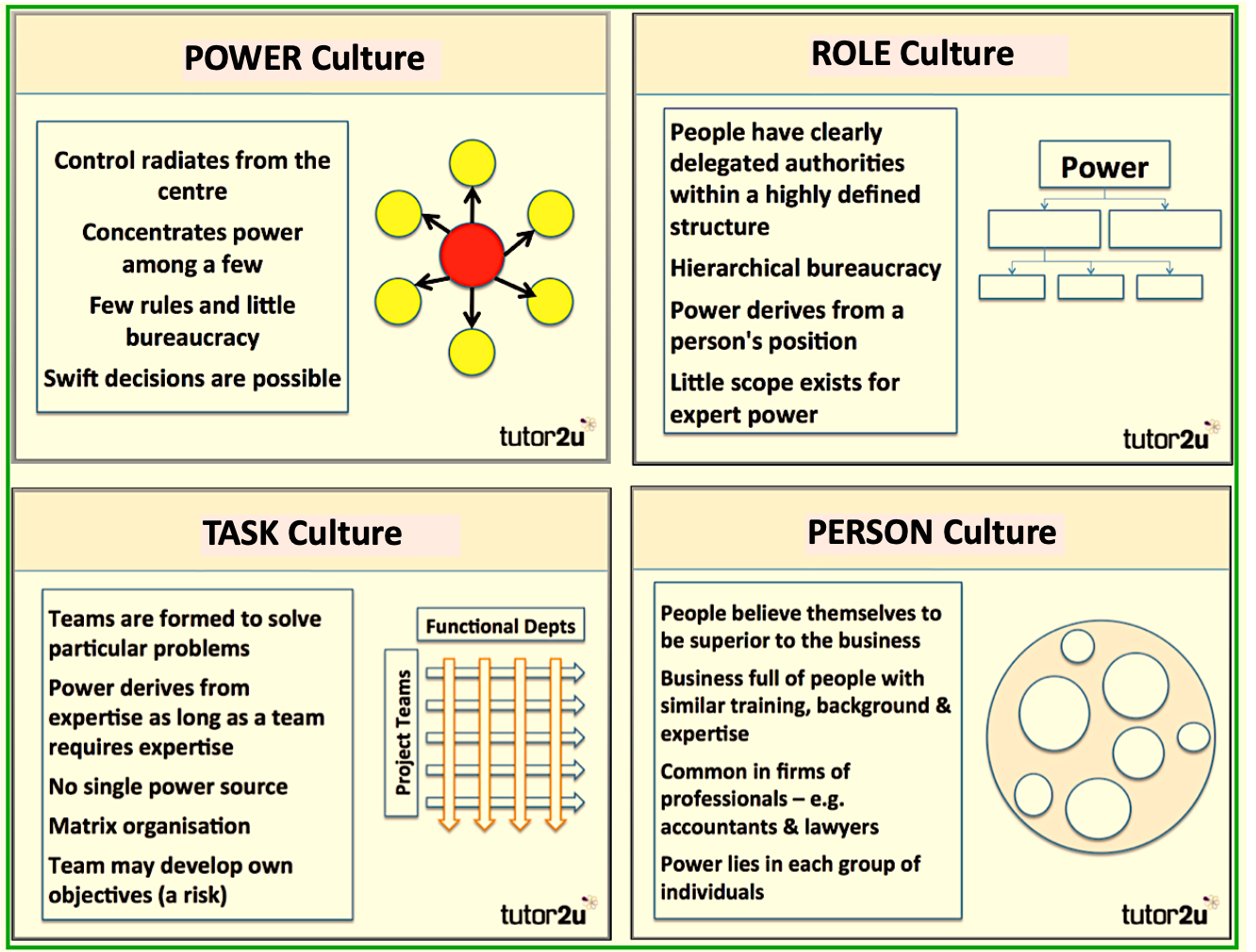
3 Leadership CULTURES : Operate from the belief —-> that:
‣ Dependent – only people in authority are responsible for leadership
‣ Independent – leadership grows out of individual expertise & heroic action
‣ Interdependent – leadership is a collective activity for the benefit of the organization as a whole.

One way to decode a leadership culture is to observe how leaders create shared direction, alignment & commitment (DAC).

COMMUNICATION
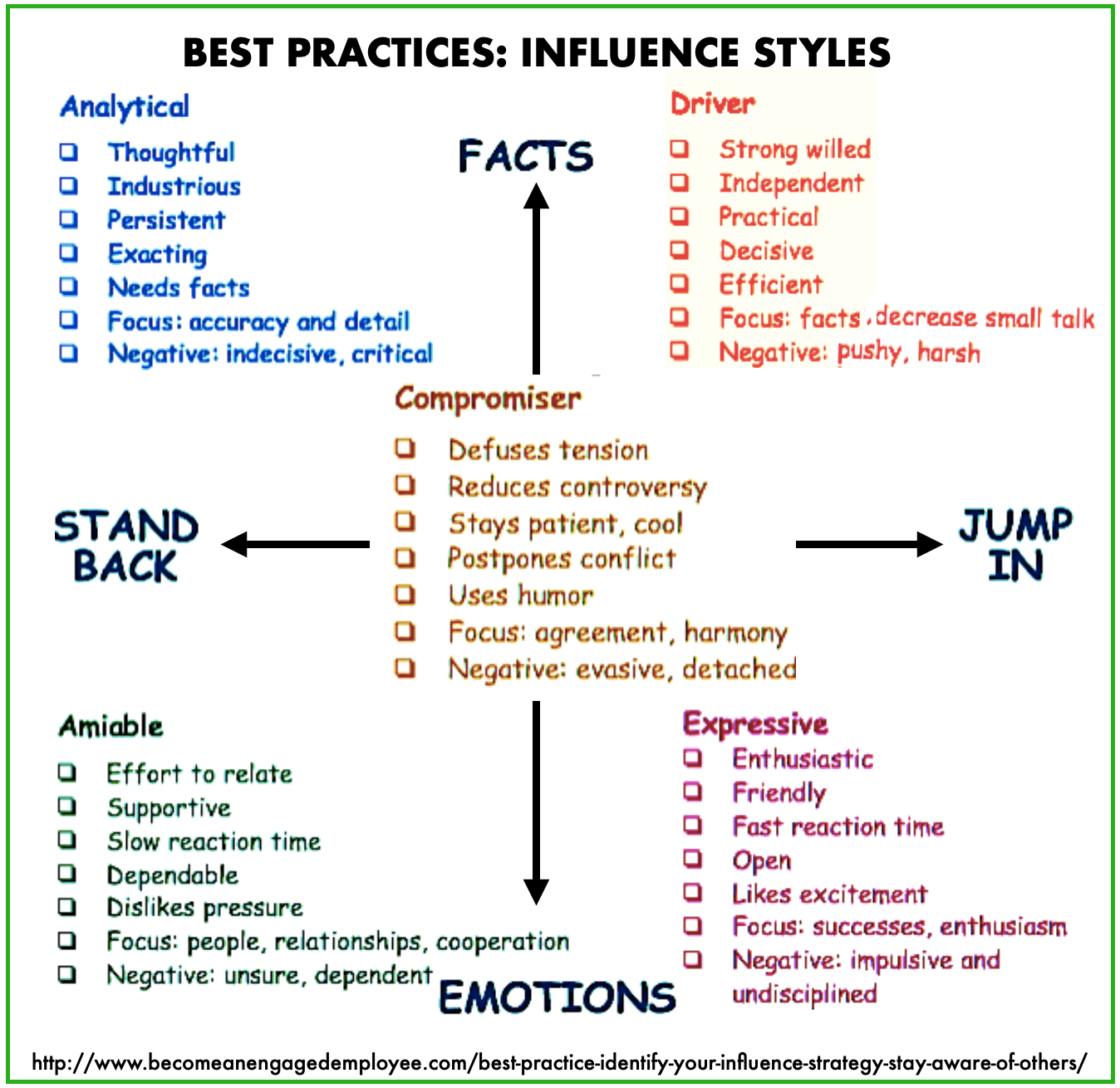
Frameworks like the following chart ⬇️ remind leaders that people process things differently, so they shouldn’t all be treated identically. “If you know what quadrant someone fits into, you can deal with them effectively. Understanding leads to compassion & empathy.” (Thought Ensemble)

Behavioral Leadership Styles fall within two broad categories:
🔹 Task-centered, which is about giving group members instructions & directions to accomplish goals more efficiently & effectively. The focus is on the objective analysis of what needs to be done, & the specific course of actions to be taken. Employees are seen as resources used to accomplish goals
OR
🔺Employee-centered (relationship-centered) leaders focus more on building relationships between themselves & employees. By encouraging & supporting them, the leader hopes to make them better qualified, more confident & productive. Attention is on inspiring employees to follow the vision as presented. 

👤 Analyticals – want to know “how” things work, & want to be accurate. They value numbers, statistics & ideas, love details
👤 Amiables – want to know “why”. They want to build relationships, love to give others support & attention, value suggestions from others

👤 Drivers – want to know “what”. They value results, want to save time, love being in control
👤 Expressives – want to know “who”. They value appreciation, love social situations & parties, like to inspire others

STRESS EFFECTS on Leadership
Having & using power comes with several positives – more action, optimism, abstract thinking & goal-directed behavior.

However, Professor Jennifer Jordan points out that stress can be caused :
🔆 by the ever-increasing demands & pressure to meet expectations that often come with powerful positions, OR
⚠️ when an executive (or any other leader) sees their power being threatened – but only if they value hierarchy. So, much of how stress is experiences coms from how they interpret the world around them. It also affect the quality of their leadership.  Reactions include:

a. Risk-taking – In general, powerful people are more likely to resort to risky negotiation tactics. Ignoring potential business dangers & an over-focus on rewards encourage risk-taking. And
research indicates that power-users in an unstable situation (under threat) and have a low tolerance for stress – engage in even riskier behaviors

b. No Power-sharing – When a leader feels at risk of losing their power, they interacts less with their staff, not allowing subordinates to influence or participate in decision making, because don’t trust  most people in the organization

c. Transformational – While some leaders under power-threat are motivated to inspire & motivate the troops, research suggests the greater the threat, the less likely most leaders will use transformational tools (lead by doing, encourage collaboration among team members….).  Instead, they may go into “survivor mode”, & actually stop leading – although this is less likely to happen with the Directive style. (SOLUTIONS…..)

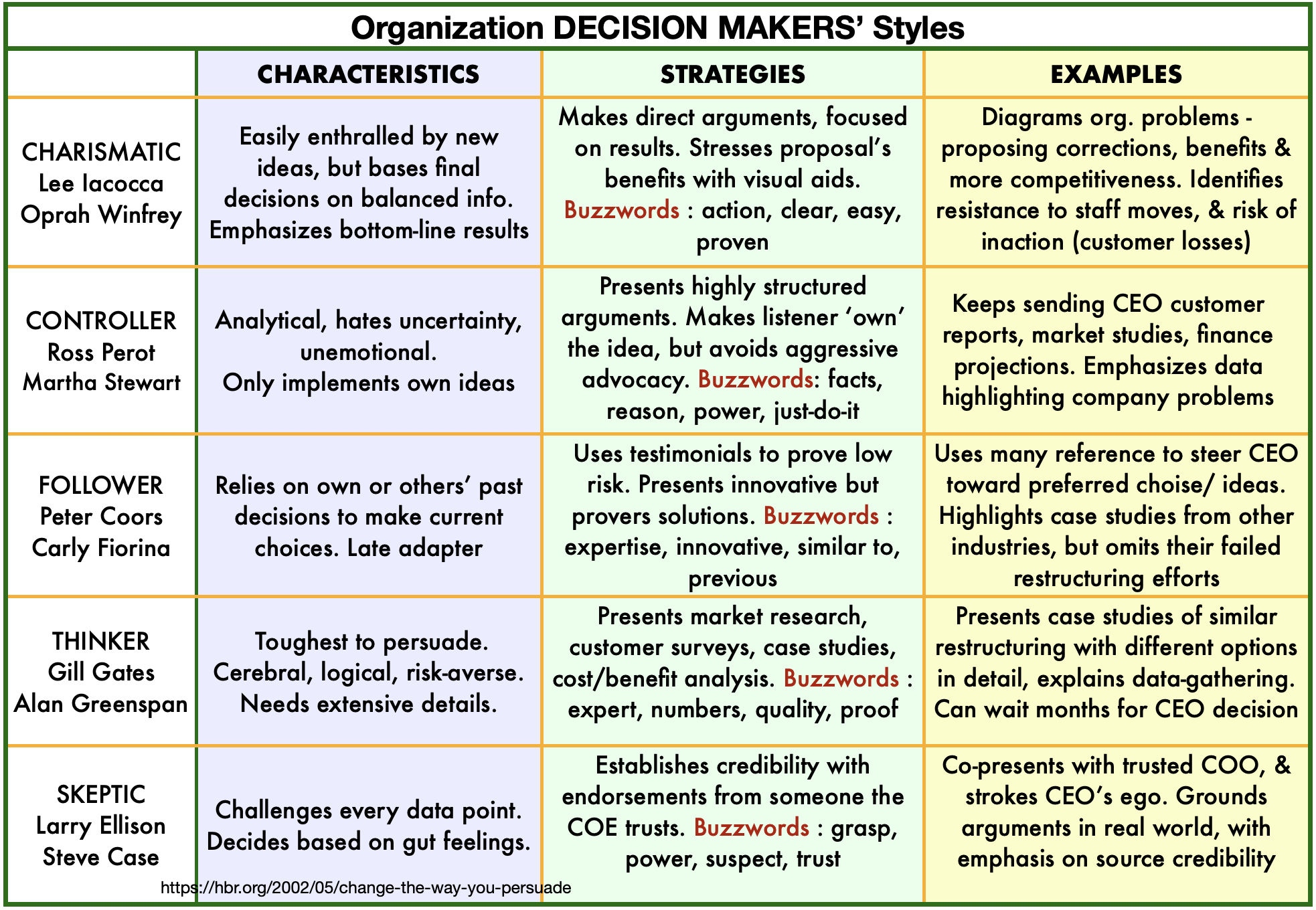
DECISIONS
“All too often, people make the mistake of focusing too much on the content of their point / project-idea / concern…., & not enough on how they deliver their message. Far too many decisions go against the employ or leader because their presentation was ineffective or done poorly.

However, people can greatly improve their chances of having a proposal succeed by identifying who the chief decision-maker is they’re trying to persuade, & then tailoring their arguments to fit that executive’s style.” (More….)

NEXT: Leadership #2a

POWER – Manipulation in Business (Part b)


PREVIOUS: POWER – Manipulation #1


MANIPULATION TACTICS (cont)
⚡️3. Influencing the influencer
⚡️4. Lies, half-truths, evasion & denial

⚡️5. The Naked Emperor’s Tailors: These people – like the duplicitous tailors – try to convince you that, of course, someone with your credentials, position & experience can certainly recognize what’s so obvious to everyone – an “unbelievable opportunity,” or a life-changing product – that you can’t pass up! They cite research & experts with “documented proof” of their position.

BUT when examined, the ‘unassailable’ research is flawed or non-existent, & it’s only the con-artist promoting the position or product who gains from your agreement.
Reality: You do have experience & credentials, so trust your gut. Even if there is widespread acceptance of these ‘items’, the mob is not automatically right.

⚡️6. Nuances, implications & innuendoes: This employee always seems to be “in the know.” They casually mention random bits of tantalizing information, implying something’s happening that ‘everyone’ knows – except you, of course. Catch phrases are “Well, of course… It figures…” or a sarcastic, “What a surprise.”
Creating a version of reality, they can convincing you & others, & when confronted, they can “legitimately” claim they never said anything at all.
Your response: Answer with a gentle challenge  “That’s not what I heard. I disagree. That’s not really true.” Neutralize the manipulator.

⚡️ 7. Outrage & intimidation: You start a work discussion & are interrupted by a fist slammed on the table, a stack of papers tossed aside & scattered. This may be followed by the clenched fist, an indignant huff, or a head shake trying to clear away your ‘unbelievable ignorance’. They’re trembling with rage & disbelief. How can you be so oblivious to the truth?
Their goal is to get you to back down, to modify your point, even to apologize, while you anxiously try to calm them down.
Your response: Instead – wait quietly, holding your ground. When the smoke clears & the bully has run out of steam, repeat your position & go on from there.

⚡️8. Projection: The manipulator “only” wants what everyone else has or wants. Their typical argument is : “Well, Joe & the guys are saying that we absolutely need this, or Everyone in other departments gets this benefit….” When you look into it, Joe never said anything of the sort, & only one department made a special exception for an unusual circumstance.
Your response: Check it out. Don’t make promises, & don’t take action on the word of this manipulator.

⚡️9. Redirection: This person is a master of evasion. You approach them to correct a behavior or call out an error, & they quickly alert you to a crisis that requires your immediate attention : another employee is doing something so horrendous that the redirector’s minor flaw pales in comparison. The typical reaction will be: “Well, what about Susie? Are you just going to let that go?”

Of course, if you let yourself get sidetracked – then when you rush to correct the alleged ‘worse’ threat – you find out there’s no such issue! So the redirector has escaped punishment.
Your response: Don’t be misled & stay focused. Even if Susie’s a ‘bad-un’, it can wait until you’ve dealt with the redirector’s transgression.

⚡️10. Stonewalling: This most often occurs between peer managers. You have an assignment or a new project that involves another department, but all requests hit a brick wall – emails aren’t answered, calls or texts never returned.
You try to set up a meeting but their schedule never seems to be open. You see them in the corridor, but they’re rushing off to an important meeting, while assuring you they’ll get back to you soon. But of course, they never do.

As manipulation tactics go, this is one of the most frustrating. While the project at hand is critical to you, your peer sees it as either totally unimportant, or more likely, detrimental to them.
Your response: If there is a benefit to them, remind them of that. If this project is to their detriment, as, for example, if it means they’ll be fired, find an alternative ‘carrot’ for their cooperation. Otherwise, you’ll never get the help you need & may instead be sabotaged.   (FROM: 10 Traps and How to Avoid Them )

STATUS & POWER
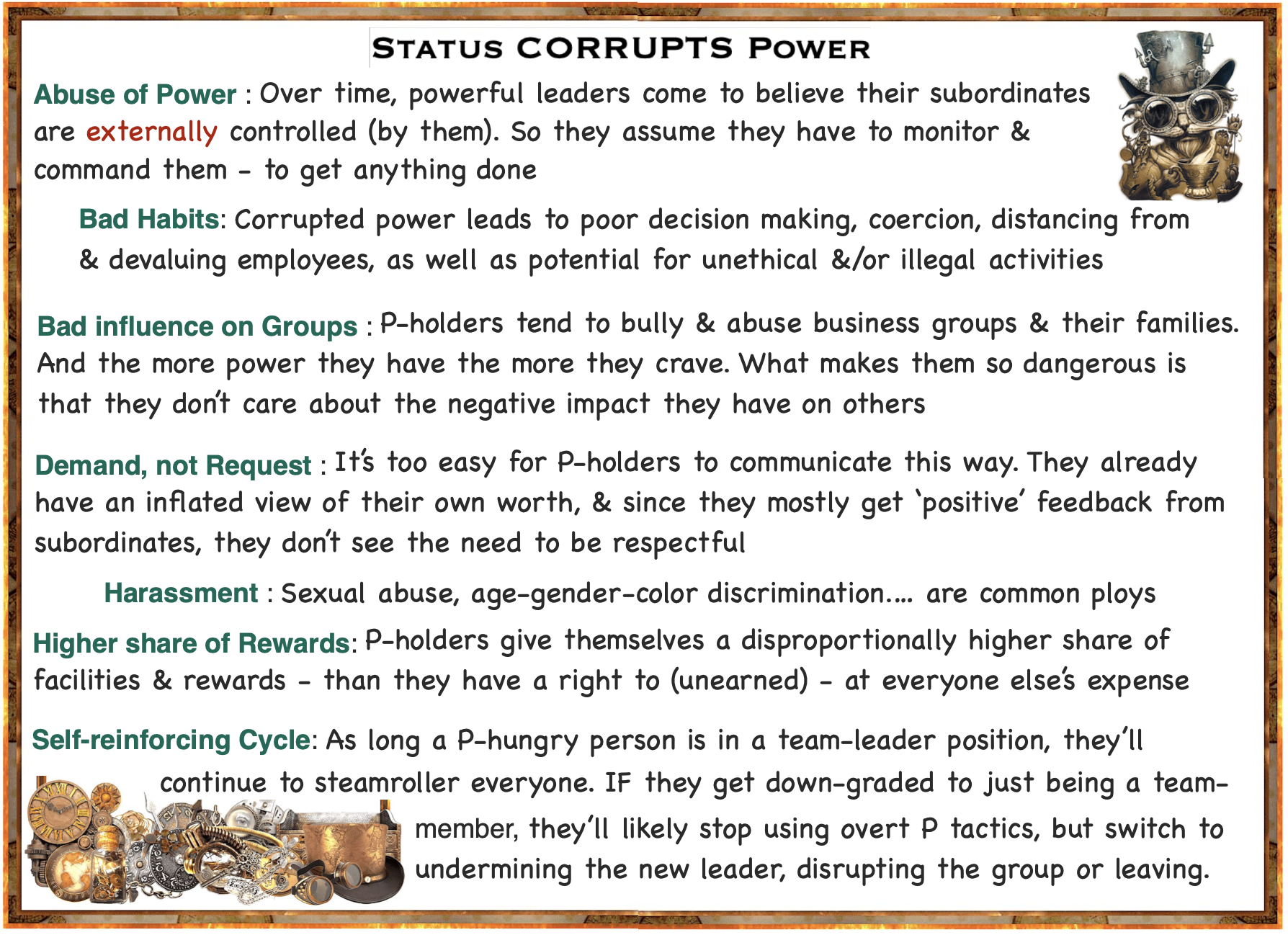
Power corrupts when someone has a great deal of power but is not held accountable for its use, & results in using their power exclusively for personal gain. Since Power is it’s own reward, power-wielders often want more, which can have a corrupting influence.

NEXT : Power –

POWER – Manipulation in Business (Part a)

PREVIOUS: POWER – Persuasion

SITE : “8 Family Manipulation Tactics…..

DEF: Manipulate – to negotiate, control, or influence something or someone cleverly, skillfully or deviously.

Almost all business – indeed almost all of life – includes elements of manipulation. In business, negative tactics can be subtle or blatant, part of cultural norms, or press uncomfortably into the unacceptable.  Sometimes manipulation data to get a point across clearly or using some other version – to influence an outcome for the good of those involved – are effective & acceptable maneuvers.

But when it concerns working relationships, manipulation depends on hidden agendas & is totally harmful to running a business successfully. A scheming boss or co-worker can easily stir a happy, enthusiastic workforce into a group of disconnected people who don’t trust each other, & end up disliking their jobs. Psychologically, aggression is disguised by manipulation as good intentions.

Power-hungry parents, teachers, bosses, CEOs, religious leaders….. choose to use negative behavior to maneuver & massage the system, working to gain more power & stay on top – for as long as they can get away with it.

Managers can get caught up in the drama of mind-games without realizing it. Manipulators having been successful using tactics honed to a fine art – for years if not decades – bend outcomes to suit private goals. Their tools have to be subtle & subversive, since outrageous & immediately obvious ploys are rarely effective.

When line-supervisors are taken in by corporate power-wielders, subordinates who recognize the tactics will become frustrated by the gullibility of management. Morale will sag, taking with it productivity & erosion of the corporate culture.

However, if the arrogant manipulator goes too far, their outrageous games becoming obvious, or there’s some kind of catastrophe – internally or from outside – then the self-serving impact of the puppeteer is exposed. Unfortunately, by that point, the damage is done.

GOOD NEWS : Leaning about the many exploitive tactics can help leaders & subordinates protect themselves – whatever age or position in life! You many notice how these ‘10 Traps….’ from Ellen Huxtable overlap with characteristics of NPDs & Pathological Narcissists.

⚡️1. Hyper-sensitivity: They meet every challenge with extreme ‘regret’ – eyes downcast, shoulders hunched, lower lip quivering, using tears as a tactic. Message : you’ve caused them such emotional grief & you’re the most evil person on earth.
Your response: Pause, hand over the box of tissues, wait for the tears to pass, & proceed with your talk. If there’s an actual problem, direct the individual to get psychological help.

⚡️2. Ingratiating behavior: They’re charming, understanding & supportive. Idealizing – they look at you with stars in their eyes. You can do no wrong – all your decisions are wonderful, so anyone who questions you is jealous or ignorant. They’re your protege or your pet. You obviously have superior insight about things.
So – when they shyly suggest something ‘helpful’ (which they want for themselves but won’t be good for you or the company), naturally they’ll seem to have “your & the organization’s best interests” at heart. Or not. Beware the flatterer.

⚡️3. Influencing the influencer: This employee has an agenda, a new product, service or process they want to promote. And your response is “no,” or “not right now.”
Not deterred, they’ll find someone they know can influence you – a peer, supervisor or customer, and suggest the idea to them instead.
Ideally, the employee gets them to think it was their idea all along. They approach you with it, but you recognize your employee’s fixation.
Your response: Tell both influencer & employee how interesting it is that they both happened to have the same idea at the same time, then repeat your “No.”

⚡️4. Lies, half-truths, evasion & denial: This manipulator  may or may not be deliberately manipulating – maybe just have a fanciful view of reality, living in their own twilight zone.

Regardless, they mix absolute, accurate, truthful statements with biased facts, misinterpretations & outright fabrications. When confronted or questioned, they shift position, or deny they ever said any such thing. They ‘helpfully’ clarify your ‘misunderstanding’ – which indicates deliberate dishonesty.
Your response : Carefully separate their facts from fiction, & be very cautious about taking action based on their claims, without substantiating them through one or more reliable other sources.

NEXT : Manipulation #2

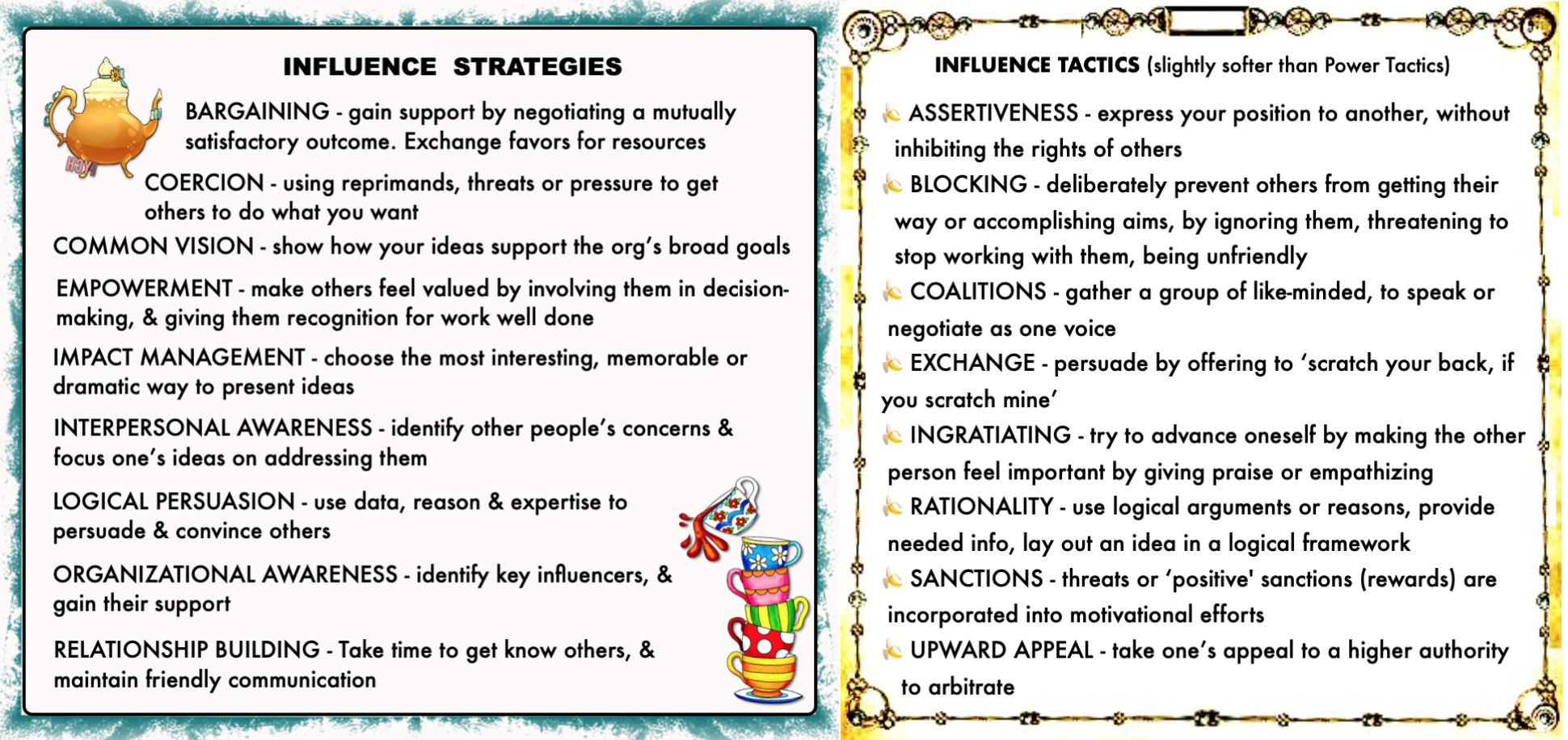
POWER – Influence Strategies

PREVIOUS: POWER – Persuasion

SITE: Taxonomy of Influence Strategies identifies 23 ‘plays’ – basic strategies used in influence industries : communications, marketing,  media, military & government intelligence, politics & sales  (MORE….with chart )

INFLUENCE STRATEGY 
Def: “A social or rhetorical technique, irreducibly unique, used by a person, organization or surrogate, to improve mutual or competitive advantage, through means & methods of persuasion.”
EXP : A new Senior Manager adopts a new dress code, which others in the org. then start to copy

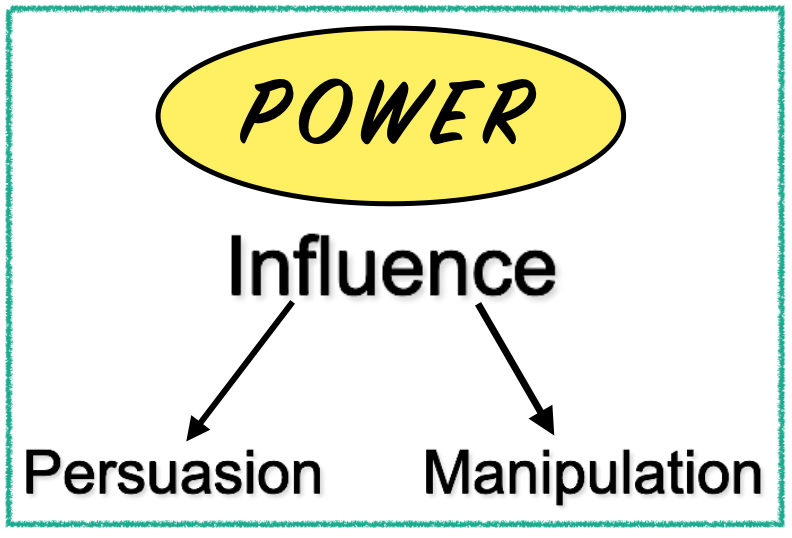
3 Leadership STRATEGIES which can transform POWER into INFLUENCE
(Angela Sinickas, 2016)
See also “Neutralizing” each of these strategies – when needed. Slides 18-20
AND See “Pros & Cons” slide 18-21

2 GOALS
: a. to get others to work with you in reaching an objective
b. AND avoid feeling powerless, exploited or manipulated, in situations where you should be taking initiative rather than complying

1. Retribution though intimidation (pressure) or Coercion (threaten)
EXP a : Forcing all businesses to use new logo & brand themes
EXP b : Offer alternative strategies with fewer negative consequences bit still accomplish the original demand. Used WHEN:
‣ Commitment & quality not important
‣ Influencer had complete power
‣ Resistance to request if likely
‣ Specific, unambiguous requests
‣ There are serious violations
‣ Tight time constraints

2. Reciprocity through ingratiation (obligate) or Bargaining (exchange)
EXP a : Helping an executive in a crisis, the get them to recommend you earlier in the next emerging issue
EXP b: Ask questions, decline a ‘gift’, suggest an alternative exchange or refuse outright. Used WHEN :
‣ Commitment to values not critical
‣ Established exchange norms already exist
‣ Needs are specific & short term
‣ Parties mutually depend
‣ Parties viewed as trustworthy
‣ There’s enough time for negotiating

3. Reason through appeal to values (general principles) or Facts (merits & needs)
EXP a : Refer to expert opinions, use survey data. OR appeal to their ‘higher good’
EXP b :
Acknowledge their need, but explain that the request won’t work at this time. Be firm when saying ‘no’.  Appeal to their sense of fairness or point out it’s inconsistency with the org’s values, & to not wait to the last minute for help
Used WHEN:
‣ Parties have common values and goals
‣ Parties share an ongoing relationship
‣ Parties share mutual respect
‣ There’s adequate time for extensive discussion

STRATEGIES – define long-term goals & the plans to achieve the org’s mission. They must include “premeditation, anticipating others’ behavior, & the purposeful design of coordinated actions.” Usually more important when someone else (individual or group) has the potential to thwart or disrupt actions, or where plans are at risk if practical steps are not actively taken

TACTICS – (“initiatives”) are much more concrete, using smaller steps & a shorter time frame for the process toward a goal. Involve ‘best practices’, specific plans, resources… Successful tactics can include an ‘implementation trigger’ that signals when they should be used, such as an “if this, then that” plan for Where, When & Why.


ANOTHER way to list Influence Strategies (the ‘Six Ps’)

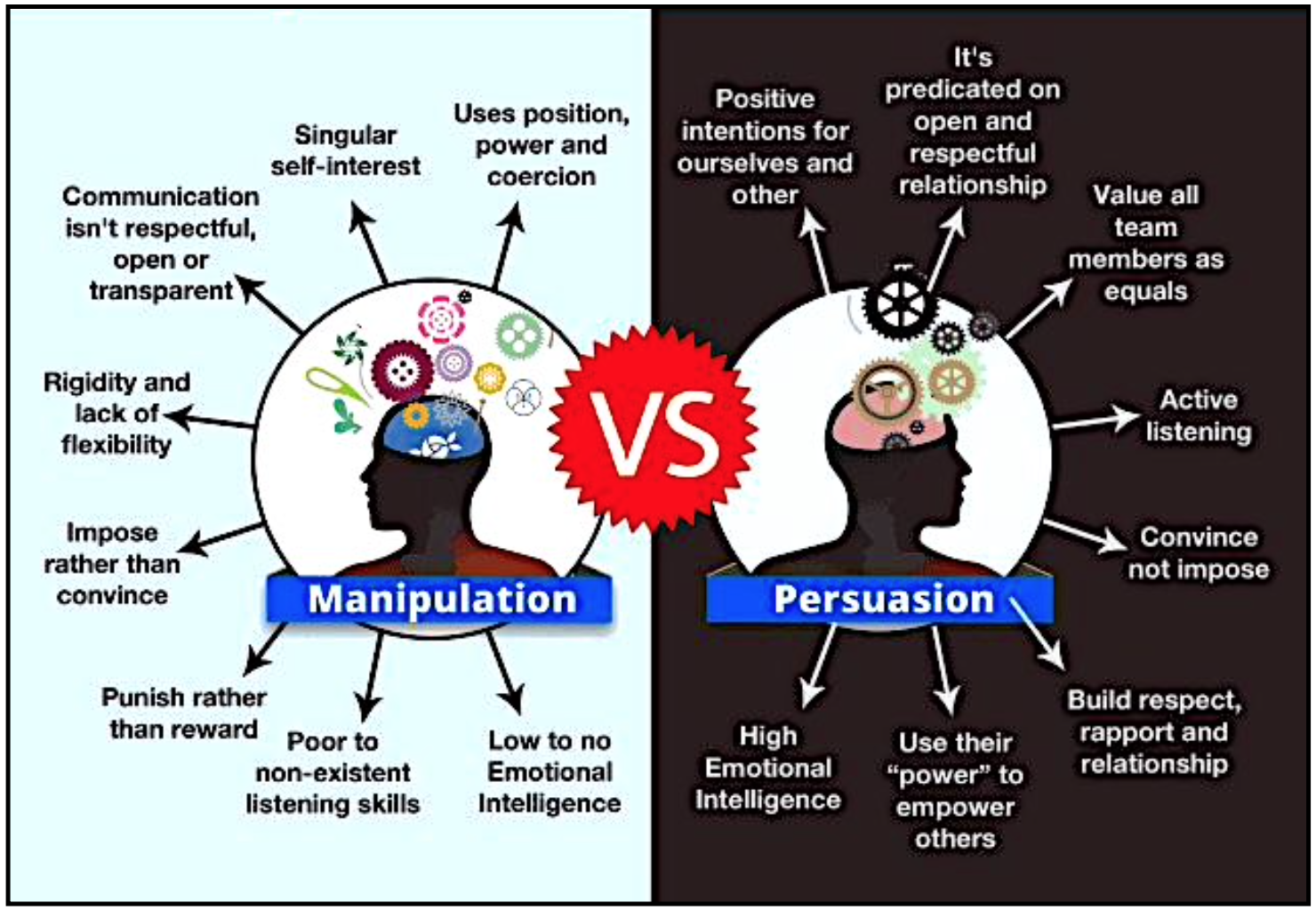
♝Persuasion – gaining influence by appealing to reason via argument. Requires a mix of Expertise & Personal characteristics. Once persuaded, people will want to continue doing as the leader ‘suggests’.

♝Position – how authority is used in a particular org. depends on its corporate culture, on which forms of authority the org approves of, & the manager’s preferred management style

Preparatory – laying the ground for future attempt at influence – such as building a positive relationship with colleagues to make them more willing to cooperate in the future.  Acceptable strategies depends on context or else will seem like manipulation

Preventative – ways to prevent certain actions, such as holding back information, stop questions being asked, suppress dissent. Both Prep & Prev. can be either overt or covert. EXP: The way an agenda is structured may not be obvious to participants

♝Pull (Reward) – depends on the value to the Target. Usually a co. will set guidelines to ensure limitations & fairness. Unfair benefits will create resentments & reduce motivation in others

♝Push (Coercion) – imposing or threatening to use sanctions for non-compliance, a bullying approach which may include legal sanctions

NEXT: Power – Manipulation


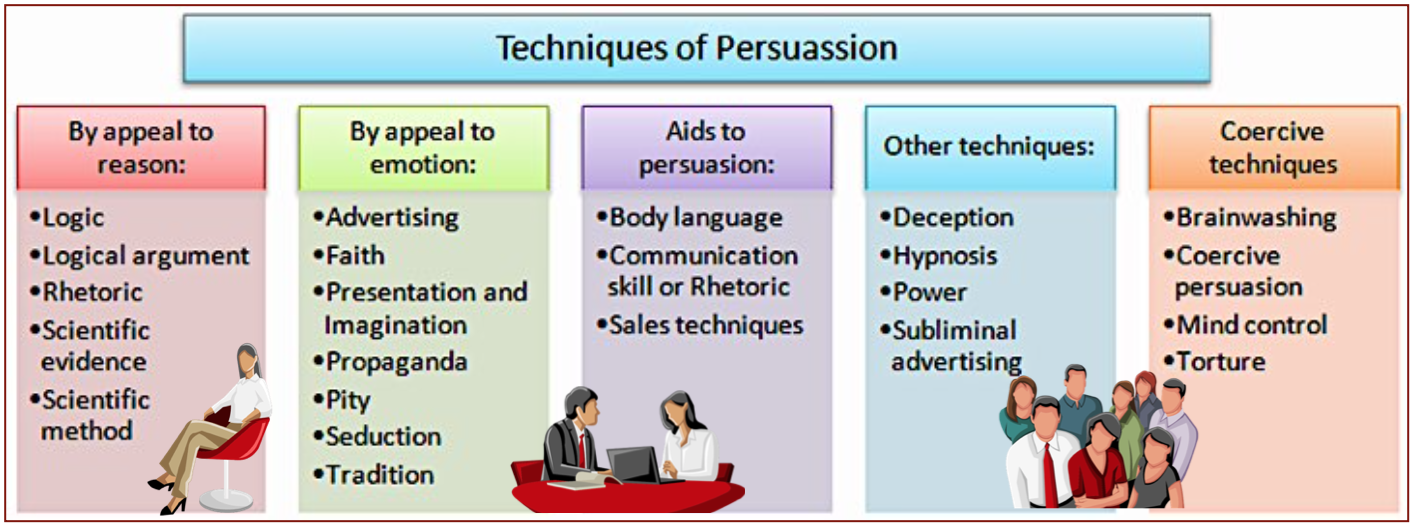
POWER – Persuasion

PREVIOUS: Person BIZ POWER – 

SITE : “10 Ways To Persuade Someone to Your Point of View”


HARD POWER – uses treats & punishments

SOFT Power: INFLUENCE, which uses affirmations & encouragements


Influence as the POWER of PERSUASION
An ancient art – More than 2,000 years ago Aristotle outlined a formula on how to become a master of persuasion in his work “Rhetoric”. To be effective, his time-honored principles can be used to make a successful presentation or writing:
Ethos – ‘character,’ Logos – ‘to reason,’ Pathos – ‘suffering’ or ‘experience + Metaphor (verbal beauty) & Brevity.  (MORE…. )
Currently: Warren Buffett once told business students that improving their communication skills would boost their professional value by 50% — instantly.

DEF: Persuasion is a communicator’s effort to convince people to change their own attitudes or behaviors about a topic or issue. Changes must come from the listeners themselves, or they have the option to resist persuasion. It can only occur in an atmosphere of free choice, geared to autonomous individuals capable of changing their mind on a subject or of saying ‘No’.

Persuasion is one form of social influence on attitude, & represents the intersection of social thinking in everyday life. It’s symbolic – utilizing words, images, sounds….. verbally & nonverbally via TV, radio, Internet or face-to-face communication.

SAMPLE of Persuasion used to make a major work / company change —>
In a positive environment, employees not only understand why change is necessary, they’ll also be emotionally committed to making it happen, faithfully executing the required steps

TARGETED AT someone’s response to an object or issue:
✫ Attitude – to change someone’s opinion, within a wide range, from negative to positive
✫ Behavior – to change a person’s overt actions
✫ Cognition – a powerful tool to change individuals’ beliefs, which may include defining, interpreting, identifying qualities, observing outcome…. re. something

METHODS
Rational & emotional appeals
A rational appeal uses logical arguments, even factual evidence, to persuade individuals about the legitimacy of goals & the likelihood of reaching them. Success will depend on the strength & quality of arguments, provided the recipient (Target) is able to process the message correctly.

An emotional appeal is designed to arouse the recipient’s feelings. The most commonly used methods is the fear- or threat-appeal. Even guilt-appeal is considered highly persuasive

Source credibility
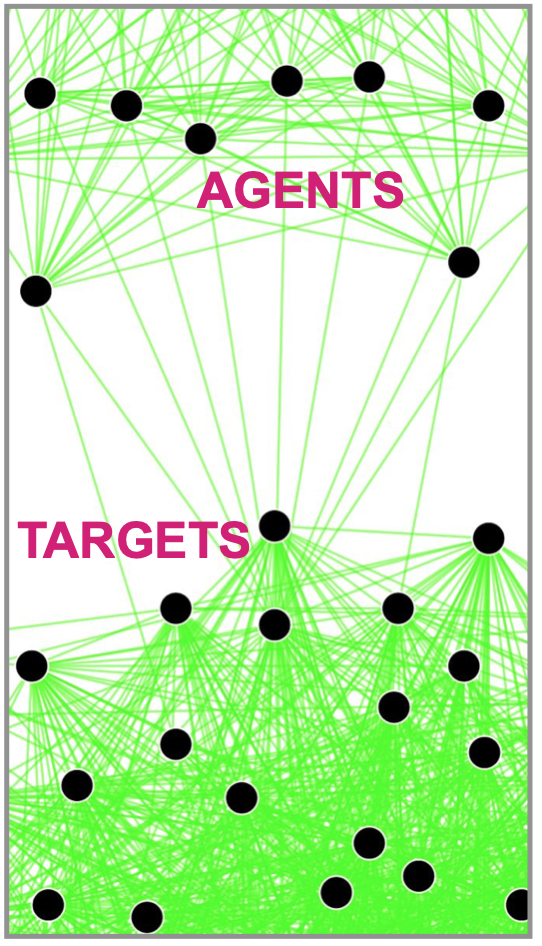
This involves 2 major criteria – expertise & trustworthiness. Along with these – physical attractiveness, similarity & non-verbal cues like facial expressions, posture, vocal sounds – all play a subtle role in influencing source-credibility, which can be bolstered by information about the source’s (Agent) background, education, formal training, legitimacy, personal experience…..

SOCIAL INFLUENCE
This occurs when a person’s thoughts & actions are consciously and unconsciously being affected by other people & groups.
EXP: Advertising, Coercion, Criticism, Enabling, Ethics, Ethnic values, Interpersonal influences, Mass media, Power, Prejudice, Propaganda, Self-brand, Social approval, Social desirability, Social norms, Social values, Superstitions, Taboos.

The effect of these influences can be seen in people’s reactions – in their style of
Conformity, Leadership, Obedience, Peer pressure, Socialization, Social change or Social control

3 broad RESULTS of social influence
• Instrumental Compliance – when people agree with others but hide their opinions. They carry out a request only to get a reward & avoid punishment
• Personal Identification – when people are influenced by someone they like & respect. Target imitates Agent’s attitudes & behaviors to get approval
• Internalization – when a belief or behavior is completely absorbed, being agreed to both publicly & privately. Agent’s requirements fit with the Target’s values, ideas & self-image

Factors AFFECTING social influence
‣ Charisma
– the ability to influence people to follow one’s own will. People who have beauty, riches, good jobs… usually have more influence, since these things instill great confidence in others, which boosts their self-esteem

‣ Emotions – Strong emotions have a strong influence. Studies found that narratives trigger a rush of neuro-chemicals in the brain that connects people on a deeper, emotional level
‣ Reputation – This is the credibility factor in determining social influence, which can come from experience, attractiveness, word-of-mouth….

‣ Peer Pressure – People tend to do things they may not be personally interested in, just to keep up positive relationships
‣ Social Trends – They are great carriers of social influence, especially when they are creative & non-conforming, even though they are usually short-lived.

NEXT : Power – Influence Strategies

Personal POWER – in Business


PREVIOUS : ACoA POWERLESSNESS

SITE : “Be Humble, and Proudly….
☆ 
8 Things that Cause your LACK of MOTIVATION (& how to fix them)

NOTE: Here are 3 lists of PERSONAL & LEADERSHIP POWER characteristics – with some overlaps.

A person who uses Power RESPONSIBLY considers it an unwritten psychological contract with a person or group – always to help & improve.

FROMPower: Why Some People Have It – and Others Don’t“∼ Jeffery Pfeffer

❖ Ambition “Success requires effort & hard work as well as persistence.”
ACTION :  Be goal-oriented. Knowing where you want to end up makes it easier to overlook big frustrations & daily annoyances that could otherwise distract you

❖ Ability to Tolerate Conflict “If you can handle difficult conflict & stress-filled situations effectively, you have an advantage over most people.”
ACTION : Build your skill in dealing with conflict, positively & wisely. You’ll have the advantage, since most people are conflict-averse, & so avoid situations where they have to engage others in emotionally difficult conversations.

❖ Confidence “Because power usually allows someone to be acconfident, observers will associate mature behavior with actually having power.”
ACTION : Your title can represent power, but when you’re working with people who don’t know your background, actions speak loudest to prove i

Empathy “Consider other people’s agendas & reactions by putting yourself in their shoes, not just being focused on the end goal & your own objectives.”
ACTION : To succeed at negotiations, assess where the other person or group is coming from

❖ Energy “Energy is contagious, like anger or happiness.”
ACTION : Inspire others by harness your energy, showing your commitment to the group or organization, & the willingness to put your time into achieving goals

❖ Focus … you’re more likely to gain power by narrowing focus & applying your energies to a limited range of activities in a smaller number of areas.”
ACTION : Specialize when you can. It provides a depth of understanding & a substantial web of concentrated relationships

❖ Self-knowledge “There’s no learning & personal development without reflection.”
ACTION : Learn from experience what works & identify what you need to do differently next time
✴︎      ✴︎      ✴︎ 

🤓 PERSONAL MASTERY areas to develop for positive leadership (Alfred Chung) :
🥉 Character & attitude: Cultivate versatility, appreciating multiple world-views different from yours – with curiosity & gratitude, no matter how much you know.  This empowers you to manage yourself, so you can show up with humility, regardless of your role or status.
While Humility is not the boldest of personality traits, it’s an important one. And it’s hard to fake. To increasing your potential for success, work on your core motivations, as well as your personal blindspots.

🥉Emotional mastery: Learn to regulate your internal reactions & emotions, which will enhance your thought process & resourcefulness

🥉Mental rehearsal: Rehearse & refine your thinking with variations & possibilities, to see what will work best in each situation. Be innovative when changes are needed, like generating strategic winning moves in a chess game.

🥉Observational skills: Know what to watch out for. Hone your ability to read people & situations, especially subtle signs & cues. That will allow you to better understand what others are communicating by what they’re not saying.

🥉Sense of timing & rhythm: It’s counterproductive to rush through the process when you’re eager to achieve something.  Using observational skills & Developing multi-intelligences along with observational skills, you’ll know when to come in, when to step back or when to leave – to improve conditions for others to be in peak performance.

🥉Physical agility & resilience: Stay aware of your body posture, gestures, inner sensations, energy & movements – to better align & support the above abilities without burnout.

INVENTORY
❧ What does power mean to me?
❧ Is power important for me to have?
❧ Is there one most important quality to gain power?
❧ 
What qualities do I have that are my strengths?
❧ What qualities would I like to develop ?
❧ What am I already working on?

(FROM: Jennifer Stangl, Director of Professional Development at CUES)

NEXT : POWER

POWER – Employee Resistance to CHANGE

PREVIOUS: Manipulation in biz (#2)

NEGATIVE – RESPONSES
Managers & supervisors need to see employees’ (good or bad) reactions to organizational changes as a normal part of the restructuring process.

√ Anger
Some employees are so resistant to change they become frustrated & angry. a typical reaction when employees feel a loss of control over their work environment, or worry that their job security is being threatened. If they suppress the anger will  cause an increased stress level. If it’s overt, it can end up in emotional outbursts.

√ Gossip
Gossip, always an organizational challenge (& staple), will escalates during periods of change. Employees who experience a loss of power & control can respond with frustration, anger & disbelief, resorting to vicious gossip or “back-stabbing”, which obviously is detrimental to a positive forward movement toward restructuring

√ “Not me!”
Employees asked to do a different job or change the way they currently do a particular task may react with: “Not me!” They may deny being able make the proposed change &/or suggest that someone else is better suited for the job. Their initial reaction is from being satisfied with the status quo, & fear of the unknown.

√ “I quit!”
A few employees prefer to quit rather than make the required changes. Unfortunately for them, changes are going on in other organizations as well. Choosing to stand on one’s principles & fight the ‘new’ by quitting may make their point, but usually at their own expense, not the organization’s.

√ Panic!
Some employee find comfort in predictable routine, & panic at the mere mention of change. They worry about chow to deal with major shifts in the way they normally do their work. They’ll resist, not out of stubbornness, but rather out of fear about how the changes will affect them personally, & so unable to deal rationally with the “new regime”. Some may even become physically ill.

√ “What will this do to my job security?”
It’s natural for employees to first consider the impact of change on their own job security & the possible financial impact, & only secondly regard the needs of the organization. They can’t help wondering what will happen to their position if tech advances are added, or if downsizing creates losses. Will changes result in less work for them, or even do away with their job altogether?

√ “Who’s in charge here?”
When a company is restructuring, it’s natural for employees to question leadership. Working for a new supervisor may make it hard to change allegiance from one  manager to another. If employees have not been kept in the communication loop & so don’t see the benefits of the new policies, they’re likely to question the wisdom of the new leadership.

POSITIVE RESPONSES
These are people with a good amount of self-confidence & clear sense of personal competence. They’re open-minded, seeing change as a benefit – for everyone. When aligned with a supervisor, they can support & ‘sell’ organizational shifts to other employees.

√ Enthusiasm
Some employees naturally approach life’s challenges more enthusiastically than others, able to embrace newness. Instead of picking apart a proposed change to find all the ways it won’t work, they see it as a natural part of the organization’s growth. Supervisors lucky enough to have such employees need to support & nurture them, since their enthusiasm can ‘infect’ coworkers, which helps make implementing changes more palatable for everyone.

√ “Maybe I could adjust to this change . . . .”
Some employees watch from the sidelines, but stay open-minded. After observing for a while, they may agree to give required changes a chance. While not initially eager participants, they’re at least willing to consider adjusting. This includes learning new techniques & procedures, without sabotaging.

√ “This is a challenge!”
Employees who see change as a challenge can rise to the occasion, since they know they have what it takes to be a contributing team player. With a “can do” attitude, they’re open to new ideas, will ask relevant questions & feel confident in their ability to learn whatever new info or skill needed to complete projects. They may admit a new task is difficult, the procedure at first a bit cloudy, & the outcome unknown or questionable, but they’re committed to solving problems.

√ Positive Vision
A few employees look at the big picture & visualize possibilities.Their positive attitude toward change is based on a realistic awareness of the marketplace in their specific industry & the company’s competitive position in it, which helps them trust leadership. Feeling enthusiastic about the company’s future, these employees create a positive vision for their coworkers in a time of confusion, which encourages them to also consider future benefits.
(Modified from peterstark.com)

NEXT :