
 PREVIOUS: MBTI Basics #1b
SITE: How Each Myers-Briggs Type Reacts to Stress (& Help!)
NOTE: Each dichotomy is on a continuum, from most….<— to —>most…..
OVERVIEW
The 2 ‘OUTER’ levels (E-I & J-P)
1. EXTROVERSION (E) vs INTROVERSION (I)
Where we prefer to put our ATTENTION, & get our energy from
• Extroverts focus on what’s happening in the re al world around them – always in the present moment. Outward-oriented, Es get their mental energy by being around other people & in social situations. They think out loud, so can be quite talkative.
Strongly Extroverted people will gravitate to big events such as rock concerts, have season tickets to sporting events, go to big parties, conferences, loud family gatherings…. energized by conversations, excitement, noise, activities…… After a big events, they’ll look for the stimulation to continue, going on to another location &/or hanging out with friends
EXP: Es can get into a lively discussion or debate while paying attention to what everyone is saying / make a meal for a party / participate in a rally / play a group game / join a s tudy group / lead a class …..
— 💋 —
• Introverts focus on what’s going on inside their mind, which can involve the past, present or future events. They’re usually more private, contained & a lot quieter than Es, but internally very ‘busy’. They get their mental energy from being alone, needing privacy to recharge, preferring to work through ideas by thinking about them first, before expressing them out loud. Large groups of any kind are draining.
Is still need & like people, but want their interactions to be a lot less noisy, less crowded & less chaotic. They can also be found at big events, along with the Es, but after all of that external input they can’t wait to get away & regroup in a quiet environment. If possible, they’ll leave early. And unless they really love it – or if work requires it or family insists – they’re not likely to repeat the experience.
Instead they do very well with 1 or 2 close friends or small groups, because their neuro-chemicals more sensitive. (See Posts ‘MBTI & the Brain’).
This characteristic even shows up in shopping – for an I to be in a store or mall with too many options to choose from – like ‘Bed, Bath & Beyond’ – can feel just as confusing & overwhelming as being in a boisterous crowd (“Pick me, no pick me., no me…”) !!
EXP: Is can get caught up in a good book / think about what they’re going to say or do / are aware of how they feel / daydream or imagine / think through a problem to understand it / review & process an interaction they’ve just had …. 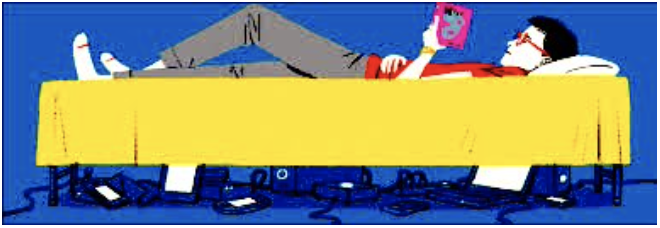 4. JUDGING (J) vs PERCEIVING (P)
Preferred way of DEALING WITH the world around us, & can be either Introverted or Extroverted
• Judging (J) – These people prefer to be in charge, tend to be highly organized & methodical.
 They’re neat, orderly, stable, & like to make extensive use of lists & calendars. They want things to be settled – so they plan & get things done way ahead of time.
EXP: Someone who form & expresses judgments / brings closure to an issue so they can move on / picks places to go ahead of time by doing research / concentrates on reaching goals & ‘doing’ their lists…..
— 👠 —
• Perceiving (P) – These people prefer to let things play out by themself. They’re usually spontaneous & flexible, having a more open-ended approach to plans, deciding their next move in the moment, & tend to get things done at the last minute.
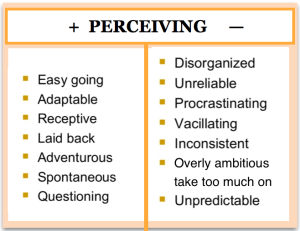 EXP: People who postpone decisions to see what other options are available / decide what else to do as we’re doing it, rather than forming a plan ahead of time / do things at the last minute / do a lot of research but not act on it because we can’t decide…..
NOTE: The practical differences between Js & Ps are quite noticeable & sometimes cause a lot of conflict.
 EXP : A strongly J person can become very frustrated by a P’s careless casualness or indecisiveness, while a strong P can feel limited & controlled by a strong J , BUT even so will may make use of the J‘s extensive planning & preparedness (like on a trip), which can cause the J to feel angry for being taken advantage of!
On the other hand, a ‘mixed’ couple (one of each – friend, spouse, biz partners…. ) can be complementary if they’re both mature enough to accept their different styles, & use those to accomplish mutual goals.
The 4 MBTI levels combine into 16 types, 8 Introverted & 8 Extroverted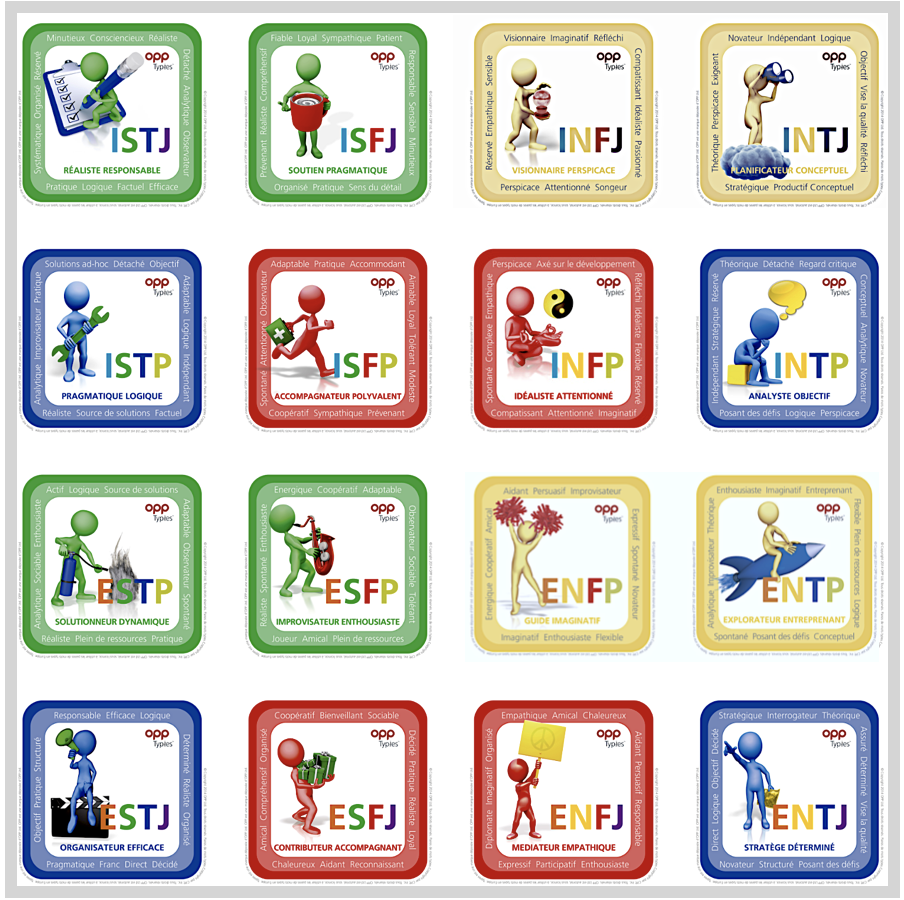
«
NEXT: MBTI Basics #2b
 HEAL & GROW for ACoAs