
 I ENVY OTHERS WHO
easily know how to function
PREVIOUS: Disorders #2a
SITEs : • Help with Organizing your mind
• Psychological Disorders: PowerPoints with Video Links & Lecture Notes
(To purchase. For teachers)
⬅️ IMAGE : Truman College Wellness Center
UNHEALTHY
Psychiatrist Otto Kernberg (Object Relations Theory) wrote that someone is mentally healthy if they have a well-organized personality, which functions reasonably well because their reality testing is mostly intact. Such people have an integrated sense of Self, with an accurate Self-to-Other concept. This helps to hold opposite feelings about someone – at the same time – without changing one’s realistic opinion of them. (not B or W) . Everyone is experienced as a ‘whole’ entity, with both positive & negative qualities.
NOTE: This does not mean we like everyone!
Using the criterion of personality organization, Dr. Kernberg marked 3 degrees of dysfunctional severity: Neurotic, Borderline & Psychotic states. The more mentally & emotionally disorganized, the worse the person’s functioning. To evaluate, ASK :
1) Is my reality-testing intact? (Explanations)
2) Do I have an integrated sense of self & others?
3) What is the maturity level of my defenses?
ACoAs fall into any one of the Mental Health Levels, depending on the individual’s native personality, the amount of trauma suffered, social environment & spiritual beliefs. However, all are wounded in some form. Unrecovered, most of us think that our usual way of being is our actual personality (who we were born as) because it’s how we’ve been since childhood. 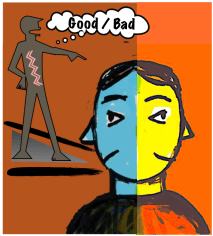
But anyone growing up in a very damaging family forms a False Self as protection, which combines PP & WIC, & houses the different disorders. Because of living thru’ years of trauma, many ACoAs have a fragmented sense of Self (not about multiple personality or schizophrenic dissociation).
Our wounded mind stores separate split-off images of ourself & others as being either all bad or all good at any given moment, based on a current event. So, when someone we think we know well and rely on to feel safe is sometimes nice to us & then turns on us at other times (parents, a mate, best friend….), we’re shocked & confused.
When that happens, the WIC actually thinks they’ve now become a totally different person – rather than realizing we’re dealing with one being who’s showing different aspects of their (perhaps unhealthy) personality.
▪️Most of the time it’s actually our internal experience of someone that has changed – in response to their current behavior or mood. This is a reflection of our own B & W thinking, usually believing ourself to be ‘all bad’ & others as ‘all good’. So when they become the ‘bad one’, we get scared. The WIC doesn’t realize that it’s normal to have inconsistencies & accept that the person is still the same, but complex. This distortion prevents us from holding a consistent sense of Self & others across time & in a variety of situations.
 EXP: If you smile & are friendly to me, you are a totally good person – in that moment – who I like & feel safe with. If at some other time you hurt my feelings or ignore me, you are then a totally bad person – in that moment – so I absolutely don’t feel safe with you, and blame myself for what happened.
😟 As a way of coping, the brain compartmentalizes traumatic experiences to keep us from feeling too much pain (physical &/or emotional) – creating a dissociation, spacing out. A part of our attention is missing, so we don’t recognize what we’re feeling, not noticing or hearing things around us, or that’s right in front of us all the time.
What’s missing is a connection to some or all of our emotions.
NOTE: ACoAs can develop mental health by getting the right help & consistency using all the tools available throughout life. With FoO work, most can improve if not totally heal, but not all wounded people are willing to go thru the process needed to Recover.
(CHAT BOT – talk to computer re. moods (Woebot on Facebook Messenger)
«
«
NEXT: Disorders #3a
 HEAL & GROW for ACoAs