

PREVIOUS: E/I anatomy #1
SITE: “How to read body language…”
Es = Extroverts
Is = Introverts
1. NERVOUS SYSTEM // 2. FACES
👁 👁 3. EYES
Some studies suggest that eyes of Es are drawn to warmer colors, like red & orange (exciting), while eyes of Is go toward cooler ones like blue & green (quiet). It may be related to Es finding their energy in activities, people & things, while Is are more energized from within.
There are 2 primary iris types – Jewel & Flower, modified by 2 secondary patterns – either Stream or Shaker. (longer descriptions). Personality styles are different for each, modified by other factors such as birth order, physical environment …..
Iris structure indicates a fundamental genetic tendency, rather than what someone has developed or learned throughout life. (shorter)
JEWEL: Thinking-oriented, analytical type // FLOWER: Feeling-oriented
STREAM: Kinesthetic type // SHAKER: Extremist or movement-oriented
Using the structural indicators of a person’s heritage – irises of Is & Es were compared by looking at the ring of expression, based on variations in fiber density encircling the pupil. This physical ring suggests how far out from their core a person is psychologically willing to extend themselves (E vs I style), & how easy it is for others to pick up on their energy field.
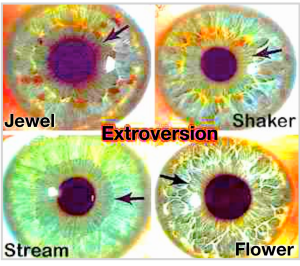 For Extroverts – the ring is quite a distance from the pupil, (arrows), easily noticeable, showing a greater outward-orientation.
It’s considered a physical expression of the basic underlying E personality:
The wider the eye’s central aperture, the easier & ‘wider’ Es can express themself, since they’re more likely to extend themself to whoever’s nearby 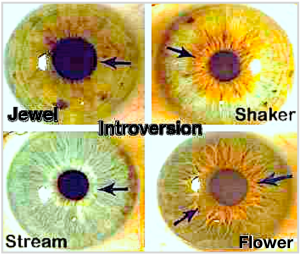
With Introverts, the ring of expression is so close to the pupil that it’s much harder to find – one has to get very close & really focus to see it at all. This is considered a reflection of the I style – the tendency to be invisible – a familiar but irritating & perplexing condition (to Es). It’s especially noticeable in withdrawn ‘extreme introverts’. (see last ¶ in Part 1)
👍🏽 👎🏽 4. HANDS
Using the ‘BIG 5’ Dimensions, research exploring hand prints identified 6 different sets of ‘vertical’ patterns for Es & Is, consistent in both male & female groups. (Holland, 1992)
Recent studies have added a 7th vertical hand factor related to these dermato-glyphic lines, making it possible to separate all Es from all Is who were studied. Detailed phantom pictures made for the hand help to identify underlying biological mechanisms. (⬇ CHART info) (Also See Google Images)
NOTE that these finding represent averages – interesting but not definitive.
EXP: Based on the charts, this female ENFJ has
• the long middle finger AND the head-line crease not quite touching the life-line of introverts, BUT
• the wider palm width of extroverts & the relatively straight unconnected heart-line of ambiverts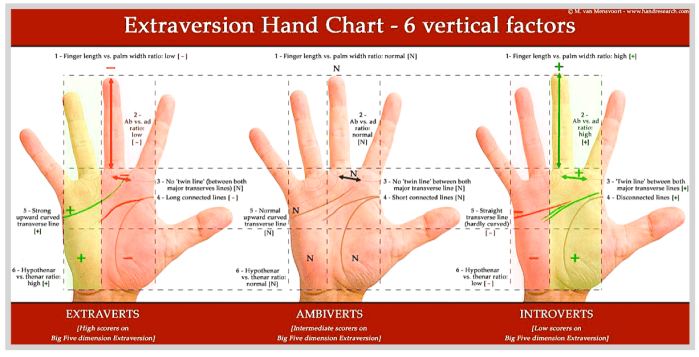
«
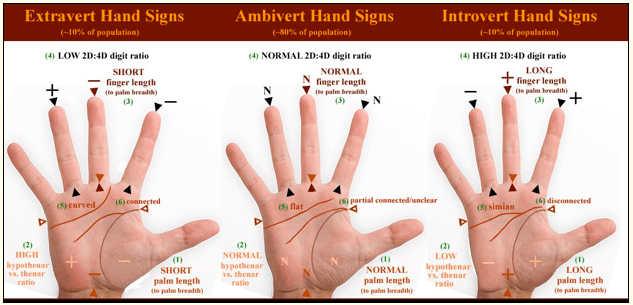
EXTROVERT hand indicators
Shape: • Shorter palm width, relative to breadth
• Hi mount of moon vs. mount of venus
Fingers: • short, relative to palm breadth
• Low 2D:4D digit ratio (thumb to ring finger)
Lines: • Sharply curved upward heart-line crease
• Heart-line crease connected to life-line
INTROVERT hand indicators are the reverse.
👄 5. LANGUAGE / Talking
People communicate differently because of the longer vs shorter brain-blood-pathway, which can lead to forming the wrong conclusions about each other, causing many misunderstandings
• Es tend to engage by jumping into conversation, without enough reflection. Is are more likely to take the time to think, which can make them seem ‘slow’ or stuck-up
• Es talk more abstractly, (“This article is interesting / Lets get some food”). Most are spontaneous, moving quickly thru their life, so are not as verbally accurate or detailed. People scoring higher in extroversion tended to use more words having to do with relationships
• Is are more concrete (“This article is very informative / Maybe we could go for dinner”). They tend to be more cautious (with words like: perhaps, maybe…), use more articles (the/a) – which refer to objects or events rather than people, & more quantifiable terms (#s, dates, times….)
Re. learning a second language, Es have the upper hand because they’re more willing to push whatever they know to the limit. Unlike Is, they take more risks in using what they learn – more willing to make conversation in the new language, in & out of the classroom.
NEXT : Introversion, #1
 HEAL & GROW for ACoAs