SAGE – & NEURO-plasticity

PREVIOUS : SAGE – Dark Side, #2

SITE : “The brain & our habits: Natural pathways to wellness

READ POST first : N-P= Retraining the brain (some overlaps)


NEURO (brain) PLASTICITY = Shifting the Balance of Power   🔆
“Neurons that fire together wire together” – Donald Hebbs
It’s the brain’s ‘biological, chemical & physical capacity to keep reorganizing its structure & function – allowing positive changes to occur (saboteur-to-Sage) .
Science tells us that our brain is not fixed – it’s a dynamic ‘environment’ with the possibility of continuous improvement – the remarkable ability to learn & adapt throughout life.
While younger brains are more malleable, humans can still keep learning past age 18-21 well into seniorhood – one key to protecting us from degenerative diseases such as Alzheimer’s, dementia & Huntington’s.

🧠 Neuro-plasticity occurs in 2 places :
• the hippocampus – focused on long-term & spatial memory,
• the cerebellum –  operating short-term & muscle-memory.

🧠 Brain’s 2 Neuro-plasticity abilities :
structural = to physically change its ‘architecture’ as a result of experiences & learning 
functional =  to restructure itself to compensate for damage or injury. So if one area is no longer working properly, others can take over. (MORE….)

The BRAIN is made up of neurons , tiny messengers that fire electrical & chemical signals throughout our body.  When we’re born, we have around 2,500 synapses per neuron in the cerebral cortex. Within 2-3 years, that grows to about 15,000. But by the time we’re adults, they have more than halved – known as synaptic pruning.

When a signal (from a thought or action) activates a neuron, it triggers the others it’s connected to, & when that happens they get somewhat joined. There are several directions that signal can go – dominant, well-formed routes, and lesser, fragile new ones. EXP : When the brain processes a new thought, it starts out as a lesser pathway. But when it gets activated again, it’s more likely to go down the same path.

❗️Over time repetition of the same thoughts & actions becomes a “neural pathway,” which become automatic habits – helpful or harmful.
Building new Neural Nets to increase personal growth happens by creating & strengthening more beneficial pathways —> through the repetition of positive mental & physical habits, which can be observed with MRI imaging.

EXP : Like a baby trying to walk for the first time, neurons connect from —> the brain to —-> various muscles, for balance… & battle for a while before stabilizing. Eventually, as adults, we don’t need to think about walking anymore, it’s become a well-ingrained pattern.

🌿 SAGE vs SABOTEURS
REVIEW : Our physical brain is made up of two halves & we need both.  However, in terms of imagery – think of the right side as healthy , & the left as unhealthy.
♠️  LEFT : The Survive Region –  houses harmful Saboteurs which destroy any attempt to increase our emotional happiness & practical performance. ⬅️
Most people go through life with the 2 halves continually playing tug of war, with their Saboteurs winning most of the time – if not always.

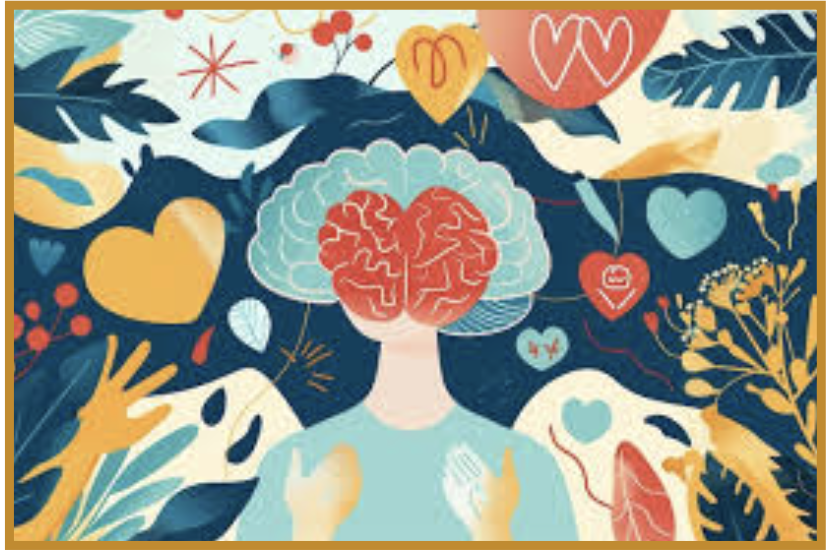
♥️ RIGHT : the Thrive Region (PQ brain), provides available mental sanity & stability.  The Sage lives in a different region of the brain – in the middle prefrontal cortex , the amygdala’s “empathy circuitry”, & parts of the right brain.  Activating this combination releases endorphins that counter the negative impact of stress-induced cortisol. (IMAGE w/ definitions ↗️ )

To reach our potential – as far as possible – requires strengthening the ‘Right’ & weaken the ‘Left’ sides.  Fortunately, the Sage provides the power to do this because it’s anchored in who we are at our core, & can resist the drama & lies of the toxic beliefs.
«

«
Sage-strengths generate positive emotions even when dealing with life’s challenges, such as compassion, empathy, gratitude, the joy of self-expression…
✧ It also allow us to be calm & have clear-headed, laser-focused thinking, with big picture awareness of what’s important, to choose the best course of action.

Using Sage-wisdom, we gain perspective, finding the opportunities we need & the gifts we long for.  With perseverance, intercepting Saboteurs & activating the Sage rewires the brain at the root level, rather than just treating symptoms. This has a wide-ranging impact :
🔅 internally, providing a sense of safety & peace
🔅 externally, as better stress management & improved performance in creativity, leadership, relationships, persuasion, resilience, selling ….
«


«
NEXT : Sage & PQ

SAGE – the DARK SIDE (Part 2)

PREVIOUS :  ARCHETYPES – #2

SITE : Feminine Archetypes Quiz 


Inner Sage’s WEAKNESSES
The Sage personality also has limitations. On good days, the Sage infused person can be articulate & helpful. On bad days, they can be one of the coldest & most arrogant individuals. Since knowledge is their ‘god’, they can look down on others who lack it as being inferior, & critical of others who don’t agree with their ideas.

🐽 Detachment: With its strong focus on introspection & its internal world, the I.S. may become too disconnected from the external world, making it hard for the person to engage with others or be present in day-to-day activities

🐽 Inability to say “no”: the I.S. can have trouble setting boundaries & prioritize your own needs, so you often take on too much responsibility for others, risking resentment &/or burnout 

🐽 Overthinking: the I.S. can sometimes become so deeply lost in introverted thought that you get ‘analysis-paralysis’, so you struggle to make decisions or take action

🐽 Perfectionism: the I.S. can harbor such high standards —
— for yourself, so you have trouble accepting imperfections, causing self-criticism…. and
— toward others, having unrealistic expectations, frustration & disappointments

🐽 Tendency to isolate: because of its ‘private’ nature & a tendency to obsess, the I.S. can too easily withdraw from social interactions, limiting personal growth & connection with other

DARK SIDE
Because the Sage is an incredibly powerful archetype, when negative, it is very dangerous. To safeguard against grandiosity requires self-compassion, humility & self-knowledge via inner work.
Sage personalities need to be wary of slipping into ivory tower thinking, dogmatism, & coming across as being without feeling or empathy. However – you don’t want someone as smart & powerful as a Sage to be without flaws, nor should they be picture-perfect.

Shadow archetypes related to the Sage
a.  Detached Manipulator (Trickster, shadow of the Magician) – the focus is on self-deception since the Sage is associated with cognition.
This archetype has a cynical disconnection from human life & values. Instead of sharing knowledge, it is focused on controlling others, by withholding specific knowledge to hinder the progress of others.

b.  Deviant Guru
Developing true moral character requires the completion of internal alchemical processes like shadow work , where the person brings their unconscious into awareness.
While gurus & spiritual teachers may be popular, getting to know one’s dark side is not. As such, the absence of moral refinement in culture & society manifests the shadow of the sage archetype in abundance.

Actually, very few gurus know their shadow. Instead, these narcissistic leaders believe they have “transcended” their body & mind. In reality, they have just dissociated from the True Self. 

With the prevalence of false gurus also comes the popularity of cultism. “Spiritual “cults are everywhere, some in physical groups, others virtual or purely ideological. They form as a psychologically symbiotic relationship between the False Guru & confused students/devotees.  The cult leader is driven by grandiosity & ego-inflation, feeding on the projections of their followers.

c. Delusional Mystic
This version has mistaken their own fantasies for Reality, secretly believes they are the sole proprietor of truth. In their grandiosity, the basic insights they might have originally gained turns progressively more distorted – eventually becoming completely divorced from reality.
Instead of comparing their insights with a community of equals (the “sangha”), they isolate from others. If they attract followers, the group instantly turns into a cult, that eventually can become self-destructive.

d.  False Prophet – Charlatan / False Teacher
They are a peddlers of “knowledge” whose real aim is to accumulate money & physical possessions. In the West this archetype is driven by what can be called “the Business of Enlightenment”.

The main difference between the Detached Manipulator & the Charlatan is that the latter knowingly deceives others. Obviously there are far more False Prophets in today’s world than authentic Sages. 

EXP : popularization of “sex techniques for spiritual development (Deviant Guru) was a combination of charlatans & marketers wanting to profit in the marketplace.
All genuine Sages & classical texts warn against falling for the hype.

(modified from “The Sage Archetype: Knower of Wisdom and Seer of Truth

NEXTthe DARK SIDE (Part 2)

SAGE – the DARK SIDE (Part 1)

PREVIOUS : Archetype – #2


SHADOWS WITHIN
“The brightest flames cast the darkest shadows …. Like an eclipse of the sun, the Shadow eclipses the true nature of a person. ”

⛔️ Carl Jung identified “shadow” as the hidden side of our personality. The first of his 3 archetypes of human development, he saw it as an integral part of the unconscious mind.
⚠️ Concept : In our early development, many infantile impulses, “negative” emotions, positive attributes & power drives – tend to get repressed.
Gradually anything opposed to our conscious Self-identity, added to the original disowned self – is denied – at least to oneself.

❎ Sadly, some people (ACoAs, addicts, depressed, differently wired….) also suppress or deny their talents, natural cleverness, intuition, dreams….. relegating them to the Shadow side as if they were something to be ashamed of ! – because those wonderful parts were originally denied or punished in childhood.

Jung noted that Whatever is rejected from the Self appears in the world as an event”- an indirect expression, most often in a self-defeating way. “Until you make the unconscious conscious, it will direct your life , but you will call it fate.” ( IMAGE  & More….)

Deep within, the Sage’s Shadow involves T.E.A . =
(T) Logical Effectiveness
(A) Concrete Experience, but
(E) Disconnected from Emotional Awareness
Everyone carries a shadow side. The more it’s hidden from our awareness, the darker & denser it becomes – an unconscious anchor scuttling our best intentions & goals. The longer it’s neglected – the greater the inevitable downfall.

At the other extreme —  danger comes when we identify with the image. EXP : Believing one is a Sage leads to grandiosity (ego inflation). And some Sages who think too highly of themself are only mediocre.  (4 variations in Part 2).

♣️ The “Intellectualdefense
 At its best the SAGE is identified by the wisdom it accumulates over time. Therefore the Shadow – already hidden – covers its self-appointed, shameful character flaws by developing the “Intellectual”.
This “Computer” toxic role is not about intelligence but rather an imbalance & misuse of the Sage’s inherent qualities of insight & self-discovery.  It thinks too much, tries to make everything have ‘meaning’ , & becomes disconnected from the physical body.
The Intellectualizing person tries to control their world through lots of information, but misses basic messages from their body & inner voice/ intuition which urges them to relax, to take time to process emotions & experiences.  Always striving to achieve more, while catastrophizing about potential disasters, they’re left feeling anxious & exhausted.

Along with suppressing most emotion (“I don’t know how I feel”), a major characteristic of this defense is to constantly be critical of self & others. It’s a distortion of insights derived from looking inward, causing oneself unfounded guilt & painful obsessions.

Intellectualism is stressed as a virtue in the modern world, an expression of Magician archetype energy.  The drive to chase FACTS for their own sake (“Cerebral Narc“), or used to manipulate everything around us – has serious limitations & complications.
Jung believed that the Western dominance of & over-emphasis on rationalism is a form of neurosis – the result of a wounded ‘feeling function’ (Enneagram)

♥️ Individuation
“One does not become enlightened by imagining figures of light, but by making the darkness conscious.” ∼∼ C. Jung

As a part of the collective journey of human psychological development, the Sage has to undergo its own process of individuation. This requires combining all the divergent parts of each of us – the lifelong steps & stages needed to distinguish the Self from our conscious & unconscious elements.

To become whole, the first part of this process is to identify & integrate one’s Shadow. In the absence of psychological unity, there’s a constant feeling of an internal void.
Many people are attracted to cult leaders & other groups because of this “missing something” feeling.  Sadly, internal tension can not be resolved externally – only by going inside. (see “Individuation” posts)

EXP : In The Lord of the Rings, the wizard Gandalf goes thru a transformation when he confronts his shadow in the form of the demon Balrog.  Gandalf ‘the Grey’ sacrifices himself to protect others & falls into a dark abyss with the demon. Later, he emerges as Gandalf, the White. (⏩️ ART by Dakota Randall)

NEXT : Sage – Dark Side, #2

SAGE & ARCHETYPES – Part 2

PREVIOUS : Sage
Archetypes – #1


The SAGE is a major archetype (cont)

Archetypes are useful in fiction & movies because they make it easy to quickly grasp the basic traits of the main characters – without detailed descriptions. Sages are often shown as detectives, experts, philosophers, professors or teachers, scientists…..
EXP : Lao Tzu – ancient Chinese philosopher. Rumi – famed Persian poet & mystic. Morrigan – a powerful Celtic figure. Gwydion – the Welsh magician.

ALSO: Merlin, Morpheus, Obi-Wan, Deepak Chopra….. Professor McGonagall, Rosalind in “As You Like It”, Sophia in The Golden Girls….

In BUSINESS = some SAGE companies: BBC, Harvard, NY times, Oprah, TED talks

3 VARIATIONS of the Sage Archetype
♦ Guru –
with intuitive insights & spontaneous knowledge of the Self  (in Part 1). Their words pierce the ego’s walls to activate the student’s ‘Guru within’ the individual. Legitimate ones also “transmit” their energy to the student, which supports their Self-realization.

♦ Magician – While Jung focused on the Sage,  Neo-Jungian Robert Moore focused on the magician archetype as the knower & creator of worlds (‘the Wizard’).  Both are associated with cognition & moral refinement (Sage / anti S), the main difference being the emphasis on how they’re expressed in the psyche.

🕸️ The Magician’s emphasis is on acquired knowledge which the ego grows over time, more of a general pattern in the process of healthy development. Magician energy is active, helping to make things happen in the external world, but also represented by private corporations.

Magician energy can come in many forms – social or business, wealth & influence, personal magic…. Its domain covers any area of knowledge that takes special training to acquire.  EXP : establishing careers, practical skills…

🦉 In contrast, the Sage’s knowledge is deeper, more primordial, with an emphasis on truth & enlightenment. It’s innate, so its knowledge can not be acquired.
Sage energy is more passive – so connecting to it can guide us to our inner world, as well as give a desire to help others, such as in charities & nonprofits.
It represents intuitive awareness of oneself & reality – just the opposite of the Magician : to access the Sage’s wisdom the ego must take a back seat, surrendering to a source greater than oneself.
♦ Shaman – also known as Medicine Man/Woman, their knowledge is mainly focused on Nature & the natural world. They often used various herbs, plants & mushrooms to create mystical peak experiences in the initiate.
In traditional societies they were the healer who restored life, found lost souls, & discovered the hidden causes of misfortune. They restored wholeness & fullness of being for individuals & in the community.
Other SUBTYPES
Analyst: Thinks things through & synthesizes learning
• Expert : Has highly developed knowledge & expertise
• Investigator: Researches & gathers information
Mentor/teacher: Shares wisdom with the world
• Philosopher/ contemplative: Uses deep thinking to seek & create clarity

AREAS of Sage Archetype’s Life
💰 Wealth – People with the Sage archetype are usually masters of various skills. They can use them to stay afloat in the worst situations –  never having to worry about money, because they know how to manage their finances.

But, those who live from this archetype are not super rich because they rarely put their knowledge to practical use. Sage energy needs to realize that knowledge goes beyond books. There’s much to discover when skills are applied in the real world.

🫦 Health – The Sage is constantly working on expanding their knowledge. Stimulating the mind feels more satisfying to the Sage than physical exertion. Since movement takes a back seat in their life, Sage people often lack good health.

This personality type needs balance between body & mind. To stay fit exercise must be a part of the Sage’s daily routine.  But the Sage’s emotional well-being depends on processing their acquired wisdom, so they also need regular quiet time.

💝 Love – for Sage people in love, being comfortable with the romantic partner is their #1 priority. They crave predictability, valuing stability & commitment. These 2 factors are needed for them to feel satisfied in a relationship.

When it comes to attracting a romantic partner, Sage resorts to its strength i.e. knowledge. Yet it will benefit by learning some social nuances to thrive in partnerships.
Naturally – Sage looks for & appreciates both thoughtfulness & intelligence in their partners.

NEXT : Sage – the DARK Side, #1

SAGE & ARCHETYPES – Part 1

PREVIOUS : SAGE – Anti-Saboteur

SITE : Archetypal Female in Mythology & Religion

ARCHETYPES are ancient symbols that exist across all cultures in all eras. It comes from the Greek word ‘archein’, which means ‘the original type or pattern’.

➣ A person’s qualities are called complexes (groupings), which live in our personal unconscious, derived from past experiences.
➣ In contrast, Archetype elements are impersonal, universal, & formless – sets of ideas & experiences that “come upon us as fate”, but affect us at our core.

Carl Jung argued that all humans share a “collective unconscious”– concepts we innately know & understand. He noticed they keep recurring indirectly in stories & mythologies throughout societies & religions, so can be identified & measured. (Each one explained)

Jung’s student, Erich Neumann (1954), stated that archetypes are similar to our internal organs – they’re relatively similar in all of us, but invisible & barely noticed.
EXP : The Self is the archetype of wholeness or transcendence. Jung said that it’s what we are but do not know we are.
It’s the center of our psyche, the totality of our conscious & unconscious parts.  In Jungian terms, the Self is both personal & impersonal, the ego & our Inner Spirit. ‘Arriving’ at the Self is the final stage of the individuation process.

NOTE : Many people mistakenly assume that ‘characters’ are Jungian archetypes, so may assume that Loki is the Trickster. Not so – while a character can personify archetypal qualities, the person itself is not.  ✱ Archetypes are not individuals, instead are broad but subtle core ideas embedded in the larger story of humanity.
Also, archetypal energy is expressed in common motifs like birth, marriage, death & any kind of initiation ritual.

The SAGE is a major archetype
Jung believed it’s the innate spiritual aspect of everyone’s personality – the True Self, with no restrictions or limitations. Unfazed by life’s conditioning & chaos, it sees all, knows all.

He called the Sage the senex (Latin for old man), the wise old man (see YouTube) or wise old woman called the crone. It’s a symbol that represents information accumulated through time & experience – from patience, learning from mistakes, & figuring out how the world
The Inner Sage (I.S.) focuses on universal Knowledge, & to find The Truth in all things it ferrets out the sources of information.  At its best, it protects & guides with Insights, Dreams, or Life Lessons. And it can be expressed as a person’s psyche, such as Jung’s Philemon, Nietzsche’s Zarathustra……

Ironically,  Hannibal Lecter is also considered a Sage. He was had an essential part in guiding Clarice Starling during her pursuit of the serial killer Buffalo Bill, even though his version of “guiding” was to direct her to a jar with a man’s heart in it. (see ‘SAGE – the Dark Side‘ post)

NOTE : There’s a lack of Sage-diversity in pop culture, the majority being male, but more recently – the female Sage is portrayed as cop or shrink.
However, for thousands of years there has always been a female embodiment of this archetype – as a wise, powerful character who mentors young seekers of Truth
EXP : Greek Cassandra, as Prophetess., Sumerian Inanna as feminine Warrior….

But also as negative feminine forces of the psyche, seen in fairy tales – evil stepmother, witch / old hag…. EXP : “Hansel & Gretel, Cinderella”
RARE archetype (0.1%) : The “Sigma Female”, known for their independence & STOIC self-reliance.  (More….)

FEMALE Sage NUANCES
• Deepest fear:
Not recognized for who she is. Confined or restricted. Losing touch with her intuition & inner guidance
GIFTS
• Empathetic Listening:
She actively listens with empathy, offering understanding & useful support. With a keen ear for honesty, she’s willing to hear any story that adds to her own store of Truth.

• Hidden Talent – Master researcher
• Intuitive Decision-Making: Like the Magician, she trusts her insights to make wise & informed choices. Her well-being comes from a strong sense of self & staying aligned with her values

• Patience and Serenity: She is calm & even-tempered. As the ‘queen of cool’, she’s composed even under pressure & in challenging situations.
• Signature move: Gives the advice you did not want but need to hear. She defies societal norms to embrace her true nature, guiding others to trust their instincts & break their constraints.
• Special ability: Taps into her deep intuition & primal wisdom to lead others toward personal empowerment.

NEXT : Sage Archetype, #2

The SAGE – the Anti-Saboteur

PREVIOUS : Saboteurs 9 & 10


DEF : The Inner Sage (I.S.) personality focuses on universal Knowledge, always searching for Truth, believing that it will lead to personal freedom.  It can be considered a kind of explorer, but while the explorer’s journey is external, the Sage’s investigations take place internally. The Sage archetype is expressed as an intuitive, reflective & wise person.

▶︎ Perspective – The Sage is the exact opposite of the Judge. Whereas that saboteur finds everything that’s wrong (or could be), the Sage accepts all experiences as opportunities or gifts.  When the Sage is activated, we’re operating from another part of the brain, which gives us access to infinite wisdom, providing the deepest insight. It’s balanced & doesn’t involve the ego, so helps us make good decisions.

CONTRAST : ⚠️ Saboteurs react to challenges in ways that cause stress & generate painful emotions
🔆 The Sage handles challenges with T.E.A.  Ts = curiosity, creativity, humor & self-confidence,  Es = comfortable emotions like calm, enjoyment, empathy, gratitude…. and As = clear-headed, laser-focused actions.
▶︎ Color: Violet

▶︎ Symbol:  Lotus

▶︎ Animal : Owl – associated with the ability to see what others cannot.  Known for its ability to navigate in darkness with keen observation, the OLW fits with the Inner Sage’s amazing vision & understanding.  EXP: Dumbledore & Yoda

▶︎ Motivation – The Inner Sage is driven by a hunger for personal growth, self-reflection – often self-directed.
a. Internally – when in Sage mode, the person works to develop skills & understanding, from a deep desire to continually improve personally & professionally. They find more value in effort & accomplishments than in external honors.

The Sage personality type is likely a loner, sometimes a hermit. Many devote themselves wholly to research, so they can get bullied & called nerds.
Also, determined to hunt down every scrap of ‘reality’ on a chosen topic – no matter what – Sages can sometimes put themself in danger or hurt others, since some Truth can be crushing.

b. Externally – the person’s purpose is to have a meaningful impact on the world – sharing their knowledge in thought-provoking writing & conversations – known for their expertise in their field. 

People look up to, respect & fear someone who is in Sage-mode.  Knowledge is power, but the Sage more often uses ‘soft power’ – the ability to co-opt rather than coerce.
If Sages do want recognition, they prefer acknowledgment for contributions to a larger goal or vision, rather than personality. Being respected & looked up to can provide the freedom to share their insights & wisdom, as in teaching or mentoring.

Sage is responsible for cultivating 2 vital elements essential for psychological development :
a. Cognitive Consciousness – relatively easy to develop. It takes daily devotion, discipline, & the will to cultivate one’s mind – learning, observing. reading….
and
2. Moral Refinement – quite a different matter. It comes from a life-long successful Hero’s Journey – an arduous individuation process. Developing true moral character is hard-earned.

▶︎ STAGES of the Sage Personality
1st : Confusion, with universal questions, wanting answers
2nd : The starts of its journey to find Truth. Here, it will seek the help of experts

3rd : When Sage discovers Truth, it starts to analyze different facets of it, using creativity to explore its depths. After a thorough understanding, it becomes an expert others consult

4th : Finally, the Sage achieves the status of master in its field
5th : Negatively, Sage can become extra-rigid & dogmatic.

▶︎ STRENGTHS
🦉 Emotional intelligence: tInner Sage (I.S.) can recognize, understand & manage its emotions, & effectively coping with the emotions of others, leading to consistent personal growth & strong inter-personal connections

🦉 Empathy: With a heightened ability to understand & share others’ emotions, the I.S. can easily relate to life experiences other than their own, & support people from different backgrounds

🦉 Intuition: I.S. has a strong sense of Inner Knowing, giving access to their natural intuition for guidance & insight in many different situations

🦉 Spirituality: I.S. has a deep connection to Spiritual Self, that helps develop grounding & inner peace, enhancing their personal-growth journey

🦉 Wisdom: Drawing from a life-time of experiences & learning, I.S. broadens its understanding of the world, making it a source of wisdom for others.

NEXT : SAGE – Archetypes, #1

Internal SABOTEURS (Types 9 & 10)

 PREVIOUS: Saboteurs #7, 8


FROM : “POSITIVE INTELLIGENCE” — Shirzad Chamine

9. The STICKLER accomplice
⛓️Description
 It’s about Perfectionism – the need for order & organization taken too far.
⚙︎ Can be irritable, tense, opinionated, sarcastic
⚙︎ Highly critical of self & others, AND too sensitive to criticism
⚙︎ Punctual, methodical, reality oriented
⚙︎ Strong need for self-control & self-restraint
⚙︎ Works overtime to make up for others’ sloppiness & laziness.

⛓️ Beliefs
⚙︎ I know the right way
⚙︎ I need to be more organized & methodical than others so things get done – right
⚙︎ If you can’t do it perfectly, don’t do it at all
⚙︎ Others too often have lax standards
⚙︎ “Right is right & wrong is wrong. I hate mistakes.

⛓️ Emotions
⚙︎ Anxious that others will mess up the order & balance I have created
⚙︎ Constantly frustrated & disappointed with self & others for not living up to ideal standards
⚙︎ Suppressed anger, with sarcastic or self-righteous overtones

⛓️ Justification Lies
✑ I know how things should be done & must do the right thing
✑ It is up to me to fix whatever messes I encounter
✑ Striving to be perfect is a good goal,  & it makes me feel better about myself
✑ To act this way is a personal obligation
✑ There’s usually a clear right & clear wrong way to do things.

⛓️ Original Survival Function
⚙︎ The Stickler may have generated a sense of order in the middle of a chaotic family dynamic, or earned acceptance & attention from emotionally distant or demanding parents by standing out as the irreproachable perfect kid
⚙︎ Trying to be perfect was a way to suppress the voice of constant self judgment & fear of others’ disapproval
⚙︎ If I did what they wanted it temporarily stopped their interference & reproaches. Perfection a brought a little relief

⛓️ Impact on Self and Others
🪄Causes resentment, ongoing anxiety & frustration & self-doubt in oneself
🪄Causes rigidity, reducing flexibility in dealing with change & others people’s difference in styles
🪄Others get tired of the Stickler’s constant criticism, & resign themself that no matter how hard they try they’ll never please it.

⚙️ ACoA posts: Perfectionism,  Enneagram Type 1,

10. The VICTIM accomplice
⛓️ Description
⚙︎
An extreme focus on internal feelings, particularly painful ones
⚙︎ Fairly dramatic reactive. When things get tough, want to crumble & give up. Repressed rage results in depression, apathy, & constant fatigue
⚙︎ Get attention by having emotional problems, or being temperamental & sullen
⚙︎ Martyr streak. If criticized or misunderstood, tend to withdraw, pout & sulk.
⚙︎ Unconsciously attached to having difficulties.

⛓️ Beliefs
⚙︎ I am what I feel. No one understands me  ⚙︎ I must be uniquely disadvantaged or flawed
⚙︎ I wish someone would save me from this dreary mess. Poor me
⚙︎ Terrible things always happen to me.”

⛓️ Emotions – I :
⚙︎ am envious / jealous, & always make negative comparisons with others
⚙︎ feel sad, unwanted, invisible, hopeless
⚙︎ feel alone & lonely, even when I’m around people I’m close to
⚙︎ tend to brood on my painful emotions for a long time

⛓️ Justification Lies
✑ If I’m perfect,  I’ll get some of the love & attention I desperately want
✑ Someone will feel sorry for me & want to take care of me
✑ Sadness is a noble & sophisticated thing that shows exceptional depth, insight & sensitivity

⛓️ Original Survival Function
☁︎ This Saboteur often develops from having truly been abused (physically, sexually….) in childhood
Also – not seen & accepted by family, so becomes convinced there’s something especially wrong with you
♥︎ Victim is a strategy to squeeze out some affection from those who would otherwise not be paying attention.
★ This attitude mimics a false sense of aliveness

⛓️ Impact on Self and Others
🪄 Vitality wasted through internal toxic brooding
🪄Backfires by pushing people away, while needing connection
🪄Others feel helpless & guilty that they can’t fix you. They get frustrated because all they can do is put a temporary BandAid on the Victim’s pain.

⚙️ ACoA posts
What is Self-Hate, Abandonment Pain Now, Our Wounded Inner Child
NEXT : The SAGE, Part 1

Internal SABOTEURS (Types 7 & 8)

PREVIOUS:
Internal Saboteurs #5, 6


List from :
“POSITIVE INTELLIGENCE” –  Shirzad Chamine


7. The  People-PLEASER in You
⛓️ Description
It tries to gain acceptance & affection – indirectly- especially without being asked for help, or someone even needing any.
YOU :
⚙︎  lose sight of your own needs & become resentful as a result
⚙︎  have a strong need to be liked by everyone, trying to earn it by helping, pleasing, rescuing, or flattering them
⚙︎ can’t express your needs directly & clearly
⚙︎ need frequent reassurance by others that you’re ok with them
⚙︎ do so manipulatively by having people feel obligated to reciprocate all your attentions.

⛓️ Thoughts
⚙︎ “To be a good person I should put the needs of others ahead of my own
⚙︎ It bothers me when people don’t notice or care about what I’ve done for them
⚙︎ They can be selfish & ungrateful
⚙︎ I give away too much & don’t think of myself enough
⚙︎ I can make anyone like me
⚙︎ If I don’t rescue people, who will?

⛓️ Emotions
⚙︎  It feels selfish if I express my own needs
⚙︎ I worry that insisting on needs will drive others away
⚙︎ I resent being taken for granted, but am afraid to say it

⛓️Justification Lies
 — I don’t do these things for my benefit
— I help others selflessly & don’t expect anything in return
— The world would be a better place if everyone did the same

⛓️ Original Survival Function
 The Pleaser tries to earn validation helping others. This is a sneaky way to have one’s OLD unfulfilled emotional needs met
It is fed by two original assumptions picked up in childhood :
1. “Other people’s needs are more important than mine” (rule)
2. I must provide love & affection in order to get any back, because I’m not actually worthy of it

⛓️ Impact on Self & Others
🪄Can jeopardize or prevent taking care of one’s own needs including emotional, physical, & financial
🪄Can lead to emotional resentment & physical burnout
🪄 Others can develop dependence on us (infantilize) rather than learning to take care of themself.
🪄Eventually the helpee feels manipulated, obligated, guilty.

🦠 ACoAs posts
Co-Dep People-pleasing, Enneagram Type 2, TOXIC Family Rules

8. The RESTLESS Part in You
⛓️Description
Constantly in search of new stimulation & greater excitement in the next activity or busyness.
YOU :
⚙︎ rarely are at peace or content with the current activity.
⚙︎ are easily distracted, can get too scattered
⚙︎ stay busy, juggling many different tasks & plans
⚙︎ chase excitement & variety rather than not comfort or safety
⚙︎ quickly bounce away (escapes) from unpleasant emotions

⛓️ Thoughts
⚙︎”This isn’t fulfilling. The next thing has got to be more amusing!
⚙︎ I have to shift my attention to something interesting
⚙︎ These negative feelings suck
⚙︎Why can’t anyone keep up with me?

⛓️ Emotions – I’m
⚙︎ impatient with what’s happening now
⚙︎ longing what’s next that I’ll enjoy
⚙︎ afraid of missing out on any interesting experiences
⚙︎ restless, wanting more & more options.
⚙︎ worried that if I focus on any unpleasant feeling it’ll grow , never stop & be overwhelming

⛓️ Justification Lies
— Life is too short. It must be lived fully
— I don’t want to miss out on all the possibilities
The continual adrenalin rush makes me feel alive

⛓️ Original Survival Function
⚙︎ The Restless Saboteur is a strategy to find constant new sources of excitement, pleasure, & self-soothing (like thumb sucking)
⚙︎ Could come from early life experiences with inadequate parental comfort in painful circumstances
⚙︎ Restless self-indulgence is a temporary escape from having to deal with anxiety & pain

⛓️Impact on Self and Others
🪄 Under all the surface fun is an anxiety-driven escape from being present in the moment’s full experience, which might include unpleasant things
🪄 The Restless avoids a genuine focus on issues & relationships that truly matter
🪄Others have a hard time keeping up with the Restless’ frenzy & chaos, & they can’t build anything sustainable around it.

🦠 ACoAs posts
Enneagram Type 7, Fear of Responsibility, Repressing unpleasant emotions

NEXT : Saboteurs – Types 9, 10

Internal SABOTEURS (Types 5 & 6)

PREVIOUS:
Types 3 & 4 

SITE : Take the Free ASSESSMENT

FROM : “POSITIVE INTELLIGENCE” Book & Stanford lectures, based on the research of Shirzad Chamine


5. The HYPER-RATIONALIST accomplice
⛓️ Description
Its exclusive & intense focus is on the rational /mental processing of everything, including relationships.
⚙︎ Can lose track of time because of intense concentration
⚙︎ Mostly show feelings through your passion about ideas
⚙︎ Prefer to just watch the craziness around you, analyzing PPT (people, places & things) at a distance
⚙︎ Too private, not letting many people into your deeper feelings
⚙︎ Very strong penchant for skepticism & debate (argumentative)
⚙︎ When in the grip of this Saboteur you can be experiences as cold, distant & intellectually arrogant &/or or secretive

 ⛓️ Beliefs
“The rational mind is where it’s at”
⚙︎ Emotions are distracting & irrelevant
⚙︎ I need to shut out all intrusions from people or ‘situations’
⚙︎ Most people are so irrational & sloppy in their thinking (cognitive distortions?)
⚙︎ Other people’s needs & emotions distract me from my projects
⚙︎ Self worth is attached to mastering info & competence
⚙︎ What I value most is knowledge, understanding & insight.

⛓️ Emotions
⚙︎ Anxious about preserving personal my time, energy & resources against intrusions
⚙︎ Feel different, alone & not understood
⚙︎ Frustrated with others being (too) emotional & not rational enough
⚙︎ Often distrust other’s motives, or & doubt their sincerity

⛓️ Justification Lies
✑ The rational mind is the most important thing
✑ It should be protected from the wasteful interruptions of others’ messy emotions & needs, so it can get its work done.

⛓️ Original Survival Function
⚙︎ This Saboteur is a useful survival strategy in early childhood, from emotional turmoil & in chaotic environments
⚙︎ Escaping into the neat & orderly internal world of the rational mind creates a (false) sense of security or of intellectual superiority
⚙︎ It can provide attention & praise for being the smartest person in the room. Sometimes it can cause envy & being marginalized.

⛓️ Impact on Self & Others
🪄Intimidates less analytically focused people, such as the highly intuitive & ‘sensitives’  (INFPs?)
🪄Limits the depth & flexibility of relationships at work & personal life by analyzing rather than experiencing feelings

⚙️ ACoAs posts
Enneagram Type 5s,  Satir’
s COMPUTER Role , perhaps having  Alexithymia, MBTI – the ISTPs

6. The HYPER-VIGILANT accomplice
⛓️ Description
It’s burdened by intense worry about all the dangers in life, & what could /will go wrong. The Vigilant can never rest.
⚙︎ Always anxious, with chronic doubts about self & others
⚙︎ Constantly expecting accidents or attacks
⚙︎ Extraordinary sensitivity to danger, real or not (paranoia?)
⚙︎ Suspicious of what others are up to, since they ‘always’ mess up
⚙︎ Seek reassurance & guidance from authorities & institutions about rules & procedures

⛓️Thoughts
⚙︎  “If I make a mistake, I’m sure everyone’s going to jump down my throat
⚙︎ I need to know the correct way to do things, although I might not always comply
⚙︎ I want to trust people, but don’t believe their motives are good (in my favor)
⚙︎ When is the other shoe going to drop?”

⛓️ Emotions
⚙︎ Mistrusting, skeptical, even cynical
⚙︎ Mostly anxious & highly vigilant. (See Article – scroll down)

⛓️ Justification Lies
✑ I’m always unsafe because life is full of dangers
✑ If I don’t keep a constant look out for them, who will?

⛓️ Original Survival Function
⚙︎ This Saboteur often comes from a childhood where the source of safety & security (parental figures) were unpredictable & neglectful
⚙︎ It could also develop from painful unexpected adult events which proved that life is threatening or unreliable.

⛓️Impact on Self & Others
 This is a hard way to live.
🪄Constant anxiety burns a great deal of vital energy that could otherwise be put to beneficial uses
🪄Loses credibility due to the “Cry Wolf” phenomenon
🪄Most people end up avoiding the Hyper-Vigilant because the intensity of their anxiety drains others.

NEXT : Saboteur Types 5, 6

Internal SABOTEURS (Types 3 & 4)

PREVIOUS:
Saboteurs – the Master & Type 2


3. The CONTROLLER accomplice
⛓️ Description
 It’s your anxiety-based need to take charge, maneuvering & manipulating situations or people’s actions to suit you. When you can’t, you get very fidgety & impatient
YOU :
⚙︎ connect to others through challenge, conflict, competition, or physicality – rather than ‘softer’ emotions
⚙︎ are a straight talker, but your in-your-face style is interpreted by others as anger or criticism
⚙︎ often intimidate or push people beyond their comfort zone, tending to be confrontational
⚙︎ come alive when doing the ‘impossible’ & beating the odds, & are surprised that you hurt others with your strong, willful energy & need to take charge.

⛓️ Beliefs
⚙︎ “If I work hard enough I can & should control the situation so it goes my way
⚙︎ Others want & need me to take control, so I’m doing them a favor
⚙︎ No one tells me what to do.”

⛓️ Emotions – YOU
⚙︎ have high anxiety when things don’t go your way
⚙︎ get angry & pushy when others don’t follow
⚙︎ are impatient with other’s feelings & difference in style
⚙︎ feel hurt & rejected when ‘out of control’, but won’t admit it

⛓️ Justification Lies
✑ “
Without my Controller, I can’t get much done
✑ I also need to push other people
✑ If I don’t control, I‘ll be controlled, & I can’t bear that
✑ I’m just trying to get the job done for everyone’s sake.”

⛓️ Original Survival Function
⚙︎ Under the Controller’s bravado there’s a hidden fear of being the vulnerable controllee.
⚙︎ It can develop from early experiences when the child is forced to grow up fast, be on its own, & cope with chaotic or dangerous surroundings, to help survive physically &/or emotionally.
When continually hurt, rejected, or betrayed, you deciding to never be that vulnerable again.

⛓️ Impact on Self & Others
🪄Being controlling comes at the cost of others feeling resentful toward us
🪄The Controller does get temporary results, but can’t tap into their own greater reserves
🪄It creates a great deal of anxiety, since we can’t control everything in life.

🦠 ACoAs posts
AcoAs acting Controlling – Part 1“. Also “
Over-C ourselves

4. The HYPER-ACHIEVER accomplice
⛓️ Description
⚙︎ It makes you dependent on constant performance & achievement for self-respect & self-validation
⚙︎ Highly focused on external success, rather than being touch with deeper emotional or relationship needs
YOU
⚙︎
are c
ompetitive, image obsessed & status conscious
⚙︎ good at covering up insecurities & showing positive image, keeping people at a safe distance
⚙︎ adapt your facade to fit what will most impress other, to perfect a public image
⚙︎ are goal-oriented & self-promoting, with an unsustainable workaholic compulsion

⛓️ Beliefs – I :
⚙︎ “am worthy only as long as others think well of me
⚙︎ can be anything I want to be
⚙︎ focus on thinking & actions – Emotions get in the way of performance
⚙︎ must be efficient & effective – the best at whatever I do
⚙︎ won’t bother if I can’t be successful & outstanding”

⛓️ Emotions
⚙︎ I avoid emotions as much as possible & don’t feel them for too long when they do crop up
⚙︎ I’m afraid of intimacy & being vulnerable – can’t let others see who I really am (weak & needy)
⚙︎ Sometimes I feel empty & depressed inside, but don’t linger

⛓️ Justification Lies
✑ life is all about achieving & producing results
✑ my feelings are just a distraction & don’t help anything
✑ portraying a good image helps me achieve results

⛓️Original Survival Function
⚙︎ validation, self-acceptance & self-love are all conditional — based on continual performance
✒︎ it’s usually the result of conditional or altogether absent validation from parental figures
♥︎ Even with very loving, approving parents, it’s easy for children to conclude they’re mainly loved for achievements, obeying family rules…. rather than unconditionally.

⛓️ Impact on Self and Others
🪄Peace & happiness from brief achievement celebrations – is fleeting or short-lived
🪄Self-approval is very limited, & based on the next success
🪄Lost touch with True Self ‘s deeper feelings, & so have a weak ability to intimately connect to others
🪄Others can be pulled into your ‘performance vortex’ & get as lopsided in being focused on external achievement.

⚙️ ACoA posts
See all 4 posts, & Actions = Healthy opposites (part 1, ¶ f)

NEXT : Saboteurs # 5, 6