“I Who Have Nothing” Song Evaluation (Part 2)


PREVIOUS:
“I Who Have Nothing” by Tom Jones (#1)

See Part 1 for the Tom Jones rendition (or in YouTube)


💔  “I Who Have Nothing” 💔
I who have nothing, I who have no one – adore you & want you so
I’m just a no one with nothing to give you, but oh – I love you

He, he buys you diamonds, bright sparkling diamonds
But, believe me, dear, when I say That he can give you the world,
but he’ll never love you the way I love you

He can take you any place he wants, To fancy clubs and restaurants
But I can only watch you with My nose pressed up against the window pane

I, I who have nothing. I, I who have no one
Must watch you go dancing by Wrapped in the arms of somebody else – when, darling, it’s I who loves you.
I love you, I love you, I love you
EVALUATION
The SINGER (in this case a man)
💔 “I who have nothing, I who have no one…. I’m just a no one with nothing to give you”
◆ Is he is actually poor, maybe unemployed?  An average person, maybe a middle-class worker….?
◆ Clearly he has deep-seated self-hate (S-H), regardless of what his actual status & ability is in life
◆ He’s comparing himself – negatively – to her. She has all the power to get the best things in life, & he is powerless
💔 “I who have no one
◆ Why is that? Is he an isolate, because of S-H? Is he old, physically ugly or deformed? Or have a mental illness….?
◆ He would rather pine away for something out of his reach, rather than search (& find) a woman who can love him in return! (He’s in the reverse of the Serenity Prayer)
◆ Continuing to watch her with someone else is a way to keep torturing himself – unnecessarily!
◆ That way he doesn’t have to focus on himself, maybe even get the help he needs to improve his self-esteem & find realistic options
💔 “adore you & want you so
◆ He lives in a fantasy world of envy & longing
◆ He’s obsessed with this particular woman – who is obviously unattainable
◆ Even more to the point – he has never actually met her, only seen her at a distance, so he has no idea what she’s really like
◆ Since he’s never met her – he’s totally focused on her externals – she’s likely beautiful, & obviously dressed to the teeth
◆ There’s no way for the singer to find out what kind of person she really is inside – he might be very dissapointed
💔 “but he’ll never love you the way I love you
◆ Ironically – in spite of his S-H, he believes he is capable of loving, AND can love her more than the man she’s with – even though he’s never met that man either!
◆ He may be equating bring rich with being shallow & lavish spending with arrogance / narcissism, OR with insecurity, that the rich man is “love buying“.
From: “Money Madness: The Psychology of Saving, Spending, Loving, and Hating Money”. Goldberg, H., & Lewis, R. T. (1978)
These motives may be true for some, but the singer is projecting his own assumptions onto a stranger (not thinking accurately – see list of some cognitive distortions as in Generalizing)
The WOMAN:
💔 “He, he buys you diamonds, bright sparkling diamonds…..
◆ We don’t know if there’s a real relationship (love, respect….) between the couple – it may be very new, superficial or…..
◆ She may just be using him for the “good life” – in which case she is not ‘worthy’ of admiration, much less the singer’s passionate love
◆ It’s not likely that she’d ever be interested in this poor, self-deprecating man
◆ She may be shallow, narcissistic & ‘high maintenance’ ….. OR just having a good time, for now
◆ She may come from a rich family & this is how she’s used to being treated …..
WHAT DO YOU THINK?  You can add evaluation, suppositions or conclusions of your own – about all 3 characters in this song.
— Do you identify with any of them?
— Do you know anyone like one of these characters?
— Have you gathered / learned anything useful from the analysis of this song?
Feel free to leave COMMENTS.
DMT

NEXT ??

“I Who Have Nothing” Song Evaluation (Part 1)


PREVIOUS: 2 ego states – reprint

SITEs:  The Narcissism of Romantic Obsession

👄 The Untouchable Woman


A CHALLENGE : How AWARE are you?

This post is about listening to people – looking at the lyrics of the TITLE song, from a live performance by Tom Jones in 1970. I like this rendition of his the best, even better than Shirley Bassey’s.

Not everyone is familiar with Sir Jones’ work for the past 60 yrs.
He’s 80 this year (2020) AND still going strong – his voice as clear & powerful as ever. He’s been a coach on ‘The Voice UK’ on & off for 4 yrs, 2003 – 2020. (Solo concert, 2017)

But this post is not about him.
It’s a challenge to ACoAs, whatever your level of Recovery. If you’re willing to listen to this YouTube video (lyrics below), how would you evaluate the characters in this song? – in psychological terms, based on everything you know. In this exercise, see how clearly you can identifying what the man in this song is telling us about himself.

It’s true that people tell us about themselves all the time, even at the first meeting, often without realizing. The more we hear & see others clearly & realistically, the better we can choose our friends, mates & jobs.

What are you picking up AND acknowledging? (ACoAs think accurately about a situation or conversation that’s doesn’t seem right BUT automatically negate those thoughts & therefore don’t follow thru on them – to protect or stand up for ourselves).

How many different issues / comments / conclusions can you come up with? Include alternative explanations.
EXP:
◆ what kind of person is he? ◆ what about his love? ◆ who is the woman? ….

If you’d like, write them down, & you might even choose to post them in the comment section.  I’ll list my observations in Part 2.

💔  “I Who Have Nothing” 💔
I who have nothing, I who have no one – adore you & want you so
I’m just a no one with nothing to give you, but oh – I love you

He, he buys you diamonds, bright sparkling diamonds
But, believe me, dear, when I say That he can give you the world,
but he’ll never love you the way I love you

He can take you any place he wants, To fancy clubs and restaurants
But I can only watch you with My nose pressed up against the window pane

I, I who have nothing. I, I who have no one
Must watch you go dancing by Wrapped in the arms of somebody else – when, darling, it’s I who loves you.
I love you, I love you, I love you
——
(Spoken) I need you girl, I have nothing without you
I love you girl, I am just nothing without you

INTERESTING
: This song is an English language cover of the Italian song “Uno Dei Tanti” (“One of Many”), with music by Carlo Donida and lyrics by Giulio “Mogol” Rapetti.
English lyrics for “I Who Have Nothing” were written by Jerry Leiber and Mike Stoller, who also produced the first English language release performed by Ben E. King in 1963., & made popular by Shirley Bassey, in 1979.

NEXT : SONG lyrics evaluation (Part 2)

2 EGO STATES – Reprint (Part 2)

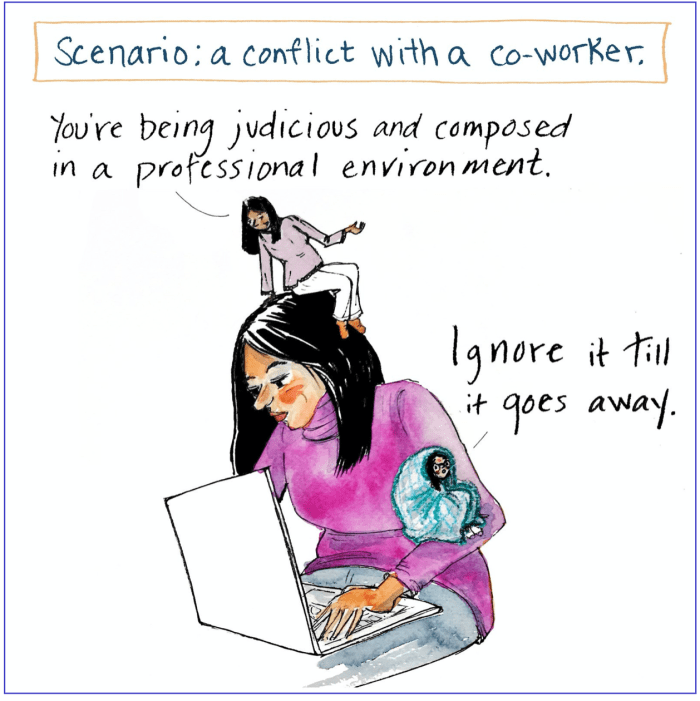
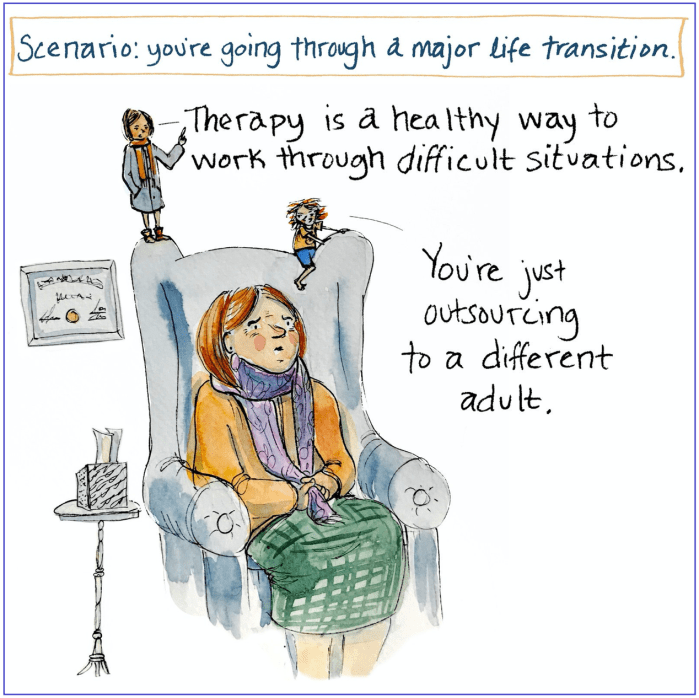
KENDRA ALLENBY, artist

Cartoons:
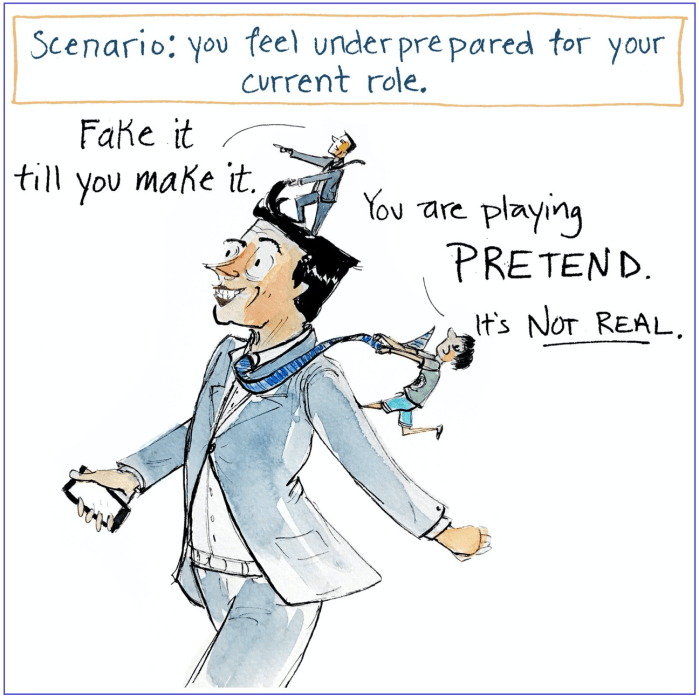
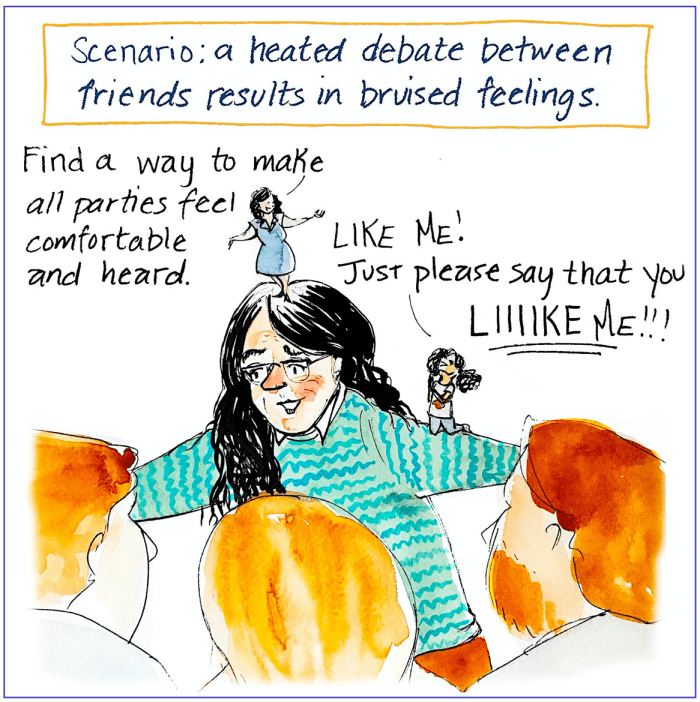
‘Is That the Voice of Your Inner Child (bratty teen) or Your Inner Adult?’


“I draw cartoons for the New Yorker and other magazines. I teach. I give talks. I use drawing to help organizations clarify and share their thoughts. I’m based in New York City but I go for long hikes and bike rides that sometimes last for months and I draw what I find there.  I use drawing to better understand being human.”

ALL IMAGES published in New Yorker, 3/2020

—————————-

REVIEW ACoA posts :   The UNIT (includes dialogues)
Why resist Dialoguing w/ Inner Child?


2 EGO STATES – Reprint (Part 1)


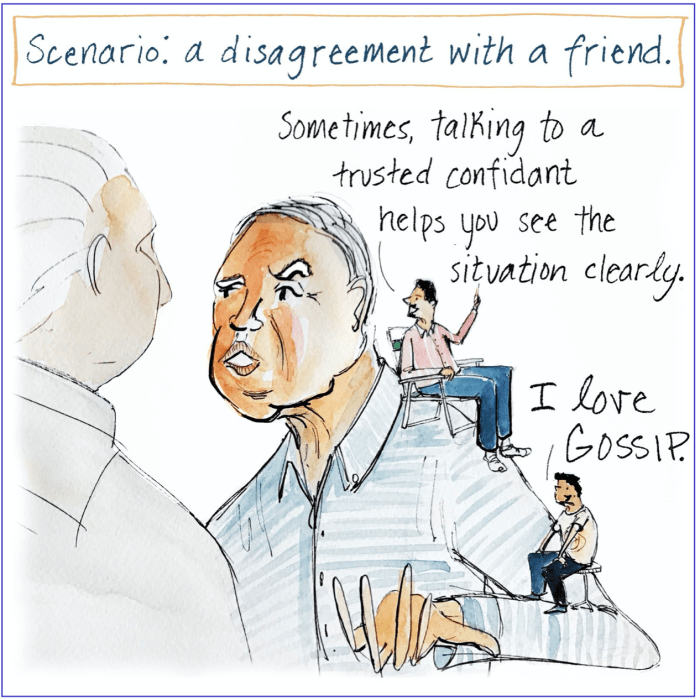
Cartoons by:

KENDRA ALLENBY: Freelance   cartoonist and illustrator, teacher & speaker. Published in the New Yorker, Barrons, Fantasy & Science Fiction Magazine, Woman’s World, Alpinist etc.


” I like to draw the moments when the contradictions break the surface. I like to draw the things that are hard to put into words. When I can draw a thing, I can understand it. And I can share that understanding with someone else.” http://www.kendraallenby.com

ALL IMAGES published in New Yorker, 3/2020

———————–
REVIEW ACoA posts : ♦ Ego States  ♦ ADULT  ♦  Inner CHILD


PAUSE on new Material


CONTACT:
acoarecovery@yahoo.com
212-580-9631
646-460-7417

Dear Readers,

As some of you have noticed (followers), I’ve been sending out revised OLD posts now for some months – along with new info. The series on Alcoholism is the last NEW for a while.

I wrote in Feb. explaining what I’m currently working on – going over ALL old post to make corrections & modifications where needed. As of now I’m half way thru 2016.

I’m suspending all new material until I finish going thru 2010 – 2020 posts already published. There are many more topics in the wings, maybe for next year, such as “Attachment Types, What Children Need, Money Madness, more on the Enneagram & the MBTI….. ”

EXCEPTION : If I find something new I want to pass on, or is especially interesting & relevant, I will add it throughout the rest of this year.

I hope you enjoy the updates. While every post is being worked on, only the revised or split ones (when one is too long) get moved from draft to ‘publish’. Since that means only 1 or 2 posts in each series, it’s a reminder to review the whole set.

For non-followers, if you’re curious, you can go to year pages 2010-14 & pick up the refurbished posts. Many include new artwork as well.

In the meantime you’re welcome to listen to my podcasts – there are 20, covering all the basic ACoA issues. To access, go to:

  • businesstalkradio1.com
  • click on red button “Archives” at top right
  • fill in my full name Donna M Torbico
  • interviews are listed by date, but not by topic (unfortunately)
  • Feel free to leave comments via email at acoarecovery@yahoo.com.

ALSO:
I continue to see individual clients for ACoA Therapy, by phone or Skype,
– intro session is FREE.
If you or someone you know would like to do some Recovery work, I’m available to take new clients. 

Thank you for you support & loyalty!

DMT
Alcoholism – PHYSICAL (#4)


 PREVIOUS: Alcoholic TRAITS #3b

SITE: “Alcoholism & the Brain: An Overview” (extensive)

PHYSICAL characteristics – Alcoholism CAUSES:
• Compulsions: talking for hours & hours – to a captive audience (like one of their children), continually repeating oneself, stalking, unwanted phone calls, esp late at night…
• Loss of control – mental & physical – leading to accidents, fights, falling down, lowered inhibitions (perpetrating rape, incest, assaults, killing..)

• Many physical problems (see below)
• Patterns of drinking : daily, weekends, periodic, binge, steady…

• Personality changes: chemical changes in the brain, serious blood-sugar level disturbance – like people with low blood-sugar when they’re out of fuel (food): headaches, nausea, very cranky, can’t think…
• Progression – in 3 stages, from mild to psychosis & then death
• Victimization : more vulnerable to crimes, sexual & domestic abuse

🚦☠️ Alcohol & Health
Accidents : burns, fall, fights…. 
Birth defects : binge drinking early in pregnancy is particularly risky for the developing baby
Blackouts: blocked memory – a few minutes, several hours or more

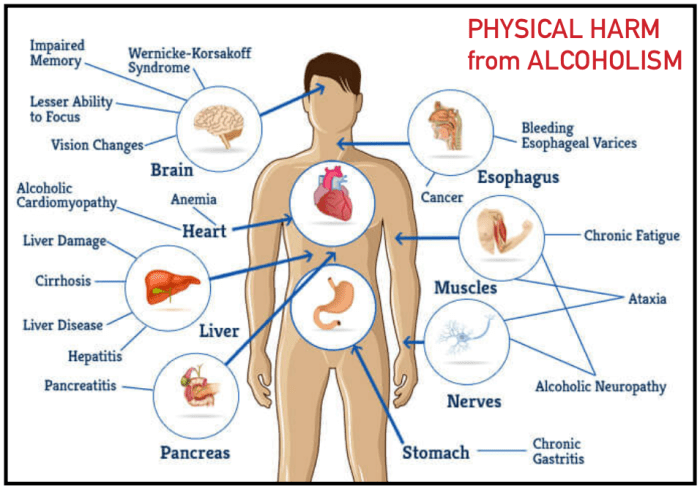
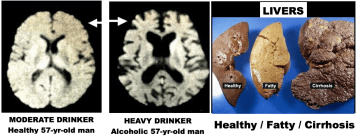
◘ Brain : inflammation, dementia & other neurological deficiencies
◘ Cancer :  alcohol consumption is a risk factor for cancers of the mouth, throat, colon, breast & liver (even 1 drink per day is linked to a 20% increase
◘ Depression : worsens overall mental health & sparks a vicious cycle
◘ Diabetes : heavy & binge drinking rises the risk

◘ Digestion : alcohol alters the composition of needed bacteria in the GI tract, causing anemia, bleeding, gastritis, ulcers & other lesions, scarring
◘ Heart disease : heavy drinking appears to increase risk – high blood pressure & stoke…

◘ Infections : bacterial, respiratory & viral infections such as HIV, hepatitis (B & C), pneumonia & tuberculosis
◘ Immune System: affects the number of immune cells in a person’s system, alters their functioning, & can often kill existing cells

◘ Kidneys : affects rate of blood flow & disrupt hormones needed to filter out harmful substances from blood
◘ Liver diseases : alcohol poisoning, fatty liver, inflammation, cirrhosis

◘ Obesity : 2nd most calorie-rich nutrient after fat — packing about 7 calories per gram. Heavy drinking can cause increased weight gain
◘ Sex : F – unwanted pregnancies, infertility, menstrual problems, reduced lubrication, harder to have an orgasm….
M – physical insensitivity, erectile dysfunction, premature ejaculation, loss of sexual desire, ‘brewer’s droop’ into full-blown impotence
◘ Death : alcohol abuse is the 3rd most common cause of preventable death in the US, including drug ODs  (More….)

ONE DRINK: Significant alcohol intake produces changes in the brain’s structure & chemistry, BUT some occur even with minimal use over a short time, to form tolerance & physical dependence
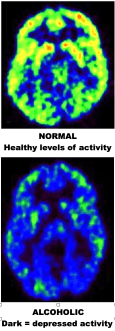
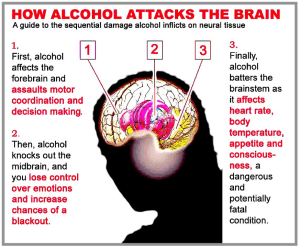
✴︎ 30 seconds after the first sip, alcohol rushes into the brain, slowing down its chemicals & pathways used to send messages. This alters mood, slows reflexes, throws the drinker off balance & they can’t think straight. Alcohol makes it hard to store experiences in long-term memory, so they won’t remember things later …. (More…. )

➡️ MRI scanner forms images using strong magnetic fields & radio waves

🌀 🌀 🌀

Behavioral Addiction is an intense desire to repeat some action that’s pleasurable, believed to improve well-being, or able to alleviating some personal distress – despite knowing its negative consequences

Researcher Jeffrey A. Gray (1981 & 87) proposed 2 brain-based systems which control a person’s interactions with their environment. Emotional situations are identified by the intensity of reaction, AND actions, based on what’s appealing or unpleasant.

⬇️ BIS & BAS brain activity have been connected to a broad range of psycho-pathologies, such as lifetime diagnoses of depression, anxiety, drug & alcohol abuse, ADHD & conduct disorder
❤️ FFFS = Fight, Flight, Freeze System (on chart↘️)
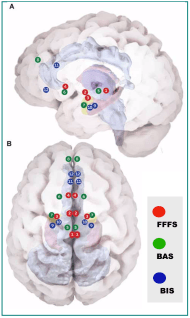
Systems controlling actions:
1. BIS – The Behavioral Inhibition System is responsible for curtailing, stopping, or avoiding ‘dangerous’ behaviors which can lead to disappointment or loss

People with strong BIS activity have a heightened sensitivity to new experiences that are non-rewarding, and to anything they experience as punishment, which they avoid to prevent feeling anxiety, frustration, terror & sadness.

🖤 OPPOSITE: People with low BIS (high BAS) activity have strong urges & desires, & are usually more impulsive & Extroverted

2. BAS – The Behavioral Activation System created a high sensitivity to reward – actions that don’t produce punishment.
It’s the desire to approach, pursue & achieve goals, with emotions such as elation, happiness & hope, especially when a benefit is imminent.
Strong BAS activity produces impulsivity, which may lead to punishment – not a deterrent – so pleasurable behaviors will be repeat, such as the instant-gratification use of addictive substances.

💚 OPPOSITE: People with low BAS (high BIS) activity have weaker urges & desires, & tend to be more careful & Introverted   (MORE….. scroll down)

NEXT:

Alcoholism – Personality TRAITS (#3b)

PREVIOUS: Personality TRAITS (#2a)

SITE: “Personality and Alcoholism: Establishing the Link” ~ Stanton Peele (author of “Love & Addiction” highly recommended)

PERSONALITY TRAITS  (cont.)

🏴 REMINDER: NO ONE has ALL these characteristics!
Pick out several that fit your ‘favorite’ addict (or yourself ??), the ones that really stand out, that are over-blown, that keep getting in the way of a success, happy life.

2. PSYCHOLOGICAL defences
Underlying the addiction are what 12-Step programs call ‘character defects’, which contribute to the desire to escape.
ACTIONS
Blackmail. Use threats of emotional withdrawal of acceptance, affection, approval, love, sex…. to get the other person to do something they don’t want to
Bully. Demand others be or do what the addict wants, & won’t take no for an answer. Push, push push

Chase. Run after someone not immediately available, or not interested in them (short of stalking)
Come-here-go-away. Crazy-making, draw someone toward themselves & them push them away (sabotaging….) when the other gets ‘too close’

Impatient. Can’t wait for things to unfold naturally, insist on getting attention
• Impulsive. Often acts before really thinking through consequences
Irresponsible. Undependable, rarely /never follows thru, arbitrarily changes plans, regularly breaks promises …

VERBAL
Argumentative. Always looking to start a verbal tussle, & even when they actually agree with the other’s point of view, feel the need to fight against it

Cognitive distorted. Have many unrealistic or completely erroneous beliefs. Includes ‘all-or-nothing’, ‘black-or-white’ thinking…..
Combative. Always feel disrespected (bumped in the subway, not being greeted….) as an excuse to be angry, or pick a fight

Compulsive Liar. Lie when not necessary – lost conscious contact with The Truth
Complain. Highly critical of others & Self, often their own worst enemy. Whiny.
Cynical. Bitter, have an overall very negative assessment of people & life

Double-messaging. Cause great confusion or paralysis in others by giving opposing info or expectations – as if both are true, (love you / hate you) OR demand that 2 incompatible rules both be obeyed

PSYCHOLOGICAL
Boundary-less. Don’t how when / where to set limits, with self or others
Chameleon. Easily change attitude & actions to match people & their environment, blend right in, but not ‘real Self’

Dependent. Needy. Expecting others to do for them what they can, but won’t do for themselves
• Fake. What they feel inside is not what they show on the outside
Idealizing. Unwilling to see others for who they really are, making them better than what’s real, & better than themselves

Low Frustration tolerance. Easily upset & knocked off
 balance
Narcissistic. Everything is about the addict, only their point of view & needs are valid

Passive. Unwilling to exert themself, have an opinion, participate….
Perfectionist. Their’s is the only ‘Right Way’. If they can’t do something perfectly, it’s worthless – causing procrastination & paralysis

• Separate. Never feel part of or belong anywhere – even in ‘similar’ groups. ‘Different, not like the rest’ (negatively special)
Superiority complex. The attitude / belief (not emotion) of seeing oneself as better than others

Victim. Suicidal thoughts / feelings (NOT because of severe physical pain, debility or actually being trapped). Instead:
– Rage: wanting to punish everyone who’s ever hurt or abandoned them (“I’ll show you!”)
– Unwilling to dig deep into their emotional pain, for healing

SOCIAL
Arrogant. Condescending, sometimes or always ‘full of it’
Demanding. “I want what I want – NOW!”
Defiant. Don’t want to be told what to do, do opposite of what someone needs, wants or asks for – just to be ‘difficult / contrary’, but not from actual disagreement

• Isolated. Socially withdrawn, even when with others, not really connected. Can’t be reached, but complains that no-one understands
People-pleaser. Overly agreeable, to keep the focus off themselves & get people to like them

Sadistic (‘perpetrator’). Gets pleasure from hurting people, or secretly seeing them be hurt (physically, financially, socially….). Also harm animals & children
• Socially awkward. Feel like they don’t know what to do or say

Thrill junkie.  Deliberately goes for risky behavior, stuck in self-destructive mode
• Thwarts Authority. Rebels against ‘status quo’

SPIRITUAL
Lost / Tortured Soul – wandering in the ‘land of the living dead’
 Unearthly. Truly believe an ideal world possible, & that it ‘should be’. See everyone as one united family. However, often feel disillusioned & disheartened when the world fails to live up to their Utopian ideals.

NEXT: Alcoholism – Physical

Alcoholism – Personality TRAITS (#3a)


PREVIOUS: Alcoholism #2b

IMAGE ⬆️ : Pain directly linked to Emotional States 

SITE: “Heal suffering w/ Self-acceptance (+ Negative beliefs)

🌈 Poor Mental health plays an important role in all forms of substance abuse, which often overlap with psychiatric disorders, because addictive substances change the way the brain works, impacting a person’s mood, thoughts & actions. Psychological evaluation of a potential patient includes:

Personal history:  age when they first started using alcohol…., family history of substance use, & all traumatic experiences, Also – housing, financial & marital status, education & employment, physical & mental health (theirs & their family), & legal problems.

VIOLENCE & ADDICTION
The Journal of Substance Abuse Treatment noted that more than 75% of people entering treatment admit to various acts of violence, although researches claim that “only a tiny fraction of all drinking events involve violence.”
The likelihood of an active drinker being violent seems to stem from how they usually deal with their anger when not drinking. Since alcohol lowers inhibitions, robbing a person of self-control which allows for risky behavior, so previously suppressed rage can be acted out when sufficiently drunk.

RESEARCH: The central nervous system (CNS) processes which integrate emotional behavior are altered in people at high risk for alcoholism, with 3 markers for identifying the risk:
1) Proportion: a characteristic balance of positive to negative emotions
2) Cortisol: emotion-related changes in this stress hormone
3) The Startle Eyeblink: a measure of emotion-related change in CNS activation

PERSONALITY TRAITS that underpin active addictions
🏴 NOTE: NO ONE has ALL of these! Look for several that fit your ‘favorite’ addict (or yourself ??), the ones that seem to really stand out, that are over-blown, that keep getting in the way of a success, happy life.

Alcoholism is called a 3-fold disease: Physical, Emotional & Spiritual (not religion) :
1. EMOTIONAL
Angry. Volatile E-motions, explosive temper, often acts out in violent ways
Co-dependent. Deeply effected by other people’s emotions, reactions,  difficulties…. & other social influences, mostly negative &/or toxic

Defensive. Very guarded & protective of inner most thoughts & feelings
Depressed. This can be physical /hereditary and/OR from decades of abandonment & abuse. Either way its’s long-term & debilitating

Desperate. Feel like their would is falling apart. Don’t know what to do
Disconnected. Unaware of what they’re feeling emotionally
Distracted. In constant escape-mode. Use Alcohol/drugs, sex, social-media…. to numb painful life experiences, or fill up with “spirit”

•  Fearful / Terrified. Worry a lot. Anxious, agitated…. always expect only the worst
Fearful of Failure and Success. Stay stuck (work, home….). Feel like they ‘can’t win for loosing’

Guilty. Continual, overwhelming self-blame for real or imagine harm they did to someone, either by a damaging action, or by neglecting to do something
Hopeless. Completely convinced there’s NO possibility for their life to get better (“learned helplessness”), they have no options, no one to help
Hyper-sensitive. Take everything personally that happens to them or even around them, as if they’re the center of everyone else’s world

Insensitive. Can’t sympathize with another’s hardship, or to empathize with someone’s emotional distress
Joyless. Nothing is fun, relaxing, stress-less.
Lonely. Feel alone, can’t ask for help because ‘no one cares’

Paranoid. Assume everyone secretly (or blatantly) intends to hurt them. Can’t trust anyone. NO one’s safe
Passive-aggressive. Can’t show anger directly, so puts on a smile, but withholds, refuses to participate….  or secretly, indirectly does harm
Resentful – of oh-so many people… Carry a long list of grudges towards anyone who’s disappointed or hurt them in life

Sad. Deep sorrow because of too many losses, often hidden from oneself, or unexpressed
• Self-Hating. Deep down inside, blame themself for everything that’s gone wrong or that hurts them.  Nothing is never ‘good enough’
Shamed. Intensely ashamed of themself, their family, their circumstance, their inability to ‘fix’ a loved one…..

Unforgiving. Unable / unwilling to release of all the bad things done to them, & the pain it caused. Can’t seem to cope with people, place, things – as they are
Un-comforted. Nothing is soothing, pleasant, stress-free
Uncomfortable in their skin. Don’t know ‘who I am”, or ‘how’ to sit, stand, walk… Restless, irritable, discontent. Life is a painful, unpleasant journey
Unlovable – Unable to love themself or to receive love from others.

NEXT: 2. Psychological 

Alcoholism – STAGES (#2b)

PREVIOUS: Alcoholism – STAGES (#2a)

SITE : Alcohol-induced brain damage continues after alcohol is stopped 

STAGES (cont.)

3. PROGRESSION  – Physical / Emotional deterioration
• An obsession with drinking. During the dependence stage, the alcoholic still planned their day around the drink. Now they simply take it with them wherever they go

• Alcohol is needed to function. The morning drink is a daily ritual, drink throughout the day, & keep a steady supply available, like a flask in the purse or bottle in the desk drawer

• Loss of other interests. Social activity continues a decrease because of erratic behavior. as drinking isolates them from friends & family. Hobbies & intellectual interests once enjoyed are long gone, & drinking is the only companion, the thing that keeps them going

• Depression, anxiety, insomnia. Alcohol is a depressant, so the physical effects will worsen in an already emotionally unhappy person. They can’t get to sleep without a drink, & often end up with paranoia – becoming overly fearful but can’t explain why

• Family relations continue to deteriorate. If it wasn’t seen before, slowly the addict become increasingly irritable, arguing with the spouse, attacking their children, alternating between being sullen & snappish. Stop attending family functions, preferring to drink, or showing up drunk – sloppy, obnoxious, sexually inappropriate or belligerent

• Friendships change or end. There continues a decrease in social activity because of erratic behavior, have a sudden change in friends, have trouble talking to strangers….. old friends will be run off when they confront addict with their drinking

• Financial, legal problems. Domestic abuse, calls to cops, harassment or stalking of spouse or lover – possibly resulting in a Restraining Order, divorce & child custody fights, court appearances for DUIs, & sometimes vehicular homicide……

• Serious health problems occur. Personal hygiene begins to slide, & eating properly is a thing of the past.  The addict will get sick much more often (respiratory infections, malnutrition…..), & the doctor will warn about damage to liver & pancreas

4. CULMINATION
• Loss of control is obvious. The addict no longer takes care of themself, (no medical care, poor hygiene, careless appearance….), & normal responsibilities have long been neglected. Without a co-dependent rescuer, they’re behind on bills, can’t borrow any more money from family & friends, & built up credit card debt to support their drinking. May even become homeless

• Family & friends are gone. The addict may have been to rehab – several times, but still found it impossible to quit, having become a slave to the bottle

Physical symptoms are excruciating. Without medical attention, this stage of alcoholism is incredibly dangerous.  Unable to hold food down, the tremors begin mere hours after any ‘last’ drink, & hallucinations or seizures might have even set in

• Full-blown addiction will carry heavy withdrawal symptoms & an increased risk of developing life-threatening conditions. These symptoms can be so painful that the person needs to drink simply to alleviate them. Life expectancy in this stage can be as short as six months.

RECOVERY requirements:
✴︎ A sincere desire for help
✴︎ Physical detox & medical treatment
✴︎ An assessment of clinical treatment needs for co-occurring disorders:  anxiety  / ADHD  /  bipolar   / college mental health  /   cross addictions /  depression  /  food  /  PTSD   / obsessive-compulsive   /  personality disorders   / schizophrenia  / self-medication……

✴︎ Establishing new ideas, attitudes, goals for life
✴︎ Ongoing group, individual & family therapy
✴︎ Rest, structured daily routine, proper nutrition

✴︎ New circle of stable, sober friends & mentors
✴︎ Increase in self-care, confidence, self-esteem
✴︎ Ongoing work toward lasting sobriety

RELAPSE
A hallmark of any chronic condition is the potential for relapse. The sufferer & doctors work together to figure out the best treatments to manage the condition.

Addiction is no different. In fact, relapse rates for addiction (40-60 %) are similar to asthma (50-70%) & adult-onset diabetes (30-50 %), reported by the National Institute on Drug Abuse. Sometimes the initial treatment is not quite right, or the person starts by trying to quit without help. Over time, control is lost & the person drinks again.
However, this is not an indication of failure. Experience has shown that a inpatient program of less than 90 days has limited effectiveness.  It is possible to interrupt the cycle of Use —> Abstinence —> Relapse, by a determination to have a better life, & by getting the right treatments.

NEXT: Alcoholic TRAITS  #3a

Alcoholism – STAGES (#2a)

PREVIOUS: Alcoholism INTRO #1b

SITE: “What is Alcoholism?

Alcoholism is a disease that usually develops over time. Whether or not initial alcohol use is likely to lead to addiction is often a matter of individual circumstances. Mayo Clinic describes a number of risk factors:
• A family history of substance abuse or other mental health disorder
• Childhood abuse &/or neglect / • A Chaotic living environment
• Peer group or family that is permissive about substance use
• Depression, social issues, loneliness…..

Not all drug dependence is addiction. EXP: an asthmatic will depend on a daily dose of medication to breathe properly. This is not addiction. In this case, the body was not working properly before the drug was introduced – which is the correct solution to the physical problem – & did not cause the original dysfunction.

1. DENIAL (Adaptive) – early stage symptoms
• Occasional drinks taken to relieve stress or other problems – used as a crutch to cope with or escape reality. Alcohol becomes a way to take the edge off after a long day, & blur sharp outlines of life

• Gradual increase in drinking frequency & tolerance – rely more & more on alcohol to get through difficult times, so it’s less enjoyable & more of a habit. Now drinking either stays moderate – or progresses to the next stage. Tolerance is an indication that the brain has changed in response to the drug

• Thoughts become more focused on the next drink : “If I can just make it through these last 2 hours of work, I can head straight to the bar for some relief”

• Rationalizing alcohol over-use / abuse – telling oneself I’m just having a rough few days, drinking isn’t that big a deal, or I’m not going out getting wasted every night, so I’m fine

• The (now) addicted person is likely still unaware that alcohol is gradually becoming a controlling force, & others have not yet seen that the person’s drinking habits are getting increasingly more dangerous

2. DEPENDENCE  – Loss of control
Desire to drink is more intense – the body has become used to larger amounts with little or no effect. As it gains a tolerance, it expects the alcohol at a certain time, so drinking will start earlier in the day to compensate for the frustration that settles in during the afternoon. The drinker can still function, but becomes more & more focused on getting that next drink

• Loss of control over drinking habits – still easy to find excuses for needing a drink throughout the day in regular society, which makes it somewhat acceptable.
Consumption is more than the average person’s, but it can be explained away: “If you had the stresses I did, you would drink too. / Everyone has a beer at lunch when we go out. There’s nothing wrong with it…. ”

• Alcohol-induced blackouts are common – the drinker can lose a lot of time (several hours, an entire day or longer….). They won’t remember where they went, what they did or who they were with, with obvious harmful physical, mental & financial consequences

• Withdrawal symptoms get more severe – when the effects of the alcohol wear off, 6 – 24 hrs after the last drink –  dry mouth, painful headache, morning shakes, nausea, sweats & trouble sleeping. Hangovers are a regular event, but still seem manageable.

• The drinker finally starts to realize there’s something abnormal about their drinking & others begin to recognize it too. They hide it from others – spiking coffee or soda, stashing full bottles throughout the home & ones in the garbage away from home. Lying about where they were when out drinking…..

• Relationship problems & social isolation increases – late nights, drunken fights at home, falling down, car accidents…. May begin missing work or social obligations because of dat-time drinking or painful hangovers. Drink at inappropriate times, such as when caring for their children, when driving with family in car, & at work

✴︎ They may make several attempts to stop drinking, even attend support groups. However, many are not ready to face the rigors of Recovery, & resort to old habits.

NEXT: Alcoholism – STAGES (#2b)