LEVELS of NARCISSISM (#2)


PREVIOUS: LEVELS of N (#1)

SITE: See great chart
re. Human Magnet Syndrome (scroll way down)


CORE attitude of unhealthy NARCISSISM : “I am the center of the universe. Everything that happens to me & around me, good & bad, is about me. I cause everything, so everything is up to me to handle.”

1. HEALTHY N

2. STABLE N
This category of the N continuum ↗️ was proposed by Kohut (1977) as less than full-blown narcissism (not yet NPD). Stable Ns have age-appropriate self-centeredness, but with areas of personality that are not fully developed.
EXP: Stable Ns generally function, day-to-day, with reasonably OK relationships, but also (secretly) conceited, selfish & vain, which shows up as being smug, withholding on occasion, & very concerned about the image they project.

However, shame
is the emotion that lurks behind most unhealthy narcissism, with the inability to process it in beneficial ways – to face it, neutralize it & move on. This weakness leads to the typical defensive postures, attitudes & behaviors of Ns.

🕯Extraordinary Ns & Productive Ns
“Ns may be either productive or unproductive. The most productive ones, who do change our world, have the charisma & drive to convince others to buy in to their vision or embrace a common purpose. They communicate a sense of meaning that inspires others to follow them.”
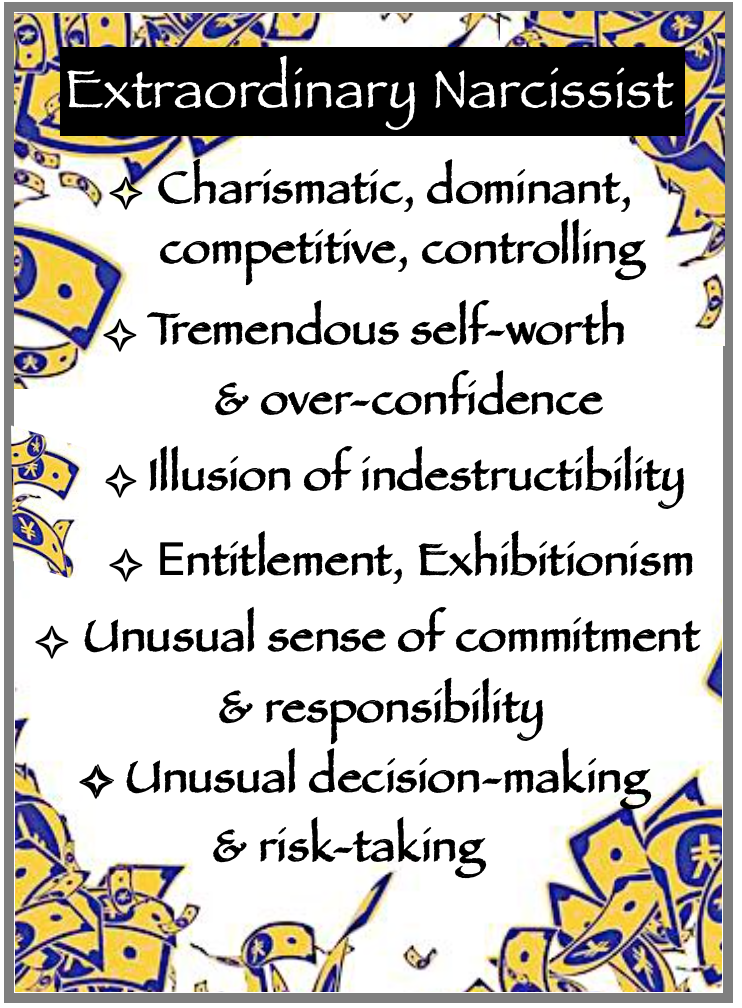
BOOK: “The Productive Narcissist~ Michael Maccoby

Strategic intelligence is their hallmark : foresight, systems thinking, visioning, motivating, & partnering. But narcissistic leaders can also be problematic.
EXP:  If the N boss or owner is an unrealistic dreamer with the illusion that only circumstances or enemies block their success, &/or they lack strategic skill – they’re fated to crash & burn. 

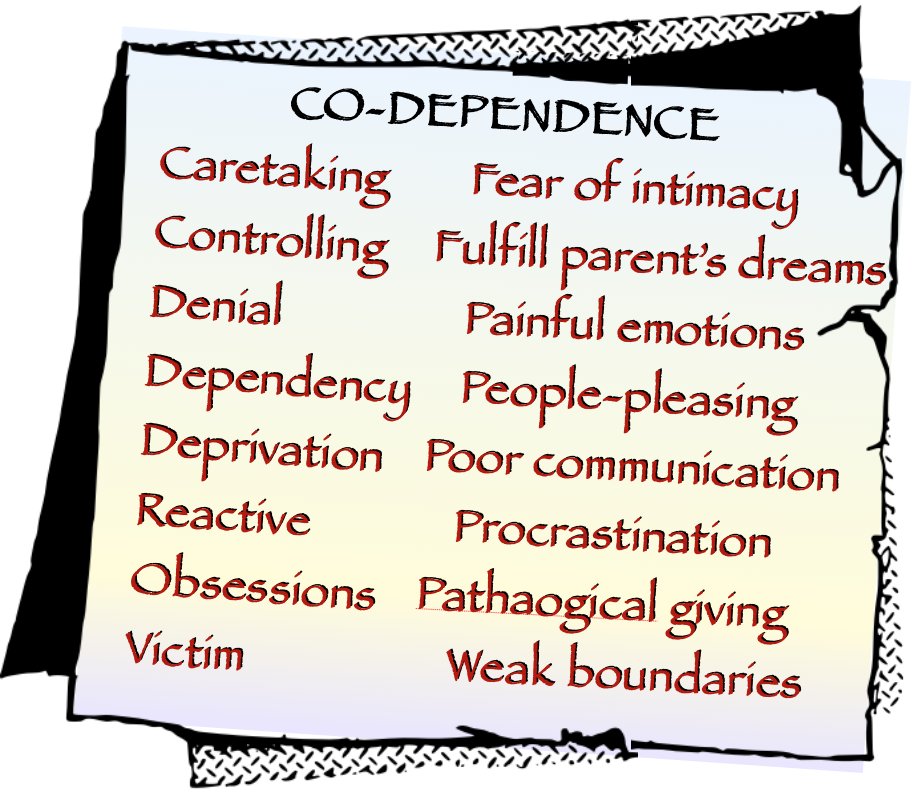
🕯Co-dependent Ns  / Co-Narcissists / Co-alcoholics
“….they act the way parents probably meant when they told us not to be “selfish”, but without teaching us healthy self-care”. ~ C. Whitfield.

‣ “Active” Co-dependents are missing a connection to their Innate Self, compulsively rejecting it (opposite of Ns). They revolve their thinking & behavior around other people, events, substances, & environments.
✴︎ Consciously, their inter-personal focus is only on others.

‣ Narcissists also suffer from this lack. In its place, they identify with the Ideal Self of a young child – an inflated, impossible image.
✴︎ Consciously, their inter-personal focus is only on themselves.

However, unconsciously, both types are other-oriented. Their self-image, beliefs & actions are aimed at stabilizing & validating their insecure, fragile ego.
Their dependency on external input is as great as that of any ‘substance’ addict. Both desperately want to be like, accepted & loved. And both types go about it the wrong way.

‘Classic’ Ns & co-deps do have different behavior patterns, but Ns can have some co-dep characteristics as well (play victim, do for others…..), while co-deps are less likely to use blatant N tactics, because they do have empathy, & overtly lack entitlement & exploitation.

ACoAs: As co-dependent caretakers, ACoAs shudder at the idea of considering themselves narcissists, & many are not NPDs . BUT – in spite of being ‘helpful‘, the underlying motivation for rescuing & people-pleasing is completely selfish, so narcissism is lurking.

❥ The main N motive is to control everyone & everything – with gifts & a smile or through gritted teeth – to prevent getting even a whiff of potential abandonment, regardless of who or what other people need & want.
As adults, “Children of the self-absorbed have to work particularly hard to form a healthy True Self, as they weren’t allowed to complete the required developmental tasks at an earlier age. Growing up with a destructively narcissistic parent, you’re likely to have an under-developed Self that needs serious attention.” ~ Nina Brown link

Generally, Co-Ns are functioning depressives, constantly anxious, seeing themselves as unworthy of anything good – so they obsessively work to please others, deferring to the opinions of others & taking on their world view.
They don’t know their own needs & beliefs, finding it hard-to-impossible to identify what they think & feel about most things, doubting the validity of their own thoughts (especially when these conflict with anyone else’s), & take total blame for inter-personal problems.

Co-Narcs may or may not start out as co-deps, but in a prolonged relationship with a NPD, they can end up with a trauma &/or fantasy bond, even Stockholm Syndrome – because of cognitive dissonance, gaslighting &  intermittent reinforcement.
REQUIRED: grief work & PTSD-trauma recovery

NEXT: LEVELS of N (#3)

LEVELS of NARCISSISM (#1)

PREVIOUS: Harmful ‘innocent’ sayings #2

NPI = Narcissism Personality Inventory measures:
Authority, Entitlement, Exhibitionism, Exploitativness, Self-sufficiency, Superiority, Vanity

UNHEALTHY N: The common use of the term ‘Narcissism’ refers to an unhealthy, selfish focus on oneself, without a genuine concern for the needs & desires of others. It’s the yucky narcissism staring back at us in the mirror when our inner-brat holds the outer-adult hostage (regression / ‘kid-whipped’). This unhealthy, age-INappropriate N. retards or prevents psychological growth, & frustrates intimacy in relationships.

1. HEALTHY N, on the other hand, is based on knowing AND accepting yourself so thoroughly that you can interact with others, safely & comfortably, without– always having to be the center of everyone’s attention, being afraid of abandonment or using others to take care of your emotional needs.

In psychoanalytic terms,”normal (legitimate) narcissism is defined as a positive investment in a normally functioning self-structure….
It plays a crucial role in the human capacity to:
‣ manage challenges, successes & changes
‣ overcome defeats, illnesses, losses & trauma
‣ experience happiness, satisfaction, & acceptance of the course of one’s life
‣ love, be productive & creative (Ronningstam).
Kohut (1977) considers that healthy narcissism in adults is expressed as creativity, empathy, a sense of humor, awareness of finiteness (limitations) & wisdom.

The N Phase of CHILDHOOD 
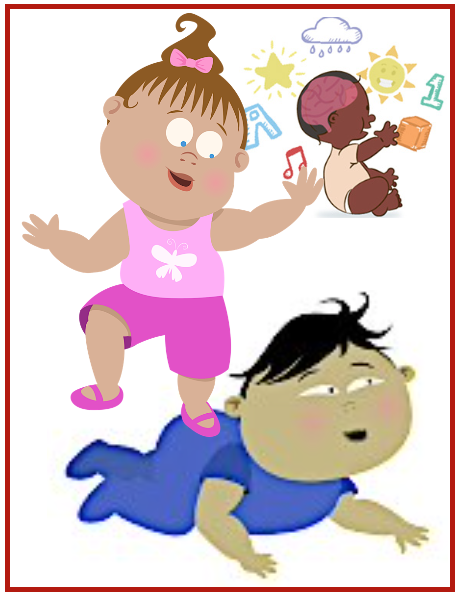
A complete preoccupation with oneself is normal & expected in young children, beginning around age 2, the same time they start talking – using words like “I, mine” and “no.” They assume the world revolves around them, with little awareness that others are separate entities.

Mahler described this phase as a “love affair with the world.” If development proceeds as it should, the child learns, through close contact with loving parents, friends & teachers, that those people also have needs & desires. Egocentrism diminishes as the child develops concern for others.

ACoAs didn’t get the opportunity to develop healthy narcissism. Many of us were ignored or punished for being exuberant or succeeding – at anything. We learned to be afraid of shining, because others did  envy &/or punish us, so we diminished our talents or hid them, even from ourselves.

ADULTHOOD : A Cohesive Self is a psychologically positive identity.
❤︎ It’s comes from combining the child’s Grandiose Self with the Idealized Parent Image (Omnipotent or Idealized Object), which allows the Adult TO :
= feel worthy of existing, have ambition, confidence & self-esteem
= have ideals, a meaning to life, & form healthy connections with others

Relinquishing or modifying childish behaviors to improve important adult relationships we don’t want to lose – increases self-development, preventing depression & burnout.

At its best, every-day narcissism is a normal part of everyone’s Self.
We need it functioning – on our own behalf – to feel good about ourselves & other people. If we had been safe enough to experiencing normal ‘ecstatic joy in yourself’ when we were a kid, it would have provided a residual strength to get through tough times later on.
EXP: Now, if you allow yourself narcissistic pleasure from a difficult job well done, it can sustain you through times of disappointment, frustration or failure.

In a healthy adult, the Inner Child’s normal Grandiose Self is tamed by being attached to an appropriate set of ideals – gathered from healthy role models & eventually our own values. IF this happens, it allows us to experience others as separate-from-us sources of actions, thoughts & emotions. All humans must undergo this process of maturation to develop a Cohesive Self.

This unified identity develops from a complicated interaction between :
(1) inborn capabilities & inherited genetic vulnerabilities – predisposing each person toward or away from psycho-pathology (strong or weak ego structure)

(2) the environment – especially interactions in childhood with Significant Others, who either strengthen & support the emerging child’s Self, OR interfere with its optimal development

A Cohesive Self basically means that all our Ego states are in sync, with the Healthy Adult in the driver’s seat. It means that we know what we need & like, with the willingness to be our own Good Parent, & respectfully express our Truth without needing to step on other’s emotional toes.  Because of this, we can let others be who they are without it threatening our wellbeing. We know we have choices, & we make the best ones we can, based on our personality.

NEXT: N. Levels #2

HARMFUL ‘innocent’ Parental Phrases (Part 2)


PREVIOUS: Harmful Parental Phrases (#1)

SITE: “My Mothers Love……Arsenic, Grain Alcohol and a Straight Razor


MORE HARMFUL PHRASES from the mental health community at “THE MIGHTY”
15. ‘You’re just going through a phase.’
Mom said about my panic attacks I’ve had since adoption, & still have. When is this ‘phase’ over?” — Elizabeth M.
16. ‘You keep messing everything up.’
“I was told that I ‘slop things up’  – whether in the kitchen or my handwriting ….” — Jen B.
17. ‘You need to act your age.’
“‘Act your age, not your IQ,’ said mom right in front of my friends when I was 11. It pierced my heart.” — Carre L.

18. ‘Should you be eating that?’
“‘Food is not your friend.’ my mom said when I started gaining weight after going through a breakup & a hard time in my life.” — Shauna A.
“My dad said : ‘Maybe guys don’t like you because of the way you look. I’m not saying you need to lose weight, but you know how guys are.’” — Morrigan R.

19. ‘Oh so now I’m the bad guy?’….
“….they said when I told told them about something they were doing that was hurtful or  made me uncomfortable.” — Bethany R.

20. ‘Are you sure you’d be qualified for that job?
“’I don’t think you have the skills for that career’ or ‘Are you SURE? That career is really difficult,’ said my parents when I was younger. I’ve had trouble now finding a career path I really want because I always think back to what they said” — Kachina M.

“When I told my mom I wanted to be a makeup artist, she said : ‘You don’t really handle people well. Maybe a nice desk job?’ Thanks for killing my dreams & making
me believe I can’t do anything.
Anytime I’d brought up a new interest for a career, she’d immediately find something wrong with it. Now I don’t have a career because I never believed I was good at anything. I still don’t.” — Kimy L.

😲    😛   😢   😡

A FEW MORE, from DMT at HEAL & GROW for ACoAs:
Mom
was an ACA & definitely a narcissist, but disguised as a ‘spiritually’ motivated righteous do-gooder who everyone (other adults) absolutely thought she was the bee’s knees! wherever we moved to – which was often & in several countries.
These are some of her favorite sayings, repeated often throughout my childhood :

❗️”Look ashamed!” =  whenever I did something she didn’t approve of, not anything actually bad, just if it made her look bad to others

❗️”You’ll be the death of me yet” = the message was 2-fold: I’m killing her & I should
be dead. I became suicidal – which morphed into long-term depression

❗️”Why did I have to have a kid like you?” = meaning I’m a disappointment, I’m a burden, nothing I do is ever right or good enough….

❗️”Now I’ve seen everything!” = her reaction when – as a tween – I designed & made a stylish, beautifully-made hat (I was always a sewer), & shaking her head, said it in front of a neighbor lady. It was not a compliment. Mom had very middle class, conservative taste & this hat was a NYC designer-style creation.
I did later go to FIT in NY, & for a while became a designer. But with all the put-downs over the years, there was no self-confidence – until therapy & Recovery.

❗️”It’s the bad coming out”  = referred to having acne as a teen. She implied there was so much bad inside me it even showed on my face. Just one more cruel comment

❗️”See, she got someone” = Looking good was the only thing that mattered & I always fell short (being so bad on the inside) so I ended up convinced I was ugly, which she knew but never corrected.
So one day after school I was walking with her when she notice a rather ‘less than attractive’ couple walking hand-in-hand across the street. She actually pointed them out & said “See, she got someone!”

❗️I’m glad I’m not sensitive like you & your dad = self-evident, we all got the message that having emotions – unless always happy – were to be avoided, ignored, never identified, explained AND never comforted !

❗️”Why can’t you be more like L.& L.?? (my cousins) = They were ‘perfect’ according to her. It turns out they’re the same Astro Sign as her – Taurus – and I’m not! Perfect match for a narcissist mom – rather than me!

❗️”You’re such a pig. You could lie down next to dirt and sleep!” = What can one say? She exaggerated – typical Narc. What she called dirt was more like disorganized & messy. She was a cleaner. I’m an artist.

NEXT:  Narcissist Levels (#1)

HARMFUL ‘innocent’ Parental Phrases (Part 1)


PREVIOUS: Alan Sayings #5

SITE: “13 Things You Should Stop Saying to Your Kids Now”

According to the American Psychological Association (APA), in the long run psychological abuse in childhood can be just as damaging as sexual or physical abuse.

To shed some light on what “innocent” comments actually hurt,  author JULIETTE VIRZI – turned to the mental health community at ‘The Mighty” for suggestions ➡️.

It’s important to remember that what may seem innocent or teasing comments to some adults are actually hurtful or abusive to children. No matter what anyone thinks, your feelings are valid, & you deserve support. The following are phrases you too may have heard growing up. They’re listed here by the people who suggested them.

1. ‘Children are meant to be seen, not heard.’
“Appearances were important – my thoughts, emotions or opinions were not.” — Keisha D.

2. ‘If you don’t behave, no one will love you.’
As a child, my dad & stepmom said so many hurtful things, & this one caused the most damage. To this day, some 40 years later, I still believe I’m unwanted & unloved, especially if I do something wrong.” — Tammy Z.

3. ‘You’re not the daughter I expected.’
“My mom said this constantly. I’m adopted, so it was heartbreaking, making me even more depressed & anxious. I don’t talk to her anymore. If I’m not wanted, I’ll stay away.” — Benedicte V.

4. ‘Never be a burden to anyone.’
“This seemed like good advice, but I grew up keeping everything to myself, & trying to help everyone. When someone did something nice for me, I felt obligated to reciprocate, not wanting to be a burden, thinking I was a burden.” — Florence N.
5. ‘Don’t be so dramatic.’
“This was said every time I expressed any emotions not pre-approved by my stepmother. I repress them to this day because of that instilled fear.” — Lea L.

“Throughout my entire childhood whenever I expressed emotions, I was told I was ‘being too dramatic,’ so when I was abused & assaulted, I couldn’t tell my parents. It’s affected my entire life, struggling to express emotions because of it.” — Natasha A.

6. ‘Sometimes I wish I never had you kids.’
“My mum told me as well as my brothers & sister.” — Christina F.
7. ‘You’re my perfect child.’
“My mom favored me over the other 4 kids.” — Brooke L.

8. ‘Why can’t you be more like your siblings?’
“- like my sister. But we’re very different people. Mum was very controlling of my looks until I got a job & could do what I wanted. Then she lost control.” — Sarah W.

9. ‘It’s like you don’t want to be happy.

“‘You can choose to be happy, you just don’t want to.,’ said my mom while I was trying to ask for help during a suicidal episode.” — Darian K.

10. ‘You should be thankful.’
“It’s what my mother tells me every time I have depressive episodes: “You survived college. You’re abundant with food, money and shelter. You have us. Your sisters actually love you. So, there is nothing to be depressed about! You’re just brokenhearted because someone you like just rejected you.’

Yes, it may seem harmless to anyone, but for me, even though I have everything, depression is still there & won’t go away just like that. I’m sorry.” — Pamela J.

11. ‘You are the sorriest youngin’ that ever lived.’
My Mama even said this on my wedding day. I responded, ‘That’s OK because after today you won’t have to worry anymore!’ Some years later I confronted her with this & she said, ‘Well I was just joking, couldn’t you tell I was joking?’ I was a child. How was I supposed to know?” — Marsha S.

12. ‘You’ve always been so difficult.’
“I heard this anytime there was a difference in opinion.” — Marie V.

13. ‘You’re really filling out your bra now, aren’t you?’
“‘You’re a woman now. You know what that means, right?’ my dad said when I got my first period at his house, at age 9. Followed by, ‘You sure are filling out your bra…’
Every weekend thereafter for the next 3 years.” — Kristy B.

14. ‘That’s silly, you shouldn’t feel that way.’
“When I was a child (& still as an adult), when I’d get the courage to tell my mom how something she did / is doing made me feel, she’d say, ‘That’s silly’ & proceeded to tell me why I shouldn’t feel that way. It made me feel bad then & even worse now, so I’ve stopped telling her things.” — Jen D.

NEXT: Parental Phrases – Part 2

Al-Anon SAYINGS & Info (Part 5)

PREVIOUS : Sayings #4

SITE: LIFELINE (Al-Anon newsletter, CONN)  


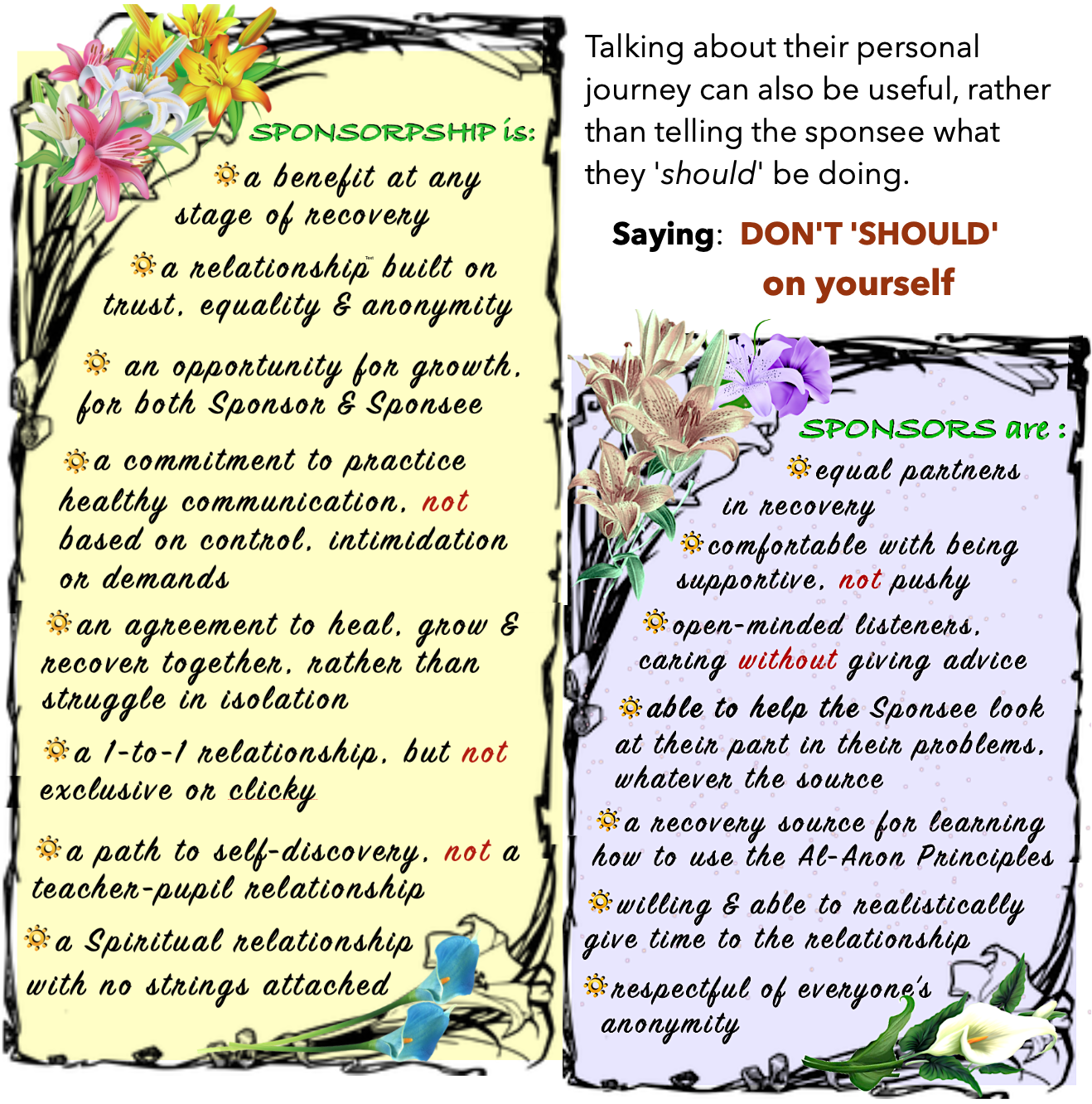
SPONSORSHIP
It’s a confidential relationship between 2regular’ Al-Anon members (no experts), who benefit from sharing their Experience, Strength & Hope. It’s focused on Al-Anon Principles, which are the 12-Steps & Traditions of AA.

The private information exchanged encourages acceptance, compassion & understanding. Making a commitment to this special relationship OR letting go of – a specific sponsor or of a sponsee – is a matter of personal choice, on either side. It’s legitimate & appropriate to end a S-S relationship any time it’s not working.
New-commers may not always know who to ask, & it may take a few tries to get the right combination. This is normal is real-life as well.

Usually the Sponsor is a long-time member with good ‘Al-Anon sobriety’ who helps a newcomer navigate the early stages of Recovery, which can be very painful & confusing.
However, 2 long-timers can be very helpful to each other in dealing with both old & new issues as they surface. Age does not matter, but it’s suggested that it’s best to be woman-to-woman & man-to-man, although straight-woman-gay-man can work very well.

The standard format it that a sponsee calls their sponsor at an agreed time of day,  generally for 15min. 4-5 times a week, more if it’s an emergency.  ‘Older’ members can call each other as needed.  The sponsor can listen to their pain & frustration, but the goal is to help the sponsee learn to think with mental clarity & develop emotional ‘sobriety’, using Al-Anon tools.

Al-Anon SAYINGS

NEXT: Harmful Parental phrases #1

Al-Anon SAYINGS & Info (Part 4)


PREVIOUS : Sayings (Part 3)
SITEs : The 3 Legacies of AL-ANON

✿  1,500 year old history of the 12 Steps (of Humility) – Written by a hermit mystic monk in 520 AD
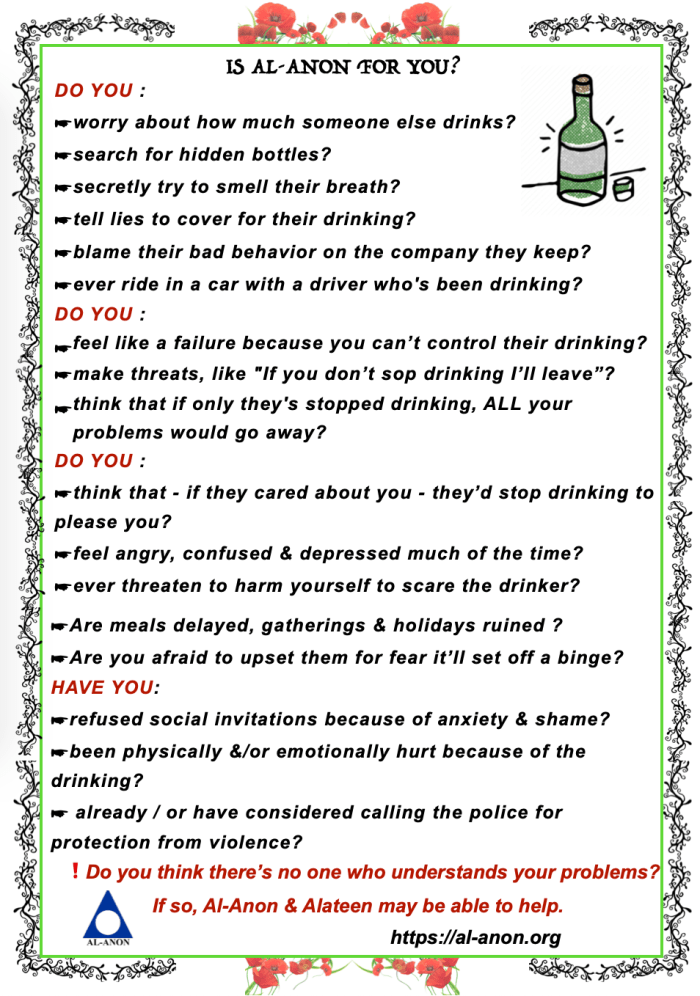
Al-Anon is for anyone affected by someone else’s addiction.
This usually means alcohol, but can include drugs & gambling, as well as unhealthy use of food, exercise, money, raging or sex, in an addictive way.
Even without active alcoholism, any Al-Anon members grew up in families with these & other severe stressors (beating, incest, mental illness, severe narcissism….) & so are also ACoAs.

At first (1960s, 70s) most 12 Step fellowships believed we couldn’t look at parental behaviors without falling into blame, rage & self-pity. As a member of AA, who also attended Al-Anon, Tony A. disagreed. He realized we can’t find clarity or peace until we identify what our family system has handed down to us – but without blame & shame.

The unhealthy beliefs & behaviors we absorbed as children became deeply embedded in our spirit, & the defenses we had to form were so much a pair of us that we assumed that’s just the way we were. Not so.
Al-Anon shows us that with much support, we can take a blameless, honest inventory of our parents & ourselves (4th Step). It allows us to separate who we are from who they were, so we can move beyond our programming, & freely choose what’s best for ourselves.

Tony’s Steps focus on gentleness, self-love, self-forgiveness & healing – in safety. They were included in his 1991 book, The Laundry List: The ACoA Experience, after years of refining.


NEXT: Sayings #5

Al-Anon SAYINGS & Info (Part 3)


PREVIOUS : Sayings (Part 1)

SITE :
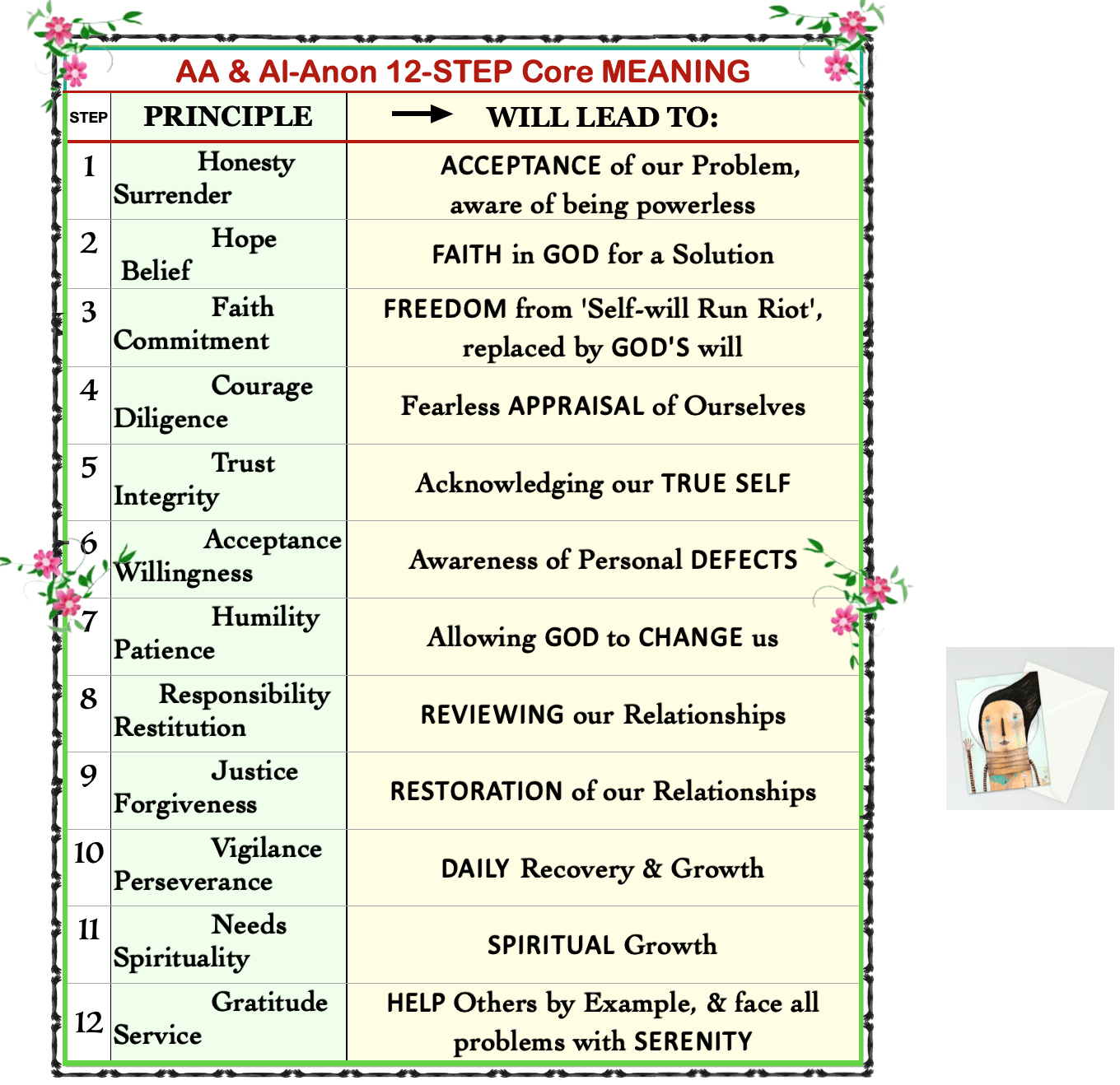
The 12 Steps Illustrated


Al-Anon recognizes that for many of us who love an active addict, codependent & enabling behavior can be difficult to quit.  Addicts tend to be emotionally abusive, deceitful & manipulative, in order to keep feeding their addiction.
When you love someone & want them to be happy, you may provide them with money, housing & other needs whether they can support themselves or not!

Unfortunately, making it easy (enabling) for someone to continue abusing alcohol will only prevent them Recovering & building a productive life. Attending Al-Anon meetings & sharing your stressors & confusion can help:
— identify behaviors that may be harmful to your loved one’s healing, and
— also work on your own emotional obstacles to personal growth.


NEXT: Al-anon #4


Al-Anon SAYINGS & Info (Part 2)

 PREVIOUS : Sayings (Part 1)

SITEs :
The RECOVERY SHOW
sayings, quotes, proverbs

LISTEN HERE
(re. Al-Anon & AA)


❣️ The core of Al-anon is about helping anyone who has been affected by someone else’s alcoholic drinking. This can be a family member, a friend, a boss… even the crazy drunk in the neighborhood.
Attending 12-Step meeting allows us to hear similar experiences from others, share our own (when we want to), deal with our own inner pain, as well as share our triumphs & successes as they occur.


NEXT : Al-anon #3

Al-Anon SAYINGS & Info (Part 1)


PREVIOUS : Affirmations

SITEs :
AL-ANON & AlaTeen info

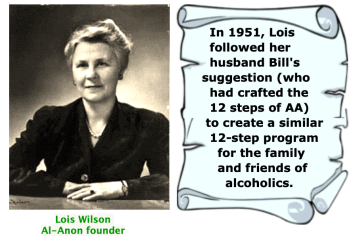
✴️Lois Wilson’s Story


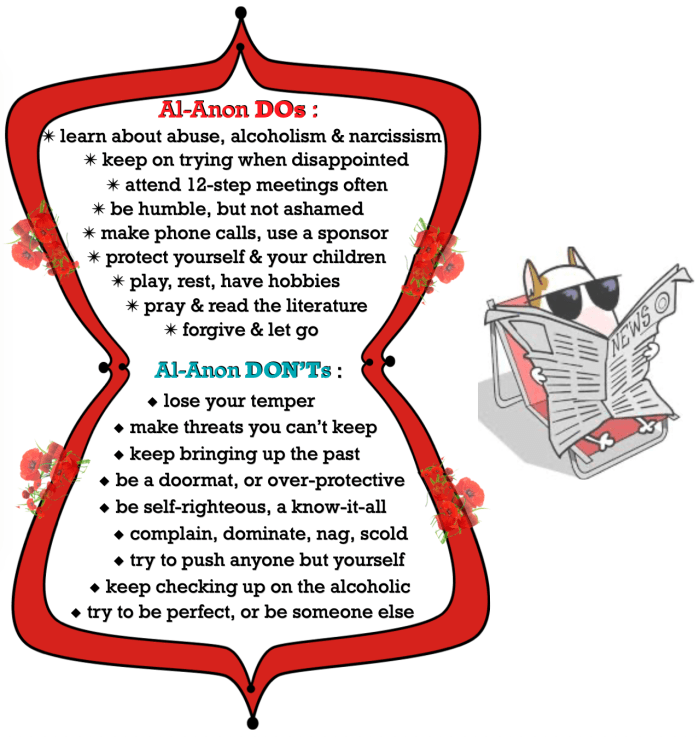
Al-Anon Family Groups is a “worldwide fellowship that offers a program of recovery for the families and friends of alcoholics, whether or not the alcoholic recognizes they have a drinking problem or seeks help”.

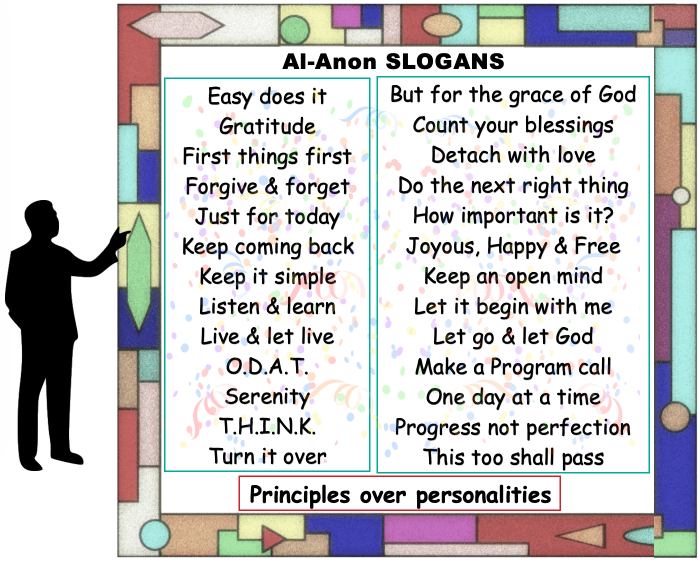
Al-Anon sayings & slogans may seem trite to some people – at first. But over time we find they’re very helpful, especially in times of great stress. Then we find they’re very useful & comforting.


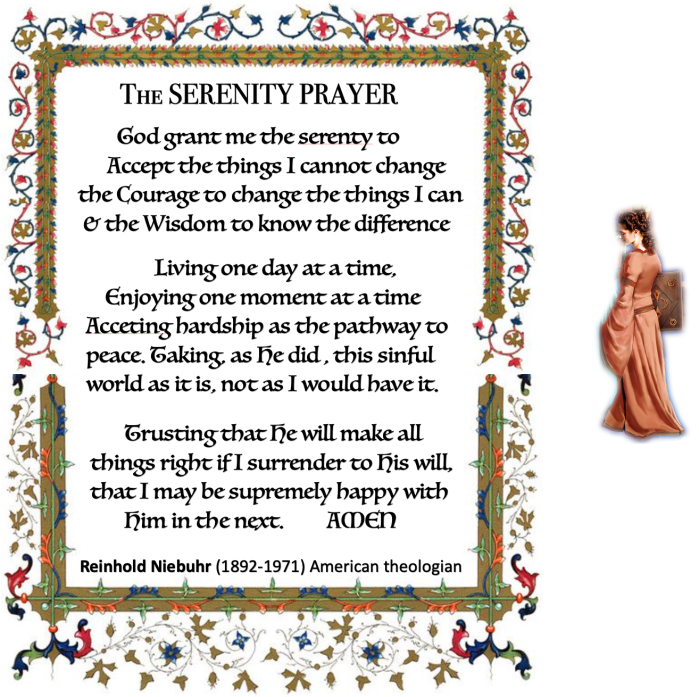
SERENITY PRAYER  –  See Post “Backwards”


NEXT: Sayings #2  

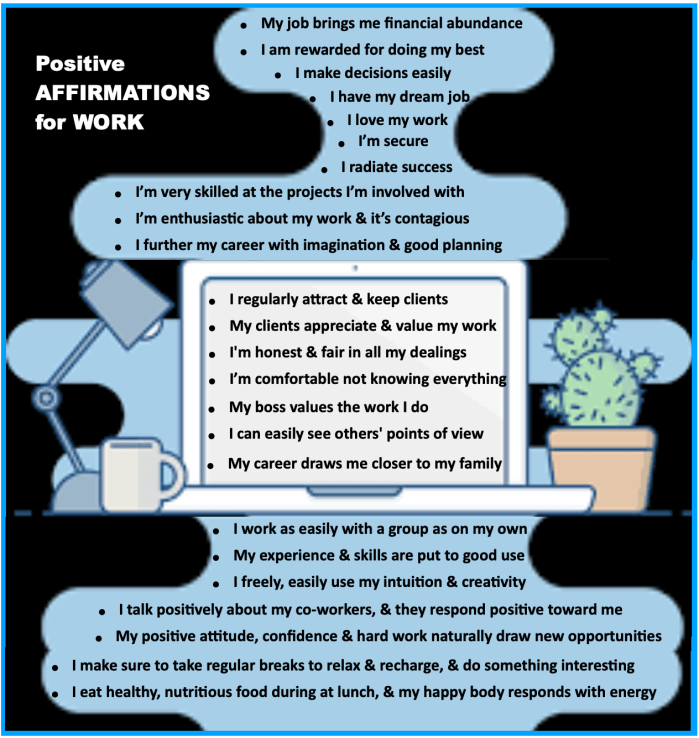
Positive AFFIRMATIONS

PREVIOUS : CORE VALUES

SITE:
Using Affirmations : Harnessing Positive Thinking


ACoAs: For those of us who don’t like using other people’s words, and who don’t want to be told what to think – work up a list of your own beliefs & attitudes that you want to grow into. Then copy it & plaster it up everywhere!
(Sneak a peek at these anyway 🧐 )

For the rest of us – enjoy :

🦋   🌺  🌴

🌈   ☀️   💫love affirmations
NEXT
: Identifying Narcissists, #1