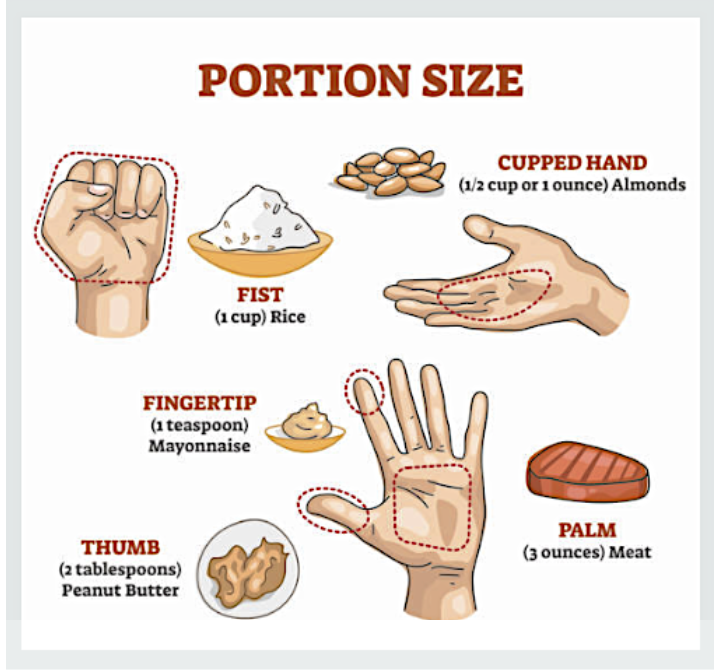
Attachment, EDs & the BODY (#1)

PREVIOUS :  Body  – DEFINITIONS

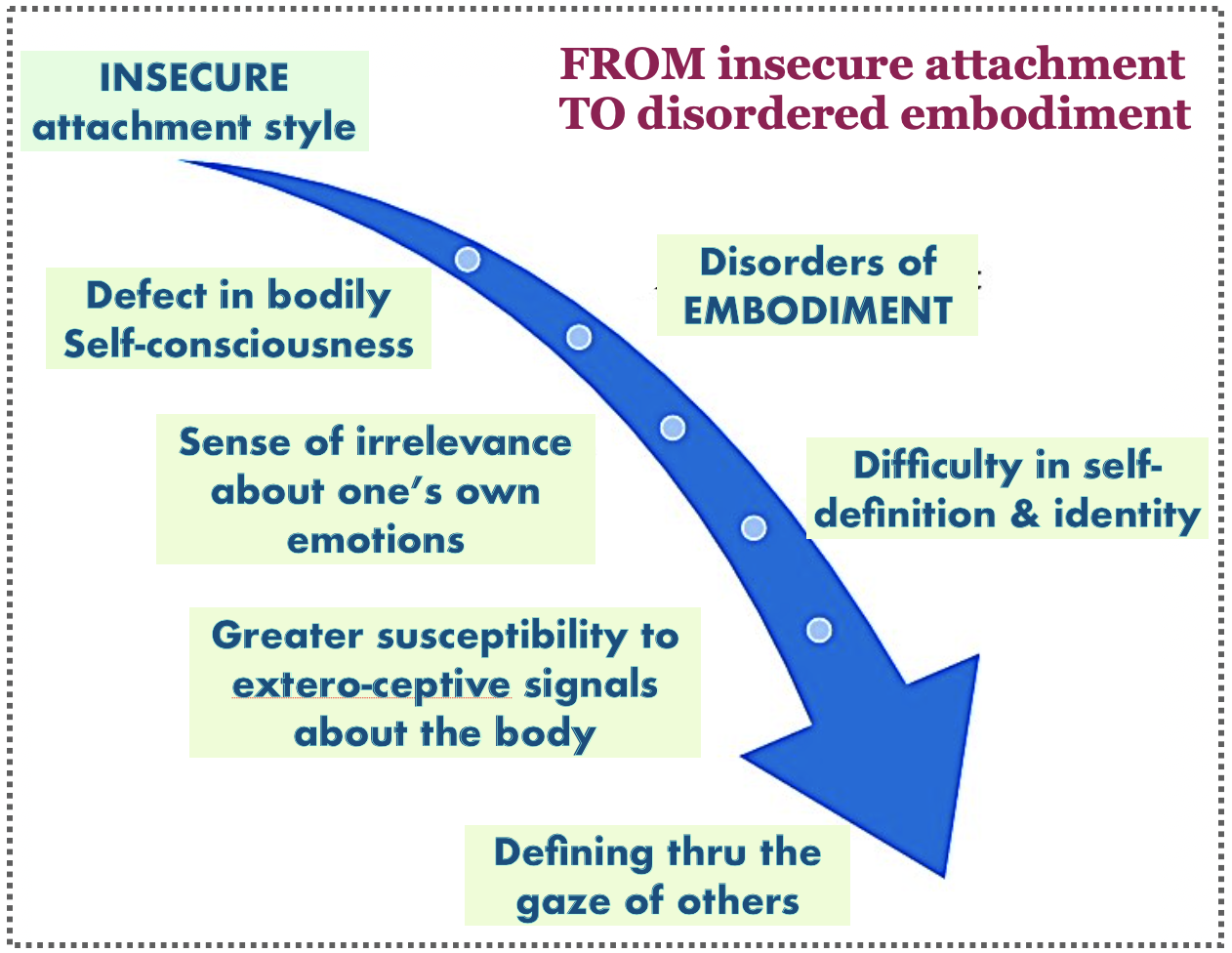
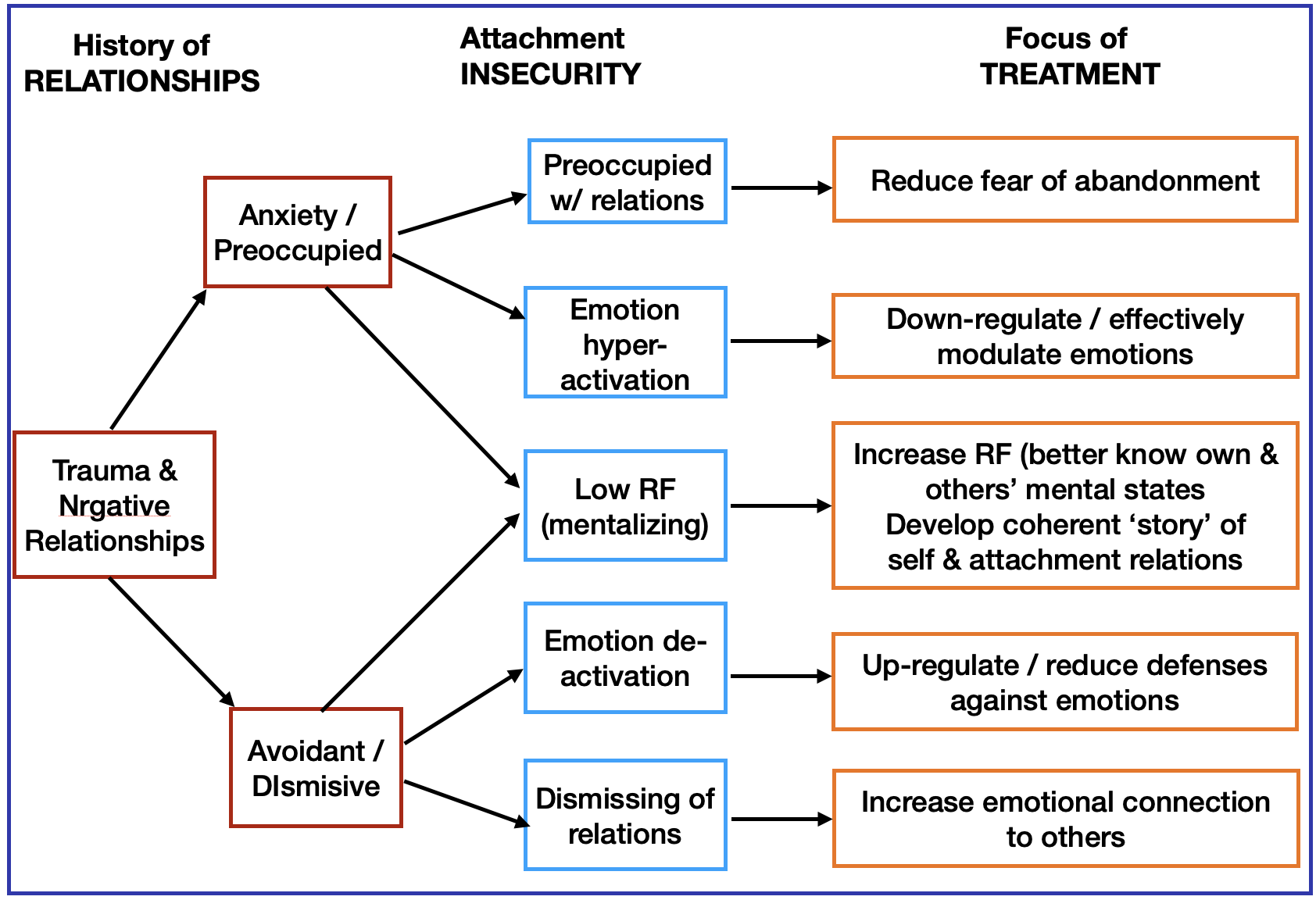
↗️ CHART :  Nested hierarchy of Self and its trauma      

NOTE: See Definitions post to understand confusing or new terms.

INTRO : The BODY is our instrument for moving thru the world.
In the first months of human life, attachment needs are first & foremost the needs of the body, which are supposed to be satisfied by the responses of the primary caregiver (m0m).  

Physical & mental development are inseparable, so the way the body is invested**, how it’s experienced in the earliest moments of life —> will determine the way we will go through our life – mentally, physically & spiritual.
** Body Investment is a person’s feelings & attitudes about their body, the level of care & protection they show it, & their comfort about being touched by other people.

The development of an internal safe base formed by positive attachment relationships – begins with the body’s contact with ‘the other’s’ body –  which provides the feeling of safety to manage all early threatening experiences.
Absorbing this experience of security allows the child to build this shelter for themself. Insecure attachment (avoidant or ambivalent) causes an internal picture of a “false bodily self”.

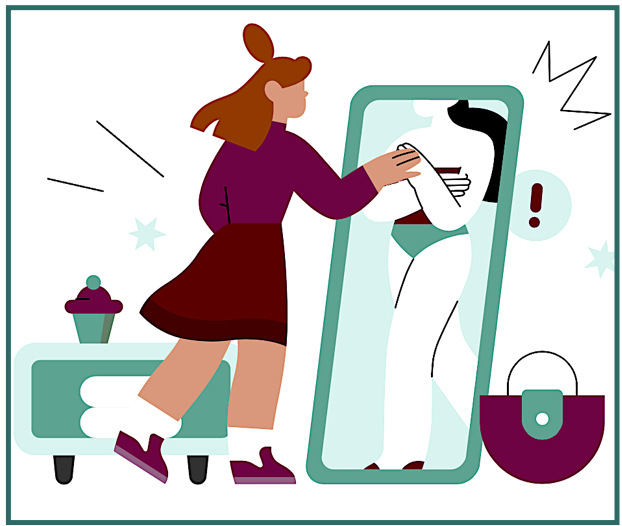
Because the mother’s face is the first psychological mirror the baby absorbs, what it reflects is the child’s reality. Crucial – the kind of mirroring** she provides will form the child’s Body Image – which is central to Self-concept, with important consequences for mental functioning.

** Mirroring : the way parents consciously or subconsciously reflect back the emotions, needs or aspirations of the child, which validates, accepts, & shows them love.**

If the mother is lovingly responsive, the baby experiences pleasure in the attachment relationship. Her ability to be attentive, sensitive & spontaneous underlies the development of the child’s mentalization, which includes emotions.

Then a memory trace is formed in the baby’s brain that connects the bodily experience with the image of the positive feelings transmitted by the mother. This creates a mental representation of the pleasurable emotion corresponding to the bodily experience.

♻️ Attachment Trauma : When there is a lack of resonance between the signals given by the child (I need you) and the answers given by the attachment figure (I’m not available / I don’t care), the potential reciprocity & pleasure of the relationship are missing. 

Trauma always involves loss. These losses may be very real & literal, such as the loss of a loved one, or be more symbolic, such as the loss of identity, meaning, or hope. Traumatic experiences affect not only the ability to connect & to feel emotions, but also the ability to think symbolically – in pictures. (⬅️ Some adult trauma results)

Whether loss is real or symbolic – when irreversible separation cannot be mourned (emotionally), & traumas cannot be represented (visualized), we make our body THE problem (leading to distorted eating, over-exercising, unnecessary cosmetic surgery….)

When the attachment relationship is based in the trauma of being rejected or ignored by Mother, the child experiences emotional deadness / emptiness. This prevents them from being able to :
💭 form a whole, accurate picture of what actually happened with the parent (confusion, denial)
💭 construct dialogue, internally & externally, using words to share experiences with “another who can tolerate & retain what is heard” (therapist, BFF, healer, minister….) .

The lack of symbolic capacity gradually reduces the ability of the child to know & see themself as a separate entity & the entity who is the source of their own actions (to be efficacious). They’re left wondering “Who am I?”

If ‘Self-agency” is weak or unavailable, it’s more likely that the body will be used to express what cannot be represented directly. Eventually this original lack makes it hard to transform the old version of Self into something new = violating the recycling capacity” needed for recovery & growth.

Without the ability to mentally image & process painful experiences, emotions are unloaded into & then communicated through the body —-> making it possible to ‘speak’ the sorrow there are no words for, expressed instead as physical symptoms (clenched jaw, tight muscles, headaches, back pain, eyesight problems, IBS….).

“What the mind suppresses, the body expresses.” Attachment trauma may also cause a greater susceptibility to stress, difficulty regulating emotions, dependency, trouble with attention, sexual acting out & mental illnesses.

NEXT : Attachment & Body, #2

Attachment & Food – DEFINITIONS

PREVIOUS: Attachment & FOOD -#3

♥          ♣        ♥
APPEARANCE (A)
🧍🏽‍♂️ A. Orientation : how much you are invested in your appearance, measures by how much & what kind of attention you pay it

🧍🏽‍♂️ A. Evaluation : beliefs about one’s appearance, positive-to-negative appraisal, such as satisfaction or dissatisfaction . Result of : how close or far way one’s opinion is between what we think we look like vs. our ideal image.

🧍🏽‍♂️ Afferent – describes things like nerves, vessels & arteries that lead toward or bring things to an organ
Efferent (think e as in exit) – is the opposite, body parts that carry or lead things away from organs or other parts

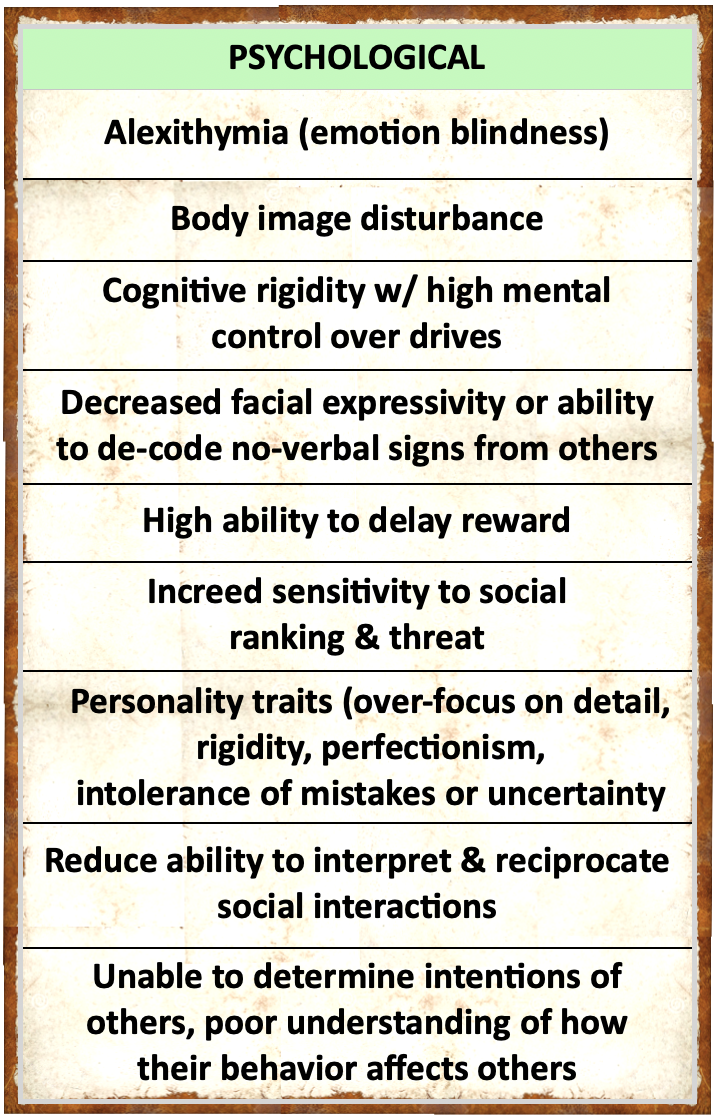
🧍🏽‍♂️ Alexithymia : the inability to recognize or describe one’s own emotions (emotional blindness)

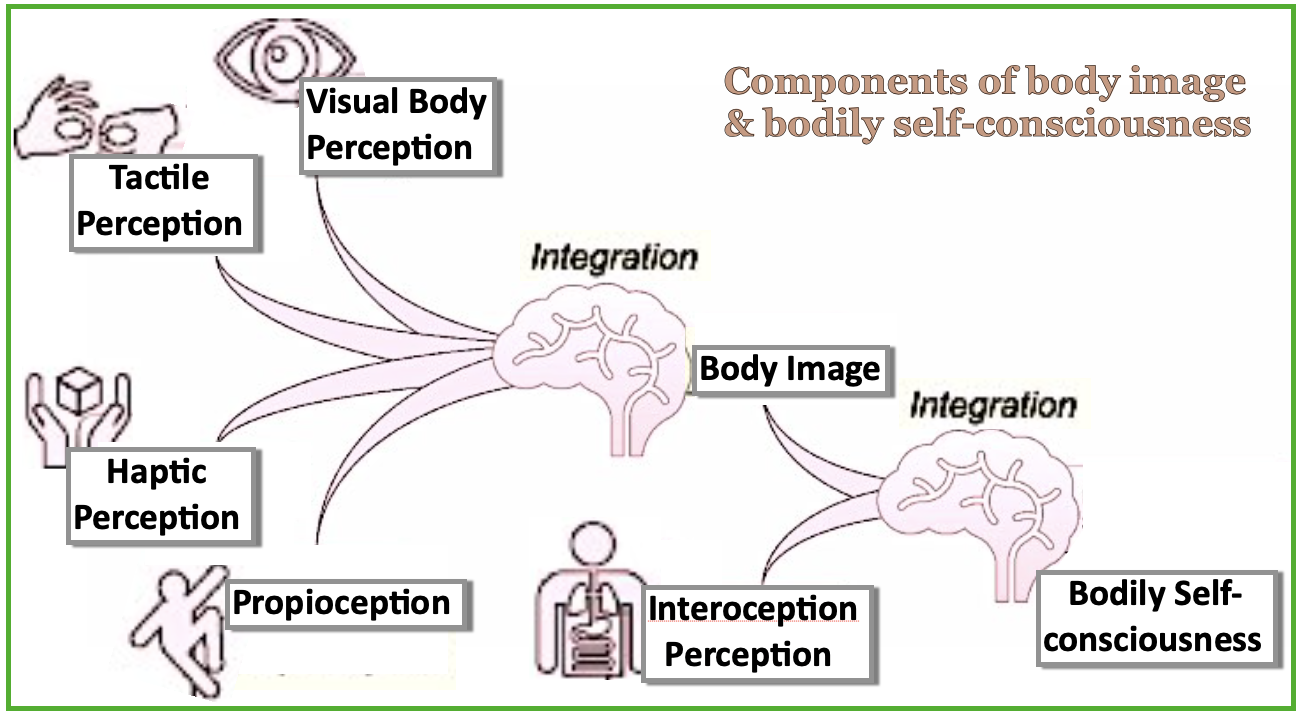
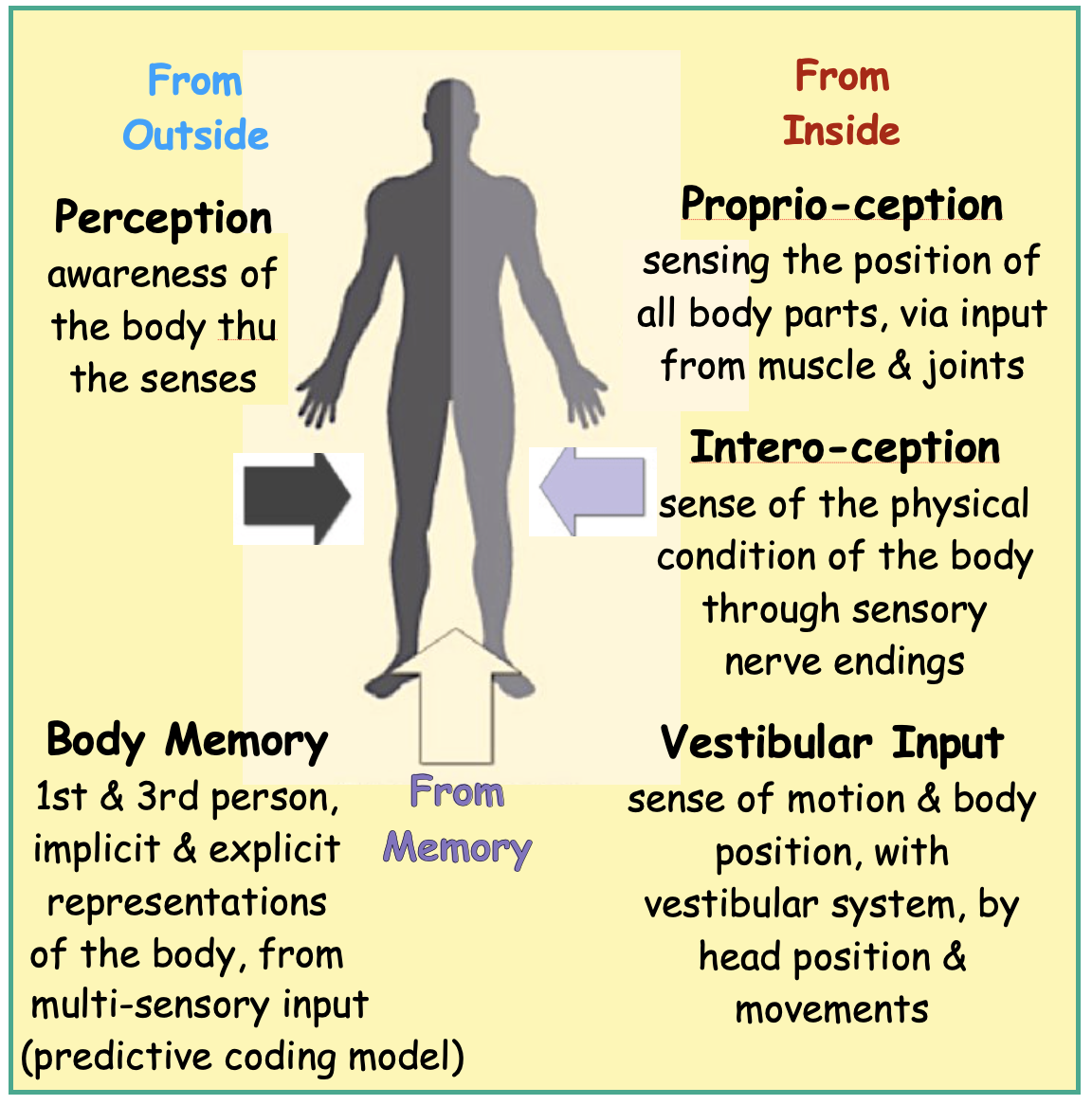
🧍🏽‍♂️ Bodily self : A sense of self through which we experience & interact with the world. Our brain integrates & applies external & internal signals to form ‘bodily self-consciousness”

🧍🏽‍♂️ Body image : a combination of the thoughts & feelings we have about our body. A conscious image of the size, shape & physical composition of our body

🧍🏽‍♂️ Emotional Dysregulation : a mental health problem = trouble controlling your emotions, & how you act on those feelings. It’s when you to feel stuck or unable to make yourself feel better

🧍🏽‍♂️ Embodiment : using our bodily experience & processes to understand our own emotional experience, and that of others.
A state in which the mind listens to the body – feeling connected & attuned, exploring the relationship between our physical being & our energy. It’s he interaction of our body, thoughts, and actions, helping to understand emotional processing.

🧍🏽‍♂️ Disembodiment : experiences of losing track of somatic feeling, the body’s movements, or the relationship of one’s own body to other bodies. It’s a sense of being “up in the head,” so we lose touch with the present moment sensory-field, what is happening right here, right now.
When distracted, we don’t notice where the body is in space, our breathing, the sense of being grounded. (MORE….)

🧍🏽‍♂️ Interoception : the ability to be aware of internal sensations in the body, including heart rate, respiration, hunger, fullness, temperature, & pain, as well as emotion sensations

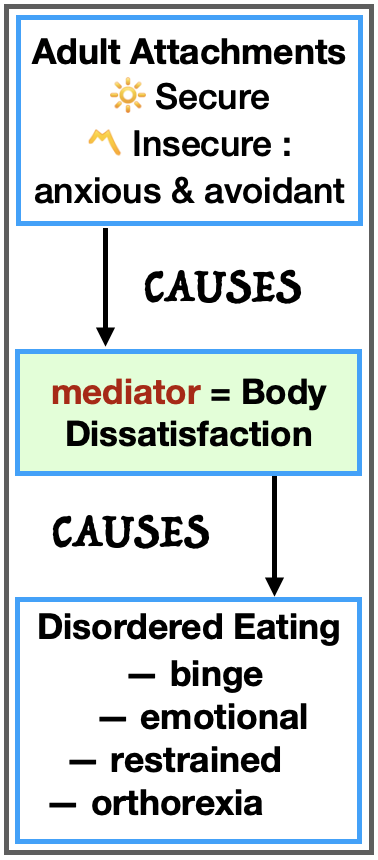
🧍🏽‍♂️ Mediator : a variable in a causal sequence between two other variables. The addition of a third variable to the X → Y relation, whereby X causes the mediator M, and M causes Y, so X → M → Y.
EXP: how well good grades (X) predict happiness (Y), but indirectly through self-esteem (M). 

🧍🏽‍♂️ Mentalizing / mental representation – a hypothetical image or picture which stands for a perception, thought, memory…. like picturing the numbers you’re dialing.  In psychological development, it’s a basic idea that represents oneSelf & significant others.  Mentalizing is an absolutely required skill needed to successfully navigate the social world.

🧍🏽‍♂️Orthorexia – an obsession with only eating foods that the person considers healthy, limiting too many ok categories

🧍🏽‍♂️ Priming : exposure to one stimulus can influence the response to a subsequent stimulus, without conscious guidance or intention. It work best when the two are in the same modality, such as visual priming with visual cues, & depends on either a positive or negative relationship between a priming & target stimulus  (MORE… )   (🌺 See “Kindness priming“)

🧍🏽‍♂️ Reflective functioning : intentional mental states that is our capacity to understand ourself & others in terms of feelings, desires, wishes, goals & attitudes.

🧍🏽‍♂️Representation : perception, memory, & cognition related to the body, updated continuously by sensory input. The mental image we create of ourself, made up of : body image, schema, superficial schema, model, structural description & body as distinct semantic domain

🧍🏽‍♂️ Representational reunion = mentally picturing the infant feeling of being positive & happy when mother returns

🧍🏽‍♂️ Reciprocity :  the tendency to return a favor or a benevolent action with another benevolent action (in 3 styles). Responding in kind

🧍🏽‍♂️ Reflexive self-awareness : the ability to experience oneself as an independent object. (around age 2 – to recognize oneself in the mirror)

🧍🏽‍♂️Somatics : is about the wholeness of a person – of body and mind. Our body holds so much information for us, it’s imperative we listen 

🧍🏽‍♂️ Synchronize / Synchronicity – two or more things working in harmony, by mirroring each other, either consciously or unconsciously 

🧍🏽‍♂️ Thinking : mental activity that can be experienced or manipulated, using symbols . Includes — imagining, remembering, problem solving, daydreaming, free association, concept formation….

NEXT :

ALEXITHYMIA – Emotional Blindness


PREVIOUS : Attachment Body DEFINITIONS

SITE : “Multifaceted Nature of Alexithymia – A Neuroscientific Perspective


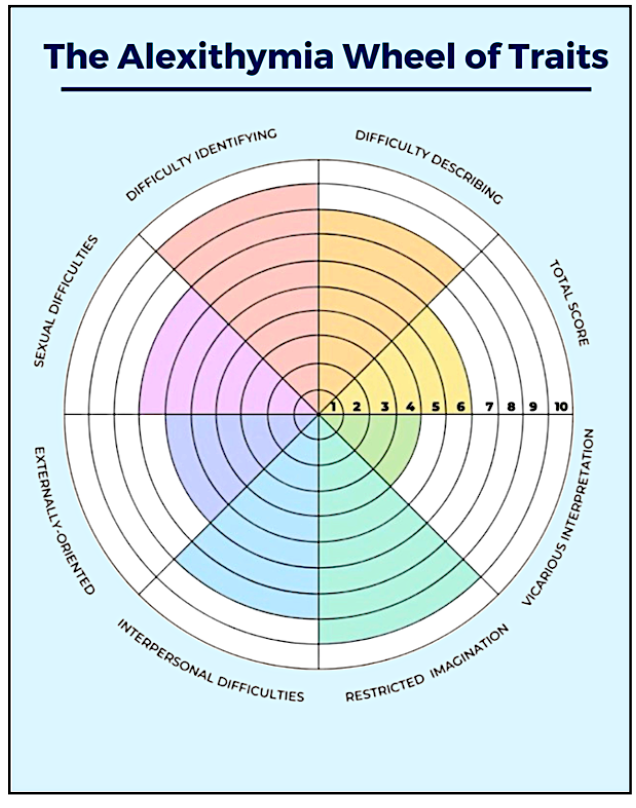
Alexithymia
A broad term for a condition whereby a person struggles to distinguish between emotions & bodily sensations.
A relatively new concept, it was coined by the psychoanalytic psychiatrist Peter Sifneos in 1972, who borrowed the term from his native language – “without words for emotion.”

Alexithymia occurs on a spectrum, & is considered a personality trait, not a medical diagnosis.
Estimated : 1 in 10 people (from a study in the Netherlands). But the rate is higher among neuro-divergent people (ADHD, Autism…) and those with mental health conditions (depression, anxiety….), chronic pain & other health issues.

🔻Primary  (trait alexithymia) is innate, considered a part of a person’s baseline personality, present from birth, & consistent across time & situations. It has genetic components, & possibly exacerbated by an environmental upset causing emotion dysregulation in early youth, likely as a result of traumatic experiences.
It may be considered mainly a problem with interoception.

🔺Secondary (state alexithymia) is temporary &/or situational. It often results from life circumstances or a recent medical diagnosis.
EXP: As with PTSD & SUD, the effect may be present for a much shorter time, & could potentially be resolved after treatment or if the stressor no longer exists.

Nurture: A person’s early environment can harm their ability to perceive & register emotions from —> Lack of mother’s positive attention, the negative emotional tone of the home, inadequate emotional labeling, extremes of emotional expression….. (Source)

CORE features : note that a person may have high alexithymia traits in one area, but low traits in other areas. 

1. Difficulty Identifying Feelings
These people experience confusion about their internal experiences, struggling to distinguish between emotions & bodily sensations
EXP : hunger vs anxiety, hunger cues vs exhaustion, anxiety vs sadness…..
The ability to identify emotions plays a key role in our ability to regulate them. Trouble with this has been linked with depression, non-suicidal self-harm, & suicidal behavior

2.Difficulty Describing Feelings
They have trouble finding words /labels for emotions so can’t express them to others. Descriptors may be vague, general & diffuse.

They may also have trouble recognizing facial cues in others. while being hyper-sensitive to physical sensations

3. Externally oriented thinking
All their mental energy is focused on the external world. All situations are considered independent of oneself or one’s own experiences, without ever noticing their internal processes. This kind of thinking reduces the ability to feel positive emotions, which can contribute to depression & other mood issues.

4. Interpersonal Relationship Difficulties
They have trouble with empathy – not picking up others’ point of view, feelings & intentions – limiting their ability to form & deepen relationships.
One study found the cause to be alexithymia rather than autism. Autistic people who did not also have A. did not have the same struggles with empathy as people with both conditions (<—- 50-60%). .  

5.  Restricted Imaginative Processes
 Many people with alexithymia  – but not all – have a diminished fantasy life, with limited imaginative capacities.
Because they’re oriented to the concrete world of facts & pragmatics** they have little interest in the arts & other creative efforts. They’re unlikely to spend time daydreaming.
** Pragmatics is the study of indirectly verbalized communication, where the speaker implies something & a listener needs to infer the meaning.

6. Sexual Difficulties & Disinterest:
While not primary, many A. people have reduced sexual satisfaction, sexual shyness / nervousness. & greater detachment from potential sexual partners. 2 CAUSES
— A. is associated with more ‘negative’ emotion, which can dampen sexual responses
— They have a more detached, avoidant attachment style, lending to  sexual avoidance, & even to identifying themself as asexual (source). This may be a reason for a higher rate of asexuality within the Autistic population. (MORE….re. A & A)
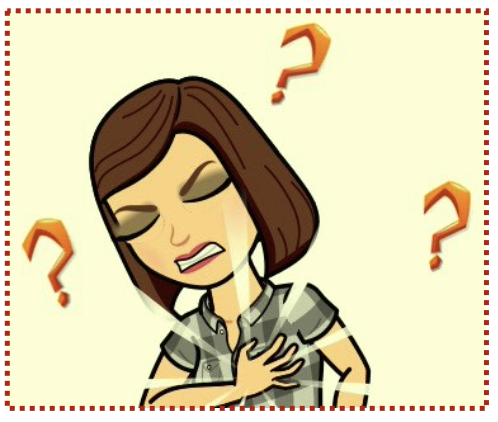
7.  Vicarious Interpretation of Feeling
DEF:
The undesirable emotion is experienced in another person, & the observer projects what they interpret as the appropriate response onto themselves.
Called “affective empathy”, As. can experience other people’s feelings on their behalf – but not their own!. EXP : have a strong emotion when learning someone’s had a great loss, mirroring what the mourner felt.

IDENTIFYING A —  2 online measures widely used :
:Alexithymia Online Test and the Toronto Alexithymia Scale, which mirror the traits mentioned above & will show your range.

NOTE: #4,  5,  6 & 7  —- are not part of the formal definition, but often correlate with it.  

NEXT : Attachment & the BODY, #1

ATTACHMENT & EATING Styles (#2)

PREVIOUS : Attachment & Eating #1

SITE : “How HR can help Manage Eating Disorders in the Workplace


3. AVOIDANT
:   A child with an avoidant attachment will not be able depend on the caregiver for security, realizing it’s not safe to express its needs, its Trues Self, emotions & opinions….
Adults with unhealed avoidant attachment – prefer being on their own because they developed trouble trusting, committing, connecting, communicating & expressing emotions.

Believing that no one will ever meet their needs, they’re learned to ‘manage’ by not wanting, much less asking.  Terrified of being dependent on anyone or anything, they actively eliminate whatever might nourish them, which includes food. They’re perfectionist, denying any form of vulnerability, always needing to be in control, so relaxing their guard & letting go – even a little – is totally unacceptable.

Avoidants eat because they have to, not because they want to – food is not enjoyment. Their mantra is : “I only trust myself & don’t need love. Refusing to take anything in is the best way to cope.”
They believe that depriving themself the pleasure & abundance of food is a way of being in charge of their choices, in order to feel safe. They’re prone to anorexia, keeping anxiety at bay by cutting or restricting calories, often eating the same things, obsessing over scientific diets, beating up the body…..
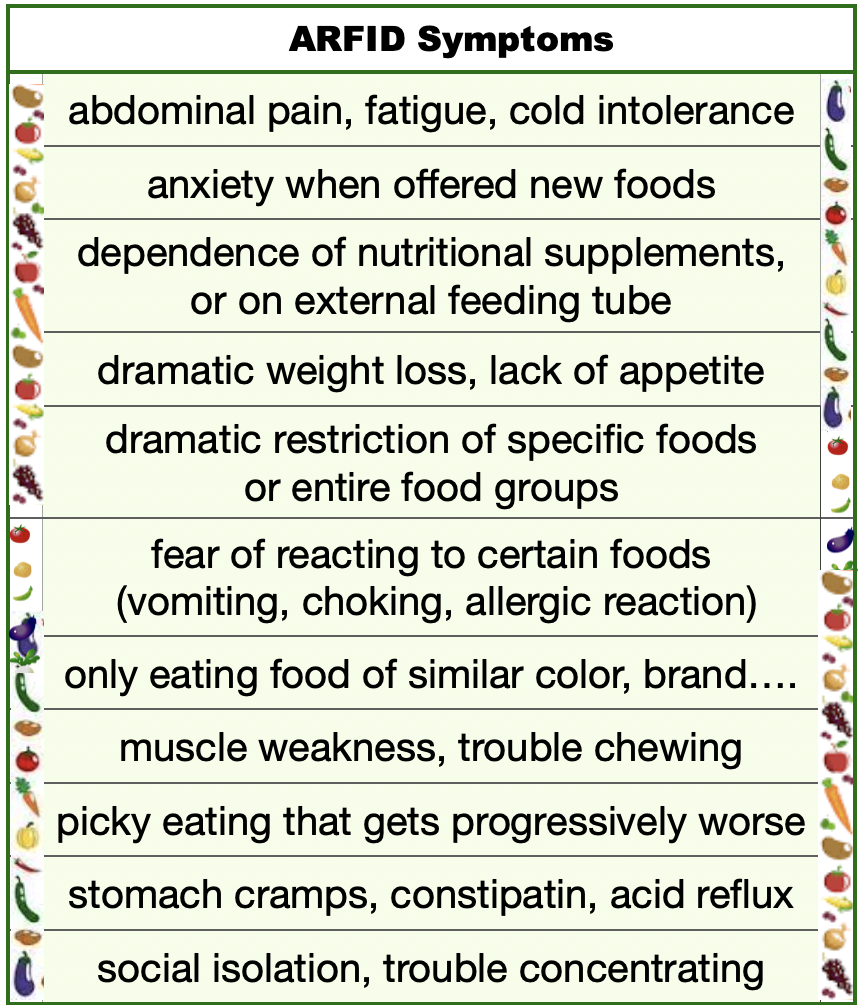
ARFID (See Part 2b) Avoidant/Restrictive Food Intake Disorder (Anorexia)

NOT about body dysmorphia or Weight-gain distress.  
3 Types
:
🔒Sensory-based = overly sensitive to specific foods
🔒Trauma related = had abusive experiences with food (typical for many ACoAs)
🔒Restrictive = don’t recognize hunger or fullness
RISK factors: autism spectrum, ADHD & other learning disabilities, anxiety disorders

SUGGESTIONS : to heal an avoidant food attachment,
🔆 the main goal is to accept that self-protection & true safely comes from proving as many of our human needs as  possible. Self-care = self=nourishment.

🔆 Then slowly create a relationship with food that feels good , as a way to provide the nurture that was missing n childhood. EXP : add more choices to meals & workouts, join cooking classes or learn recipes, get a vegan dessert once a week or do yoga instead of a run. This is not loosing control, but finding ways to consciously choose comfort rather than self-punishment.

💃🏻      🕺🏼     🍏      🍒        

4. DISORGANIZED:   A child with a disorganized attachment is in a frozen state between anxious & avoidant.   They’re in a double bind, feeling the need to avoid the caregiver because he/she is dangerous, yet not wanting to be alone & abandoned.
Adults with unhealed disorganized attachment continue this bind – they long for a connection with someone – while pushing them away. They don’t want to be violated but also not abandoned. Equally, their reaction to eating is also disorganized.

They have a control-rebel, love-hate, love-fear relationship with food.   trapped between hungry/not hungry, wanting to eat but afraid to. Disorganized-Ambivalents will binge, feel shame & then punish themself by purging, restricting or overexercising.

Whether they lean more strongly toward the anxiety or avoidance end of the scale  can determine the form of unhealthy eating . EXP: anxious = binge-purge, & avoidant = calorie restriction. In either case they’re trying to stifle the pain of being terribly dissatisfied with their body.

This attachment style is associated with gaslighting & perpetrator bonding. Disorganizeds live in two opposite realities: food is considered a physical violation (boundary invasion) but it’s also needed to survive.
So they gaslight themself into thinking that painful food experiences are good for them. Frustrated, they’ll switch from binging to restriction, chasing an illusion of emotional relief but never safe enough to land on one side.

SUGGESTIONS : To heal a Disorganized-Ambivalent attachment,
🔆 the major task is to balance containment & structure (the body) with pleasure & flow (emotions) .

🔆 A food schedule & structured meals are required, while still allowing for choices & enjoyment. Eat at regular times. Accept that this is a long hard process – but do-able.

🔆  It’s crucial you embrace & heal the fear & negative beliefs, used as gaslighting & self-rejection. Replace fear with acceptance & love.
SITE : 5 Stages of recovery from ED – Pre-Contemplation, Contemplation, Preparation, Action, Maintenance.
«

«
NEXT : Eating Disorder DEFINITIONS

ATTACHMENT & EATING Styles (#1)


PREVIOUS : FOOD- (#1)

SITE : “Eating disorders & Neurodivergence


ATTACHMENT Styles

♥️ SECURE :  Child – develops a secure attachment when mom consistently attends to toddler’s needs, who looks for mom’s approval, but continues exploring around her.
Secure Adults – have a balanced sense of self & a healthy connection with others. Easily trusting themself & others, they can openly share ideas, feelings & desires.

With a secure attachment to mom, it’s likely the child will also have it with food. Food is abundant, a form of love, & not causing any fear. Secures approach food in a healthy, balanced & structured way, as well as getting pleasure, comfort & joy from meals. They value growth & health, food as a tool to heal & to share creativity & enjoyment with others.

SUGGESTION : To develop a secure attachment to food, it’s best to have 3 regular meals throughout the day & small snacks in between.
Try cooking new tasty dishes, create fun dinner parties, & think of food as a way to positively maintain & increase the body’s electrical vibrations .
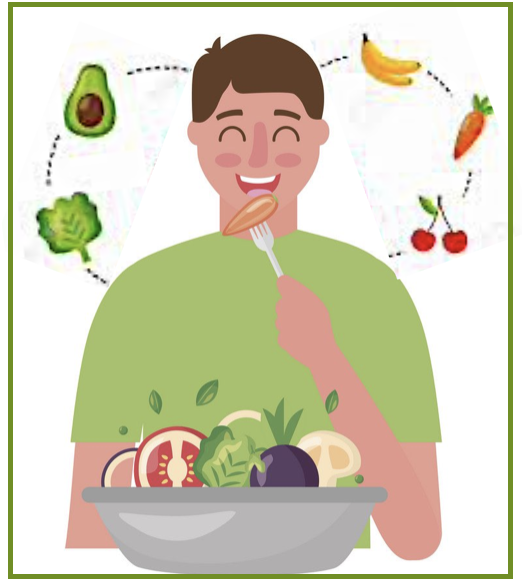
AFFIRMATION : “This colorful food is replenishing my body, mind & spirit. I can feel my energy expanding!

😼

2. ANXIOUS:
Child – An anxious attachment is formed when the mother is inconsistent in meeting the child’s needs, creating anxiety & fear of abandonment.
Adults with an unhealed anxious attachment may become addictive, constantly looking for validation & security from similarly inconsistent people, not wanting to be on their own.  They scream their need for trust, security & nurture by chasing it externally from others, while sacrificing their sense of self.

Similarly, this person will chase food as a way to soothe the emotional pain of not being validated, safe, or understood.
Overeating or binge-eating gives a false sense of grounding, a fullness they were regularly deprived of in their family. This leaves anxious attachers particularly at risk for eating disorders, with increasing severity of symptoms.

Because Anxious types are afraid of scarcity & being abandoned – tomorrow – eating now is considered predictable, reliable (at least in Western societies), the one thing they can rely on. This leaves anxious attachers particularly at risk for eating disorders, with increasing severity of symptoms.

They’re addicted to negative thoughts about themself (S-H), with heightened emotional reactions to any slight, expecting to be rejected by those close to them, wanting constant strokes. Many will turn to fool to fill the emptiness rather than healing the trauma from childhood.

They use food to silence their emotional body the sane way their original caregivers did, teaching by word & deed that emotions are unsafe. Lacking internal boundaries, they don’t trust they can create a positive/ balanced relationship with food.

BINGE Eating Disorder (BED) – a common choice for the Anxious : The more you eat, the fuller you feel – physically. Food-fullness tries to quiet the ‘huger’ to be filled up by warm, loving relationships.
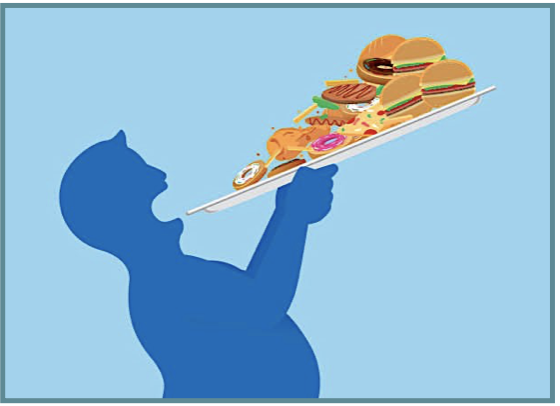
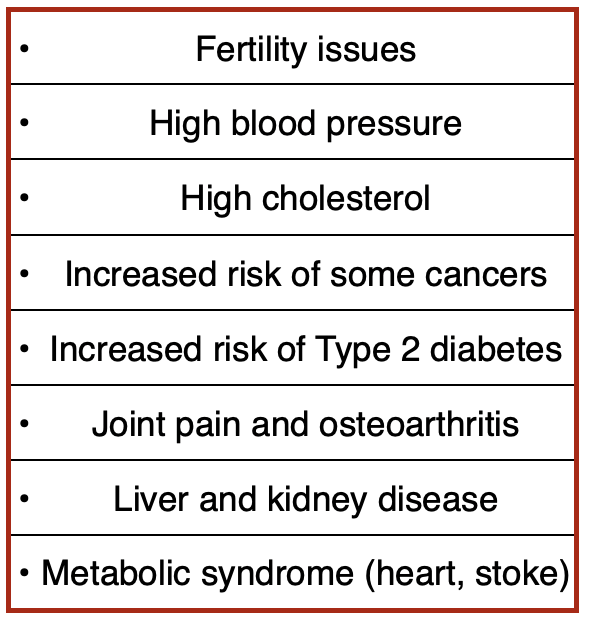
⬅️ EXP of some over-eating results

Ritual is important in any addiction. The day is planned around “the binge” – it’s something to look forward to,  like a friend who will never disappoint. It fills the loneliness & quiets the anxiety. A lot of time is spent (wasted) thinking about when it will happen, what will be eaten, even avoiding certain foods earlier – to make the binge that much more pleasurable. 

Tragically, it backfires. Alter the binge, the person (often women) will drown in self-criticism & shame, adding another layer to the original pain the binge was meant to mask.

SUGGESTIONs to heal anxious food attachment
🔆 make a daily habit of noticing when you’re emotionally shutting down, (see list) & instead —-> speak or write down the bottled emotions.
Ask : “What emotional need am I trying to get from food? How can I get more of this need (company, safety, comfort, guidance, nurture) from myself & from safe PPT (people, place & things) ?

🔅Learn how to plan 3 moderate daily meals, with a few heathy snacks in between.
🔆Get a food-buddy for encouragement & to keep you on track (therapy, online groups,  OA).
🌺 Keep to a structure throughout the day, as much as possible, allowing  yourself to enjoy taking care of yourself – as you use food for nourishment instead of a numbing agent.

NEXT : FOOD – (#3)

ATTACHMENT & FOOD : Others (#4c)

PREVIOUS :
Attachment & FOOD #4a


Reminder : ALL major eating disorders are related to one of the INSECURE Attachment styles. (See also : “Co-occuring problems“)`

1. EXP = ORTHOREXIA Nervosa (ON)
A “fixation on righteous eating”, the unhealthy focus on trying to eat healthily. This person will  lose weight although not trying to.  Breaking the rules they set for themself creates fear of disease along with anxiety & shame for their choices, so the rules get harsher over time. The person may also do unnecessary cleanses.

Insecure attachment styles are connect to EDs, especially with high levels of Anxious attachment, along with depression & low-self-esteem  People with stronger Ortho-tendencies were often unsuccessful at emotion regulation, a common feature of eating & emotional disorders.

They have serious misconceptions about nutrition, such as assuming the benefits of excluding entire food groups.  This will lead to severe nutrient deficiencies, eventually causing life-threatening problems such as anemia, osteoporosis, hormone imbalances, & an abnormally slow heart rate. (More….)
«

«
IRONY : If sustained, this pattern actually does the opposite – it damages the person’s overall health & well-being,
♨︎ Similarities between orthorexia and anorexia (both avoidant attachment) & bulimia (anxiety attachment) include eliminating food to have control – over deep abandonment anxiety.

2. EXP = BED (Binging)
 These people usually do not lose large amounts of weight – a typical sign, although they’re been publicly dieting for much of their lives. (More….) BED is more common in adulthood than other EDs, & especially in men – who are about half of all sufferers, rather than in other disorders. Treatment can be harder to get for adults because the medical community still has biases against their age & type of disorder.

How it’s MAINTAINED
🔹Impulsivity (I)
is premature decision-making without forethought, & no consideration for the consequences of one’s actions. There’s a failure to stop oneself from acting, & the inability to postpone rewards, wanting immediate reinforcement.

People with BED (binge eating) have high Impulsivity scores, & initially this behavior leads to feeling pleasure & satisfaction.

🔸Compulsivity (C) is repeated & persistent actions not related to a goal or reward, but continues in spite of negative consequences.
Persistent repetition of binging – despite obvious self-harm – is a sign of addiction.

With any chronic substance abuse, there’s a ventral-to-dorsal shift (I to C), as the person’s drive moves from pleasure-seeking to needing relief from the painful symptoms of withdrawal & obsession to get more of the ‘drug / food’. This shift help maintained the disorder.  (MORE…. ⬆️ & ⬇️)

Coordinating INFO :
Polyvagal theory, Attachment & ED
In treatment, a person’s nutrition status & ability to regulate their nervous system are intertwined. Whenever the Sympathetic system rules (#b), the person is stuck in survival mode. (CHART )
🇨🇭 A body & brain struggling with nourishment is a body in distress & a brain that doesn’t have the capacity to engage in higher-level healing.

Nervous System Activation
(Ladder + resources)
a. Ventral vagal social engagement: The state that allows us to connect with & relate to others. We feel safe & secure, easily being present for ourself. We can empathize with others, as well as accurately interpret facial expressions & body language.

b. Sympathetic activation: causes the fight-flight response – motivating us to quickly get away from a threat – by increasing our heart rate, breathing rate….. We may feel anxious, chaotic, overwhelmed, even frenzied.

c. Dorsal vagal shutdown: The nervous system tells us we’re in a life-threatening situation (actual or not) & signals the body to stop. This is the freeze response – a state of collapse with feelings of being stuck, despondent, lethargic, unmotivated, & hopelessness.

Stressors & trauma can cause us to move from #a 🔺 to #b🔻. However, the body can’t sustain anxiety for too long, so, for self-preservation, it will go into shutdown, #c.

3. EXP = OVEREATING (OE)
Note – Overeating is not BED (binge eating disorder). Rather, it’s biological & very common. When stressed, our body makes more of the hormone cortisol. – a fight-or-flight response that tells us it’s time to find food, making us crave foods high in sugar, fat or salt.
Some symptoms of OE : acid reflux, bloating, gas, heartburn, nausea. Other factors that contribute to OE are how fast you eat, what, when & and what you’re doing while eating.
BRAIN
☄️Food causes dopamine neurons to release this chemical into the NA.  (area re. something important, that’s striking), which plays an important role in assessing reward
☄️In the ‘addicted brain” which causes over-eating, the PFC and CG have a reduced ability to regulate compulsive drives
☄️Compulsive behavior is then driven by the relationship between NA & Memory areas of the brain
«

«
NEXT
: FOOD – #2

ATTACHMENT & FOOD : Bulimia (#4b)

PREVIOUS : Attachment & FOOD (#4a

IMAGE  ⬆️ = Regions w/ associated behaviors & functions

SITE : Attachment Theory in the Treatment of Bulimia


CNS Regulation of Binge- & Over- Eating
RESEARCH : Appetite & body weight regulation are controlled by the body’s central nervous system (CNS), the brain playing a central role in integrating inner & outer inputs to keep energy provisions in balance. Circuitry which controls eating is regulated by the attention, emotion/memory, cognitive-control & reward systems.

Changes in mental & emotional processes are implicated in the dysregulation of human eating behavior. Techniques used to examine appetitive include neuro-cognitive testing (via computer games), fMRI, PET & SPECT scans. Together they revealed the neuro-chemical determinants critical to understanding how the reward center in the brain is altered in obesity & emotional eating.    Brain LOBES ➡️

Some RESULTS
Insecure Attachment & their subtypes are linked to many brain functions  : 13 executive regions, 6 affect (emotions), 6 reward, 3 sensory, 1 social & 1 cerebellar. 

CHANGEs found in the :
— Executive function = high frequency of externalizing behaviors (aggression, antisocial & behavioral problems)
— Affective processing = high frequency of internalizing behavioral disorders (anxiety, depression, suicidality)
— Reward regions = higher frequency of substance abuse
— Social circuits = high frequency of excessive help-seeking, dependency & excessive social isolation 

Insecure adults required more of their executive control functions when faced with attachment-relevant stimuli (listen to infant crying) –  staying in the head to not feel. The excess stress could relate to a high prevalence of personality disorders.
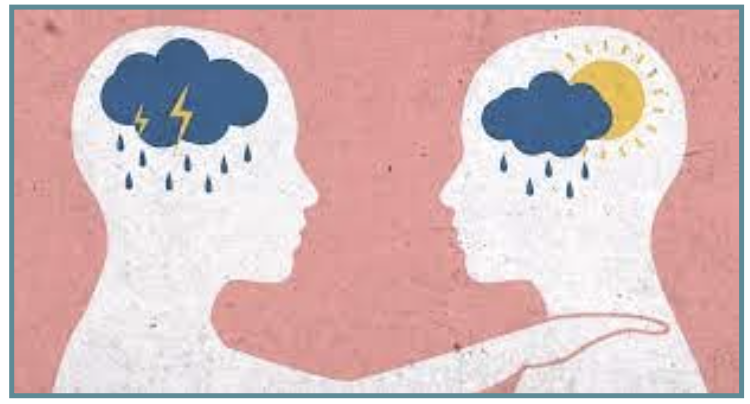
— Resistant types, being highly emotional & obsessive, were less able to gather brain resources to stop negative thoughts
—  Avoidants showed poorer memory of attachment-related events (childhood trauma), linked to a higher prevalence of conduct disorders. 

 ♦︎        ♦︎       ♦︎

BULIMIA
The term refers to an eating disorder (ED) characterized by episodes of binge eating followed by compensatory behaviors such as purging, fasting, and/or excessive exercise.. It is the result of genetic predisposition along with the influence of psychosocial &/or environmental triggers.

Many studies have proven overlapping behaviors & addictive personality traits of substance abusers & Bulimics. In fact this ED commonly co-occurs with drug addictions,
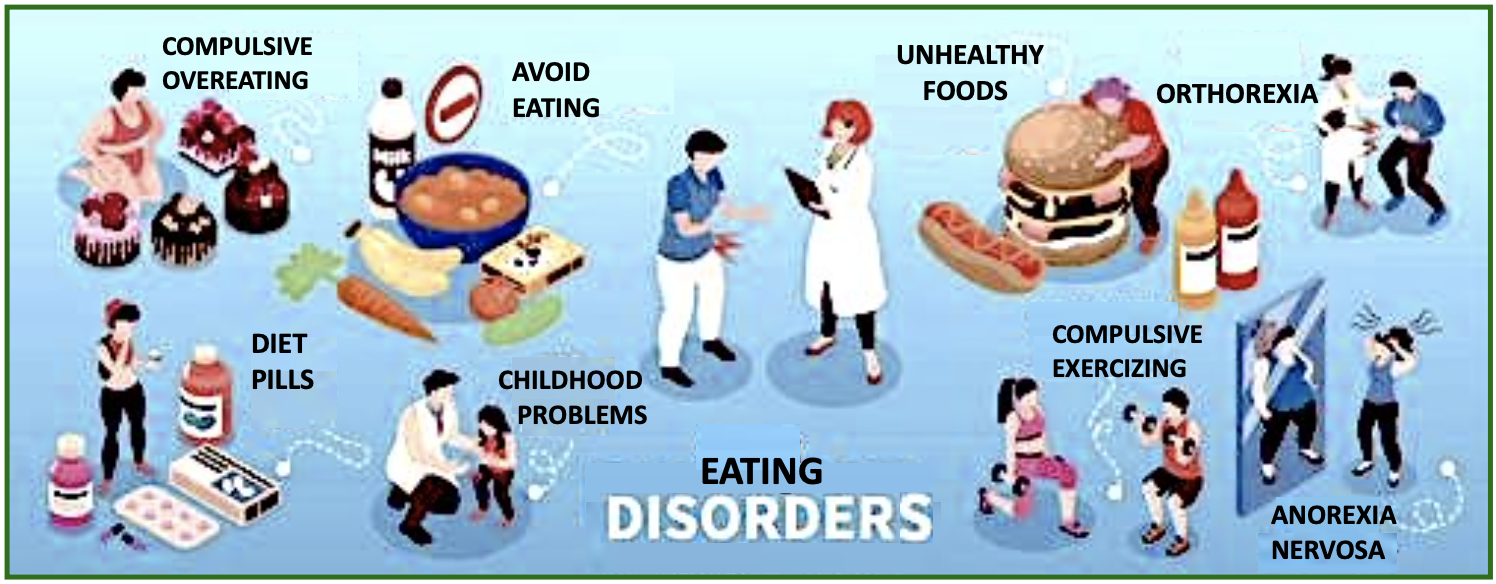
EXP: the National Center on Addiction & Substance Abuse has shown that approximately 35% of all alcoholic women also have an ED. And 50% of people with EDs also struggle with substance abuse.

2 TYPES  – Because symptoms & behaviors of Bulimia are complex, it’s divided into :
Purging – The most commonly understood version, which involves the person binge eating, followed by such behaviors as vomiting &/or laxative/ diuretics/ enemas.
Non-Purging – This group do not expel food from the body as a way to deal with their self-loathing. Instead, they compensate by fasting or compulsive exercise, & rarely if ever purge.

A faulty reward-processing system seems to be an important feature of the diseases.
Brain studies reveal that neurological abnormalities contribute to the development of bulimia, a result of altered brain chemicals such as serotonin levels, which contribute to the dysregulation of mood, appetite, & impulse control.

EXP : Dopamine activity is altered in both bulimia & anorexia — but in opposite ways. While the reward circuits in women with anorexia are overly sensitive to food-related stimuli, women with Bulimia have a weaker-than-normal response in brain regions that are part of the dopamine-related reward circuitry.
STATISTICS = In the US as of 2023, Bulimia Nervosa :
▶︎ affects 4.7 million women, & 1.5 million men, although the number of males being diagnosed is expected to increase because of better awareness of how males display symptoms.

▶︎ As much as 25% of college age females use bingeing & purging as a weight loss method , with an average onset age of 18. Overall –
▶︎ 78% experience daily life impairment
▶︎ 43.9% experience severe impairment
▶︎ 8% are female, lasting more than 5 years, 5x more the men
▶︎ Only 3% receive treatment
▶︎ 3.9% will die from the disorder.

Bulimics are more likely to come from a family with a history of eating disorders, physical illness, & other mental health problems. Adult traits include the tendency to impulsivity & sensation seeking, typically present from childhood. But they have a secret life, keeping their eating disorder very private & hidden.
«

«
NEXT : Attachment, Food & Others, #4c

ATTACHMENT & FOOD : Anorexia (#4a)

PREVIOUS : S & I (#3)


BRAIN – Normal APPETITE
An key role of the brain is to ensure that there’s enough regularly circulating energy needed for smooth tissue functioning, as well as enough stored energy to cope with intervals when external provision is scarce (food). An important goal of the brain is to limit meal size, by coordinating several processes that allow the most effective circulation & storage quantity of energy-rich nutrients.

Brain centers (hypothalamus, brainstem & reward centers) provide signals that are integrated by peripheral nerves, resulting in appetite stimulation or satiety.

The hypothalamus acts as a main appetite regulatory center, playing a central role in orchestrating bodily responses to hunger & food, It provides peptides to the reward pathways, & controls the release of leptin, ghrelin & orexin, with one area increasing appetite, another reducing it. (IMAGE ⬇️ )

The meso-limbic reward pathway projects from the VAT into the NA in the limbic system (ventral tegmental area —>nucleus accumbens).  This pathway stimulates pleasure by increasing the release of dopamine.

Food activates the reward system, providing the feeling of pleasure, which in turn can lead to food-seeking, so that the person’s thinking about hunger motivate the action (memory of pleasure).  More….download full-text.  ) “Control of Food Intake and Appetite“.
«

«
Insecure attachment styles are made up of negative mental images about close relationships —-> anxious or avoidant, preoccupied & dismissing <—- which have important implications in the development & maintenance of eating disorders.

ANOREXIA = traits
Anorectics
are anxiety based – they think negatively about the world, experiencing it as a dangerous, overwhelming place. They’re also negative about themself – not seeing their body accurately as everyone else does, & as not friendly, pretty, or capable.

✒︎ They develop an OCD-like pattern because something feels out of order & they don’t know how to correct it. So they create rules to avoid food, which makes them less scared.

✒︎ Being reward dependent & perfectionistic, they want to be the very best, the top dog or they don’t feel ‘legitimate”
✒︎ But they’re also stressed because of low reward reactivity, so that even when they succeed, it doesn’t help them feel better.

✒︎ Their interoceptive** awareness (how we experience our body) is distorted so they misinterpret cues from their stomach, or other internal parts.
** INTEROception = Body Awareness
Muscles & joints have receptors that tell you where your body parts are.  Interoception works much the same way,  but the receptors are in your —> organs, including your skin. These receptors send messages about the body to the brain, helping to regulate vital functions such as hunger, thirst, digestion, or heart rate.
The Anorectic BRAIN : Researchers say an ongoing eating disorder can distort the brain’s reward circuitry. They lose weight everywhere, including inside the brain. This reduction is a danger to ED sufferer – as the volume drops, parts of the brain thin. The white matter shrinks & cells lose the ability to communicate clearly. Ironically, making decisions about their diet is the only thing that brings them relief & joy.

At ‘best’ the thinning breaks connections between brain areas, at worst it destroys cells. Areas affected include Attention, Impulsivity, Self-regulation & Social interactions. The damages also injures memory circuits, so anorectics can struggle to remember details about daily life, which can persist even after people enter recovery & regain weight .

No satisfaction : The release of Dopamine, from the hypothalamus, that should act as a reward (eating tasty food) —> is instead felt as punishment (for adding a snack).
EXP : Anorectics may feel happy when reading ingredient labels & finding hidden fat calories, and rewarded when they harm their bodies, such as : pushing food around the plate instead of eating it, excessive exercise, dropping an unhealthy amount of weight….

When brain cells that are normally used to signal happiness vs harm are reversed, & the alterations can make it very hard for the anorectic to make good choices. Since those switched neuro-transmitters provide physical rewards, telling the person they’re making the right choices, they’re not likely to see the need to get treatment.

RECOVERY : Brain structure & broken connections can’t be repaired, but anorectics can gather information, apply acceptance & develop new coping skills. They can come to understand & accept why changing eating habits is crucial. Since brain losses in this disease are progressive, early treatment will lessen the damage, & improve their life.
«

«
NEXT : Attachment & Food – Bulimia, #4b

ATTACHMENT & FOOD : S & I (#3)

PREVIOUS :
Attachment & Food #2c

Dysfunctional Individuation, Spiritual struggle & Identity…..a Developmental approach


TEENs – a Risk Factor

😡 Striving for Independence from attachment figures is a natural developmental need – to redefine relationships with them in line with the new needs of adolescence.
However, this often creates an internal struggle for the young person & resistance from parents.

On the one hand, the teen wants a sense of freedom & control over their own life but still crave the comfort & support of family. This inner & outer conflict causes intense stress.
When a balance is not reached, some teens try to cope with their frustration, fear & anger by restricting food, as a way to have what little control over their environment they can.

☼ Young people ages 15 to 24 with anorexia have a 10x higher risk of dying compared to non-ED peers, & of that group, 1 in 5 deaths is by suicide. (ED Treatment for Children & Teens)

This family battle is not unusual in our culture, a natural result of the “Separation & Individuation” process, but – in so many dysfunctional homes – it doesn’t end well.
The possibility for it to work out is influenced by the type of attachment bond members share.  It could be resolved slowly, perhaps uneasily – if parents & teens were healthy enough to openly, lovingly communicate thoughts, feelings & needs with each other, likely with some outside help.

So when parents provide support & encouragement for autonomy, the child can grow into their own person & be resilient, which in turn increases their ability to cope well in life.

Dysfunctional INDIVIDUATION
Attachment style is one of the variables in the study of eating disorders, specifically with Insecure adult attachment. While the style is relatively stable throughout ones lifetime, research suggests that our Internal Working Model** can be modified during the individuation process.
** IWNs are mental representation of our earliest relationships, which become the prototype for all others in the future.


When a person’s individuation is problematic (incomplete, distorted, thwarted), positive IWMs of ourself & others are harder to develop & hold on to.
Studies using the “Disordered Eating & Body Image Concerns” scale validate that dysfunctional individuation has a negative indirect effect on unhealthy forms of eating – identifying it as one important mediator ⬅️  between attachment style & ED.

EDs usually develop in dysfunctional parent-child relationships – from a the lack of empathic mirroring & the mother’s discouragement of independence in early childhood.  If the child tries to express their own personality, separation anxiety gets triggered, leading to depression & hopelessness, formed by negative mental pictures (IWSs) of relationships.

When the S & I process goes awry (incomplete individuation) it can cause —-> emotion dysregulation, poor self-image & trouble knowing what their needs are. Continuing the spiral —> there’s a lack of confidence in one’s coping skills to manage life’s challenges —> which can set them up for an ED.
This pattern is a reliable predictor of poor adjustment in late adolescence, as either unhealthy dependence (Anxiety) or unhealthy independence (Avoidance).

Even when parents think they’re well-meaning, if they’re subtly controlling &/or manipulative, their behavior will backfire, leaving harmful after-effects.
Adult-children from that background report they had or still have a hard time mentally & emotionally separating from family. Insecure attachment plus the personality dimension of self-criticism add up to a risk factor for adolescent suicide fantasies or attempts.

Bulimics (less with Anorexics) describe their families as “more conflictual & disengaged, less cohesive & nurturant” than controls. TRANSLATION : a lot of fighting, emotionally distant & disconnected, no loyalty or togetherness, & not kind & loving.!!
This has been supported by studies that identified families of both subgroups as “enmeshed, intrusive, hostile, & negated the child’s emotional need ”  (MORE….)

🌺 To consolidate one’s True Self identity, emerging adults need to successfully complete the developmental process of Separation & Individuation when we are supposed to work out ‘self-other’ boundaries. Although this is meant to start in the first years of life, adolescence & young adulthood provides a ‘second phase’ chance to re-negotiated these issues with parents.
This is a crucial personal-growth task, needed to balance autonomy and connectedness, to decide one’s own values, be self-motivating & able to effectively cope with life.
In this round, however, the process is more about starting their separation from the internalized parent rather than the physical ones, especially if it’s a negative introject.

NEXT : FOOD – #4

ATTACHMENT & FOOD : INFO (#2c)

PREVIOUS : Attachment & Food #2b


8
COMMON Eating Disorders
PICA — eating nonfood items with no nutritional value. Although it can be normal for children under age 2 to put various objects in their mouth, any similar activity after that represents a serious problem

RUMINATION disorder — repeatedly regurgitating recently eaten food, followed by spitting out, re-chewing, or swallowing it. These people do not have nausea, vomiting urges or food disgust – but it is linked with neglect, stress &/or lack of stimulation.
OTHERS:
(ARFID) Avoidant/restrictive food intake disorder
(BED) Binge eating disorder and Overeating ⬇️
(OSFED) Other specified feeding or eating disorders
(UFED) Unspecified feeding or eating disorders
Also in posts:  Anorexia, Bulimia, Orthorexia

SOCIAL MEDIA  DIET“-  50 studies in 17 countries indicated that social media usage contributes to eating disorders with body image worry, & overall poor mental health affected by social comparisons, absorbing the thin / fit ideal as valid, & considering oneself as a ‘thing’ rather than a whole person. (Toxic world of Social Media Diet Culture“)
(“Balance your media diet”) and (Social Media Diet – for moderation)

♢ A study of 463 college students (Chongqing, China) looked at addiction to social networking sites (SNS), based on research evidence that emotion dysregulation plays a role in maintaining addictive behavior – such as eating disorders, problematic phone & internet use, gambling,…..
Results indicated that attachment anxiety correctly predicted SNS addiction & that poor emotion regulation mediates (affects) this connection.

SUB-Categories of EDs
♦︎ Asperger’s preferences –
for starches & snack foods, & more frequent rejection of fruits & vegetables.
♦︎ Autism – autistic children are bothered by color – they like plain beige foods (pasta, chips…)
♦︎ Brumotactillo-phobia –
fear of different foods touching each other
♦︎ Isolationism – eating one food item in its entirety before moving on to the next

♦︎ Mortuusequus-phobia : fear of tomato ketchup. (Australian slang meaning “dead horse”)
♦︎ Neophobia – reject or be reluctant to try new or unfamiliar foods
♦︎ Pseudodys-phagia – in its severe form, the irrational fear of swallowing. In its minor form, of choking.
♦︎ Sensory Food Autism – kids on the spectrum often express a strong preference for foods that feel a certain way in their mouth.

CO-OCCURING Disorders
As much as 80% of EDs are triggered, sustained by & intertwined with mental health conditions  (EXP for Bulimia). A dual-diagnosis can worsen a person’s symptoms & complicate treatment.
✒︎ INFO from website “Eating Disorder HOPE
A study with 2400 people found that 94% of those hospitalized for ED also had a mental health disorder, such as OCD/ Trichotillomania (pulling hair out), SAD, PTSD, ADHD,  ….

☀︎ Major Depressive disorder (92%)
☀︎ Anxiety disorders (GAD) (48 – 81%)
☀︎ Borderline PD (up to 54%) . Self-injury (61%)
☀︎☀︎ Substance abuse – 50%, over 5x higher than in the general population

NOTE ***As of 2008, about 10 out of every 1,000 children experience neglect or abuse in the United States! It’s likely higher now because of covid (2020+)

Severe ED Medical Complications
☻ Mortality rates – conservative estimates : Anorexia = 4%, Bulimia =  3.9%.  Others = 5.9%

☻ Diabulimia / ED-DMT1 – One of the most dangerous, when a person with type-1 diabetes intentionally skips their insulin dosage to lose weight. Restricting insulin as well as food can cause dizziness & fainting, slowness to heal from cuts & bruises, organ failure caused by diabetic ketoacidosis, strokes, various staph & other infections, and death.
Purging – Withdrawal & Detox treatment from purging  (self-induced vomiting, laxative &/or diuretic abuse) is physically harsh, & exposes internal damage : abdominal pain, constipation /irritable bowel, duodenal obstruction, edema, eye pain, gastroparesis, hypotension, liver problems,  trouble swallowing….. (More….)

STATISTICS
☼ EDs have the 2nd highest mortality rate of any psychiatric disorder, after opioid misuse
☼ Most common :  Binging & OSFED (Other….)
☼ Prevalence for the over 40  : Women = 3.5%, and Men = 1-2%, mostly untreated

☼ Men are just as vulnerable to ED as women : Anorexia, 25%,  Binge 36% ,  Bbulimia  25%
☼ Rates have increased in all populations, but at a faster rate in male- lower socioeconomic- older patients

☼ Stressful life events can trigger an ED onset : relationship problems & breakups, death of a loved one, change of job, retirement, menopause…. especially if they pile up

☼ People of color have the same rate of ED, but are significantly less likely to receive help for it (MORE….)

Rates of all EDs are generally higher in the LGBTQ+ community

☼ Older patients are more susceptible to complications, such as osteoporosis, arrhythmia, heart problems, gastro-paresis, depression, anxiety, & substance misuse (SUD).

SITE for many STATs = Categories  «
NEXT :