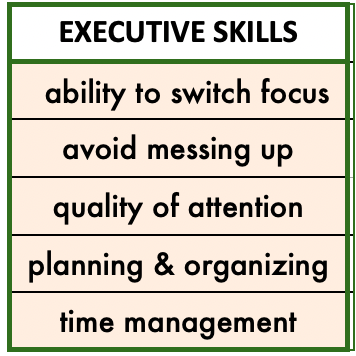
Self-Regulation : INHIBITION (#1) √

PREVIOUS : Bottom-UP

SITEs : Parenting Guide: Healthy Principles That Work”

NOTE: This type of Inhibition is NOT about negating oneself out of fear, self-hate & lack of boundaries  (Post “Over-controlling ourselves#2“)
In physiological psychology, inhibition refers to the suppression of neural electrical activity.
In personality psychology
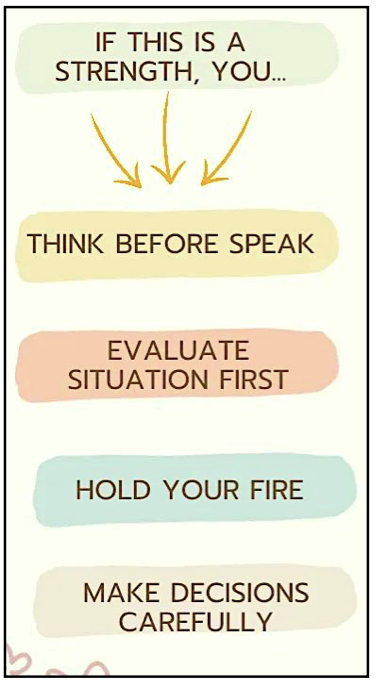
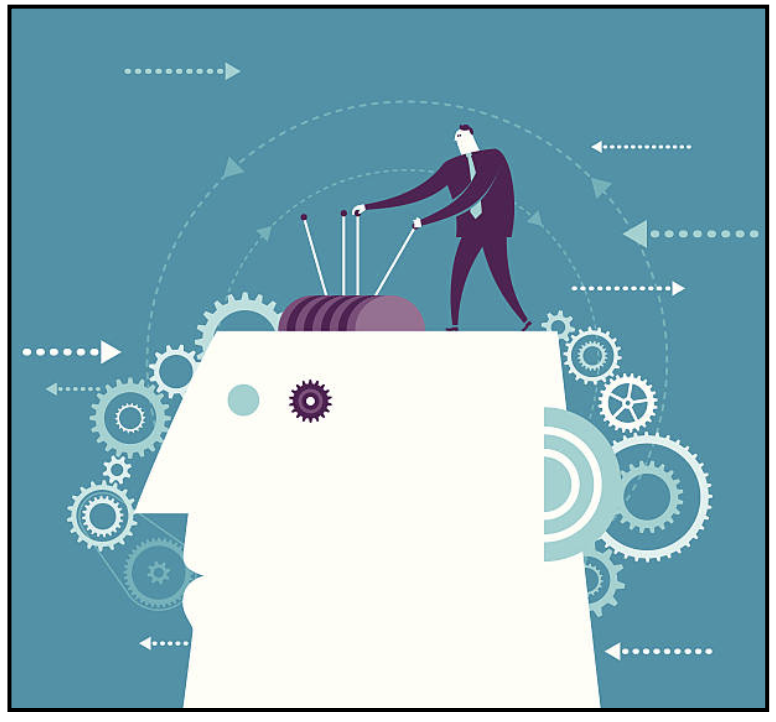
, inhibition (self-restraint) is the capacity to think before you act – which involves controlling our automatic urges (attention, behavior, thoughts, emotions) —-> by pausing, then using attention and reasoning to respond appropriately.
It’s the conscious or unconscious ability to stop ourself from doing or saying something that would harm personal goals or social standing, injure someone we need or care about, or prevent a negative consequence to self or others.

Inhibitory control has 3 stages : (1) interference over emotional impulses (2) action restraint or suppression (early response), (3) action cancellation or termination (late response).
Conscious inhibition is often used in daily life, especially when faced with conflicting needs or wishes, serving a necessary social function
TO lessen or prevent harmful impulses from being acted out toward others (not hitting someone when in a rage)
AND
TO make it possible to delay gratifying a pleasurable activity when it can harm oneself or someone else. EXP :
— resist the urge to scratch a mosquito bite
— not interrupt someone when they are talking to us
— pull ourselves out of obsessive negative thought patterns & self-talk
— stay focused on a task even with several distractions all around us
— stay quiet when we’d really like to say but know we shouldn’t…..

Response inhibition is part of Positive Mental control (an executive function),  a core feature of self-regulation (S-R).  Adults mostly restrain emotional displays, as various pressures & events increase its importance. EXP : when negotiating, it’s self-defeating to reveal one’s wishes or feelings too much.

Participation in human culture involves performing complex tasks, & effective performance can benefit from inhibiting any responses that might disturb, distract from or compete with one’s needs
It’s allows people TO :
initiate, adjust, interrupt, stop, or change their thoughts, feelings or actions (T.E.As), in order
to accomplish something desired, or to maintain a current standard of living.
It’s also important for learning, because to master new info one must restrain unhelpful, automatic behaviors or previously learned patterns.

Types of Inhibitory Control
Cognitive:  the ability to control our focus & attention while surrounded  by several distracting stimuli.
LOW control = distractibility and inattention
Behavioral : the ability to control the urges to react or respond to situations because we know it would not be appropriate to do so.
LOW control  = impulsivity

Emotional :  the ability to control or regulate our emotions.
LOW control = outburst, tantrums
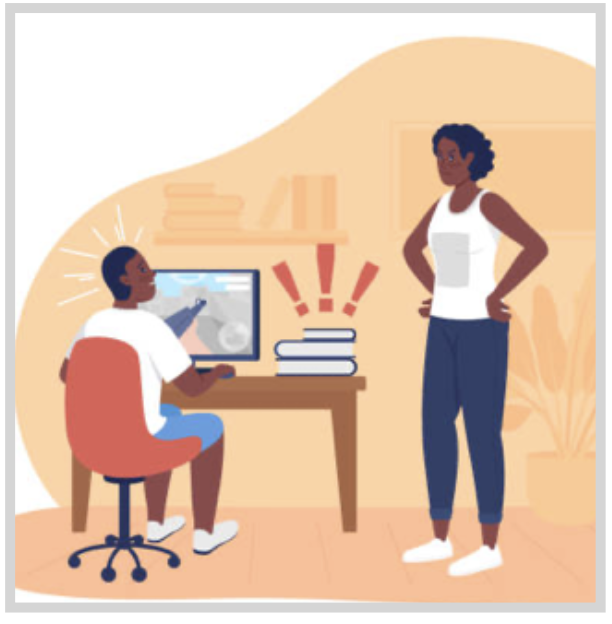
Motor :  the ability to control our motor behavior, such as staying in our seat in class even though we feel bored.
LOW motor inhibition looks like hyperactivity (ADHD)

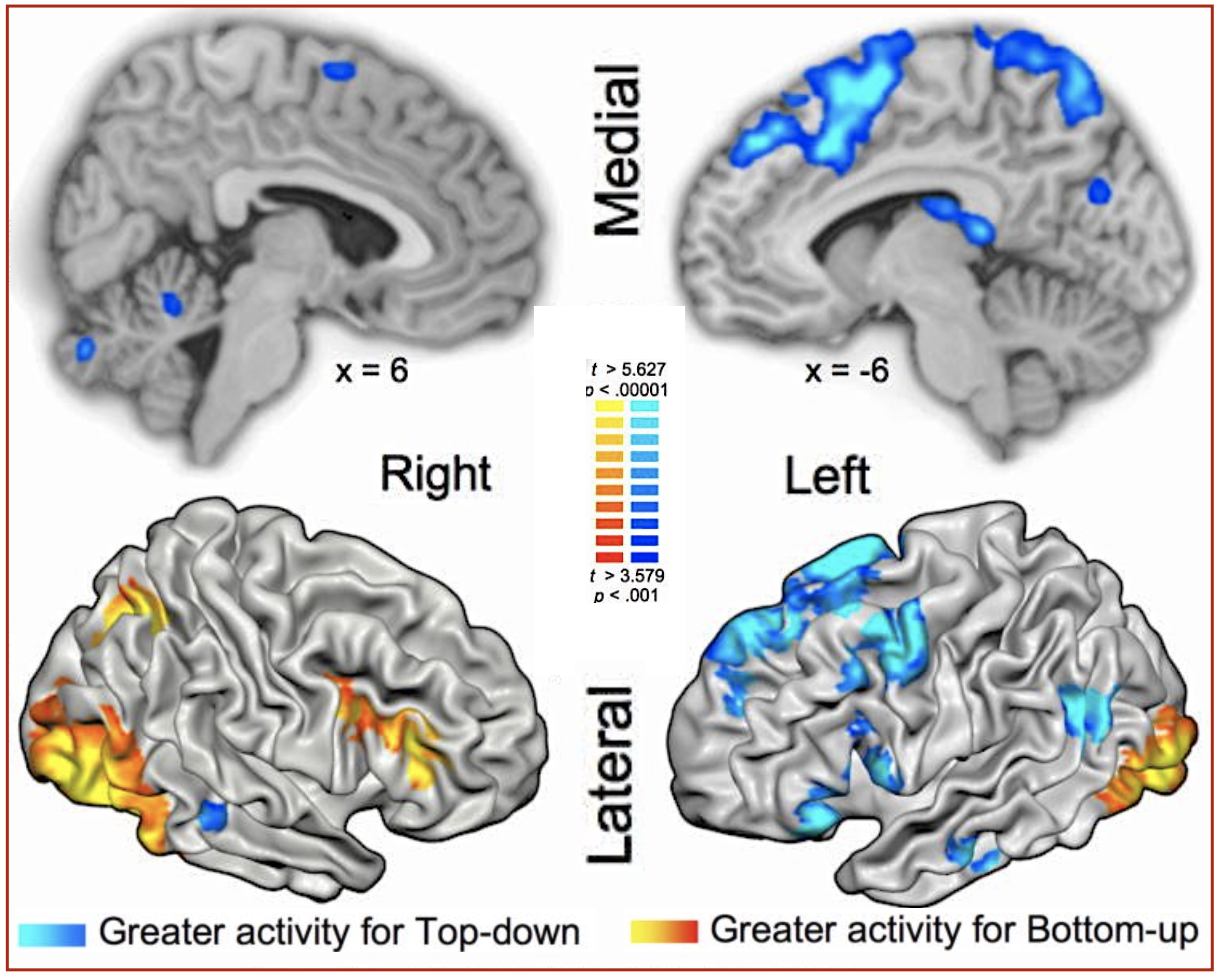
Inhibitory control begins to develop at the end of the first year of life. It progresses quickly until the age of 6. Over the next 20-30 years the person’s prefrontal brain grows, allowing the top-down generation of emotions & emotional self-regulation. Then it slowly declines as we age.

Our brain is adapted (prefrontal cortex) to function in complex social environments, with specific neural mechanisms (antennae) acutely sensitive to any sign that membership in our ‘group’ might be in trouble.
So most people regulate their actions to avoid being excluded from whatever community is important to them.

➖  An extreme lack of inhibition is disruptive, a symptom of certain mental disorders such as the Behavioral, Antisocial, Sociopathic & Schizophrenic ones
EXP : ADHD is considered a developmental disorder of inhibitory control, with a less mature or active prefrontal cortex
Too much inhibition can be personally destructive, causing sexual frigidity or impotence, &/or a neurotic inability to feel or express most emotions.  (Response Inhibition….)

GENERALLY : Females have a greater basal capacity than males for inhibition control, the brain connections that allow different areas to work together which limit unwanted or habitual behaviors . Also Fs respond differently than Ms to environmental cues.
EXP :  Listening to music tends to significantly improve the rate of inhibition-responses in females, but reduces it in males.

NEXT : S-R = Top Down, Bottom Up

Self-Regulation : SELF-REFLECTION √

PREVIOUS : Executive Function, #2
SITE : Asking Questions


Self-REFLECTION
This is another characteristic of self-regulation which declutters the mind, helps us think clearly to make better decisions, admit our true motives & acknowledge our positive values. For some people, it’s a way to get acquainted with oneself. For others it’s more about keeping current.

It improves our relationships by developing empathy & understanding who others are – separate from us. It’s also a powerful tool for enriching our learning-ability by considering why & how we’ve learned something. (POST : “How the brain learns

It’s about :
★ monitoring what’s going on right now, to be aware of the nature & quality of events as they occur, & understand their meaning
★ taking the time to look over your day, both private & public – examining & pondering your thoughts & actions
★ and not only what you do, but why you do it, identifying strengths & weaknesses to improve future choices
It’s ABOUT
★ regularly examining your distressing thoughts, emotions & actions (T.E.A.) – maybe at a mental distance. If necessary, try talking to yourself about them in the third person, as an observer. This can make you more objective & lessen the temptation to sweep them under the rug or get depressed
★ BEST of ALL – it’s an opportunity to recognize your growth, validate positive actions & remind yourself of personal strength & talents. Self-awareness is a skill, the foundation of emotional intelligence, self-leadership & mature adulthood.

1.
GENERAL Qs to quietly wonder about, anytime :
🚶🏽‍♀️”How do I feel about myself?”
• Am I happy, kind, in love, anxious, frustrated, lonely….
🚶🏽‍♀️”What do I think about & know my personal qualities are?”
• DoI use my time well, am I organized, persevering, ambitious….
🚶🏽‍♀️ “How do I evaluate my life, overall?
• about my health, my energy, my relationships, my career…..

DOWN TIME
At least once a week set aside time for self-reflection (30 – 60 min), AND also take little ‘stolen’ moments throughout your day (5-10 min) to pay attention to your Inner Adult & Inner Children.

Give yourself the gift of quiet time to make a private space, but also know when to stop. Set a timer if it’ll help set a boundary – it’s important to not overdo (NOT as perfection or obsession). It should be a healthy activity you look forward to, that can be done daily, for a lifetime.
Find a quiet spot
It’s important to be in the right frame of mind, & the location set aside to be quiet, peaceful & comfortable, preferably a location you’re familiar with. But it can also be in a parked car, a bench in the park, a basement lounger….

2. Specific REFLECTIONS
Ask some Qs about a specific event in your day, or maybe about general experiences in your life. What’s the first thing that comes into your mind?
What were the sensations in my body? What was I thinking? What were my emotions? Why did I act that way? ” (my T.E.As)

Ask
What? Where? Who?
These 3 Qs are a great way to structure your thoughts. Looking back on a situation or event,  consider:
✴︎”What did I do right? What would I have done differently?
✴︎Where did I choose to go?  Where do I want to get to?
✴︎ Who am I ? Who do I want to become? “ 

Ask How?
If you’ve determined some areas you’d like to improve on, consider how to go about it : what are my options, what approaches are possible & what am I capable of ? What are the first steps toward making a positive change ?

Ask what did you Notice or Uncover?
Don’t be afraid to make notes about what came up, even quick one-liners when a lot’s going on. You won’t remember them later as you continue to your busy life!
Journaling your thoughts & & feelings is great when you have more time. It’s always enjoyable to look back on moments you’ve had with yourself, to see your progress & relive the benefits.

NEXT : Control vs. Regulation
Self-Regulation : CONTROL vs REGULATION √


PREVIOUS : Self-regulation – Inhibition

SITEs :”Self-Regulation vs. Self-Control”
re. child’s brain


Self-Control (S-C) vs. Self-Regulation (S-R)

Self-regulation is about identifying & reducing the causes of  mood, thought & behavior problems. It’s deliberately being in charge of what those T.E.As are, in ways that allow us to provide our needs & promote desires. It includes goal-setting, habit formation, emotional regulation and self-control.

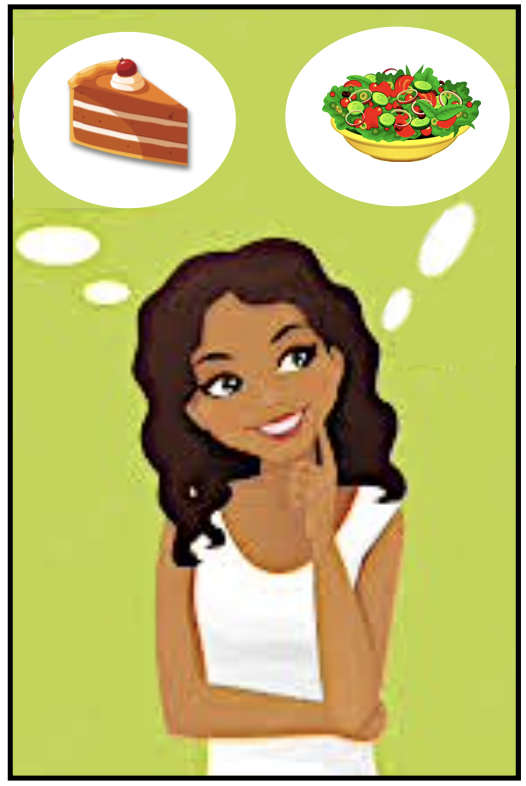
Self-control (S-C)  is always searching for hidden stressors. It’s the ability to resolve conflicts between our short-term desires & long-term goals.  Stuart Shanker (2016) wrote : “Self-control inhibits strong impulses, but only a small part of S-R, & is more valuable in the long run.” EXP : I’m trying to lose weight, but I’d rather a burger than a salad …

Successful self-control means choosing to sacrifice a smaller immediate pleasure (binge watching TV) and instead – pursuing an option that yields a larger but delayed reward (working on or finishing a project).

A S-R ‘failure‘ means ignoring the delayed reward in order to get immediate pleasure, which is called a ‘temptation’. So, does giving in to temptations really make us happy?

Researcher gave smart phones to a group of young people, & at random times asked them if they were currently experiencing a temptation.
If they said “yes”, they were to indicate whether they indulged or not, & how they felt about their choice.  Although responders did get short-term pleasure from giving in, it didn’t increase their overall happiness. On the contrary – they felt less happy soon afterward.

However, not all decisions we make when choosing between immediate pleasures & long-term rewards cause inner conflict.
— For S-C inhibition to be triggered, we have to experience stress about the choice, such as “I really want cake BUT should pick salad”
— However, there will not be any conflict IF you don’t care about your health or you don’t like sweets. So you can freely pick either one.

DEVELOPMENT:  
The background to Self-control & Self Regulation is ancient, going back as the writings of Plato.
♥︎ S-R can also be traced to Hippocrates, whose work evolved into the 20th cent. science of Physiology, which looks at bodily systems that keep the balance between energy output & restoration.
More recently much focus has been put on stress management & how S-R can help’
S-R is mainly about social interactions.

♠︎ S-C has traditionally been used by religious authorities & educators, who’ve worked on building character to strengthen ‘willpower’. This eventually developed into Behavioral Psychology, which looks for ways to contain the surface effects of imbalance, using age-old methods of punishment & reward to manage behavior.
S-C is only about individuals.

GOAL: Both styles aim to achieve “effortful control”- the ability to voluntarily focus one’s attention, which results in inhibiting or activating actions in response to their environment.

S-R is a way of reducing the amount of work needed to reach this “effortful control”, by keeping track of one’s impulses, worries & fixations – without being judgmental.
S-C instead encourages battling one’s ‘weaknesses’ to achieve “effortful control”, by judging oneself harshly, as well as being judged BY others (controlled by what others think of us).

When most people consider Self-control, we usually assume it means trying to force the brain to ignore or drown out uncomfortable or painful emotions. We take a deep breath, count to 10, or more often do something to distract ourself…..

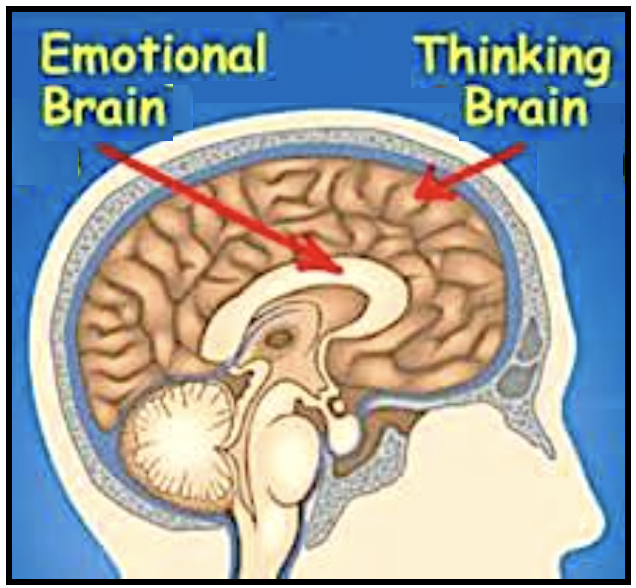
While such activities may temporarily help some, they’re basically flawed, since we’re expecting the prefrontal cortex to make decisions that will override the limbic systemBut once we’re upset, the emotional brain has already taken control, so the rational part is at a big disadvantage.

That’s where Self-Regulation comes in. Simply trying to ‘push through’ emotions when they get triggered is setting oneself up for failure. To S-regulate we have to first identify the stressors & work to reduce or eliminate them.

INTERESTING: An international team of researchers (in 2013) identified that robust white matter connectivity between specific brain regions is key to fluid intelligence & thinking proactively (strong self-regulation).
Conversely, they found that poor white matter organization is linked to hyper-reactivity (too much S-C) and anxiety, from paying too much attention to irrelevant internal or external stimuli. (MORE….)

NEXT : Self-Regulation = Top-Down processing

Self-Regulation – 4 STRATEGIES √

PREVIOUS : Bottom-Up S-R

SITE: ‘Common S-R strategies for students


Self-regulation (S-R) creates identity
in modern individualistic society. Children construct their values within their cultural & use to them when making decisions for taking actions. This resulting S-R is needed for human beings to prosper in the face of adversity.

4 components that propel self-regulation into action are:
❕ having standards of desirable behavior
❕ having the motivation to meet those standards
❕ monitoring situations and thoughts
❕executing willpower – internal strength to control urges

EXP : Monitoring and Willpower are cognitive mechanisms, willpower is the ability to resist temptations, & monitoring is one strategy to help with this resistance. 

They 4 tools were designed to help students find their values & virtues in order to self-regulate so they can become the person they want to be.
However, these skills are equally useful for adults, especially for anyone who didn’t learn good study habits in childhood.

Applying them consistently allow a person to :
• work independently & develop flexibility skills
• organize work assignments, complete expected task(s), review completed work, & continue to the next job
• experience success because they stick with challenging problems in order to find solutions.

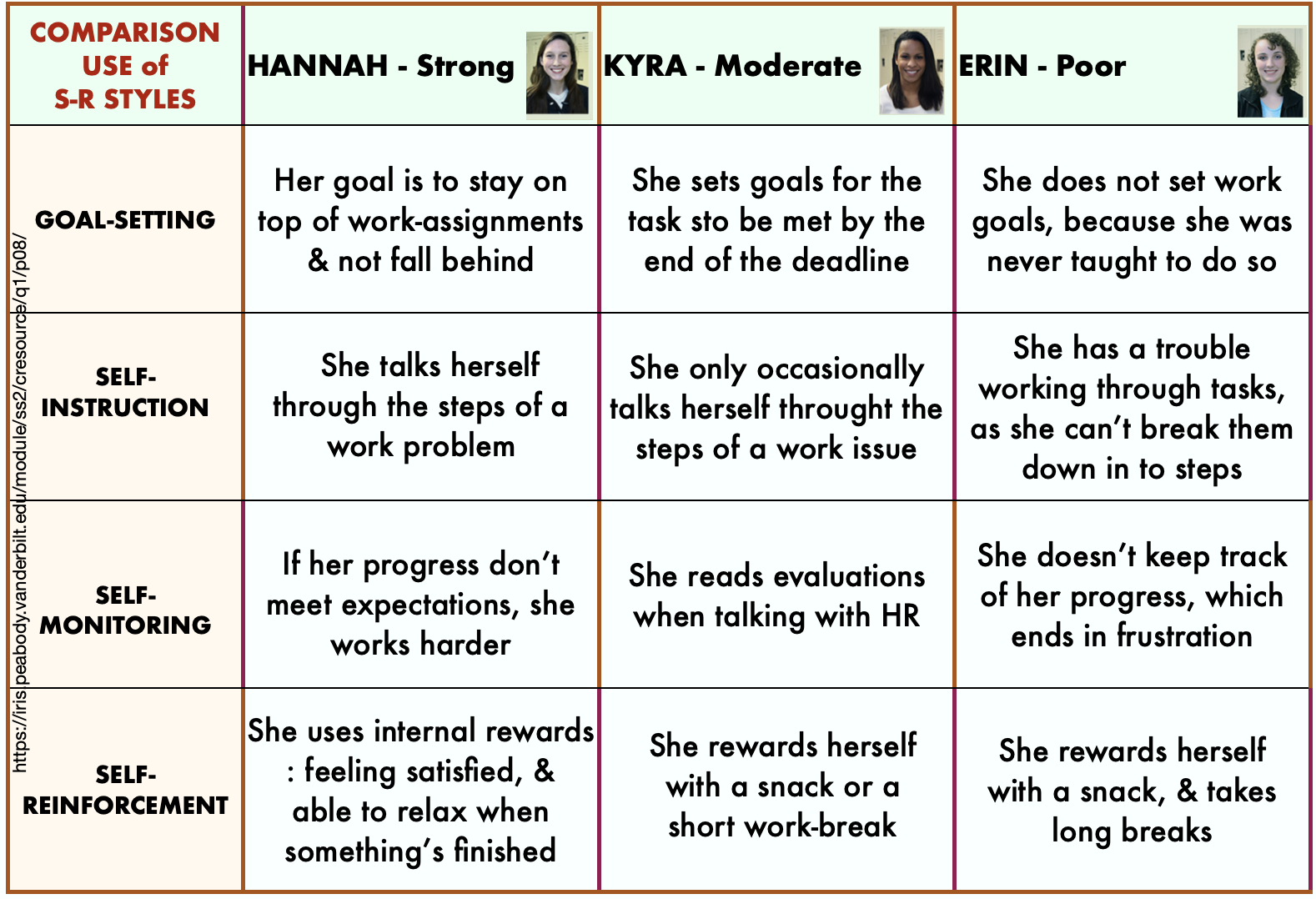
1. Goal-setting
Def: Establishing achievable objectives for tasks or projects

It helps a person identify what they’re working toward, increasing attention, motivation & effort. For those who struggle with completing tasks on time, the best goals are those that can be accomplished fairly quickly (short-term).

When long-term goals are required, the person may need help creating a series of short-term action that add up.
📍Identify appropriate goals  = not too easy or too hard, & ones that are specific enough to measure
📍Develop plans for meeting goals & monitoring progress
📍Implement the plans
📍Self-monitor progress toward meeting the goal
📍Revise the goals & actions as needed

2. Self-instruction
Def
: Talking oneself through a task or activity (self-talk).
A person can create encouraging or guiding statements for different types of situations, such as
WHEN :

⭐︎ Starting on or working through a task or problem
ASK : “What do I need to solve this problem? First, I need to….. I can use the formula d=t x r.…”

⭐︎ Coping with a difficult situation
ASK : “I forgot the outline is due Wednesday. Stay calm. If I do the research tonight, & finish the paper tomorrow night.”

⭐︎ Self-evaluating
ASK :“Did I understand what I just read? No, I didn’t so I need to reread the paragraph.”

⭐︎ Rewarding oneself
SAY “I was on the computer for several hours & did my best. I’m going to have a good meal, watch TV & cuddle with my mate.”

3. Self-monitoring
Def: Keeping track of one’s progress & recording the results. Though it doesn’t create new skills or knowledge, it does increase or decrease activity according to – how fast, how often or how long is needed to be successful. This strategy helps to:
📍stay focused on the task
📍increase awareness of ones behavior & attitude
📍provide more immediate feedback evaluated objectively
📍clearly show improvement over time
4. Self-reinforcement
Def: Rewarding oneself after completing a task, especially when long & difficult. It produces a definite improvement in performance, & creates greater changes than eternally-imposed rewards. Payoffs & Rewards can be :
❣️Tangible (buy a new shirt / blouse, try a new restaurant)
❣️Social (a night out with friends, go to a show)
❣️Activity-related (read a favorite book, yoga, take a run…)

Other examples of S-R Behavior
🔅A cashier stays polite & calm when an angry customer is berating him for something he has no control over
🔅A child stops herself from throwing a tantrum when told she can’t have the toy she desperately wants

🔅A couple in a heated argument about something important to both of them – deciding to take some time to cool off before continuing their discussion instead of devolving into yelling & name-calling
🔅A student tempted to join his friends for a fun night out but instead decides to stay in to study for tomorrow’s exam

🔅A woman trying to lose weight meets a friend at a restaurant and sticks to the “healthy options” menu instead of ordering a favorite high-calorie dish.

NEXT : Biological Domaine
Self-Regulation : STRESSORS

PREVIOUS: 

SITE : What causes stress?  (lists)


REVIEW  =
Executive function & (S-R) self-regulation skills depend on 3 types of brain function: working memory, mental flexibility & self-control.
Because they are highly interrelated, successful ability to self-reg requires them to fully work together.
☀︎The dorsolateral prefrontal cortex is the processor
☀︎ The anterior cingulate cortex is about emotional drive & integration
☀︎The orbitofrontal cortex is key for monitoring ongoing appropriate social behaviors

When these functions are not working properly, several critical skills – for effectively managing our daily lives – will show signs of impairment . Stress impacts underlying neuro-biological processes of self-regulation as well as cognitive, emotional & behavioral aspects of S-R.

♥︎ ACUTE stress involves the body’s stress system activated for a short time in response to a temporary stimulus. Although such stress can have lasting biological or behavioral effects if severe enough, the ‘human stress response system’ is generally well-equipped to manage.
♥︎ CHRONIC stress – where body’s stress system is activated very frequently, or for a prolonged period, or in response to
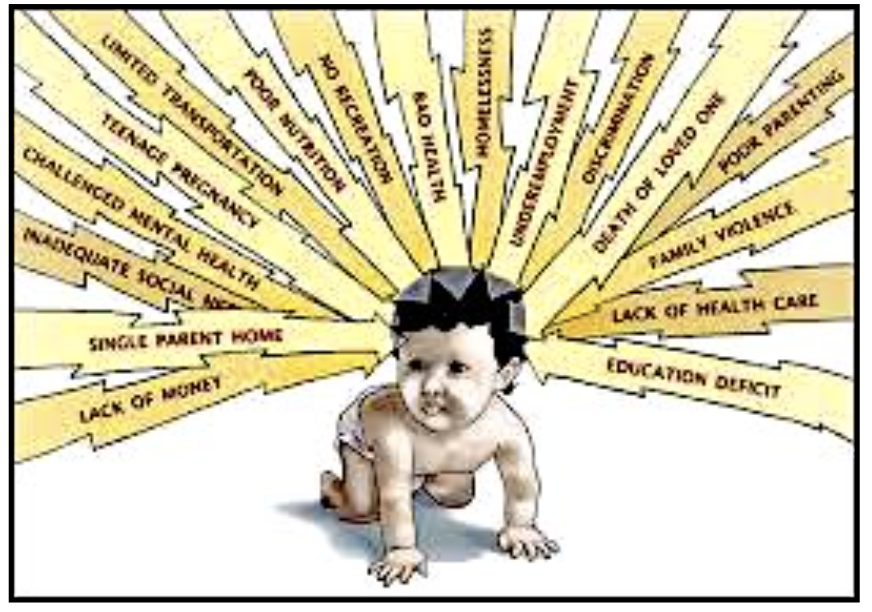
persistent stimuli —- will definitely have detrimental effects on the brain & behavior. Being continually upset makes it harder to regulate actions & thinking.
♥︎ TOXIC stress response – when a child experiences strong, frequent &/or prolonged adversity that overwhelms their skills or support.  This includes physical & emotional abuse, chronic neglect, caregiver substance abuse or mental illness, exposure to violence, and/or the accumulated burdens of family economic hardship.
Trauma can either be acute (natural disaster, robbery….) or chronic (child mistreatment). Also, the after-math of acute trauma (sustained homelessness, disruption of social networks after a natural disaster….) can create chronic stress when long-lasting. (from OPRE, Duke U.)

Self-Reg WEAKNESS
At any given time our ability to self-regulate is limited. You try your best to be on an even keel to get things done, but lots of life events can reduce the amount of self-regulation energy available. The 6 main things that can shrink our supply :

♦︎ Behavior of other people : if you let yourself be drawn in to their agenda or excitement – it can act as a temptation to ‘leave’ yourself, decreasing your self-regulation. EXP : Hearing someone going shopping or on a trip, it’s easy to start thinking about doing that yourself

♦︎ Overdoing one of the areas of self-regulation : if you have to (over)control your body & actions for long periods of time, your thinking & emotional self-regulation will temporarily be weakened or worn down

♦︎ Negative mood – if you’re feeling low, frustrated, grouchy…. it means your supply of self-regulation is low. You might think “Everything else has gone wrong today so I’m not even going to try ___.” But the more you try to control your mood, the worse it seems to get

♦︎ Stress – Physical effects ➡️ CHART

♦︎ Temptations – if you let something delicious, beautiful or fun grab your attention away from a desired goal or important  activity, self-regulation can go out the window.
Also, when self-control is impaired (alcohol consumption or effort depletion), when overwhelmed by immediate external temptations or internal impulses, or when minor indulgences snowball into full blown addictions….

♦︎ Tiredness – if you’re unrested, self-regulation is weakened. making it harder to effectively use your executive functions. You might feel, “(groan) I just can’t make myself do it right now.”

Self-Regulation – EXECUTIVE FUNCTIONS (#2) √

PREVIOUS : Executive Functions (# 1)

SITE : “Executive Dysfunction Workbook”


MORE Executive Functions SKILLS

❣️ Planning & Problem Solving : how we mentally play with information to form new ways of doing something. And, taking things apart & re-combining them in various ways, we find solutions to problems. Planning for future events requires estimation & forethought – setting a goal & forming a strategy to reach it.

❣️Self-contol
This is about stopping to think before acting, in order to make the best verbal or behavioral choice in stressful moments. That involves “hitting the pause button” to calm down when emotions run high, in order to consider our options & make a good choice for present & future outcomes

❣️ Self-motivation : How well we can motivate ourself start a task without procrastinating, & the willingness to complete a task when there’s no real or immediate external consequence

❣️Task initiation
This means starting right away, rather than procrastinating, even when we’re not pleased with the task

❣️Time management
It’s about using time well then working on something – being able prioritize tasks, to correctly estimate how long something will take, & use the time efficiently

❣️ Verbal Working Memory :  the ability to use self-talk / “inner monologues” to monitor & regulate our behavior,  as well as direct future actions. It’s an important part of planning & problem-solving

❣️ Non-Verbal Working Memory : the ability to retain & manipulate distinct pieces of info over short periods of time, & hold info in memory while performing complex tasks.
Also, how well the brain can mentally picture things

Signs of Executive DYSFUNCTION
An executive function disorder impairs some of these skills, affecting a person’s ability to manage & organize themself to achieve goals. Although the DSM-5 does not recognize it as a specific mental health condition, it’s considered symptomatic of other neurological, mental health, & behavioral disorders.

☇ Attention – pay attention to minor details, but fail to see how these details fit into a bigger picture
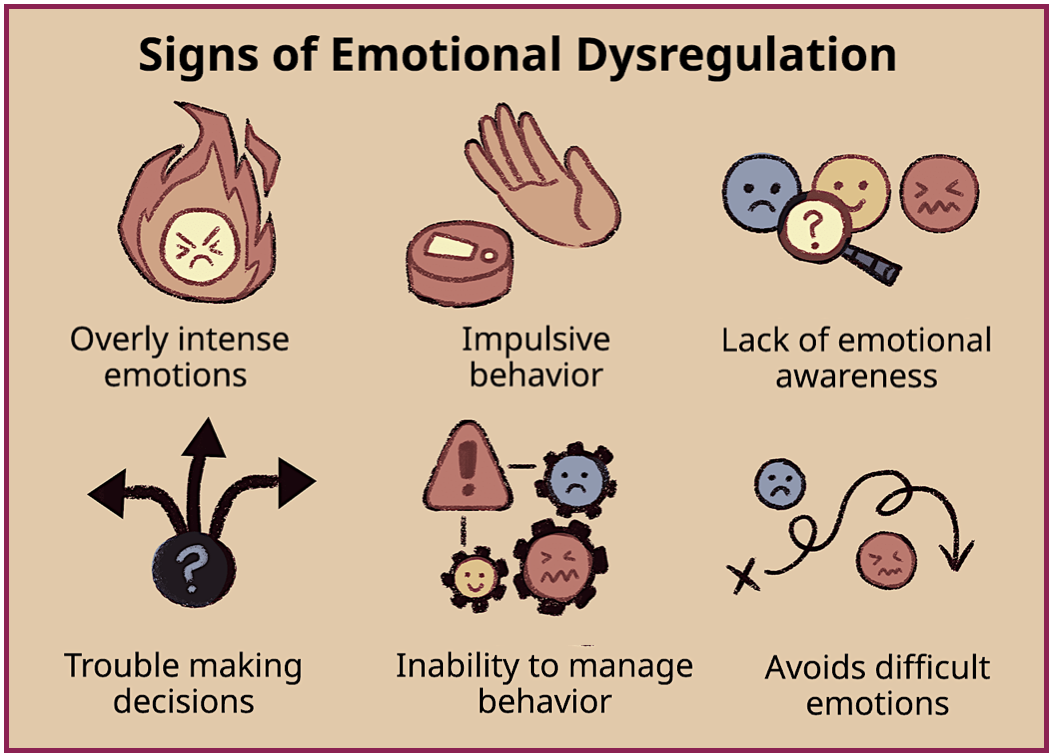
☇ Emotional control – have poor impulse control & overall weak S-R (low self-esteem, mood swings or extremes)

☇ Flexibility – may be very stubborn, with rigid attitudes & thinking, & taking things too literally
☇ Organization – not able to pay attention or organize thoughts & actions – constantly losing or misplacing things

☇ Planning & Prioritizing – problems with complex thinking that requires holding more than one train of thought at the same time. May not know how to start a project, easily become overwhelmed
☇ Task Initiation – are habitual procrastinators, may be considered lazy or “not very bright” because they struggle with starting or finishing tasks, avoid ones that cause anxiety

☇ Working memory – trouble mentally holding on to one piece of information while moving on to the next step in a sequence (multi-step tasks, taking notes…. forgetting directions or explanations just given)

EGO-DEPLETION
Having self-control is often referred to as willpower. It allows people to stay on point even when there are many distractions, or many calls on their attention.  It benefits relationships, & is the basis for  achievement, from school to the workplace.

There’s evidence that willpower is a limited resource, so even relatively minor acts of self-control – repeated – can take a toll. The idea is that willpower is like a muscle which can be both strengthened & fatigued.
Ego depletion happens when people use up their available willpower on one task. As a result, they can’t exert the same level of self-control on subsequent, often unrelated tasks.

This may explain why we struggle to avoid “bad behavior” when tempted by something  enticing over a long period of time.
EXP : — why many dieters can keep to their strict diet all day but give in after dinner when tempted by dessert
— why a married /committed person can rebuff repeated advances from someone other than their partner for days or weeks, but eventually gives in & have an affair.

Findings in neuroscience back this up. One study by Wagner et al. in 2013 used functional neuro-imaging to see if participants’ self-regulation energy would be depleted by the experiment’s prolonged activity.
✴︎ The scans showed there was less connectivity between areas of the brain involved in self-control and those involved in rewards. As their brain tired (maybe bored?), it was harder to keep resisting the available temptation. (Other research….)

NEXT : Self-REFLECTION
Self-Regulation – EXECUTIVE FUNCTIONS (#1)

PREVIOUS : Self-regulation & the BRAIN 

SITE : “Executive Function Deficits Tied to ADHD”

EXECUTIVE FUNCTIONING (E-F) (Adult Ego State) expresses
the True Self’s active, intentional aspects (free will). It’s the ability to focus attention, remember instructions, manage emotional reactions & actions, & organize our thinking.
AND
Self-regulation
is using these skills to control our behavior.  It’s one the Self’s major executive functions – to rationally change responses or inner states.

E-F basics are several aspects of thinking :  inhibitory control, working memory, & mental flexibility – which make intentional S-R possible. It’s a combination of :
(1) behavioral regulation  = inhibiting impulsive reaction, shifting or adjusting to changes in routine or task demands, & regulating emotional responses
(2) meta-cognition = organizing problem-solving approaches, initiating activities, & keeping information in memory.

Weak levels of these 2 skills are related to greater depression symptoms, interpersonal & work problems

Quality E-F lets us :
— adapt to changing situations
— break out of unhelpful habits
— consider alternative solutions (find a Plan B when Plan A doesn’t work out)
— remember goals & the steps needed to reach them
— resist distractions along the way….

Executive function is judged by the strength of these skills, & when used effectively, can improve our life. We’re not born with these 7 important skills, but are born with the capacity to develop them through the right experiences & practice.

SKILLS – Like a talented conductor, the brain combines Executive Functions into a harmonious symphony.  It can also be seen as our air-traffic control system, that assigns tasks to each skill. At best, these work together to ensure we function efficiently & effectively when completing daily activities.

In a neuro-typical person, they develop in chronological order :
Self-awareness (#1) starts around age 2, and by age 30 > Planning & Problem Solving (#7) will be fully developed.

❣️ Self-awareness : regular inner-directed attention – controlling who & what you’re paying attention to, staying on topic, filtering out un-needed thoughts, & moving from one activity to another as required

❣️Adaptability
It’s the ability to modify our responses & emotions according to what fits the situation we’re in – which means we can cope with change. It makes us more flexible when confronting views or opinions different from our own, so we can see issues from many different perspectives

❣️Attention
This allows us to focus on a person or task for some period of time, ignore distractions, & re-focus quickly when side-tracked. It helps us hear & understand instructions, focus well during conversations, & concentrate on longer tasks

❣️Emotional Self-Regulation : The ability to understand & accept emotional experiences, & act appropriately in response to them. Use the first 4 functions to handle our own emotional states in order to process & modify or alter how we ‘feel’

❣️Flexibility
This allows us to be open-minded, testing out new approaches, going-with-the-flow when things don’t go as planned. It also means seeing situations in more than one way, critical for perspective-taking, problem-solving & effectively cope with unexpected change

❣️ Inhibition : (self-restraint) the capacity to think before you act (scroll to: The Need for Inhibition)

❣️Metacognition
It’s thinking about our thinking – considering what we know & what we don’t know about a topic as we’re in the process of learning. It can be identifying a critical skill when studying, able to complete challenging tasks, & understanding new material

❣️ Optimism
This is having a positive attitude toward experiences, knowing we have options & possibilities. Also appreciating the ability to can calm ourself when feeling stressed, anxious or down. It allows us to keep our eyes on what’s in our control while bypassing situations that are not. Strong self-regulators consider ‘problems’ as opportunities to learn from & improve future efforts.

❣️Organization
This skill is about keeping material & objects neat & orderly. It includes creating a place for everything, having designated spaced / containers to store things, & cleaning up we go thru the day. It insures being able to find what we need when we need it
(More in Part 2)

❣️Persistence
This is the ability to keep moving toward our goals regardless of external or internal struggles, working through delays & roadblocks whenever they come up. It includes trying new strategies, continuing to work when a task is hard, & asking for help when needed – giving 100% effort to keep on track (More in Part 2)

NEXT : Executive Functions #2

SELF-REGULATION & the BRAIN


PREVIOUS : Self-regulation – Theory

DIAGRAMS ⬆️ from Develop Executive Function & Self-Regulation Skills

SITE6 Scientifically Proven Ways To Boost Your Self-Control


Core CAPABILITIES

In the brain, self-regulation (S-R) includes 2 types of responses:
🔸Automatic = rapid, impulse-directed (“fight or flight”), needed for urgent or threatening situations, AND
🔹Intentional = conscious, deliberate, proactive, used to achieve goals.

Our brain has distinct mechanisms for knowing ourself, knowing how others respond to us, detecting threats from within the social group, & regulating actions in order to avoid being excluded from those groups. Adults need specific abilities to succeed in life & support the successful development of the next generation.
Neuroscience & psychology research indicate these include, but are not limited to:
▫️ awareness, ▫️ focus, ▫️ planning,▫️ cognitive flexibility –—> which maintain or shift our attention in response to different demands, or apply different rules in different settings (ability to revise plans in the face of obstacles, setbacks, new information or mistakes)
▫️ self-control —-> ability to set priorities & resist impulsive actions or responses

As adults, they help us to get & keep a job, provide responsive care for children, manage a household, & contribute productively to the community.
When such skills have not developed as they should, or are compromised by ongoing stressors, individuals & communities pay the price in physical, social & financial health   (MORE….15 pgs. from a Harvard study)

To scientists, these Capabilities are part of self-regulation & executive functioning.  Integrating them requires communication between the prefrontal cortex & other brain areas which are devoted to different mental functions. These parts connect up over time & with the right experiences, become progressively more efficient.

The 3 main areas of the PFC (pre-frontal cortex) that are particularly important to self-regulatory functioning are ventromedial PFC (vMPFC) including orbitofrontal cortex, lateral PFC, and ACC. Damage to these areas have shown the various ways such patients can’t regulate themself – they become aggressive, antisocial, or laugh inappropriately, are hypersexual or excessively overeat.

The ACC (anterior cingulate cortex) is known to be crucial for self-regulation from neuro-imaging & electro-physiology studies. When damaged, common symptoms are general apathy, a depleted emotional capacity, & trouble carrying out goal-oriented activities.

Attention is the critical gate-keeper to trigger intentional S-R. It’s ‘staying awake’, opposite of dissociated in-attention = having & using a sustained focus on specific things inside & around us. Also the capacity to stay focused on a situation or task – in spite of distractions, fatigue, or boredom.

FIRST the brain must recognize that a current situation (the stimulus) requires a response
THEN – the brain’s automatic self-regulation system
(ASRS) immediately launches a rapid-fire cycle of interacting neuro-transmitters, paying attention to the stimulus that’s presented.

NEXT – the intentional self-regulation system (ISRS) must act fast to determine what needs attention & prioritizing. It also quickly sends a signal to the ASRS to identify whether the initial response to the stimulus is the right one, or more careful thought / action is required.

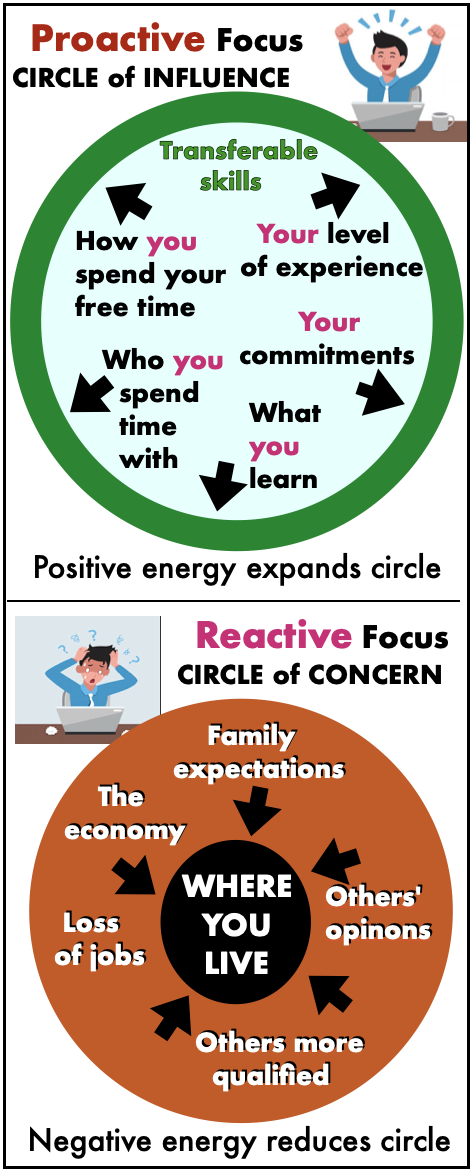
This cycle moves on a continuum between Reactive / impulsive behavior at one end  <——> to Pro-active / goal-directed behavior at the other.
🎯 The Pro-active system relies on fluid intelligence (current ability to reason & deal with complex info)  to connect the dots of various moving parts of a situation, & come up with a streamlined game plan.
⚙️ The Reactive system scrambles to reorient itself when the brain is caught off guard & needs to quickly problem-solve in a seemingly new situation.

Both are important adaptations to the person’s early environment, since quick responses are helpful when faced with immediate or constant threats. But when longer-term goals are more important than immediate concerns, proactive action-choices taking precedence.

This is because it continually generates predictions (“what ifs) that anticipate future needs relevant to accomplishing goals. Comparisons between options are made from basic information quickly extracted from available input, linking it with images that exist in the person’s memory.

Self-regulation involves a balance between the orbitofrontal cortex – brain regions that represent the reward, importance & emotional value of a stimulus and prefrontal areas that provide our highest cognitive abilities – concentration, decision making, insight, judgment, planning, and the ability to retrieve memories. That balance is a vital part of being able to use our core capabilities – awareness, flexibility, focus & self-control.

NEXT : S-R &

SELF-REGULATION – Theory √

PREVIOUS : Self-regulation – Intro 


THEORY
Self-regulation
 (S-R) has received a great deal of attention from psychology, education, neuroscience & athletics. Research began with Albert Bandura in the 70s-80s. Since then, many others have developed models of S-R, (with overlapping aspects), which expand our understanding of this concept.
The term refers to internal states & processes linked to the regulation of attention, emotions, impulses, stress, moods, stressors & thoughts.

1. Self-regulation theory (SRT) says that we expend conscious effort to control what we think, say & do, trying to be the person we want to be, both in specific situations & in the longer-term.

S-R is especially needed when there’s a conflict of motivations (to run from a fire OR help to rescue victims), & also relates to creating beneficial actions, such as studying for exams. To accomplish one’s goals, developing S-R requires evaluating & taking charge of one’s choices, by monitoring, directing & regulating behavior.

Baumeister (2007) listed the main S-R components of goal-attainment-efforts in any area of life :
▫️ Standards  = develop a model of desirable behavior
▫️ Motivation = the ability to meet those standards
▫️ 
Monitoring = keep track of events & thoughts that cause us to ignore or betray those standards
▫️ Willpower = internal strength to control self-defeating urges

S-R is intertwined with Motivation, which are our beliefs & attitudes that affect the development & use of various mental skills (cognitive & meta-cognitive). It’s deliberately choosing to act – avoid slacking off or procrastinating – so we complete tasks when there’s no real or immediate external consequence.

It’s one factor that determines how well we succeed. Whatever other qualities we may have, a strong capacity to be self-motivating is needed to promote our sense of purpose, competence & self-esteem. (HOW TO….Use these on yourself!)

SIMPLIFIED : ➡️  The Zimmerman S-R Model consists of 3 aspects, forming a cycle which can be repeated as many times as needed until it becomes integrated & automatic :
‣Preparing, with forethought, what we want to do before we act
‣Taking Action,  what we do during a task or event
‣Reflecting. reviewing what we did, after an action. This should determine how we prepare before a next attempt. (MORE…. about each one)

2. An integrative approach to S-R research called Personality Systems Interactions (PSI) theory” analyzes personality architecture that underpins human motivation & S-R. It combines insights from cognitive science, motivation science, personality psychology & neurobiology into a single coherent framework used in self-management research.

➡️ Personality Development is listed from the simple (Level 1) to the complex (7), from biological TO the psychological, which progressively leads to more self-determination & personal freedom.

At the top, Self-management skills (7) are important self-protective factors, a human achievement which closely depends on the formation & healthy growth of the prefrontal cortex.

A basic assumption of PSI theory is that human motivation & personality are affected by a hierarchy of regulatory systems which act to maintain homeostasis. It includes:
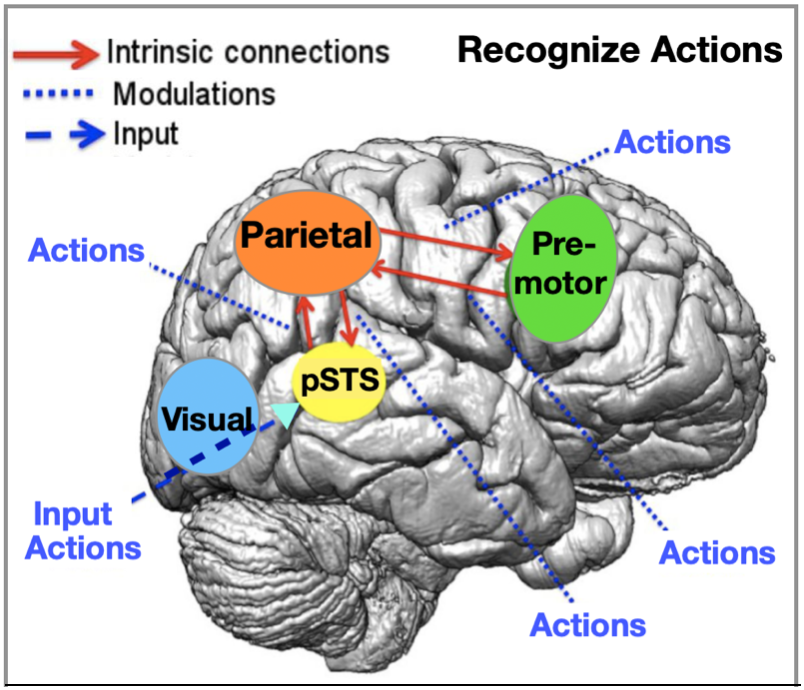
a. Object recognition = organizing the visual world into meaningful perceptual units, which supports basic sensation. It specializes in detecting unexpected or incongruous things, from external & internal “objects of experience” (what seems to be present when having that experience).
b. Intuitive behavior control = activates the motor system not usually  conscious, letting us dive in to the task at hand. It triggers automatic physical activities, like driving a car, housework, taking a walk, working out….

4. The Self-Regulatory Model
S-R model ↘️ of illness-activity shows the interplay between a person’s interpretation of a health threat, their coping strategies, and appraisal of the outcome of treatment – a useful summary of the complex processes at work during S-R of any kind.

a. Stimuli are presented : something happens that provokes a reaction, (a thought, what someone said, receiving significant news….)
b. The person makes sense of the events, both emotionally (feeling it) & cognitively (understanding it)
c. The sense-making leads them to choose coping responses (what they do to manage their feelings about the stressor, & actions taken to address the event/ situation)

d. Sense-making [ (b) + Coping responses (c) ] determine the Outcomes (the person’s overall reaction & behavior)
e. The person then Evaluates their coping responses in light of these outcomes, deciding whether to continue using the same actions or change their approach. (MORE….)

«
NEXT
: S-R & the BRAIN

SELF-REGULATION – INTRO

PREVIOUS : Song “THIS IS ME”

SITEBlue Brain, Red Brain BALANCE is the Key

DEF
PHYSICAL – Our bodies have the capacity for self-regulation, such as heart rate rising & slowing down according to our activities. Also, the autonomic nervous system works – below our awareness – to regulate & balance many automatic functions. When any of these are out of balance, we experience internal symptoms & feeling out of synch with our environment.

PSYCHOLOGICAL : Self-regulation (S-R) also means being “in control of oneself by oneself” – the necessary steps taken to stay even-keeled.
It’s a person’s ability to consciously, deliberately monitor & manage reactions to their environment in appropriate ways, so they can navigate daily life successfully, more easily absorb info, feel good in their skin & generally get along well in the world.

Importance of S-R
Being self-regulated helps us use the right personal & social skills – at the right time – resisting self-defeating or dangerous responses to internal reactions & external aggravations. In its most basic form, being able to S-R allows us to  :
▶︎ 1. stay calm under stress
(the lead-up to a big event), & pressure (what we experience at that moment)
Stress moments are experienced when no one else is paying attention when we’re overwhelmed. Pressure is the tension we feel when a moment is important or uncertain to ua, & when we think we’re being judged by others.
▶︎ 2. bounce back from failure, disappointment or loss

More than many other skills, these 2 will successfully carry us thru life. They’re founded on self-esteem & strong resilience.
Having the ability to activate S-R gives us room to pause between a feeling & an action – the time to think things through, make a valid plan & wait patiently for the right outcome when necessary.
Children often struggle to implementing these options, & many adults do as well.

It’s easy to see how a lack of S-R causes problems in life. A child who yells or hits other children out of frustration will not be popular among peers, & face reprimands at school.
An adult who lacks self-esteem & self-confidence will have poor S-R skills, so have trouble handling frustration & disappointments. This can be expressed as anger or anxiety, & in more severe cases may become a mental disorder (depression, mild paranoia….)

AREAS to be Self-regulated
• Biological – related to the level of energy in our nervous system
• Cognitive – the mental processes needed for absorbing, retaining &  being able to use info : memory, attention, problem solving….
• Emotional – about pleasant & painful feelings

• Social – the child’s ability to use social cues to act in acceptable / appropriate ways, also known as social intelligence (SQ)
• Actions / Prosocial –
 as adults, how we behave with others around us with empathy – keeping up positive social connections

LEVELS of S-R Awareness (T.E.A.)
Mental = replace distorted / unrealistic beliefs (Stinkin’ Thinkin’) with healthy though patterns, use one’s executive function strategies to learn & to solve problems

Emotional = able to identify a variety of emotions (Es) as they surface, take responsibility for having those Es and for expressing them in healthy ways, recognizing that Es can dissipate or change

Physical = recognize physical arousal by sensations in various parts of the body, seen via body scans, or by successfully used strategies (deep breathing, NLP, biofeedback devices…..) – to calm down & return to a higher brain function (Adulting)

HEALTHY self-control is a fundamental human capacity, but must be learned, so Self-regulation (S-R) is a major developmental task of childhood. Ideally, the adults act as role models, providing a psychological framework for the child’s internal ability to regulate.
(SEE 7 posts re. unhealthy ACoA over-control)

In a safe environment – the infant learns that its needs will be met by one or more adults, within a reasonable time, so it learns to trust that a caretaker will come, help her/him to calm itself, & provide all its needs.

❣️ Consistently responsive adults help the child build the capacity to wait, because it knows it will be taken care of.

S-R skills can be taught. They develop gradually, so it’s important that parents & teachers have age-appropriate expectations for how a child is able to react to various experiences. Most children learn by imitation – observing how others regulate themselves, especially the important adult, but some will need more hands-on instructions & a lot of practice.

✴︎ Good self-control in childhood predicts better health, less need for addictions, better income, & less criminal offending – as positive outcomes in adulthood.

NEXT: Self-Regulation – S-R Theory