
 PREVIOUS: RELATIONSHIPS (#1)
1. SECURE (Part 1)
2. INSECURE
Our partner should be a complement to us, not used to complete us, & vice versa. (Good Men Project)
↘️ ARTWORK : “Show me the love… or Not“ = People Can Be Happy With Their Emotional Opposites (2012)
«
«
a. ANXIOUS type – about 20% of the population
1. ‘Protest behavior’ may be used to get the other’s attention, then later regret it
2. You’re always on the lookout for rejection – even when there is none
3. You’re always worried about losing the relationship. But if your partner is an Avoidant, there may be a reason – they’re more likely to cheat at some point
4. A partner who isn’t great at communicating their feelings directly may hope you’ll be quick to notice.
ANXIOUS Needs
These are the “pull” types – the co-dependent people-pleasers.. Even with very poor self-esteem they’re desperate to feel safe, which means always being connected to someone.
i. Being Heard
Many have gone ‘silenced’ into their adult life, with no voice or are too scared to use it to stand up for themself. They need continual help to validate their inner experiences & external reality.
You don’t have to agree with their opinions or attitudes, but if you love them – then just listen, giving them the time & space to reflect, without judgment & without conditions.
ii. Trust
This is a big one for Insecures because their original family couldn’t be trusted, or hypocrisy was disguised as trust, leaving them deeply confused.
Giving an Insecure partner time to trust us starts with admitting they don’t & not taking it personally. Getting through their carefully constructed self-protection armor is hard work for both – a long road, but do-able, with patience & the right information.
Both have to work at finding healthy ways to build reliability, such as paying attention to what we say & do, & that what’s being promised is what’s being done.
«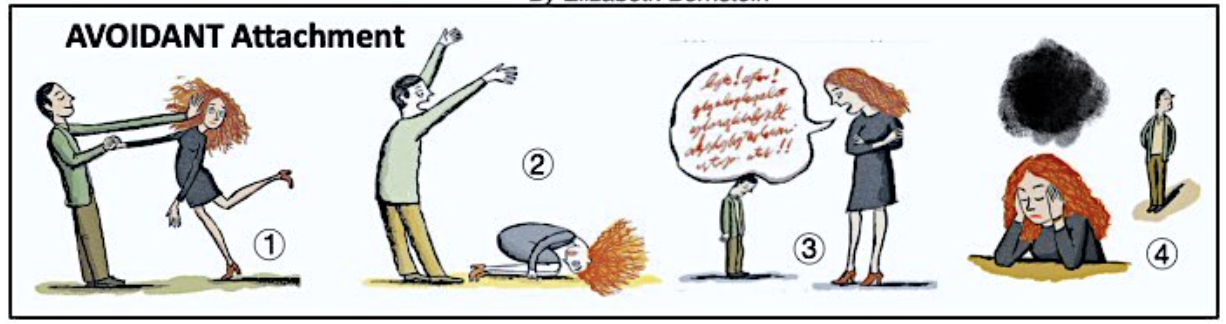
b. AVOIDANT – about 25%
1. They’re irritated or unnerved by too much closeness
2. They feel overwhelmed when bombarded with too much emotions
3. They focus on your faults & make unfavorable comparisons with past partners
4. They don’t deal well with intimacy, so are stand-off-ish
SITE :“5 Dismissive-Avoidant Breakup Stages” «
AVOIDANT Needs
These are the “push” away types. Most of their tactics are either indirect (long work hrs….), or dishonest, used to hide, cheat or punish.
i. Space
This is a ‘must’, to keep their sense of independence. To make this possible in positive ways the Avoidant has to be honest with their partner about that they need – consistently trustworthy, & clear about the legitimate ‘alone time’ activities that work best for them. (jogging alone, private time in their home office, quietly reading….). That way they can become more available without fear of suffocating.
ii. Privacy
This is the other big need, which can trigger the Anxious partner’s fears, although a Secure will not feel threatened. The Avoidant’s need for privacy & space is not necessarily a sign of being secretive or uninterested. Here too honest communication is crucial – to build trust & keep it there has to be integrity. They also have to be willing to some compromise, mutually figuring out when & how the Avoidant can meet their partner half way.
«
«
c. DISORGANIZED
** These types respond normally to casual friends or strangers and only react in disorganized ways in intimate relationships, since they too believe they’re unlovable.
1. Difficulty “opening up” // 2. Demanding
3. Acting out // 4. Trouble regulating emotions
DISORGANIZED Needs
They are both “push” & “pull” – a combination of needs, their deepest anxiety is both of being abandoned and of being engulfed.
i. Stability
Their biggest need is to feel protected, for the relationship to be a safe haven. Because they grew up in chaos, they have a lot of fear (EXP: physical abuse one day, & emotional neglect the next…. ). Stability offers emotional consistency, predictability & physical protection so they can grow to trust themself & others
ii. Patience
This is another critical need, because their reaction to triggers will be fight, flight, freeze or fawn – depending on which old button gets pushed, & how extreme the fear is. This complexity has to be understood & accepted, & the partner’s patience used with a great deal of compassion – so the Disorganized can feel heard, as well as given the space to feel secure.
«
NEXT : Attachment & RELATIONSHIPS (#3)
 HEAL & GROW for ACoAs