

PREVIOUS : Attachment DYSFUNCTIONS (#1)
PERSONALITY DISORDERS & Attachment
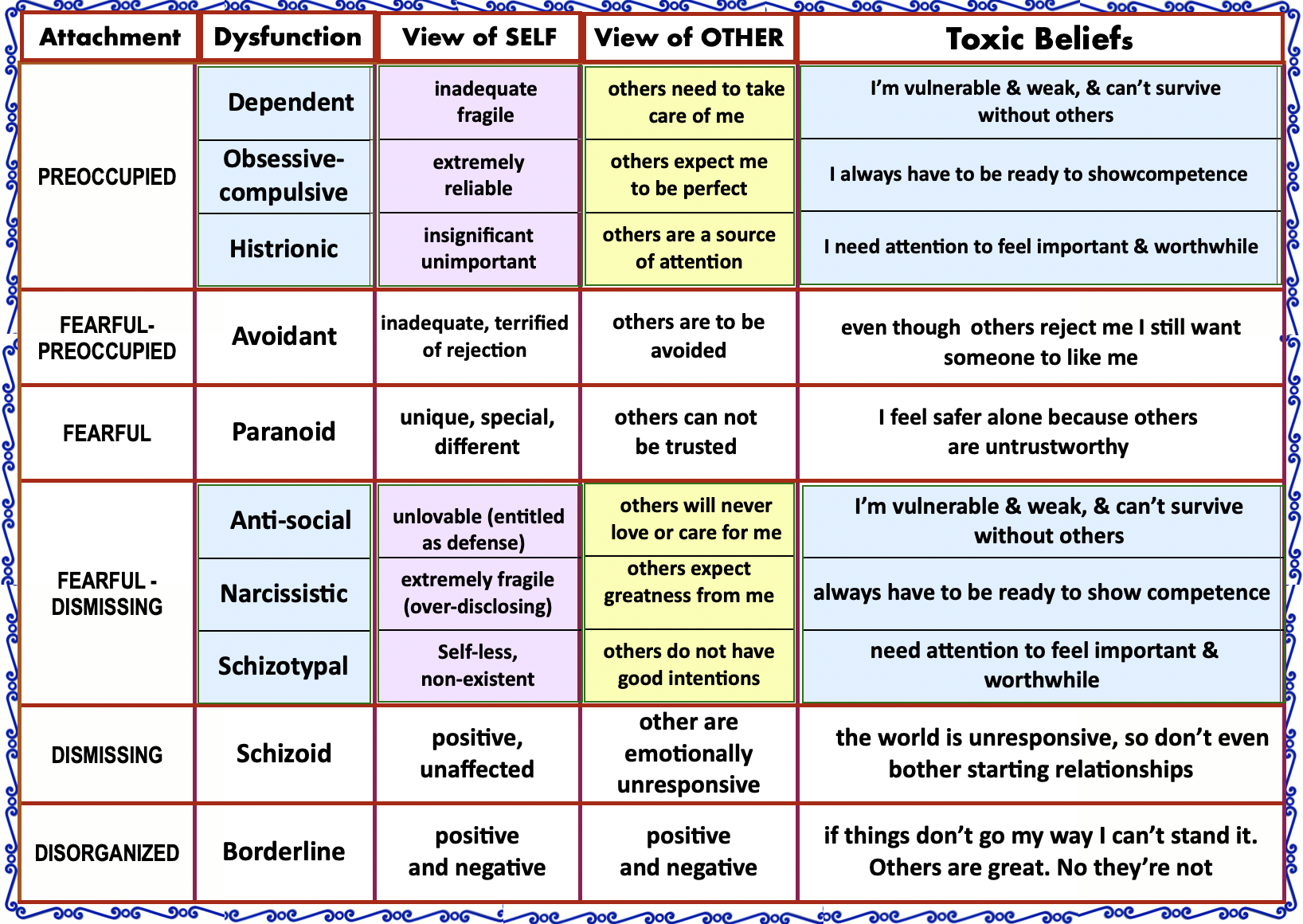
☂︎ Adults with a Preoccupied style, being anxious & more reactive to rejection, are prone to avoidant, borderline & dependent & histrionic PDs (personality disorders).
Based on a history of inconsistent parental support – they feel unsafe & wary, likely to be over-sensitized to possible environmental threats & therefore easily stressed.
☻ Conversely, the hypo-activation of Dismissing attachment (desensitized) is associated with antisocial, narcissistic, paranoid & schizoid PDs.
Chronically lacking support from original attachment figures, Dismissives habitually deny or dismiss environmental threats, & have less ability to experience hard emotions or admit a need for connections.
☁︎ Most likely to have personality disorders, such as BPD, are the Unresolved/ Disorganized individuals – the adult analog of disorganized/ disoriented infants – with abusive parents who had their own unresolved losses or abuse experiences. (MORE….)

«
ALCOHOLISM as an Attachment Disorder (POSTs….)
A study from Poland with 94 addicts & 94 non-addicts (pub 2014) showed that people with alcohol dependence significantly differ from non-alcoholics in terms of attachment style.
The ‘users’ had lower scores for Secure attachment, snd
higher scores for the Insecure types :
— anxious-ambivalent & avoidant style – indicating mistrust in interpersonal relationships, &
— anxiety corresponding to fear of rejection & avoidance referring to avoidance of intimacy
This follows other studies which concluded that 66 to 95% of the alcoholics observed were identified as Insecure attached, while only 6 to 40% were Secure. (See details & statistics….)
There is ample evidence that higher rates of substance dependence is found among emotionally wounded adults. Many alcoholics say they feel a “Hole in the Soul”, that something’s missing in their make up. Actually – all addictive behavior is an expression of the False Self, underpinned by Anxious attachment.
It’s about not having a clear sense of a positive identity. This ‘hole” is not a personality defect, but rather a lack of a safe Introject = feeling unloved by family. It comes with distorted thinking (S-H / CDs) & an inability to cope with overwhelming emotions accumulated from painful & dangerous childhood experiences.
Studies also note that addicts avoid being vulnerable, & are terrified of intimacy, more likely to show distrust & fear in relationships with loved ones.
Interestingly, the brain’s “love chemical” oxytocin – known for its role in bonding – is negatively linked to Insecure attachment, which affects all other neuro-chemicals involved in addiction. Oxytocin is severely reduced by chronic alcohol use & stress reactions caused by fear-based attachment styles, which reduces the other chemicals as well.
😣 Active alcoholics try to replace them at the bottom of a bottle. (Article : “Oxytocin could help treat alcohol addiction“)
Researchers from Hamburg, Germany (pub 2019) studied people with substance use disorders (SUDs).
Based on attachment theory, substance abuse can be considered “self-medication”, an attempt to compensate for missing Secure attachment strategies.
Longitudinal studies show that Insecure attachment is a risk factor for SUD, and continued substance abuse impairs the ability to form close relationships – which are needed to form Secure connections.
They also noted different patterns of attachment in different groups of users, suggesting different developmental pathways. EXP: — heroin addicts more often were Fearful–avoidant
— alcohol abusers could be more than one type
— SUD & insecure attachment was more strongly linked during adolescence than in adulthood
— Disorganized Attached people are at the highest risk for developing SUD (MORE….)
«
«
DOMESTIC VIOLENCE
Approximately 1 in 4 (24.3%) women have experienced severe physical violence by an intimate male partner. Compared to intimate partner violence (IPV) toward men, women experience more severe injuries & longer lasting symptoms such as PTSD, depression, & anxiety. (Black, 2011)
In a study of 132 male partner abusers in Texas Researchers Lawson & Brossart (pub 2013) examined whether hostile dominant interpersonal problems (HDIP) plus antisocial & borderline features —> had an effect on the connection between anxiety or avoidance attachment styles and intimate partner violence (IPV).
They conducted a two path analysis, with Avoidant and Anxious attachment styles as predictors……. Both hypotheses were supported, but the Avoidant model provided the stronger evidence……. It showed that abusive partner men with predominantly avoidant attachment are most like to deal with domestic conflicts (HDIP) in coercive, controlling, & vengeful ways, using physical aggression toward a partner……
NOTE : In this study, the 2 PDs ⬇️ did not correlate with domestic violence.
«
«
NEXT : Attachment DYSFUNCTIONS (#2)
 HEAL & GROW for ACoAs