
 PREVIOUS : INTRO #2
Internal WORKING MODELS (IWM)
Over time, children internalize their specific attachment style as a base to form a prototype for later relationships outside the family. This is made up of a set of archetypes of Self & Others, an automatic process of creating cognitive schemas (mental pictures).
IWMs are a key component of a person’s earliest development, because those schemas become an inner guidance system for future behavior. (as SBS = secure base scripts)
They govern the way each child interprets & responds to the caregiver’s behavior, as an expectation of care, which is then used to make decisions about & plans for ways to interact with others.
EXP: As an adult, it’s used to decide whether to approach or withdraw from a situation, as well as for voluntary emotion- & distress-regulation strategies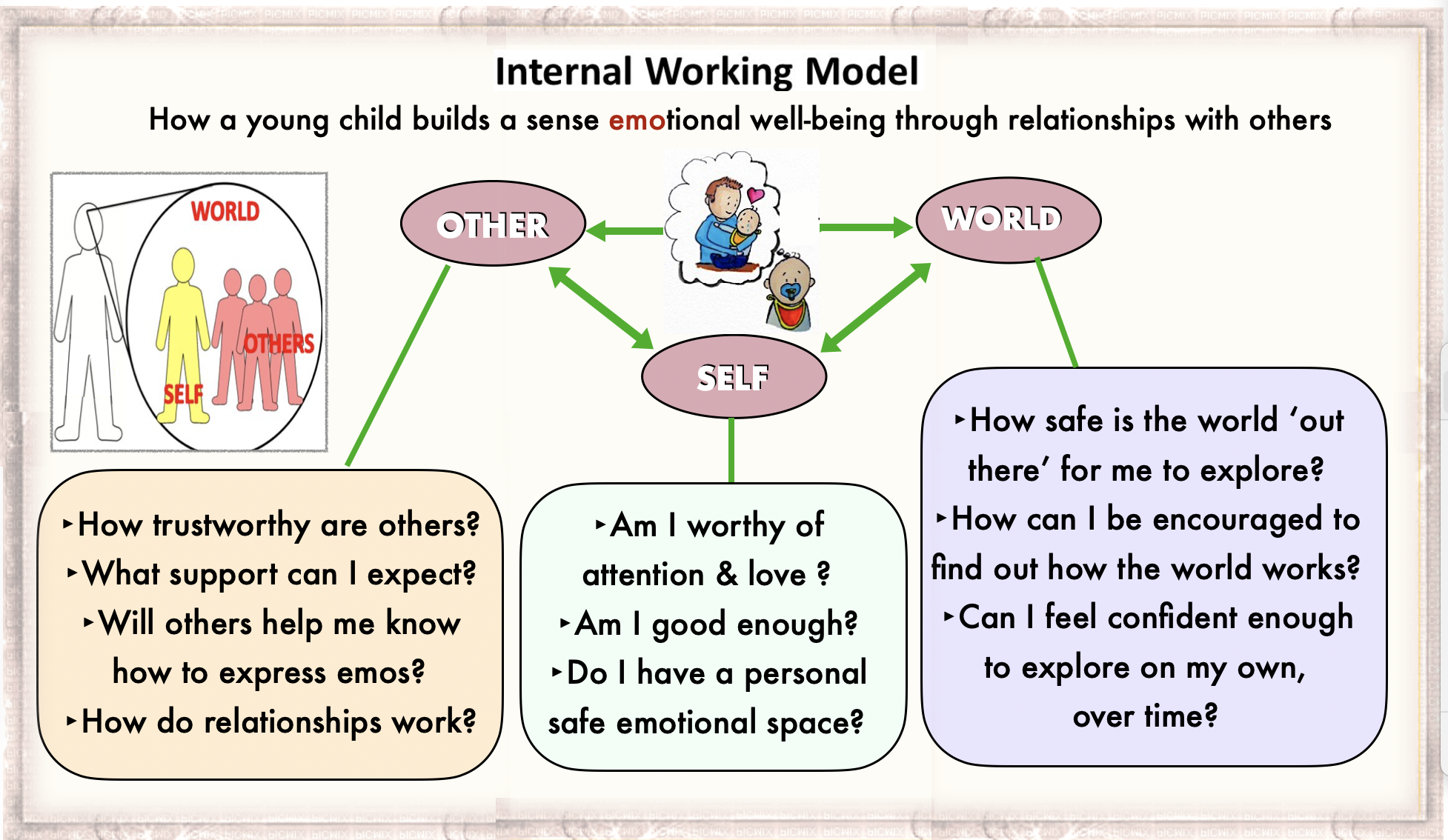
IWMs influence a person’s emotions, general behavior, interaction with others, & assumptions about how others will treat them in relationships. For most, IWMs operate unconsciously, guiding our attention & actions in social situations.
IWMs are dynamic, so can be modified under some conditions, but tend to remain stable over time, based on the quality of the original parent-child relationship.
🌗 This is why Recovery from an unhealthy or traumatic childhood takes so much time & effort!
RESEARCH
Studies validate the reality of universal human social needs. In the UK, after World War II, the unmet needs of homeless & orphaned children created great distress for the British. To deal with this, relief organizations addressed the problem with the help of attachment theory, based on Maslow & Bowlby’s developmental psychology work.
At the time, the focus was mainly on maternal deprivation & the corresponding loss of the child’s essential / primal needs. Attachment theory has since been extended to explain nearly all the human needs in Maslow’s hierarchy, from basic physical needs & mating -to- group membership & justice.
The theory indicates that attachment Security or Insecurity are connected with specific images & beliefs about the Self & Others.
♝ Security is usually related to positive Self- & Other-models
♝ Avoidance comes from an overly positive Self- but negative Other- view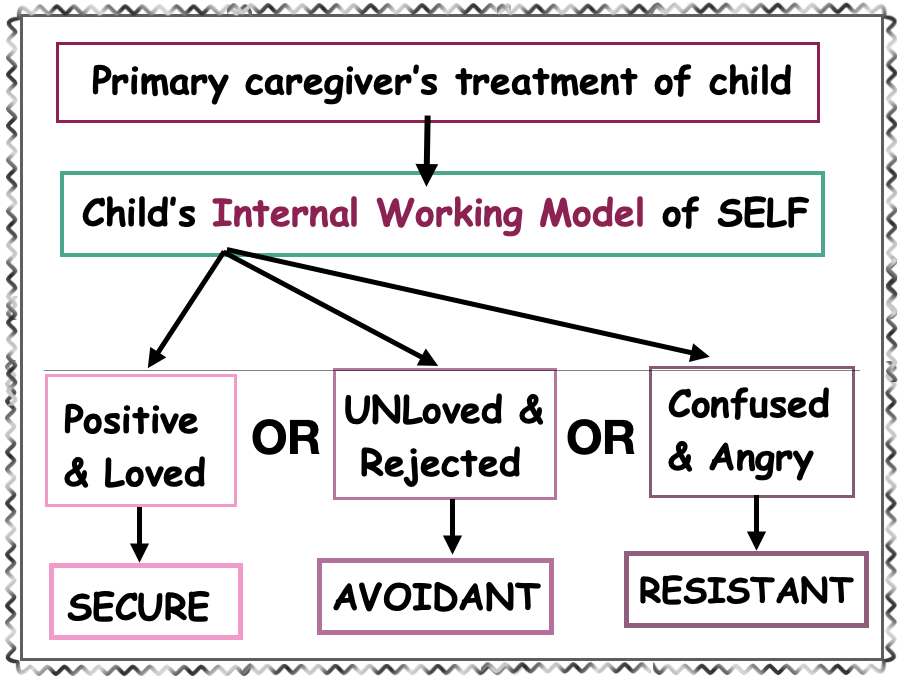
♝ Anxiety is linked to a more ambivalent Self- & Other opinion
Based on a person’s childhood experiences, R. C. Fraley, (2002) adults pay particular attention to experiences & information that fit their internal expectation about how the world works, referred to as the Confirmation bias.
CONCLUSIONS
Both insecure styles (Avoidance & Anxiety) interfere with rational thinking & reality evaluation of people / places / things (PPT) – which would normally regulate emotion as part of a person’s positive functioning. Interestingly, they seem to have opposite effects on how life is understood ⇓
🔹 Avoidance is linked to a general decrease of emotional reactions, especially re. incoming positive social info (good news is not comforting!)
🔹 Anxiety includes a general increase in emotional reactions, especially in the case of incoming negative social information (bad news is very triggering)
➡️ IMAGES from “Early Attachment Relationships & Their Impact on the Brain’s Wiring“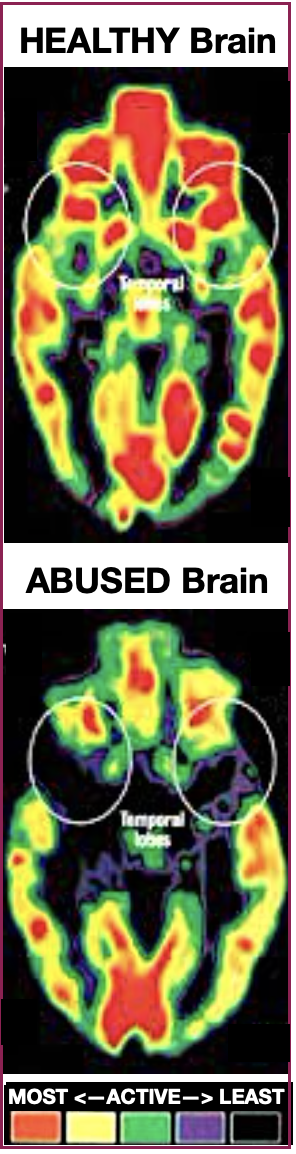
ALSO :
Two studies used a brief adjective checklist (strong, safe, cruel, stupid….) to measure attachment. Data revealed that participants with a more negative self-image showed — ⇓
🔸 increased brain activity >thinking< during either positive or negative adjective evaluation about the Self (“I’m strong OR I’m unattractive”) (pleased OR upset)
🔸 but decreased brain activity >stop thinking< when hearing negative adjective about a close ‘other’ (“Mom is selfish / My kids are aggravating”). (More….)
re. TEENS (More….)
Normally, as a teen grows, they can better cope with incongruent (unclear or negative) reaction to themself in social situations.
For Anxiety attachment, the observed effects were similar to age-related brain activation – increased brain activity (being upset) when dealing with incongruent social feedback or conflict.
However, Avoidance attachment influences brain activity opposite to “normal” development, causing a stronger focus on congruent (clear & positive) social feedback, AND ignoring anything unpleasant – which is less psychologically mature.
‘High’ Avoidance seems to make a person unable to notice or deal with variations in social interactions.
EXP : Avoidant teens will gravitate to friends & locations which totally agree with their own attitude & point of view.
NOTE : Avoidant Attachment does not always mean physical isolation, but rather emotional withholding.
NEXT: INTRO – #4
 HEAL & GROW for ACoAs