FRIENDS – FAKE

  PREVIOUS: Real vs Fake People 

SITEs: “How to Spot a Fake Friend”

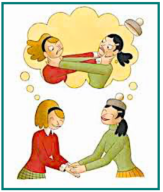
▪︎ 12 Signs of a Fake Friendship    – Expanded info, with cartoons

Some FAKE FRIEND (FF) Characteristics

MENTAL / VERBAL – THEY:
◎ often gossip about other friends with you (so are very likely to gossip about you too)

◎ are not interested in getting to know you on a deeper level

◎ put down your opinions or beliefs

◎ judge your limitations or mistakes harshly

◎ always turn the conversation back to themselves

◎ forget the important things going on in your life

◎ insist on convincing you of their point / opinion

EMOTIONAL  / PSYCHOLOGICAL THEY:

◎ tend to disappear when you need their friendship the most

◎ try to make you feel guilty or get passive-aggressive when things don’t go their way

◎ have a hard time being happy for your successes & achievements (envy / jealousy)

◎ use back-handed compliments to confuse & wound you

◎ are quick to take offense or get angry with you

◎ infect you & everyone else with their continual bad mood or ill temper

◎ only find you when they need help
◎ have a heightened sense of self-importance & entitlement

◎ hold your past mistakes over you & won’t let them go

◎ try to control & change you

SOCIALTHEY:

◎ rarely initiate calls or get-togethers

◎ never stand up for you in front of others

◎ frequently break promises or “forget” commitments

◎ say things to embarrass or shame you in front of others

◎ call you only when it seems they have nothing better to do

◎ can easily drop you as a friend when it suits them

◎ selfishly take up a lot of your time

◎ don’t like your other friends (possessive)

ADD YOUR OWN to the list  

 FAKE FRIENDS (FFs) :
⦿ ask about you but aren’t actually interested
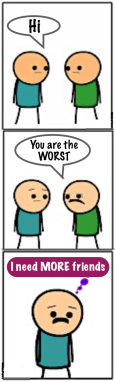
FF may say, “Hi! How are you?”, & then turn away to talk to someone else before you can open your mouth, OR immediately start talking about themselves, & never take a breath!

⦿ always demand convenience 
FFs make sure they have everything they need first – & to their taste – before considering others. They may be charming, smooth, even cheerful, yet it’s all done for their own benefit, even when it means others will suffer

Notice:  they’re only nice as long as a situation suits them, & not a minute longer. As soon as they’re not happy, they’re not nice (high-maintenance).

⦿ leave your side for someone ‘better’
FFs use others to comfort themselves – only act friendly when they don’t want to be alone. In an unfamiliar or uncomfortable social situation they’ll act like your friend so they’ll feel better & look popular (not a wallflower). As soon as they spot someone with a higher social status or is more interesting, they’ll mosey over to the ‘more valuable’ person.

⦿ are inappropriately excited to see you 
If you run into an old friend you haven’t seen in a long time, you might exclaim & hug each other. But when someone you barely know does that (you’ve only exchanged small talk with, at work or other group), it’s not about friendship. It’s boundary invasion &  being presumptuous.

Maybe the FF is just desperate to be liked, wants to look better to others, hopes to placate you if they think you’re angry at or displeased with them, or just buttering you up to get something from you later.

⦿ constantly talk over you
Some people just likes to hear themselves talk – who ask a question just so they can gives their version or opinion, or who forever tell the same story, even using the very same words & expressions.
Sometimes FFs will act really interested in what you have to say, nodding with enthusiasm – but later you realize they never seem to remember things you’ve told them over & over.
ALWAYS notice people’s pattern of interaction with you & with others.
IF
you want to tell a FF they’ve hurt you, remember to be respectful & have good boundaries.
IF they don’t want to hear it, but instead get defensive, change the subject or turn it back on you – making you the bad-guy – then it’s time to let go . Life’s too short to hang onto to a toxic relationship.

NEXT: Real friends
ODD FRIENDSHIPS


PREVIOUS: Real vs Fake #3

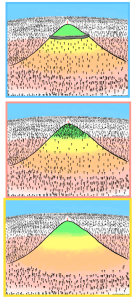
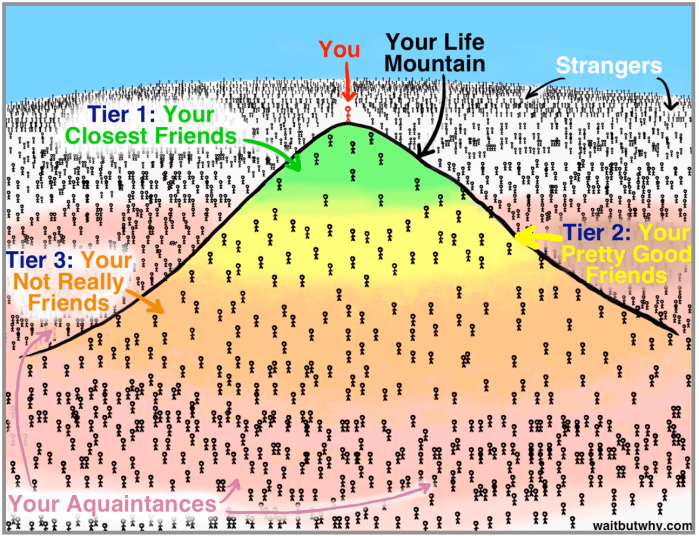
IMAGE shows relationships in TIERS ⬆️

The following article is modified from Tim Urban’s site.  See other images & longer explanations at “The Friendship Quadrant”

“Once student-life ends, the people in your life start to shake into more distinct tiers….. Whatever your particular mountain looks like, eventually the blur of youth is behind you, the dust has settled, & there you are living your life – when one day, usually around your mid or late 20s, it hits you: It’s not that easy to make friends anymore…”

Tier 1 – those who feel like close siblings (if you like any of those!)
Tier 2 – your Pretty Good friends…
Tier 3 – your Not Really friends…. the lowest part starts to blend indistinguishably into your large group of acquaintances (pink zone),
who gradually blend into the endless world of strangers (white).

Some TYPES ➡️ :
▪︎ Walled-Off Wally – surrounded but totally alone
▪︎ Phony Phoebe – trying to be everyone’s best friend, but ends up with lots of people mad at her
▪︎ Unabomber Ulysses  – who gets rid of everyone

ODD FRIENDSHIPS (unhealthy)

1) The Non-Question-Asking Friend
– extremely self-absorbed & only wants to talk about themself
– avoids getting close to others & won’t talk either about you or themself (nothing personal, just third-party topics)
– considers you as being insufferably self-absorbed, & knows if they ask about your life, you’ll talk their ear off

2) The Friend in your Group YOU can’t ever be Alone with
– because you’re jealous of each other, or are too similar, have too much rivalry, or are both alpha dogs / queen bees…..

3) The Non-Character-Breaking Friend you have to be “On” with
– they’re terrified of having a genuine interaction, so your friendship with them is always some kind of performance. They’re only capable of shallow communication, based on a facade

4) The Double-Obligated Friendship
– neither of you really want to spend time together – but won’t admit it, somehow believing you have to keep up the pretense (“don’t want to hurt their feelings”// better them than no one)

5) The Half “Marriage” Friendship
– it would be a marriage if only the other person weren’t very, very, extremely not interested in that happening….  It feels like one long, continuous rejection of you as a human being, but you stay, & wallow in longing

6) The Frenemy
– the one who roots very hard against you – just because you’re you…  usually someone you go way back with – & have or though you had – a very deep friendship, but the trouble probably started a long time ago (they’re envious, you have unspoken hurt feelings, one of you is holding a grudge….)

7) The Non-Parallel Life Paths Friendship
– early friends who seemed to be going in the same direction as you (under 30), but later some of them suddenly veered in a completely different life direction you couldn’t have imagined…. so can’t be as close as you used to be
8) The Historical Friend
– someone you met when you were little & stayed friends with through the years, even though you’re a very weird match…. often someone you absolutely would not be friends with if you met them today
9) The Facebook Celebrity Friend
– a rare Tier 3 friend or just an acquaintance, who you turned into a ‘deep connection’, but it’s all in your mind – since you’re not actually friends… like someone at work you’ve a ‘thing’ for, or someone on Facebook you’re following fanatically, but they have no idea of your obsessive attention

10) The Lopsided Friendship
– one can be higher on one friend’s mountain than the other
– one can want to spend more time with a friend than the other does
– one will consistently spend 90% of their time listening & only 10% of the time being listened to…..

URBAN concludes:  Not All Friendships Are Grim….
“No friendship is perfect, but those in Quadrant 1 are doing what they’re supposed to – making the lives of both parties better.
And when a friendship is both in Quadrant 1 and on Tier 1 of your mountain – they’re a rock to depend on” ….
SO:
✦ Figure out which ‘friends’ are NOT in Quadrant 1, & demote them down the mountain

✦ Since Tier 1 people are a comfort & a joy, dedicate more time to them

NEXT: False people

REAL vs FAKE People (Part 3)


PREVIOUS:  REAL vs FAKE – #2

SITEs: “How to tell if someone is lying to you

QUOTE: “When someone shows you who they are, believe them  – the first time.” Maya Angelou


GP = Genuine Person
FP = Fake Person


NOTE:
Fake people can fall into 2 broad categories:
a. The mean, selfish narcissists who are good at pretending to be friendly & interested in others, but are really angry, manipulative & (indirectly) controlling, sure they know what they’re doing.

b. The self-hating, fearful, depressed, needy co-dependents who don’t know who they are, desperate to avoid abandonment in any form, who try to feel OK by attaching themselves to Real people.

✦ Up-front
GPs can express their opinions & feelings clearly, so when they have a problem with you, they’ll talk about it directly. They’re ‘adult’ enough to deal with an issue respectfully, hoping a positive conversation will resolve it.
GPs think about the best way to deal with a dispute or hard feelings. They know that sometimes waiting a while before saying anything it better, & sometimes letting go is best.

vs.Sneaky
FPs are cowards when it comes to speaking up. They confuse self-assertion with confrontation (angry communication) – assuming assertion & processing out an issue is the same as attacking the other person.

This is because most of the the time they are angry & don’t know how to deal with it correctly. Instead, they’ll smile when they see you, but complain about you to anyone else who’ll listen.  When you’re back is turned you become the enemy, so they gossip, venting their frustration & annoyance by triangulating.

✦ No Ulterior Motives
GPs are honestly nice & helpful – because it makes them feel good to make others happy & safe. They don’t ne-e-ed recognition or praise, but do enjoy a thank-you. They don’t play games or have hidden motives. They consider the effect of their behavior on others – without losing their own identity.

Their relationships aren’t based on using others to get something for themselves. If they spend time with someone it’s because they genuinely want to, & are interested in them as a person. Whenever possible – within boundaries & reality – they’ll be available even when there’s nothing practical or material to be gained by it. EXP: they’ll reach out randomly to say Hi, or check on someone’s who’s having hard time – because they care.

vs. Ulterior Motives
FPs have that a “I’ll scratch your back IF you scratch mine” attitude. Usually they’re only nice when they want something. If they help, they expect a return, but if they sense there’s no reciprocation, they can’t be bothered.

▸ FPs always think about how they can be happy by using others. The carefully choose who to respect & when, based on what the other person can do for their image & personal gratification. They’re only nice when it suits them, since they only care about their own satisfaction. If others can help them or have something they want, they’ll be ‘your best friend’, but when the person has fulfilled their purpose, the FP will be gone without a trace.

✦ Cleaning Up Messes
GPs take care of their own messes, which are relatively rare. However, being thoughtful & generous, they may end up compensating for or cleaning up after a dysfunctional person they care about, whether physically or emotionally. But being healthy, GPs also have a limit. When someone persists in being irresponsible or has gone too far, GPs with back off or back out altogether. (Cartoon)

vs. Making Messes
Many FP are selfish, immature users. They try to get away with as much as possible, taking advantage of anyone who’s willing to rescue them.
EXP: They may ask for one thing which the helper agrees to, & then spring on them a sting of other “requests” (expectations / demands) added on to the first – at theist minute, when it’s too late to change the situation.
And, some FPs are perverse enough that they’ll make messes even worse on purpose. 

NEXT: Real FRIENDS

REAL vs FAKE People (Part 2)


PREVIOUS:
REAL vs FAKE – #1

SITEs:
▪︎  The Science Of Smiles, Real & Fake


GP = Genuine Person
FP = Fake Person


✦ PRIVATE 
GPs are comfortable in their own company. Being alone is needed for self-reflection, & they know everyone benefits from down-time to process & recharge. This is not isolation, but rather a comfort zone, whether occasionally enjoying some solitude at home or going places unaccompanied. “Healthy” others will understand & respect this need, & some maybe even learn to do the same for themselves.
PS: Introverts need this more often than Extroverts.

vs. PUBLIC
Regardless of their MBTI type, many FPs don’t like to be on their own for too long,  surrounding themselves with lots of events, groups & acquaintances. Not everyone will see their true colors & so will fall for their manipulations, thinking they’re ‘great’.

Some will do whatever it takes to stay center-stage, showing off, constantly talking, or playing victim to get sympathy by talking about their misfortunes, even throwing a ‘tantrum’.

✦ PRIVATELY HELPFUL
GPs ALSO don’t need to brag or go out of their way to get recognition – for doing something good for another person or group (professional help or as a favor). But it’s more important to them to do a good job & that others are encouraged & helped.

vs. HELPING for RECOGNITION 
FPs think they’re vital to other people’ lives (no-one can do without them!). They try to live up to others’ expectations, always wanting to be (or seem like) the ‘good guy / gal’, trying to please everyone.
They’ll rush in to be helpful – even when someone doesn’t need it or didn’t ask, then tell everyone about it so they can feel important. At work – they want to look like the boss’s favorite, but others can usually tell they’re not sincere.

✦ HUMBLE
GPs don’t need to brag. While it’s natural & healthy to be proud of one’s achievements, & to share them with others, GPs know it’s not imperative. They have enough self-esteem to be modest – but not self-facing (false humility). They can easily talk about their own positive experiences & abilities – or not.

vs. ARROGANT
FPs are generally more materialistic & self-gratifying. They have a hard time empathizing with others, only interested in promoting their own agenda.
Because they need to be the center of attention, they’re constantly bragging about their assets & achievements, talking up even their smallest action to get admiration & praise. They often embellish stories or outright lie, & tend to tell the same story over & over

✦ RELIABLE
GPs are not afraid to take responsibility for their life, without having to be perfect. They always make an effort to keep their commitments, & if they can’t for any reason, they admit it with a sincere apology. They don’t need to make excuses, & while sometimes a non-whiney explanation is appropriate, at other times none is required.

However, what really makes the difference is that GPs takes time to consider if they can realistically follow-thru on something, so don’t make promises easily or often, & never just to people-please.

vs. UNDEPENDABLE
FPs are not great at taking personal responsibility – for any of their T.E.A.s. They can talk a big game, agreeing to or offering to do things, but rarely follow through. They’re the ones who make plans with you, but often cancel – & usually at the last minute. They carelessly make promises, wanting to feel important without having to earn it.

When called out, they come up with a list of excuses, even recycling the same old ones. They may be people-pleasers, afraid to say no, don’t think they’re in control of their own destiny, or they feel entitle & basically are inconsiderate.

✦ LISTENING
GPs are careful, attentive listeners, noticing what someone is saying about themselves, without the GP having to give advice or insist on their opinion. IF asked, they offer their experience, options & suggestions, without having to ‘be right’.

vs. PRETEND to LISTEN
FP will either talk over others, interrupt, insist on giving advice (only their point of view), or only listen if there’s something juicy for them to pass along (gossip’).

NEXT: GPs vs FPs #3

REAL vs FAKE People (Part 1)


PREVIOUS: MBTI Feeling as INF

SITEs: The truth on FAKE & REAL People

▪︎ “Why Empaths Freeze around Fake People”

▪︎ “Overcoming Fake Talk

QUOTE: “The BEST way to deal with FAKE people is to BE REAL with them”

GP = Genuine Person
FP = Fake Person

Telling the difference between a fake & a genuine person is a great skill to have. It will keep you away from those who don’t have anything positive to offer, or just want to take advantage.

NOTE: Genuine people are NOT perfect, not perfectly healthy, not free of limitations & weaknesses
BUT – they DO have a decent amount of self-esteem & a low level of anxiety, good boundaries, & are aware that others can & will have their own (different) point of view about things.

✦ RESPECTFUL 
GPs make an effort to respect everything & anyone, taking people’s feelings into consideration. They don’t look down on others, wanting everyone to feel appreciated & important, no matter the situation. At the very least they’re polite to everyone, or appropriately friendly, not just when they’re in a good mood, or when they think it’ll give them some advantage.

vs. CONDESCENDING 
FPs can be deceptively well-behaved, but not to everyone, mainly showing respect to those in power, to get something out of every situation. They try to get close to ‘important’ people, & won’t give you the time of day if you don’t have something they can benefit from.  If it means using some acting skills, they will.

✦ OPEN
GPs are generally transparent, so others know where they’re coming from, both positively & negatively.  (“Say what you mean but don’t say to mean”) They’re not afraid to admit having
 limitations & vulnerabilities, but also know how to deal with hurts & protect themselves when appropriate.
They don’t sweat the small stuff, nor nit-pick about imperfections, knowing they themselves are also not perfect.

vs. CLOSED
FPs have defensive walls, manipulating the truth, to 
never show others their vulnerable side. They don’t want people to know they have weaknesses – not being ‘perfect’, so they put on a great show to make themselves look happy & self-sufficient. They don’t ask for help, then get resentful when others don’t ‘intuit’ what they need.

✦ CURIOUS
GPs are tolerant of new ideas, knowledge & truth. They don’t pretend to know everything, so are attracted to others with expertise to learn from them, & appreciate the time someone takes to give them information.
They don’t have to accept and agree with what someone else thinks – but are willing to pay attention, wanting to  improve themselves.

vs. LIMITED
FPs are 
set in their ways, not interested in evaluating their point of view about anything, nor broadening their understanding of the world. They need to make themselves look superior & more knowledgable the everyone else. They feel the need to have an answer for everything, even if they don’t know about a subject, or are completely wrong. They’d rather be right than fair. 

✦ KIND
GPs express, encourage & spread compassion & understanding. While they know ‘things’ have some value, they put more emphasis on personal values & forming strong relationships. GPs support others to do their best, & encourage them to ‘keep going. They’re comfortable hearing others talk about their creativity & accomplishments – being gracious, admiring & give praise where it’s due.

vs. CRITICAL
FPs don’t accept responsibility for mistake they make. Instead they try to make others feel like they’ve done something wrong & are to blame.

They expose their insecurity by constantly criticizing, making fun of or putting down people/ place/ things, feeling great (& relieved) when finding mistakes in others’ work or personal weakness, & telling everyone about it.

They can’t be happy for anyone else, belittling & undermine other people’s happiness, because they’re envious & feel diminished. To keep up their self-image FPs can do a lot of harm.

NEXT: Real vs Fake #2

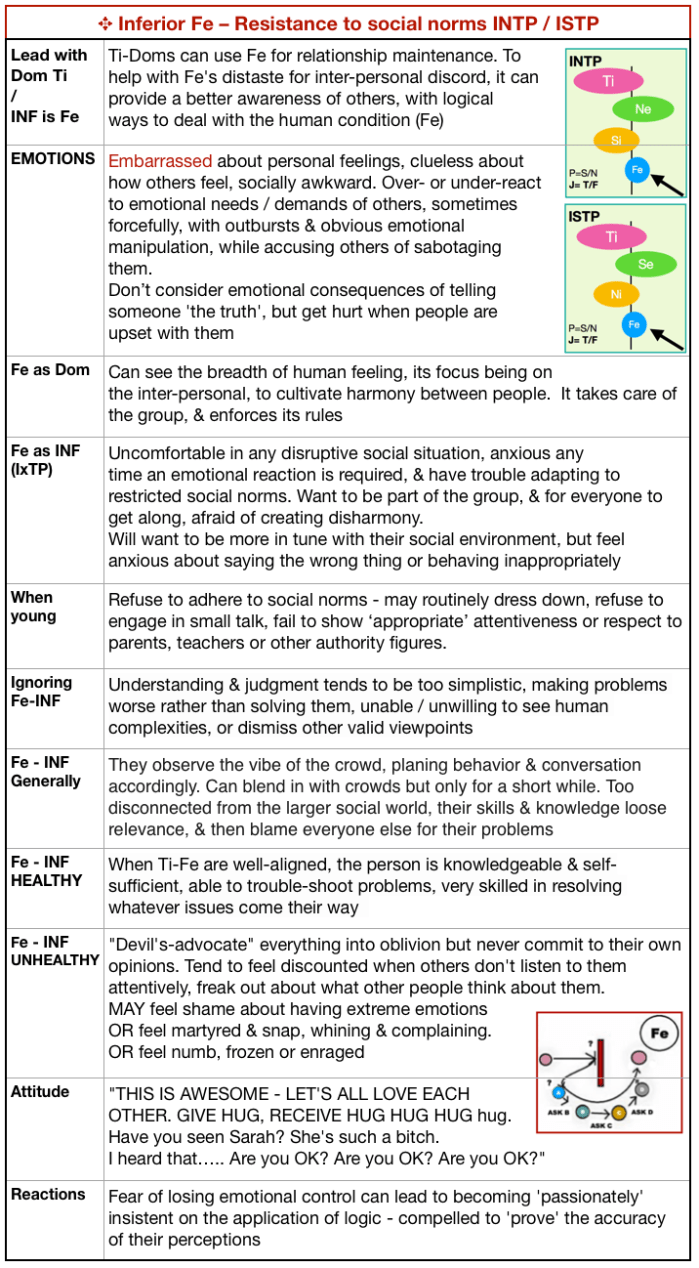
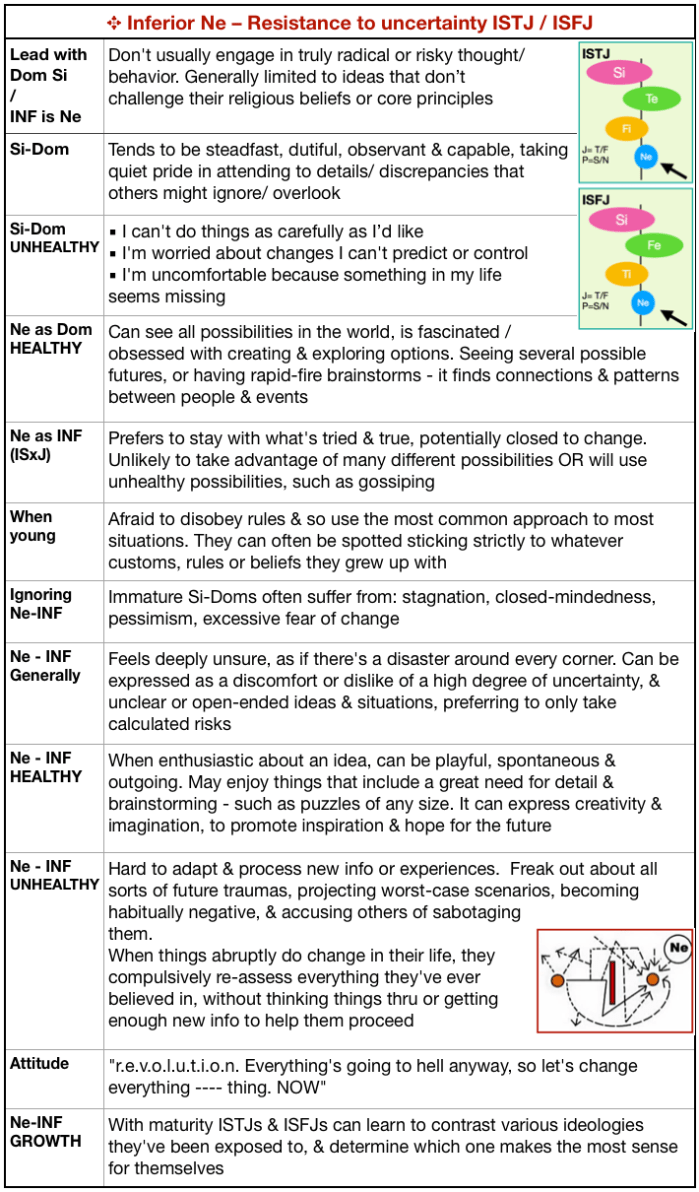
MBTI – Feeling as INFERIOR Function


PREVIOUS: Thinking as Inferior Function

SITEs :• LINKS re Inferior functions

•  “No, you don’t need to develop your inferior function”

Mistyping and Inferior Fe?

Underdeveloped vs developed inferior functions

A JUDGING function
The F function can produce fears about: feelings being hurt, not supported, being misunderstood, not living up to one’s ideals/standards


NEXT: Functions in combo

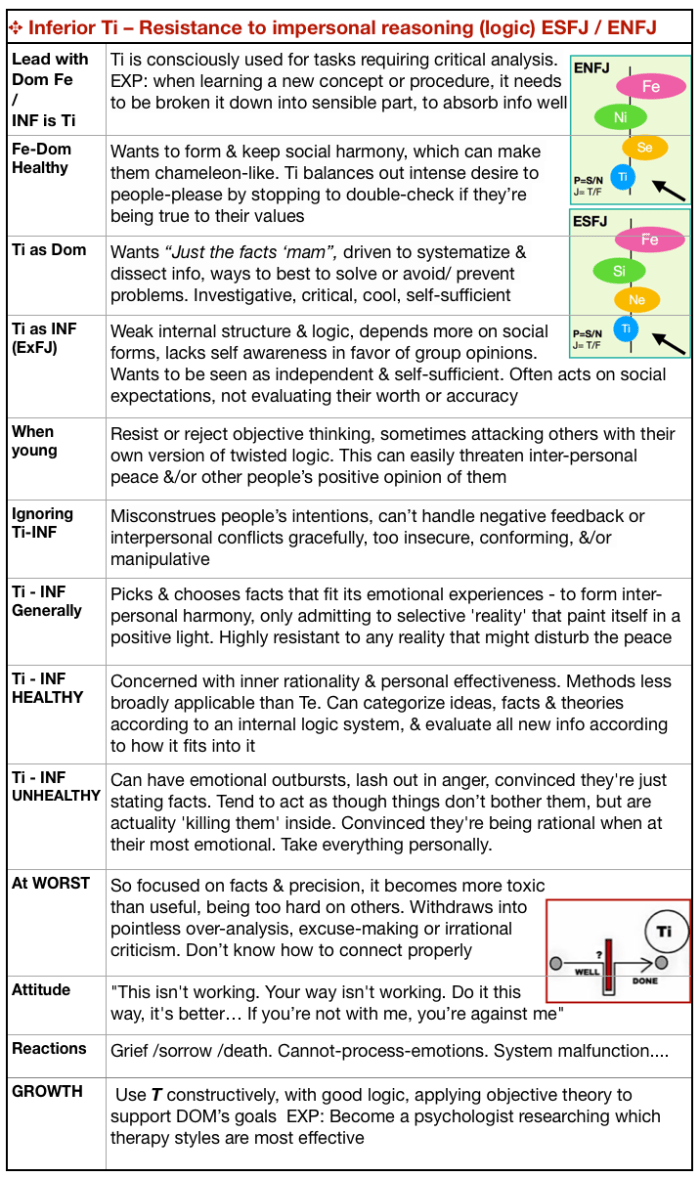
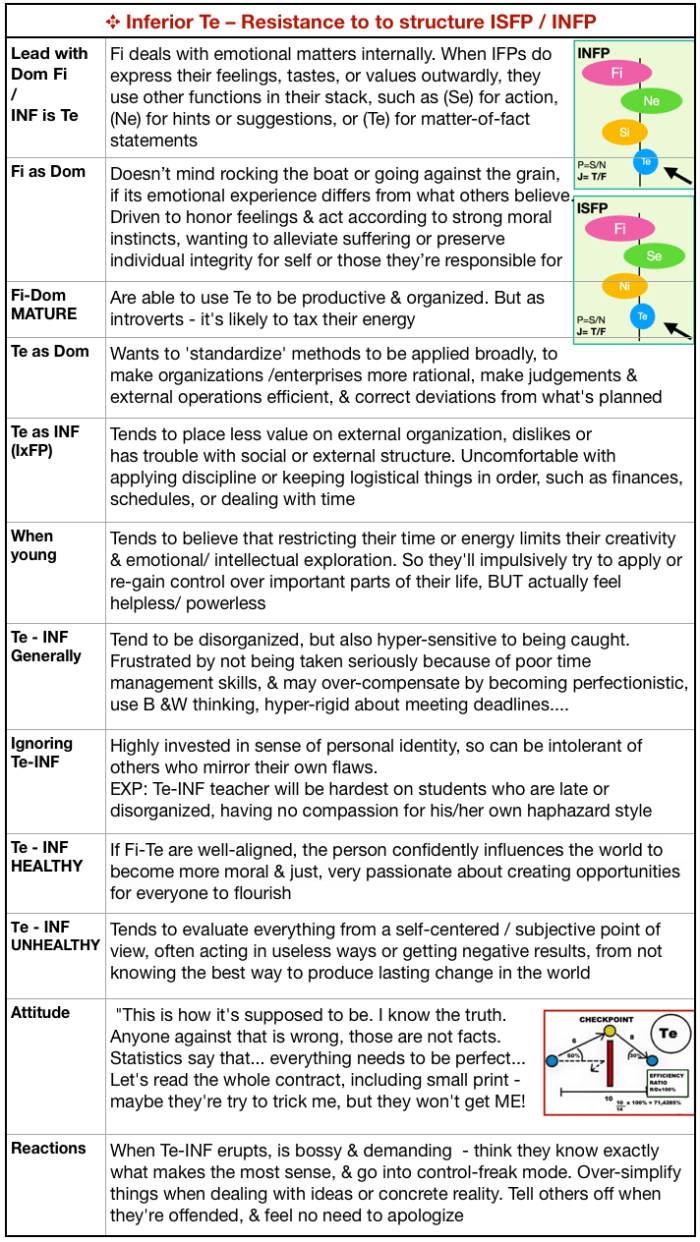
MBTI – Thinking as INFERIOR Function


PREVIOUS: Intuition as INF

SITEs: • “Inferior Functions in Depth”

16 Types:  Inf functions


A JUDGING function
The T function can produce fears about: losing power & control, failure & inadequacy, being stupid or incompetent


SOURCES :  Heidi Priebe / MBTI Database / MTI Notes / funkymbtifiction

NEXT: FEELING as INF

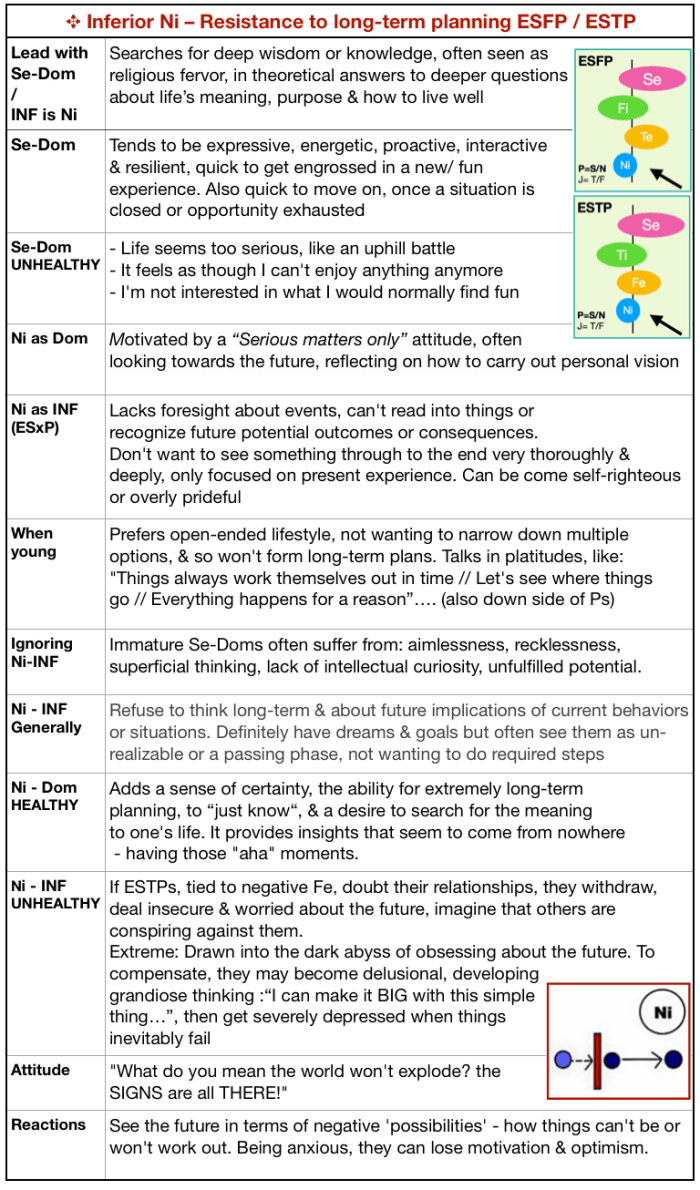
MBTI – Intuition as INFERIOR Function


PREVIOUS: Sensing as INF

SITEs: ▪︎ UNHEALTHY Inferiors

▪︎ FORM of Inferior Functions


READ Expanded info for all 8 functions (Se/i, Ne/i, Te/i, Fe/i)

A PERCEIVING Function
The N function can create fears: of the future, living a meaningless or hopeless life, wasting promise & potential


SOURCES :  Heidi Priebe / MBTI Database / MTI Notes / funkymbtifiction

NEXT: Thinking as INF

MBTI – Sensing as INFERIOR Function

PREVIOUS: Function Overview

SITEs: Comments on INF Functions 

• “Inferior Functions in fiction”

• “I’d Rather Not Be This Way


A PERCEIVING Function
The S function can produce fears about: health & mortality related pressures, physical safety, material security, missing out


MBTI – Functions OVERVIEW

PREVIOUS: Function development

SITEs: “Objective Personality” (+ more)

▪︎ How to recognize each MBTI Type (good detail)

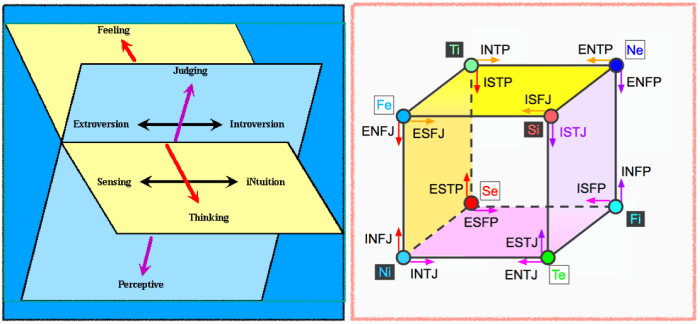
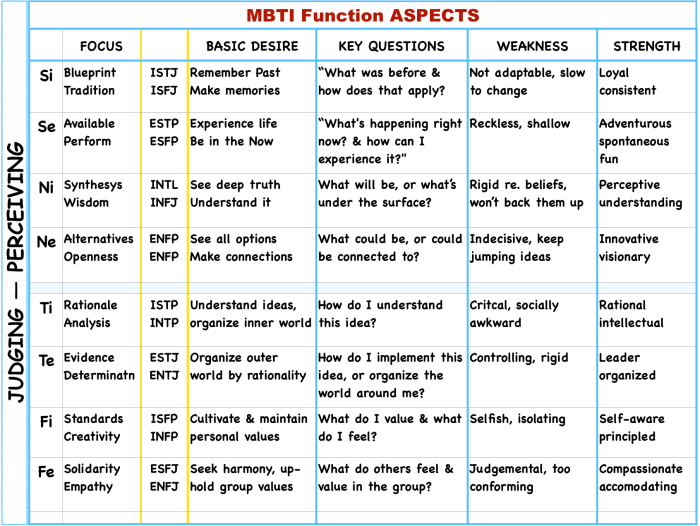
⬆️ A look at what’s important to Js & Ps 

⬆️ Degrees of mental health for each function 


⬆️ Fundamental focus of each part of a stack – Sensing, Intuition, Thinking, Feeling, as either Introvert or Extrovert
«

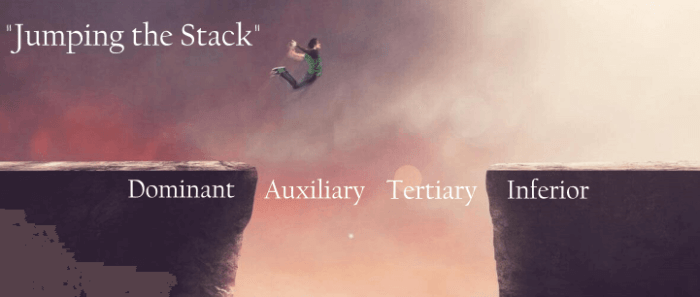
⬆️ INFERIOR Function is what you aspire to. (More….)

a. When (INF) thinks it can heal the Self, if it usurps the role of the DOM
b. When Inferior (INF) function wants to show off – if it just tries really hard, even though it’s not strong enough to lead


➡️ The healthiest use of our Stack – learn about, acknowledge & fully USE the part of us that comes most naturally from birth. The other 3 functions can then support & augment, to make our life more successful
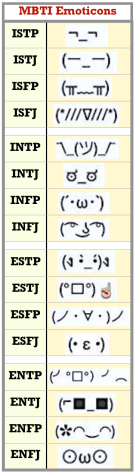
⬆️ Emoticons.   Also – a VARIATION

NEXT: SENSING as INF