
 PREVIOUS : Biological Domain
ACoA website : ⛰ Negative “Decision Making Styles” – 2 charts
🪴”Problem Solving & Decision Making” – 5 charts
◉ POSTs : LIST of “To think” alternative words (scroll down)
2. COGNITIVE (mental / thinking)
“Cognition” refers to any mental process involved in gaining knowledge : attention, perception, memory & problem-solving. The domain is also about verbal & written communication.
• Self-Regulation in this domain is concerned with the basis of these processes – the so-called Roots of Attention, which involve the body as much as the mind. S-R should not be confused with mental ability or academic performance skill. Instead, it is a self-directed inner process & set of actions used by learner to transform their mental abilities into practical skills.
Having positive mental control is a critical requirement needed to stop oneself from doing & saying self-defeating or abusive things in response to environmental & internal demands.
Roy Baumeister et.al listed S-R’s mental availability as:
a. knowledge – needed to exert self-control
b. strength – requiring willpower, so is a limited resource
c. a skill – built up over time & can not be diminished 
High-order mental processes such as decision making require flexible mental control. This adaptability provides the resources to modify planned responses as needed, & reacts appropriately to ever-changing information from external events & internal goals (Duque et al. 2017).
With any new skill, learning goes through 4 basic stages :
1: Unconscious INcompetence
We’re not aware of lacking skill in some area
2: Conscious INcompetence
We’re now aware that we don’t know something, perhaps causing a feeling of weakness & inadequacy, which our ego wants to avoid. What’s required is the determination to follow through to the goal, with self-compassion, hard work & discipline (cultivating the will).
3: Conscious Competence
A commitment to consistent practice of new info & skills – with devotion, patience & kindness toward oneself. It requires the ability to manage one’s time & effort while moving through boring plateaus & long periods of hard work.
Observing our progress builds confidence, & reviewing where we once were allows us to marvel at improvements. We still need to focus intently on learning, but growth is undeniable.
4: UNconscious Competence
 The real ‘magic’ happens at this final stage of transformation. From total darkness, awkwardness, discomfort & frustration experienced in stages 1 & 2, through herculean efforts of consistent practice in stage 3, emerges a new level of ‘being’.
To perform a skill effortlessly no longer requires conscious focus. Automatic responses allow us to be in an absorbed mental state, as “in the zone / in the flow.” We see this in great athletes, musicians, orators, & anyone on the path of self-mastery.
S-R LEARNING occurs BY:
1. Planning : think through your task, set goals, outline strategies to tackle it, &/or create a schedule for the task
2. Monitoring: put the plans into action. Closely monitor performance & experiences from the chosen methods
3. Reflection: When finished & results are in, review on how well you did (➕/➖), & why you performed the way you did (see S-R post “Self-Reflection“)
Components of S-R learning
💎 Cognition = skills & habits needed to encode, memorize & recall info, as well as to think critically & problem-solve
💎 Meta-cognition = ability to stand back, take a birds-eye view of yourself in a situation, & observe how you problem-solve (negative versions -3 posts)
Also : using self-monitoring & self-evaluation skills (“How did I do, or how am I doing ?”). Knowledge IS:
▫️declarative – what influences your performance
▫️procedural – about learning strategies & tactics
▫️conditional – why & when to use a particular strategy
💎 Motivation = beliefs & attitudes that affect the use & development of both cognitive & meta-cognitive skills, by understand & monitoring then both
▫️self-efficacy – degree of confidence that one can perform a task or accomplish a goal
▫️epistemological beliefs – about the origin & nature of knowledge
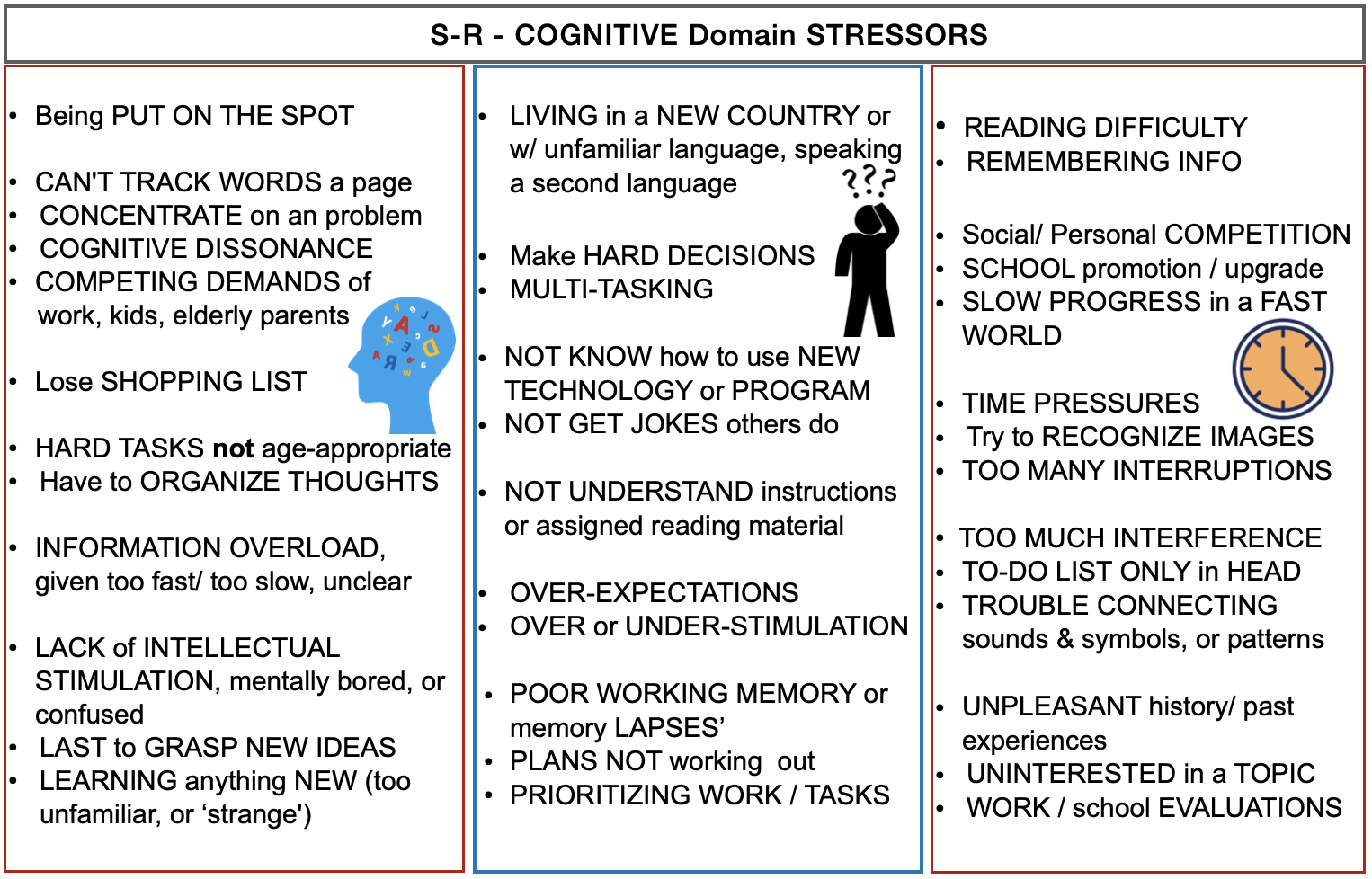
⚙️ The Cognitive domain includes the stress of processing various kinds of information, maintaining attention, dealing with time pressures, & the demands on our working memory.
Sustained concentration of any kind can take a high energy drain on a person’s autonomic nervous system (ANS). So someone uncomfortable for any reason in a learning situation will have to work harder to concentrate than someone who’s calm & alert. And problems self-regulating in any of the other domains can seriously limit their ability to focus on a mental task.
«
«
NEXT : Emotional Domain
 HEAL & GROW for ACoAs