

PREVIOUS : Executive Function, #2
SITE : Asking Questions
Self-REFLECTION
This is another characteristic of self-regulation which declutters the mind, helps us think clearly to make better decisions, admit our true motives & acknowledge our positive values. For some people, it’s a way to get acquainted with oneself. For others it’s more about keeping current.
It improves our relationships by developing empathy & understanding who others are – separate from us. It’s also a powerful tool for enriching our learning-ability by considering why & how we’ve learned something. (POST : “How the brain learns” 
It’s about :
★ monitoring what’s going on right now, to be aware of the nature & quality of events as they occur, & understand their meaning
★ taking the time to look over your day, both private & public – examining & pondering your thoughts & actions
★ and not only what you do, but why you do it, identifying strengths & weaknesses to improve future choices
It’s ABOUT
★ regularly examining your distressing thoughts, emotions & actions (T.E.A.) – maybe at a mental distance. If necessary, try talking to yourself about them in the third person, as an observer. This can make you more objective & lessen the temptation to sweep them under the rug or get depressed 
★ BEST of ALL – it’s an opportunity to recognize your growth, validate positive actions & remind yourself of personal strength & talents. Self-awareness is a skill, the foundation of emotional intelligence, self-leadership & mature adulthood.
1. GENERAL Qs to quietly wonder about, anytime :
🚶🏽♀️”How do I feel about myself?”
• Am I happy, kind, in love, anxious, frustrated, lonely….
🚶🏽♀️”What do I think about & know my personal qualities are?”
• DoI use my time well, am I organized, persevering, ambitious….
🚶🏽♀️ “How do I evaluate my life, overall?
• about my health, my energy, my relationships, my career…..
DOWN TIME
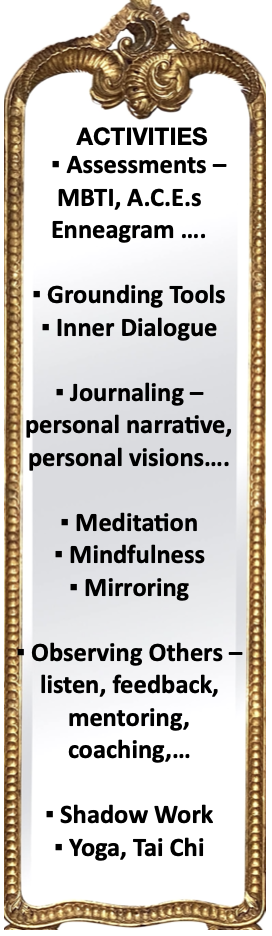
At least once a week set aside time for self-reflection (30 – 60 min), AND also take little ‘stolen’ moments throughout your day (5-10 min) to pay attention to your Inner Adult & Inner Children. 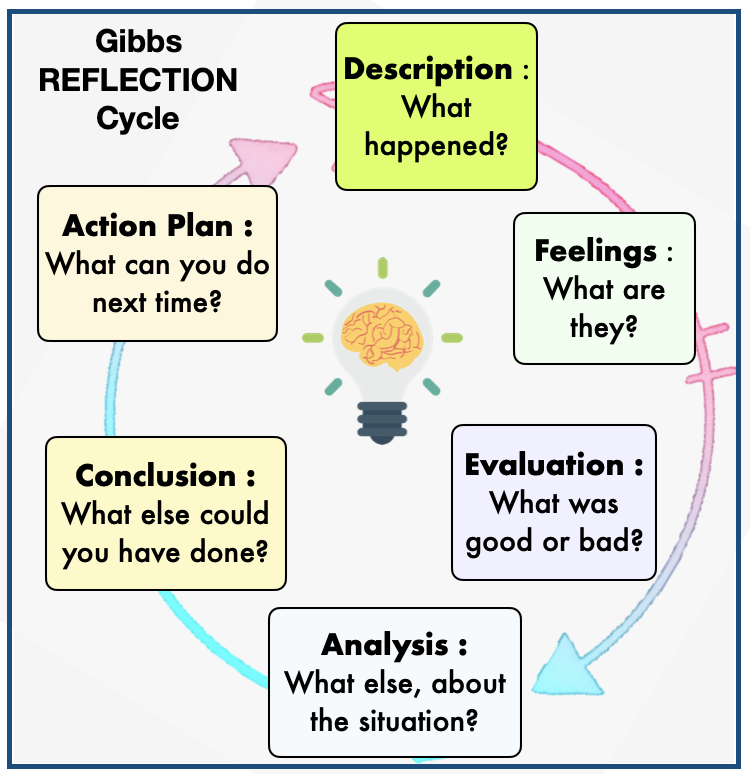
Give yourself the gift of quiet time to make a private space, but also know when to stop. Set a timer if it’ll help set a boundary – it’s important to not overdo (NOT as perfection or obsession). It should be a healthy activity you look forward to, that can be done daily, for a lifetime.
Find a quiet spot
It’s important to be in the right frame of mind, & the location set aside to be quiet, peaceful & comfortable, preferably a location you’re familiar with. But it can also be in a parked car, a bench in the park, a basement lounger….
2. Specific REFLECTIONS
Ask some Qs about a specific event in your day, or maybe about general experiences in your life. What’s the first thing that comes into your mind?
“What were the sensations in my body? What was I thinking? What were my emotions? Why did I act that way? ” (my T.E.As)
Ask What? Where? Who?
These 3 Qs are a great way to structure your thoughts. Looking back on a situation or event, consider:
 ✴︎”What did I do right? What would I have done differently?
✴︎Where did I choose to go? Where do I want to get to?
✴︎ Who am I ? Who do I want to become? “
Ask How?
If you’ve determined some areas you’d like to improve on, consider how to go about it : what are my options, what approaches are possible & what am I capable of ? What are the first steps toward making a positive change ?
Ask what did you Notice or Uncover?
Don’t be afraid to make notes about what came up, even quick one-liners when a lot’s going on. You won’t remember them later as you continue to your busy life!
Journaling your thoughts & & feelings is great when you have more time. It’s always enjoyable to look back on moments you’ve had with yourself, to see your progress & relive the benefits.
NEXT : Control vs. Regulation
 HEAL & GROW for ACoAs