

PREVIOUS : Self-regulation – Intro
THEORY
Self-regulation (S-R) has received a great deal of attention from psychology, education, neuroscience & athletics. Research began with Albert Bandura in the 70s-80s. Since then, many others have developed models of S-R, (with overlapping aspects), which expand our understanding of this concept.
The term refers to internal states & processes linked to the regulation of attention, emotions, impulses, stress, moods, stressors & thoughts.
1. Self-regulation theory (SRT) says that we expend conscious effort to control what we think, say & do, trying to be the person we want to be, both in specific situations & in the longer-term.
S-R is especially needed when there’s a conflict of motivations (to run from a fire OR help to rescue victims), & also relates to creating beneficial actions, such as studying for exams. To accomplish one’s goals, developing S-R requires evaluating & taking charge of one’s choices, by monitoring, directing & regulating behavior. 
Baumeister (2007) listed the main S-R components of goal-attainment-efforts in any area of life :
▫️ Standards = develop a model of desirable behavior
▫️ Motivation = the ability to meet those standards
▫️ Monitoring = keep track of events & thoughts that cause us to ignore or betray those standards
▫️ Willpower = internal strength to control self-defeating urges
S-R is intertwined with Motivation, which are our beliefs & attitudes that affect the development & use of various mental skills (cognitive & meta-cognitive). It’s deliberately choosing to act – avoid slacking off or procrastinating – so we complete tasks when there’s no real or immediate external consequence.
It’s one factor that determines how well we succeed. Whatever other qualities we may have, a strong capacity to be self-motivating is needed to promote our sense of purpose, competence & self-esteem. (HOW TO….Use these on yourself!)
SIMPLIFIED : ➡️ The Zimmerman S-R Model consists of 3 aspects, forming a cycle which can be repeated as many times 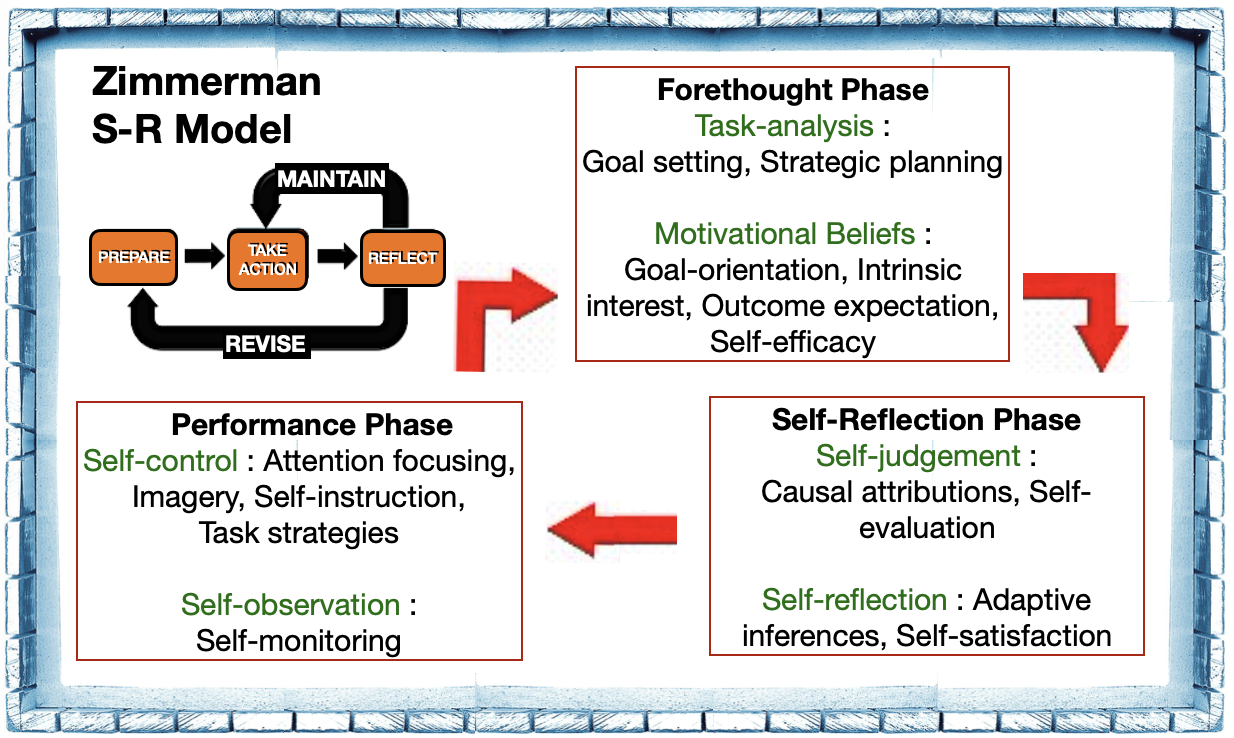 as needed until it becomes integrated & automatic :
‣Preparing, with forethought, what we want to do before we act
‣Taking Action, what we do during a task or event
‣Reflecting. reviewing what we did, after an action. This should determine how we prepare before a next attempt. (MORE…. about each one)
2. An integrative approach to S-R research called “Personality Systems Interactions (PSI) theory” analyzes personality architecture that underpins human motivation & S-R. It combines insights from cognitive science, motivation science, personality psychology & neurobiology into a single coherent framework used in self-management research.
➡️ Personality Development is listed from the simple (Level 1) to the complex (7), from biological TO the psychological, which progressively leads to more self-determination & personal freedom.
At the top, Self-management skills (7) are important self-protective factors, a human achievement which closely depends on the formation & healthy growth of the prefrontal cortex.
A basic assumption of PSI theory is that human motivation & personality are affected by a hierarchy of regulatory systems which act to maintain homeostasis. It includes:
a. Object recognition = organizing the visual world into meaningful perceptual units, which supports basic sensation. It specializes in detecting unexpected or incongruous things, from external & internal “objects of experience” (what seems to be present when having that experience).
b. Intuitive behavior control = activates the motor system not usually conscious, letting us dive in to the task at hand. It triggers automatic physical activities, like driving a car, housework, taking a walk, working out….
4. The Self-Regulatory Model
S-R model ↘️ of illness-activity shows the interplay between a person’s interpretation of a health threat, their coping strategies, and appraisal of the outcome of treatment – a useful summary of  the complex processes at work during S-R of any kind.
a. Stimuli are presented : something happens that provokes a reaction, (a thought, what someone said, receiving significant news….)
b. The person makes sense of the events, both emotionally (feeling it) & cognitively (understanding it)
c. The sense-making leads them to choose coping responses (what they do to manage their feelings about the stressor, & actions taken to address the event/ situation)
d. Sense-making [ (b) + Coping responses (c) ] determine the Outcomes (the person’s overall reaction & behavior)
e. The person then Evaluates their coping responses in light of these outcomes, deciding whether to continue using the same actions or change their approach. (MORE….)
«
NEXT : S-R & the BRAIN
 HEAL & GROW for ACoAs