
 PREVIOUS : Attachment & Food #2b
8 COMMON Eating Disorders
PICA — eating nonfood items with no nutritional value. Although it can be normal for children under age 2 to put various objects in their mouth, any similar activity after that represents a serious problem
RUMINATION disorder — repeatedly regurgitating recently eaten food, followed by spitting out, re-chewing, or swallowing it. These people do not have nausea, vomiting urges or food disgust – but it is linked with neglect, stress &/or lack of stimulation.
OTHERS:
(ARFID) Avoidant/restrictive food intake disorder
(BED) Binge eating disorder and Overeating ⬇️
(OSFED) Other specified feeding or eating disorders
(UFED) Unspecified feeding or eating disorders
Also in posts: Anorexia, Bulimia, Orthorexia
“SOCIAL MEDIA DIET“- 50 studies in 17 countries indicated that social media usage contributes to eating disorders with body image worry, & overall poor mental health affected by social comparisons, absorbing the thin / fit ideal as valid, & considering oneself as a ‘thing’ rather than a whole person. (Toxic world of Social Media Diet Culture“)
(“Balance your media diet”) and (Social Media Diet – for moderation)
♢ A study of 463 college students (Chongqing, China) looked at addiction to social networking sites (SNS), based on research evidence that emotion dysregulation plays a role in maintaining addictive behavior – such as eating disorders, problematic phone & internet use, gambling,…..
Results indicated that attachment anxiety correctly predicted SNS addiction & that poor emotion regulation mediates (affects) this connection.
SUB-Categories of EDs
♦︎ Asperger’s preferences – for starches & snack foods, & more frequent rejection of fruits & vegetables.
♦︎ Autism – autistic children are bothered by color – they like plain beige foods (pasta, chips…)
♦︎ Brumotactillo-phobia – fear of different foods touching each other
♦︎ Isolationism – eating one food item in its entirety before moving on to the next
♦︎ Mortuusequus-phobia : fear of tomato ketchup. (Australian slang meaning “dead horse”)
♦︎ Neophobia – reject or be reluctant to try new or unfamiliar foods
♦︎ Pseudodys-phagia – in its severe form, the irrational fear of swallowing. In its minor form, of choking.
♦︎ Sensory Food Autism – kids on the spectrum often express a strong preference for foods that feel a certain way in their mouth.
CO-OCCURING Disorders
As much as 80% of EDs are triggered, sustained by & intertwined with mental health conditions (EXP for Bulimia). A dual-diagnosis can worsen a person’s symptoms & complicate treatment.
✒︎ INFO from website “Eating Disorder HOPE“
A study with 2400 people found that 94% of those hospitalized for ED also had a mental health disorder, such as OCD/ Trichotillomania (pulling hair out), SAD, PTSD, ADHD, ….
☀︎ Major Depressive disorder (92%)
☀︎ Anxiety disorders (GAD) (48 – 81%)
☀︎ Borderline PD (up to 54%) . Self-injury (61%)
☀︎☀︎ Substance abuse – 50%, over 5x higher than in the general population
NOTE ***As of 2008, about 10 out of every 1,000 children experience neglect or abuse in the United States! It’s likely higher now because of covid (2020+)
Severe ED Medical Complications
☻ Mortality rates – conservative estimates : Anorexia = 4%, Bulimia = 3.9%. Others = 5.9%
☻ Diabulimia / ED-DMT1 – One of the most dangerous, when a person with type-1 diabetes intentionally skips their insulin dosage to lose weight. Restricting insulin as well as food can cause dizziness & fainting, slowness to heal from cuts & bruises, organ failure caused by diabetic ketoacidosis, strokes, various staph & other infections, and death.
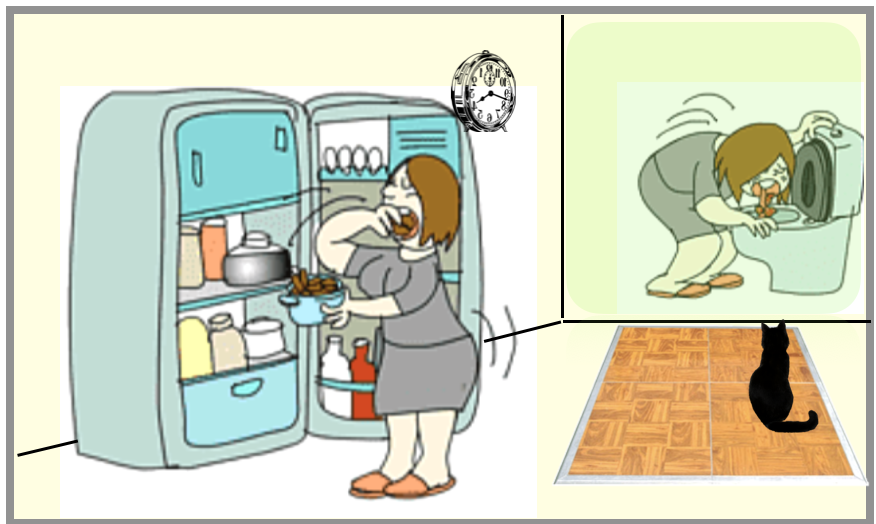 ☻ Purging – Withdrawal & Detox treatment from purging (self-induced vomiting, laxative &/or diuretic abuse) is physically harsh, & exposes internal damage : abdominal pain, constipation /irritable bowel, duodenal obstruction, edema, eye pain, gastroparesis, hypotension, liver problems, trouble swallowing….. (More….)
STATISTICS
☼ EDs have the 2nd highest mortality rate of any psychiatric disorder, after opioid misuse
☼ Most common : Binging & OSFED (Other….)
☼ Prevalence for the over 40 : Women = 3.5%, and Men = 1-2%, mostly untreated
☼ Men are just as vulnerable to ED as women : Anorexia, 25%, Binge 36% , Bbulimia 25%
☼ Rates have increased in all populations, but at a faster rate in male- lower socioeconomic- older patients
☼ Stressful life events can trigger an ED onset : relationship problems & breakups, death of a loved one, change of job, retirement, menopause…. especially if they pile up
☼ People of color have the same rate of ED, but are significantly less likely to receive help for it (MORE….)
☼ Rates of all EDs are generally higher in the LGBTQ+ community
☼ Older patients are more susceptible to complications, such as osteoporosis, arrhythmia, heart problems, gastro-paresis, depression, anxiety, & substance misuse (SUD).
SITE for many STATs = Categories 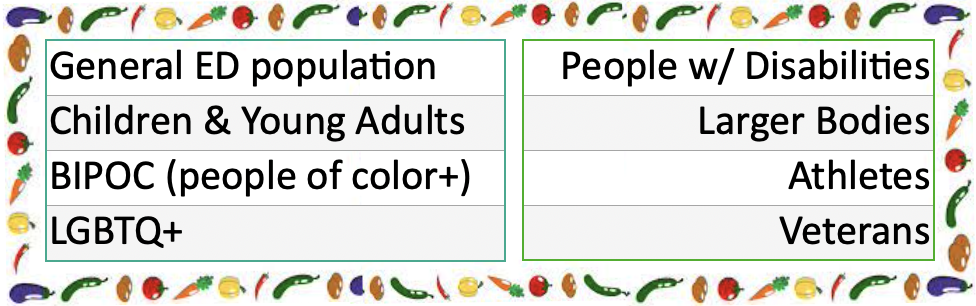 «
«
NEXT :
 HEAL & GROW for ACoAs