
 PREVIOUS : Attachment & Food #1
SITE: Prevalence of Eating Disorders in Adults, Co-morbidity with Other Mental Disorders (2001-2004 USA)
PERSONALITY & Eating Disorders (ED)
Character is defined as the sum of personality traits acquired through experience, including novelty seeking, harm avoidance, reward dependence, total persistence, & self-directedness.
 Scientists have found distinct personality traits in people with eating disorders & that they’re relatively specific to each disorder.
Some studies associated aspects of these traits with alterations in serotonin & dopamine signaling. There is also evidence that maladaptive personality traits of borderline, histrionic & schizotypal disorders precede the development of EDs.
The two strongest risk factors for ED are Neuroticism & Perfectionism (anorexia), based on the “Big Five”- Neuroticism, Extraversion, Openness (to experience), Agreeableness, & Conscientiousness. EXPs for some ED categories :
✒︎ sufferers score high on harm avoidance, impulsivity, obsessive-compulsiveness, reward dependence & sensation seeking
✒︎ combined with low self-direction, assertiveness, & cooperativeness.
✑ People with high scores for novelty-seeking were more likely to overeat or binge-eat, while
✑ a low value for novelty-seeking was linked with anorexia
✑ Low scores for persistence were associated with patients dropping out of cognitive behavior therapy CBT) inpatient treatment for ED, and
✑ bulimic patients, with high self-directedness scores, showed a rapid & sustained response to CBT.
 Personality type also matters for outcomes. Using the Big Five model, Fairburn et.al. showed that improvement is more likely when personality features are addressed along with ED symptoms. EXP :
♚ under-controlled / impulsive, & avoidant/ insecure (attachment) patients have a poorer prognosis, than
♚ high-functioning ED patients, who fare better than average. (MORE…)
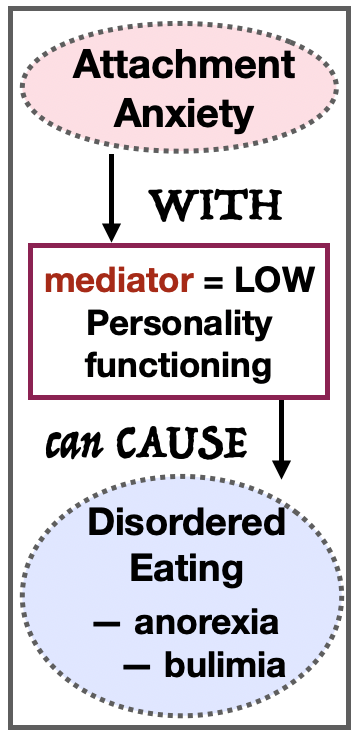
A review of 70 studies about ED identified 3 personality facets – Trust, Anxiety, Depression – that share the most variance (highly similar scores) with general psycho-pathology. ED symptoms are a result of combining :
♚ low🔻levels of personality functioning, with
♚ high🔺levels of insecure attachment (= 77% of the total study).
UNHEAlTHY Personality ADULTS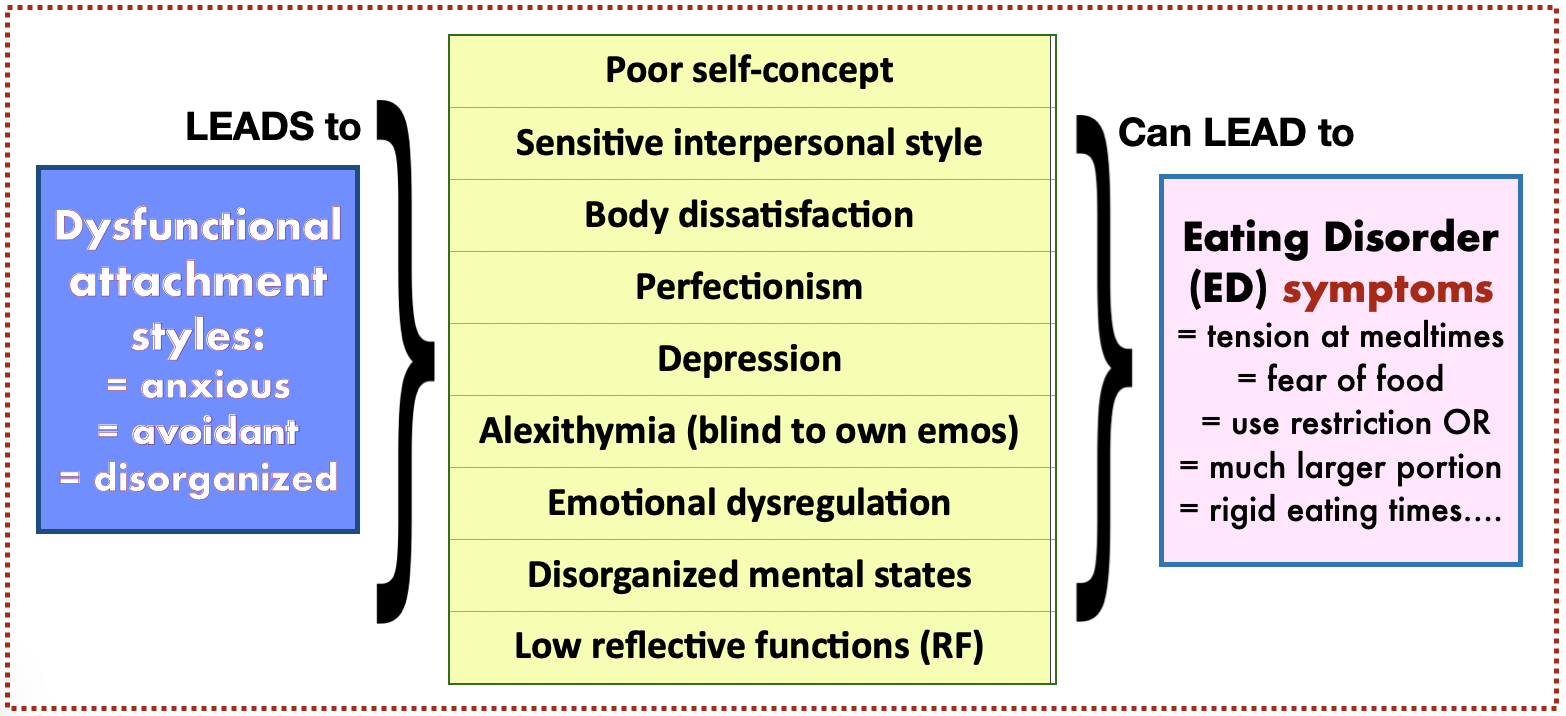
«
ADULTS
Until recently eating disorders were considered only an adolescent problem. Now there’s growing evidence that adults also suffer from untreated EDs, which threaten their health & well-being, because of:
✒︎ eating habits that result in the condition going undiagnosed & untreated
✒︎ being diagnosed as teens, & continue into adulthood
✒︎ being triggered by inter-personal or environmental stresses / trauma (divorce, death, choking incident, fat-shaming)
✒︎ peri-menopause hormonal shifts triggering an ED in some women. Social-media pressure to look younger/ thinner can be another factor.
EXP : Research noted that roughly 9.2% US adults with ED meet the criteria for ARFID (Avoidant/Restrictive Food Intake Disorder). It can affect them by limiting professional advancement, if they don’t attend company outings or entertain clients. Personally, they may find social & romantic events curtailed by a fear of being judged for their limited portions.
Recovery centers for adults focus on understanding & correcting the three subtypes : Sensory sensitivities, Fear of aversive consequences & Lack of interest.
Exercise Addiction
While not technically an EDs, compulsive exercise is commonly associated with them (anorexia & bulimia), harming a person’s physical & mental health. Especially when combined with disordered eating behaviors, excessive exercise can cause problems with the heart, bone density, bone & tendon injuries….
«
«
This behavior can interfere with a person’s social life, & career. Addicts will exercise in inappropriate situations & at inappropriate times, in bad weather, make it a requirement for “permission” to eat, & compulsively resume after an injury or illness before full recovery…..
(More …. ) ♥︎ Even if an eating disorder isn’t apparent, exercise addiction does require physical & emotional treatment.
SENIORS : If an older adult is suffering from an ED, it’s likely they’ve been plagued with the problem for decades. And sadly, since it’s gone on for so long, they’ve gotten used to the symptoms — the actions, thoughts, & feelings are simply a part of life. So, as things get worse, it’s less likely they’ll ask for help in their ‘golden’ years.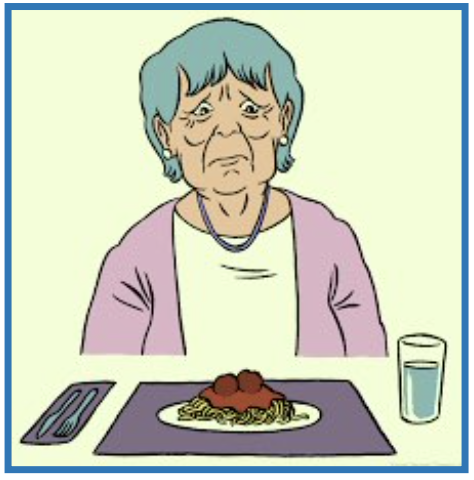
Because doctors & society still focus on treatment for adolescents & young adults, seniors are marginalized. And many signs are mistaken for other illnesses, or as a common part of aging.
Family members might also assume that malnutrition, diarrhea, vomiting, hair loss, reactions to prescription meds…. are a natural progression of aging, when these could very well be direct effects of a serious health disorder. (“Elder Eating Disorders“)
NEXT : Attachment & FOOD (#3)
 HEAL & GROW for ACoAs