Male vs Female BRAINS (Part 3)


PREVIOUS: M vs F Brains #5
SITE: “The Male Brain and Vision Work : Demystifying the Divinely Devised Differences”
✓ Extensive INFO ➡️

NOTE: Articles / books have also been written to dispel the idea of M/F differences. One such from the UK is : “Sex and the brain: fruitless research?

REVIEW: In spite of the endless variations in human behavior in both males & females, modern brain-scan research shows broad tendency differences. 

COMBINED INFO (cont.)

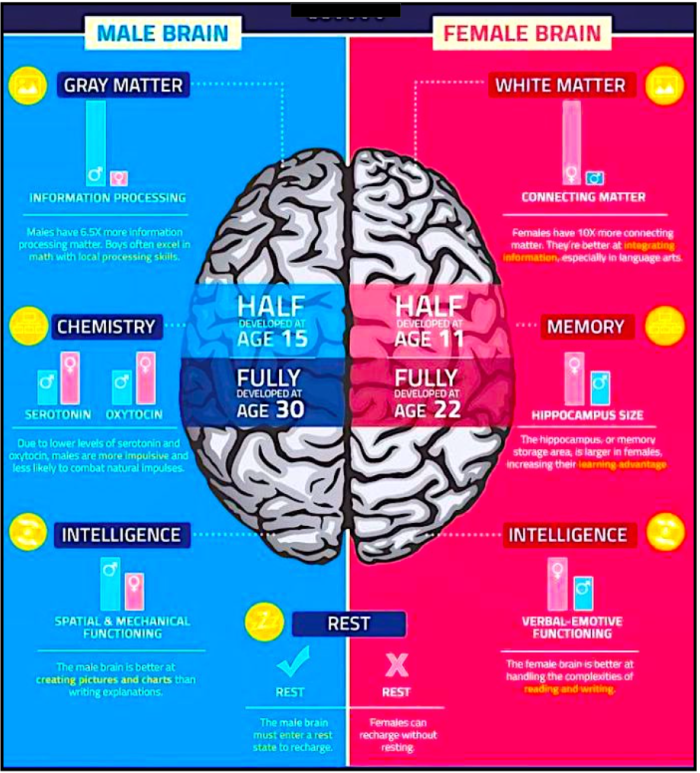
GREY & WHITE MATTER
Research  
suggests that anatomical differences between Ms & Fs exist independently of brain size effects. Both genders have both W & G matter, but in different proportions.

Grey
matter (GM) makes up the information & action-processing centers of the brain, localized in specific splotches, in specific areas, ‘encouraging’ a kind of tunnel vision
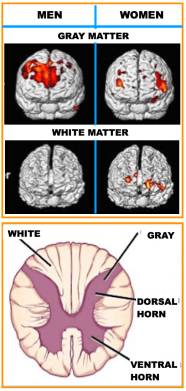
M: slightly higher % of grey matter, (computational tissue) in most parts of the cerebrum, the left caudate (communication) & hippocampus (memory)

For task-focused projects – Ms use nearly 7x more gray matter than Fs
EXP: When deeply engaged in a task or game, they can ignore people & surroundings
——-
White matter (WM) is the networking grid connecting  GM with other processing centers, so Fs can transition between tasks more quickly

F: slightly higher % of white matter, (connective cables), containing myelinated axonal fibers, & cerebro-spinal fluid
For multi-tasking – Fs use nearly 10x more white matter than Ms

SEROTONIN / DOPAMINE diff (Serotonin)
M: their Serotonin levels are usually higher (than Fs), making them less susceptible to depression – but not immune.

They also have more Dopamine (levels can be raised by oneself, from activities), the hormone of competition, risk-taking & motivation – “Go, kill Wooly Mammoth”.
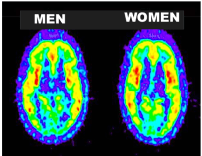
★ When men over-compete & over-push themselves, they deplete Dopamine, making them feel grumpy & in the ‘grey zone’. They may try to replenish it by high-risk activities such as driving fast cars, bikes & planes, or affairs, drugs …..

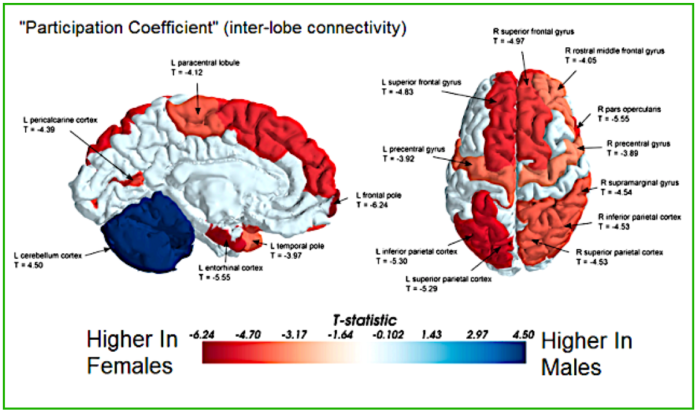
F: they have more ‘common’ receptors for Serotonin, (than Ms), but less of the protein needed to transport the chemical back into the nerve cells that secreted it (recycle). This may explain why they respond better to serotonin re-uptake inhibitor antidepressants (SSRIs) . CHART ⬇️ However, the serotonin system in healthy women differs from those with serious pre-menstrual mental symptoms.
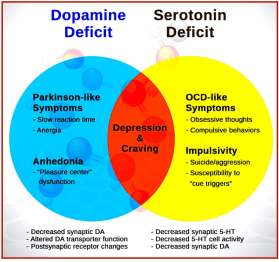
★ Long-term over-focus on caring for others & worry inevitably depletes Serotonin, leading to depression, being weepy, sad & obsessed.  (MORE…. )

IMP: Serotonin levels can not be raised by oneself.  It has to be elevated by positive feedback from the environment. This is important because Serotonin levels INcrease Dopamine levels (motivation).

IMPULSE CONTOL
There’s increasing clinical interesting impulse-control factors because it’s associated with conditions such as delinquency, antisocial behavior, suicide attempts, aggression & criminal activity.

F:  Brain areas that control aggression & anger are larger in women than in men, & they retain stronger & more vivid memories for emotional events. They’re also more resistance to psychiatric disorders because of their ability to control impulsive behavior (prefrontal cortex is more active, so they plan more thoroughly & carefully before taking action). In reward-studies, they were consistently more punishment-sensitive, &  better able to delay gratification, compared to Ms.

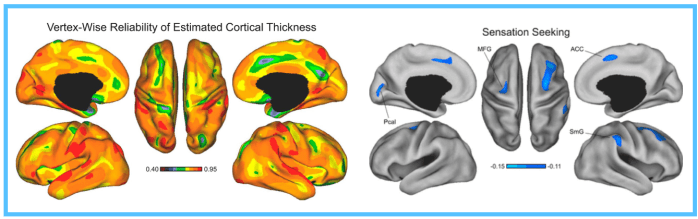
M: There’s evidence the serotonin (5-HT) system is more involved in male  impulsivity than in Fs. A questionnaire & a behavioral risk-taking task showed men being significantly greater sensation-seekers.
Impulsiveness is seen most graphically on the road (driving recklessly or when drunk, less likely to use seat-belts….). In reward-studies, Ms preferred a smaller immediate payment rather than a larger delayed one, & did not show greater reward-sensitivity.

😈 Another study correlated Impulsivity with cortical thickness, the area needed for self-control. The thinner the tissue in  the ‘front’ brain, the greater the sensation seeking. (More…. w/ images ▼)
NEXT: M/F brain #7

Female vs Male BRAINS (Part 2)


PREVIOUS: M vs F brain (#1)

SITE: Questionnaire (64 Qs) –“Kind Of Brain – M or F? ”

Combined RESULTS

NO Differences?  : Researchers at the U of Tel-Aviv categorized brain structures into M or F zones, & one common to both – a mosaic – focusing on traits that showed the biggest gender disparity.
They noted that extremes are rare – only 6% of the subjects were more M or more F, based on analyses of several sets of data. Overall, results show that human brains don’t usually belong to just one type or the other, even though specific parts do show gender differences. (More….)

Many recent imaging techniques, such as studies at the U of Penn, confirm that Ms & Fs are indeed “hard-wired” differently. Scientists have discovered almost 100 variances, so this reality can not be over-stated.

HEMISPHERES
While all parts interact, each has a main focus. In general:
▪︎ FRONT part of brain handles action
▪︎ BACK deals with perception (aware of something via the senses)
▪︎ RIGHT provides intuitive thinking
▪︎ LEFT provides logical thinking

Brain CONNECTIVITY

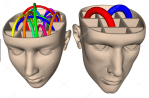
Male: Typical connections are between front & back areas, mainly confined to each hemisphere separately (blue). This is why men tend get irritated when having to do several things at the same time.

Exception: The only region they showed L-R connections was in the cerebellum, which governs muscle movement, providing good motor control.
So – males are wired more for perception & co-ordinated actions, while…..

Female: ….. processes are mainly back & forth across the meridian (corpus collosum) between the L & R sides (red)
So – females are wired for social skills, memory, & being more emotionally involved.

▪︎ Because L brain is logical & R is intuitive, Fs are hardwired for multi-tasking. Since they use both sides – when an activity requires both abilities they can more quickly transition between activities

And older Fs showed more widely distributed connections throughout the brain, rather than just in the frontal lobe.

NOTE: M & F fetuses start showing brain differences at around 26 weeks – when Fs usually start developing a thicker corpus callosum, which may explain why women tend to use both hemispheres.

RESTING BRAIN
IMP
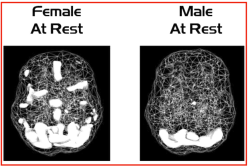
: Research (Slovenia, 2000) on 300 volunteers using EEG & hemodynamic principles, was based on resting eyes, ie. closed brain activity.

Results showed Ms & Fs differ significantly in the default mode, a complex pattern suggesting that variations in their behavior might come from the activity of the resting brain. (⬇️ Images from Amen Clinic)

Each person’s brain is an intricate & unique system of neural pathways connecting multiple networks in the cerebrum to several sub-networks in the cerebellum. The mysterious, powerful cerebellum is only 10% of brain volume, but houses over 50% of our brain’s total neurons (brain cells).

The Gurs’ studies on the resting brain found
— M activity occurred more in the amygdala, primed to react physically
— Fs’ comes from the cingulate gyrus, in the limbic emotional system, primed to react verbally

Brain SIZE
M – Typically, M brains are 11-12% bigger than women – (average weight = 3lbs) & have more volume in 14 sub-cortical regions – relative to overall brain size. This makes sense, since generally the M body is 10% larger, so it needs more neurons to control its greater bulk & muscle mass.
Also, volume & cortical thickness among Ms tended to vary much more than among Fs.  INTERESTING: With age, the M brain shrinks faster 

– Although women’s brains are 10% smaller than men’s, they use their brain more efficiently. And they have higher brain volumes than men in 10 sub-cortical regions. Average weight = 2.75lbs

CORTEX – the executive-function system
F: It’s significantly thicker & slightly more convoluted (more area), Neurons are more densely crowded on layers responsible for signals coming in & out. The prefrontal cortex is larger & matures faster in women, with fewer but larger neuronal units.

M: Their brains have more numerous but smaller neuronal units.
Larger: the parietal cortex (space perception) & the amygdala (sex)

IMAGE from another U of Penn study, ⬆️ which shows pronounced differences between the sexes during various activities, most obvious at ages 12-14.

NEXT: M vs F #3

Male vs Female BRAINS (Part 1)

PREVIOUS:
MBTI 4 functions-ENFP / ENFJ

SITE: Anatomy of the Brain


DIFFERENCES

Many ACoAs don’t know or understand that males & females really do think / act differently in certain ways – & not just because of social conditioning. Missing this awareness causes a great deal of confusion & frustration in personal, social & business relationships.

Many studies have looked at what happens in the M vs F brain when we act or think about things. While there are all kinds of variations among each gender, & that our early years (with family, religion & culture) does have a profound effect, we start with differences in bio-chemicals (estrogen vs testosterone) & brain wiring.

EXP: When Cher’s ‘daughter’ had his sex change & added testosterone to the hormonal mix, at first Chaz became more argumentative (& assertive), compared to how he had treated his long-term mate until then. (‘Becoming Chaz‘)

✴︎ Research tells us that some social stereotypes are based on actual biology – BUT have nothing to do with over-all intelligence! – only skills, tendencies & preference.
“Every individual can have both M & F characteristics”, but scientists don’t yet know how much each person has of M or F-like patterns of brain connectivity.
And study results do not apply to individuals but rather to the 2 genders as a whole. Broad indicators can be compared to the biological differences between Introverts & Extrovert.

Other M / F differences relate to:
1. Personality TYPES  // 2. Family ROLES  // 3. Birth ORDER // 4. LEARNING Preferences  …..

NOTE: Since variations in human behavior are dealt with in other posts, this series focuses mainly on physical structures.
SEE: 20  M/F Differences, Backed by Science” 

Some BRAIN MAPPING studies 
• One study at the U of Penn used diffusion-tensor-imaging (DTI) of water molecules in the brain’s white matter, made up of axons – the “wires” that connect neurons. ➡️ Tractographic images of neural connections via DTI

They scanned nearly 1,000 young people (ages 8-22),  mapping neural circuitry, showing all the signals that travel like busy road traffic (connectivity) – focused on the 4 hemispheres, (2 cerebrum & 2 cerebellum)

•  Psychologist Stuart Ritchie’s research at the U of Edinburgh, MRI-scanned over 5,000 men & women (ages 44-77), drawn from 500,000 participants in the UK Biobank‘s long-term bio-med study. The volume of 68 specific areas were examined, including the thickness of the cerebral cortex (wrinkly outer layer important in consciousness, language, memory, perception…..), white matter, resting state connectivity & cognitive testing.

▪︎ Ruigrok et.al. in Germany, studied 2,186 MRI scans (age range 21–90) for sex differences in grey matter (GM) volume, in many parts of the brain. Neither age nor longer education affected their conclusion – that size & quantity of GM was located in different part of the F & M brains.

• Research at Madrid’s Consejo Superior in Madrid looked at the cortex with stereo-logical correlative light & electron microscopy, searching for which structures may underpin M vs F variations in cognitive function (thinking). Differences were found in the density of synapses, which are the junctions between neurons that allow cells to communicate with each other

• A 2013 researchers from UCLA and Universidad Autónoma de Madrid used 3D high-resolution structural brain MRI scans of automated segmentation of the hippocampus. 104 healthy participants (ages 18-27) took a series of IQ tests measuring abstract, verbal & spatial intelligence, along with working memory, executive control, attention & processing speed

• Looking for gender differences re. the prevalence, age of onset, & symptomatology of many neuro-psychiatric conditions, Amber Ruigrok, et.al, at the U of Cambridge in the UK looked at overall brain volume & density, in 6 age-categories (18-59) – of the amygdala, hippocampus, & insula – areas implicated in sex-biased mental illnesses

Male & female brains differ right down to the genetic level. Every male cell  contains a Y chromosome, while F brains usually do not.  😾

M & F brains process the same neuro-chemicals, but in different degrees :
▪︎ serotonin – which, among other things, helps us sit still
(Ms are less inclined that Fs)
▪︎ testosterone – the sex & aggression chemical
(Ms tend to be more physically impulsive & aggressive) 
▪︎ estrogen – a F growth & reproductive chemical
▪︎ oxytocin – a bonding-relationship chemical……
(Ms process less of it)
▪︎ glucose – for thinking, memory & learning
(
Fs ‘burn’ more glucose, so their brains heat up more)

NEXT: M-F brains #2

MBTI – False Stereotypes of NFs

PREVIOUS: NTs Misjudged

CARTOONS from Personality Central

INFP – Overly emotional snowflakes who can’t deal with facts or hard logic

Reality: INFPs are intensely imaginative & passionate, & definitely prefer emotion over logic. But they’re not as fragile as they seem, more than capable of getting things done when needed. While some can wander off into a world of imagination & they loose touch with their own realistic needs, healthy INFPs have a good balance between imagination & determination. They can fulfill ‘”pipe dream” when they believe in themselves.

They can be incredibly resourceful & organized, & will go to any lengths in pursuit of what they believe is right. As highly thoughtful types INFPs are quite focused, often mistype as Js. They have a strong sense of internal morals, & will stand up for their values. Being so clearly aware of their emotions makes them quite capable of handling them – unlike some types who favor logic & are often afraid of their feelings.

ENFP – Over-excitable social butterflies who never stop spewing out about their feelings

Reality: ENFPs’ are the quintessential “idea people”, their (Ne-Dom xx Te-Inf) making them much more comfortable posing questions & debating ideas than talking about their emotions. Although they’re extroverts, they’re actually very introspective, often needing more time alone than other Es, sometimes causing them to assume they’re introverts!

Even though they are in touch with their own emotions, more than anything they enjoy the ability to learn about, explore  & process new ideas & possibilities. Naturally adventurous & innovative, they don’t like doing things ‘by the book’, & may turn down a risk-free lifestyle in favor of new experiences & challenges. They need to follow their inspiration to have a fulfilled life.


INFJ
INFJs can be consumed by an inner vision for their lives. Carl Jung said of their DOM- Ni, that it “moves from image to image, chasing after every possibility in the teeming womb of the unconscious”.
While their dreams & insight should not be stifled, they also need to use their AUX-Fe for balance, by engaging with the outer world

Stereotype #1 :  Psychic & therefore impossible to understand – the rare snowflakes wildly unlike any other type

Reality: Though they’re statistically the rarest type, they’re not the most creative or most individualistic (like INFPs are on both counts).
Since INFJs have (Fe) as AUX, they are very in tune with social norms, & value fitting in with a group over expressing their individuality. And, even though their Function Stack is uncommon, they’re not the misunderstood artists of the world (like INFPs or ISFPs).
INFJs also have powerful intuition, which helps them cmake assumptions about the future, but they’re not psychic. They ‘unconsciously’ collect facts, & then form predictions, which they can’t explain.

Stereotype #2: Natural counselors of the world who want nothing more than to care for & nurture others

Reality: They certainly do care for others, but INFJs can often come off as cold – if you don’t know them well. Although unique & rare, they’re very sensitive to other people’s emotions, which makes them easy to connect with if someone actually makes the effort.
They lead with (Ni- Dom), so they’re much more interested in analyzing big-picture problems than in helping others sort out relationship issues. While they can be empathetic to a fault, they’d rather be evaluating than sympathizing.

ENFJ – Overbearing, emotionally invasive, & never stops probing others about their feelings

Reality: ENFJs are known for their enthusiasm, empathy & outgoing nature (Fe-DOM). They crave harmony in their environment, wanting to make people happy, to feel welcome & understood.  Healthy ENFJs are usually generous with their time, good listeners, inspirational teachers & loyal friends. However, they can get so absorbed in the needs & emotions of others that they may lose sight of their own.

Extremely caring, they’re highly aware of how their actions affect others. But they’re also quite skilled at setting boundaries & respecting the privacy of others. If they push too far or ask highly personal questions, it’s not exploitation – it’s because they can sense something’s bothering you. If you try not to be defensive you may understand that you need their probing. They genuinely want to help resolve a problem & need more info from you in order to do so.

REFERENCES:  infjediHeidi Priebe & Psychology Junkie  ➡️ (+ more links)

NEXT: Male vs Feel brains #1

MBTI – False Stereotypes of NTs

  PREVIOUS: SFs Misjudged

CARTOONS from Personality Central

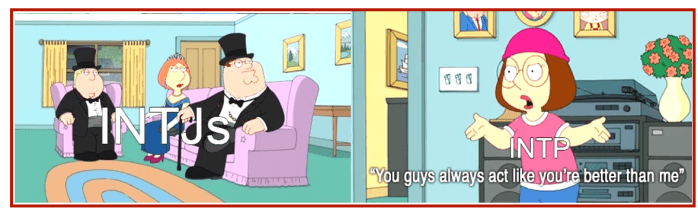
✥ INTP – Emotionless, socially awkward robots

Reality: INTPs favor objective honesty, so can unwittingly offend, not realizing their delivery is too direct & detached. This upsets the INTP because they actually do care about people, & would rather avoid conflict or hurting someone’s feelings. But – since they express caring by being very honest, if they’re ‘sugarcoating’ something, it’s probably a sign they don’t respect you. INTPs are incredibly deep thinkers, & just as capable of deep emotions as anyone, they just aren’t likely to express their feelings.

Also, INTPs re not normally socially awkward & are quite aware of how others see the.  In spite of being definite introverts, they’re perfectly able to use their extroverted intuition (Ne) to interact with the world. If they avoid it it’s usually because they don’t want to, not because they’re afraid or unskilled. Enjoying being social is not the same as being capable of it. In fact they often have strong emotional ties, & can be very warm with those they care about, with a deep connection to things that make them nostalgic.

✥ ENTP – Lazy, arrogant jerks, don’t finish things & can’t commit to anything

Reality: Although ENTPs are very confident, it’s often expressed in the form of humor, so others feel comfortable, & are very warm with loved ones. Under the bravado, they care about being liked, but also enjoy being the center of attention.

ENTPs do FLIT quickly between ideas, because they naturally see a thousand alternate angles to any statement. Their (Ne) wants to explore every perspective & find an idea’s core truth (Ti). It may seem to others that the ENTP is arguing just for the sake of it, but they’re not trying to be difficult or offend – it’s just a deep need to make sure every ideas / rule stands up to scrutiny.

They’re not always interested in following through on their ideas, but are highly motivated to achieve. Because they see so many different possibilities they can execute the best possible path to a goal, with impressive follow-through when setting their mind to something. 


✥ INTJ
– Logical robots, narcissistic know-it-alls who think everyone else is their intellectual inferior

Reality: Yes, INTJs are definitely aware of their own intelligence – but they’re also radically open-minded – so they’ll listen to another’s point of view, even if they don’t automatically agree with it. Wanting to understand the world, they constantly take in new information, deciding how each piece fits into the puzzle their mind is assembling. Intensely strategic & visionary, they favor rational thought over their own emotions, & confused by people who do the opposite. They’re boldly honest & put off by social niceties that get in the way of the truth.

They’re also capable of caring about & connecting with people, & feel like they’re helping when teaching what they know. While they prefer logic, they do have feelings – which they can be in touch with – they just prefer to ignore them. A with INTPs, INTJs are honest & direct with people they care about, & because they consider it an insult to have messages “sugarcoated” for them, they refuse to do this for others.

✥ ENTJ – Emotionless monsters who will betray or squash anyone on their way to the top

Reality: ENTJs are usually extremely driven, competitive & confident. Though they certainly are alpha dogs, they take social relationships very seriously, & never want to tarnish their good name by going against their word. They’re at ease in power positions, but not good at understanding others’ emotions – impatient with feelings, extraneous details & anyone contradicting their plans. This can intimidate many people, especially anyone more soft-spoken & gentle.

Confidence & Superiority are not the same thing. ENTJs are very concerned with how others see them, not wanting to be thought of as cold.  While skilled at controlling a group, they’re also willing to understand other’s ideas & views – as long as they’re not clouded by emotions or too many details that get in the way of the big picture.
Surprising to many, they can stick up for the underdog, & often go to great lengths to ensure they treat everyone ‘fair & square’, strongly defending those they care about. If an ENTJ is told they’re being harsh & insensitive, they’ll try hard to adjust their behavior.

REFERENCES:  infjediHeidi Priebe & Psychology Junkie  ➡️ (+ more links)

NEXT: NFs misjudged

MBTI – False Stereotypes of SFs


PREVIOUS: Misjudged STs

CARTOONS from Personality Central

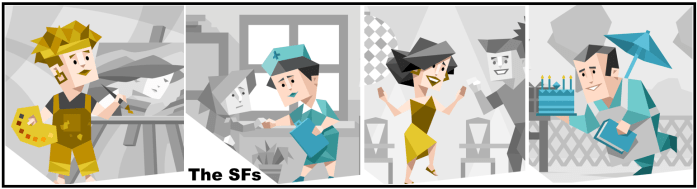
🧩 Each type is given a range of labels – but some fit better than others. And each has its share of annoying stereotypes. Some are legitimate, but most are entirely false

ISFP – Painfully shy airheads, superficial & flakey

Reality: ISFPs lead with a process called Introverted Feeling (Fi), so they tend to hold their emotions close & their values closer. They’re easily affected by injustice & harsh words, & cry more easily than other types, much to their own dismay.  Psychologist Paul D. Tieger notes that ISFPs are “highly sensitive & loving… feeling everything personally & deeply.” This makes them passionate about the welfare of troubled & struggling people or animals, but can be misconstrued as weakness.

Highly observant & highly analytical – they’re even apt to confuse themselves with Intuitives. ISFPs are extremely introspective, & of all the Sensor types, may be the most intuitive & spiritual. Being observant of their surroundings & often very intelligent, they live so much in their head that others can easily miss how insightful they really are.
Though they may always seem to be off in la-la land, their mind is always reeling – constantly processing what’s going on around them & what it all means at deeper levels.

ESFP – Shallow, self-absorbed party animals only interested in a good time

Reality: Called ‘The Entertainer’, ESFP enjoy making people laugh, with a natural enthusiasm & charisma that draws people in – but can make some people jealous of their charm & outgoing good-humor. While some ESFPs do really crave attention, many  see opportunities for fun & excitement everywhere, & don’t want anyone to miss out.
Just because they live in the moment doesn’t mean they miss what is going on around them. They can care very deeply for their loved ones, & will go to great lengths to make them happy.

Some ENFPs are actually on the quiet side, who’d rather be in the background. Most are incredibly emotionally intelligent – very aware of their own feelings, can dissect other people’s motives & desires with incredible accuracy, AND use that info effectively. They can pick up on things others may miss – because they’re missing the outside function of Perception (Ne).


ISFJ – Uptight, neurotic motherly type, desperate to grab a partner & have a family as fast as possible

Reality: ISFJs are very uncomfortable with uncertainty, so always want to know what to expect. They avoiding risks, keep their life in order, & are very protective of loved ones. This can make the average observer tell them to ‘loosen up & enjoy today”, which is not helpful.

Though ISFJs do tend to make excellent parents, they’re are not all eager to jump into a family, & many take their time to get there. Their first function is a perceptive one (Si), which means their feelings come second to their interests. Above all else they want to keep the peace while maintaining traditions. They want a warm environment, and are willing to bend to accomplish that

Because they aren’t dominant judgers (J-DOM), as a rule this type isn’t neurotic. On the contrary, they’re more often type B personalities – they’re more interested in harmony than getting exactly what they want.

ESFJ – Shallow, petty gossip hounds, only caring about the latest dirt

Reality: ESFJs lead with extroverted feeling (Fe), usually warm & compassionate, they’re strongly driven by a desire to make others happy. Very sensitive to praise & criticism, they’re “anxious to conform to all legitimate expectations”.

Even though they do have values of their own, they look outside of themselves for matching feelings of morale & acceptance, & mirror the values of those around them. So they’re more likely to be a product of their environment than other types.
EXP: If education, analytical analysis or personal growth were highly valued in their upbringing, they would take on any of those values with a passion.

ESFJs are only as petty as the people around them – their natural first instinct is to be supportive & inclusive to a fault. They care about others, & very much want to please, actually making them one of the least shallow types.

REFERENCES:  infjediHeidi Priebe & Psychology Junkie  ➡️ (+ more links)

NEXT: Misjudged NTs – Part 2