Pyramid Uses: BELIEFS

PREVIOUS:

SITE: Word Definitions (Christian)

CHRISTIAN Transcendence
Both Christianity & Psychology are concerned with answering Qs & discovering As about human actions & functions of the mind, to benefit individuals & society.

There’s truth in Maslow’s theory, which is why it’s been so widely adopted in Western education & business practices.  However, critically thinking Christians understands that his hierarchy ignores our animal instinct is not always noble or good, & that humanity cannot transcend those base reactions without divine help & inspiration.
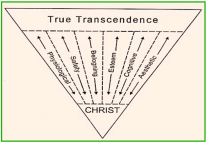
A truly Christian understanding of human transcendence contradicts Maslow, the humanist, who said that man provides for his own needs – or fails to grow.
Instead – in Luke 12:7 – Christ is saying: “Let everything rest on me. Let our relationship be your balancing point. Let me transcend your hierarchy of needs into something glorious.”  (More…. article #3) and (More….)

SPIRITUAL FOOD
In I Timothy 1:1-19 the Apostle Paul tells us that Sound Doctrine (the Scriptures) is Healthy instruction (teaching).  Heb 5:14 says that “…. But solid food is for adults, that is, for those who through constant practice have their spiritual faculties carefully trained to distinguish good from evil.”

The New Testament prescribes a healthy diet of spiritual food made up of:
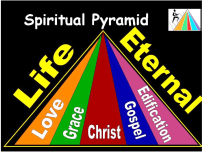
CHRIST – as our center – “For to me to live is Christ.” Phil. 1:21
LOVE – “….that ye love one another, as I have loved you.” John 15:13
GRACE – “the grace of our Lord was poured out on me abundantly, I Tim 1:14 ….He hath given us everlasting consolation & good hope by grace …” 2 Thess 2:16
GOSPEL – “the gospel of your salvation, having also believed, you were sealed in Him with the Holy Spirit of promise” Ephe. 1:13
EDIFICATION (encourage & instruct Truth) “Therefore encourage one another & build up one another…” I Thess 5:11.
“All Scripture is inspired by God & profitable for teaching, for reproof, for correction, for training in righteousness” 2 Tim 3:16
(Pyramid)

DISAPPOINTMENTS
Life can be full of disappointments – from people, circumstances …..  which come from our expectations not being met. Then some of us cry out “Why, God, is this happening to me?”
If we make the decision to let disappointment fester, we’ll feel discouraged. If unchecked, it becomes disillusion. The wedge is driven deeper, proceeding to depression… and ultimately we end up defeated.

This is one of the ways the Evil One uses our human weaknesses to :
a. take things personally (very little is about us!!)
b. keep us from taking responsibility for our own actions & desires
c. keep us from believing that “All things work together for good to them that love God, to them who are the called according to his purpose.” Rom 8:28

When faced with life’s disappointments, we can choose to focus on them, or on our God. We can choose to be thankful…for something…anything! which turns our attention from our ourselves, no matter what we’re going through. A heart of gratitude will change our attitude! (Pyramid)
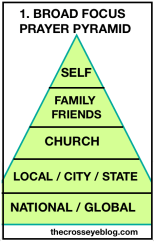
 
PRAYER
1. BROAD – We can use this pyramid to make lists of People, Places & Situations to pray for every day – from the bottom up.
Then the next chart deals with one’s personal self-issues.
2. NARROW
The 6 parts of the Lord’s Prayer:
a. We benefit by accepting God as our Savior, but this is never forced on anyone
b. Trusting God is not easy – it means giving up control & relying on HP instead of self or other humans
c. God knows what we need, but having free will, we need to decide what we want, & then ask
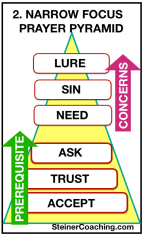
d. We need food for the body & the soul, but it’s God who provides a sense of deep peace, whether in good times or bad
e. We’re not perfect, & cannot undo our sin nature or sinful behavior – which must be acknowledged to lose their sting
f. When wants define our lives instead of needs, we’re subject to jealousy, greed, & selfishness. The good news is that God will fight for our soul even when we go astray (MORE….)

NEXT: Beliefs #2

Pyramid Uses: SPORTS


PREVIOUS: Work / Biz


PHYSICAL ACTIVITY
U.S. Department of Health and Human Services (USDHHS) recommendations for young people:  at least 60 minutes of physical activity each day.
1. Base: MODERATE
2. Vigorous aerobics = daily, min 30-60 min (brisk walking…)
3. Vigorous sports / rec. = 3+ days pr wk, min 20 min (reach target heart rate)
4. Muscle fitness exercises = 2-3 days pr wk, 8-12 reps, 2-4 sets major muscles, muscle overload
5. Flexibility exercises – 3+ days pr wk, 10-20 sec., 2-4 reps, major muscles, stretch overload (More….

SPORTS PSYCHOLOGY

What’s the motivation?
⬅️ Pyramid indicates – from weakest to best personal values.

😾 Some negative (selfish) reasons for playing are:
▪︎ contempt in our society – easier to scoff, to put others down – than to function from enthusiasm or passion
▪︎ power shift from the team to the individual. –  big name companies no longer back teams, they back specific players
▪︎ parents made their kids ‘god’ – depending for their entire happiness, hope & purpose on the child’s accomplishments
▪︎ a generation who think they’re better than they really are. There’s a difference between honest goal setting & positive thinking vs. reality – what’s physically & psychologically possible (More….)

➡️ The Sport Pyramid shows the key contributors to individual & team sports performance – 5 psychological factors most directly impacting it, which either enhance or interfere with the outcome. To be one’s best sports Self, the goal is to understand ones relationship to each factor, developing strategies & actions to minimize or alleviate psychological weaknesses, & building psychological strengths. (MORE….)

BASKETBALL SKILLS
Most players & teams rush to the top (competition), without a proper foundation. REQUIREMENTS:
1Motivation–an intrinsic desire to play and improve
2Footwork–creating space and separation
3Ball Handling–control and protection of the ball
4Vision–the single most important skill.
5Communication–talking and listening effectively
6. Awareness–on Offense and Defense, move with a purpose
7.  Shooting—consistent form, soft touch
8Mental Strength–resilience, confidence, coach-ability
9Conditioning–physical preparation and fitness
10Competition–winning or having a chance to win

CYCLING
1. Distance. Realized everything is close by, easily accessible by bike or some combination with public transport
2. Directness. It becomes clear everything is more direct by bike – such as the city’s designated route for bicycles & pedestrians

3. Safety
. It is absolutely safe to go anywhere by bike, including social & traffic. Over time, trust in the city’s safely comes with experience
4. Comfort. Most bike routes are reasonably comfortable – which routes have the least traffic lights, smoothest asphalt, lowest traffic noise, flatness….
5. Pleasurability. Consider which routes are most pleasurable. Some routes wind through a park, others have the smell of fresh coffee, on others one can hear children laughing on their way home from school….

EFFECTS of TRAINING
Levels 1 – 3 :
Volume of training, High Intensity & Intensity Distribution = Effects are well established
4.
 General periodization details (annual)  = Unclear, but likely over-rated
5.
Sports-specific & micro-periodization schemes = Not established, but likely modest
6. Training stimuli enhancement (heat, attitude, energy….) = Potentially important effects, but individual & condition specific
7. Pacing training = Potentially decisive if everything else is done right
8. Training taper = Potentially decisive in an isolated competition, if everything else is done right (More….

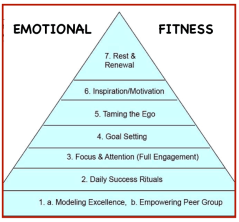
EMOTIONAL FITNESS
Basic psychological principles: It starts with what we focus on – which determines how we feel. 2 other major factors which determine our emotional state are the state of our physical bodies & the language we use to label the circumstances & events in our lives. (More….)

 “I’m already there
This mental exercise for developing a positive attitude / belief about any action is called the: “I Already Have It, I Already Am It”.

Technique: Celebrate your victories in advance! Cultivate the sense in your body of knowing you already have the outcome or goal you want.
Practice visualizing the physical & emotional feelings you will have about the events or personal qualities you wish for already.  FEEL the happiness, gratitude, elation & celebration of success! (More….)

NEXT: Belief

Pyramid Uses: WORK/BIZ


PREVIOUS:Awareness


🔺 WORK PLACE NEEDS
5. Fair wage, meals & rest facilities, breaks
4. Job security, safe working conditions, order, direction
3. Team work, social facilities (sports, clubs….)
2. How one is seen at work – status symbols (cars, corner office, qualify for promotions)
1. Achieve full potential at work, have a challenging job & perks, be promoted (More….)

🔺 TEAM FUNCTIONING
⬇️
DYSFUNCTION of team members
1.
Fear of being vulnerable, don’t to say what they mean
2. Trying to keep artificial harmony, they only say things to please
3. Lack of clarity or actual agreement re. goals causes passive compliance
4. Avoiding discomfort within the group prevents holding each other accountable. “It’s not my fault”
5. Pursuing status or individual goals erodes collective success.

⬆️ FUNCTIONAL Leader/Team PLAYER
1. Be open & accessible
2. Engage in debate re. issues/ problems. Verbalize appreciation & understanding
3. Do what’s needed to accomplish goals
4. Hold members accountable, striving to do more & better
5. Focus on collectively reaching goals. Share accomplishments with everyone
(More….)

🔺 EMPLOYEE ENGAGEMENT (Human resources management)
5. DISENGAGED
= Not interested in the job itself, only working for a paycheck
4. NOT ENGAGED =
Don’t like boss, poor working conditions, wants overtime, looking at want ads
3. ALMOST ENGAGED =
Feel OK about work, feel a part of something bigger, but no career advancement
2. ENGAGED = Feel important & a vital part of the work, very busy, maybe stressed
1. HIGHLY ENGAGED = High flyer, love work, inspire others to do their best,

🔺 EMPLOYEES
DEEPAK’s INVERTED humor: The stages an employee may go through if they don’t have enough work to do – for too long (top down):
Bored: Frequent visits to vending machine, break room / canteen or bathroom
De-motivated: Read online news, stock market….

Indifferent: Chat on IM using proxy / browser
Nervous breakdown: Blog, or read blogs of unknown people
Core sump, System error: read viewer’s comments on Reddit, Facebook, Twitter….

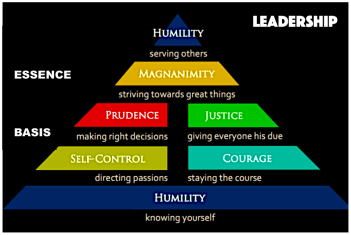
🔺 VIRTUOUS LEADERSHIP (IDEAL MANAGER)
Leadership is a way of being, which can be lived by anyone no matter their place in society or in any given organization.
Virtue is a dynamic strength that allows the leader to do what is required in service to those they lead. The virtues of practical wisdom, courage, self-control & justice form the foundation, while the virtues of magnanimity & humility form its essence. (More….

🔺 DNA BUSINESS NEEDS
The Business DNA Pyramid features the 3 game-changing Qs used to build & explain leading successful startups, from an idea.
A = Aspiration –
Vision: what’s the winning goal? The WHY – Impacts, metrics
N = Needs –
Strategy: where will biz be & how to win in chosen market
The WHAT – Environment, Problems…
D = Design –
Product: what capabilities & management systems are needed to win. The HOW – enterprise, solution

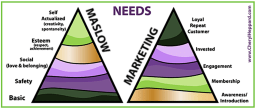
🔺 MARKETING
Basic/Awareness: Samples, freebies, and promotional items are typically offered in order to initially attract prospects.
Safety/Membership: To keep potential customer’s attention, they need to feel they’ve found a reliable place where they can find what they’re looking for, & won’t be taken advantage of

Social/Engagement: When a prospect feels they’re part of the right tribe to get value re. their own goals & wants, they’re likely to stay tuned in – “know, like, trust.”
Esteem/Invested: If customers feel respected, they’ll be confident enough to initially invest in your products or services, or invest more

Self-Actualized/Loyal Repeat Customer: This is the prized goal – where customers are convinced of your unique offering, so they only want to buy from you over & over

🔺 SUPPLY CHAIN Psychology
Hearn Industrial Services (Canada) – provider of Transportation, Supply Chain & Quality Services to the automotive industry.
Supply Chain systems are designed to achieve high service levels.
BASE:
Measurement & Action, includes
▪︎ End Customer Service = providing customers with all physical needs
▪︎ Internal Integration = a supply chain professional that is focused on your bottom line, through proper planning and resource allocation

MIDDLE: Value & Authority
▪︎ External Integration = building relationships with customers, & strategic partnerships with select companies to help address customers’ requirements
▪︎ Win-win scenario = with dynamic thinking, build trust by sharing risks & rewards with customers

TOP Level: Sustainability
Being socially, economically& environmentally responsible

NEXT: Sports

Pyramid Uses: CREATIVITY

PREVIOUS: Maslow UPDATED #2

SITE:  Designer vs Non-designer’s needs – w/ CHART


CREATIVITY

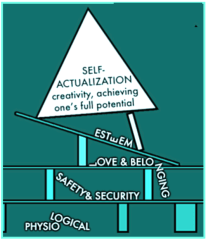
In his ULTRAsomething blog, Gregg Simpson ponders an existential Q: “Why do I always believe the world is upside-down?” He notes that Maslow’s pyramid implies that human motivation always builds on a balanced foundation of needs, & that we’re identified by how high we’ve managed to climb the pyramid.

“…. But like most catch-all theories involving human existence, Maslow’s has one fatal flaw — it doesn’t ‘catch’ me.
In fact, it utterly fails to define the seemingly haphazard way in which my own needs structure has evolved — a structure that looks something like this ⬅️. This can apply to anyone feeling their way thru life – unconventionally or without clear direction”

♦ ARTISTS: Simpson points out that not everyone follows Maslow’s original order. This especially applies to all types of artistic / creative people who obsessively focus on producing something that will change the world, or at least one piece of the world that interests them – (research, ballet, composing, programming…..). Creatives will sacrifice many things in life for their specific pinnacle’s focus.

Reversed ARTIST’S stages  :
– Self-actualization is the fundamental need driving all true creatives (#5 becomes #1)
– Esteem is looked for only when creative urges are sated – even somewhat, & temporarily (#4 is now #2)
Having reached a goal, they want others to know & appreciate their work (#3)
– And although they may long for intimate relationships (#3), many are unwilling to put energy into it – love takes too much time away from the creative process

– At the reversed top, many creatives neglect their physical & safety needs, approaching those with some disdain, as if satisfying them is so shallow & trite that it’s a form of ‘selling out’. (#1-2 are last)
The most successful creatives achieve wide recognition, but self-actualization can also be a personal experience, from a quiet satisfaction with the outcome of their efforts.

Simpson continues: ” …. but it also indicates why creative people are often more fragile & unstable. Just look at that structure: a creative’s entire existence balances on a single point. Unless needs in the levels above self-actualization are met with the utmost care, the whole pyramid tips over on its side.” (Re. Entrepreneurs….)

ALSO: Ed Hose’s comments on his drawing ↗️ of the reversed ∇ echo Simpson. Some people’s needs follow the standard pyramid – with its solid base, whereas others are like spinning tops, living the upside down life, where the fulfillment of ideas trumps the pursuit of practical necessities.
He says: “I have drawn the conclusion that both ways of being have phenomenal pluses and minuses.

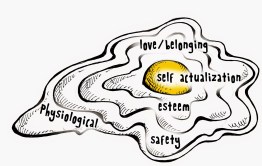
You can not begrudge the shape of your own hierarchy of needs. One shape is not better than another, whether unstable or deeply rooted.  Do not worry what yours looks like – unless….. ⬅️ If it look like this, then you should worry!”
….. “It is easy to begrudge being a spinning top when you long for the stability of a solid bottom pyramid, & it is easy to aspire to the swirling beauty of a spinning top when you are stuck in the routine of being responsible.”

👠 👠 👠

MUSIC : On the other hand, “Sou’s Voice” looks at the Pyramid as is:
Q : Where does music lie in the Maslow’s hierarchy of needs?
ANS: It depends where music fits into a person life. EXP:
Levels 1 & 2 = If your livelihood mainly comes from music, the position in your life likely relates to the physical & safety levels
At 3 = you love to sing or play at all kinds of social functions – for fun
At 4 = you have a day job but pursue music as a freelance gig
At 5 = you’re a music teacher, researcher or scholar, but also relates to 3 thru 6
At 6 = If you’re consistently earning your living by any form of musical expression, (whether well-known or not), but also 4 & 7
At 7 = If you’ve saved up ‘enough’ wealth that you consider making music, not for money but for pure joy
At 8 = If you’re publicly performing your natural talent as a gift, you become one with an attuned audience – transcending ‘ego separateness”.

NEXT: Reverse pyramids

Pyramid Uses: AWARENESS

PREVIOUS: Parenting

SELF-LOVE
DEFICIT
base: Childhood trauma dissociation. Repressed memories of abandonment.
CORE SHAME: :”I’m only as good as what I do or not do for others”
LONELINESS: Excruciating feeling of worthlessness – the existential void
ADDICTIONS: Isolation, chemicals & narcissistic lovers mask intense pain
PEOPLE-PLEASING / RESCUING: Compulsive caretaking, manipulate others for acceptance & love

ABUNDANCE Base: Self-respect & self-care
CORE Beliefs: “I love myself & I can be loved by others – just for who I am”
INNER PEACE: Freedom to be happy without a ‘relationship’ – no void to fill
MUTUALITY in Relationships: Interdependent, expecting respect & love from others
SELF-LOVE: Acceptance & appreciation of one’s place in the world

LETTING GO….
REVERSE PYRAMID of Transcendence (re. Maslow Level 6):
It foes not mean we top doing whatever it is we do in everyday life – but rather letting go of attachment to perfection, outcomes & neediness – which we base our actions on. “Before enlightenment, chop wood, carry water. After enlightenment, chop wood carry water.”

Progress of enlightenment (small e) by LETTING GO :
Base: of perfection, moving toward appropriate vulnerability
✱ Low attachment to outcomes
2. of need for other’s opinions. Not judgemental, moralizing or shaming
✱ See self as part of larger whole
3. of need to hang on to others. Loosen grip on self-preservation instincts, thoughts & emotions
✱ Able to ship internally to solve problems

4. of need for security & certainty, learning to give up control over everything
✱ Being in the present – to take actions

5. of need for physical safety, to be able to sacrifice self for a greater cause
6. of the grip of fear of death. Go for one’s dreams, no matter what the cost.

Addiction RECOVERY process
Just as individuals’ substance use disorder recovery needs might be different depending on their life course stage, those needs may also be different depending on their recovery stage. What one needs to sustain substance use disorder recovery will be different depending on if they have 3 weeks versus 3 months versus 3 years, and so on in recovery

A prominent model of behavioral change that cuts across theories – The Trans-theoretical Stages of Change Model – serves as a useful way to understand this change process. The different stages of change necessitate different recovery strategies.

From the least aware to life-long sobriety: Pre-contemplative, Contemplative, Preparation & Action, Maintenance. (More….)

SOUND RELATIONSHIPS & ADDICTION


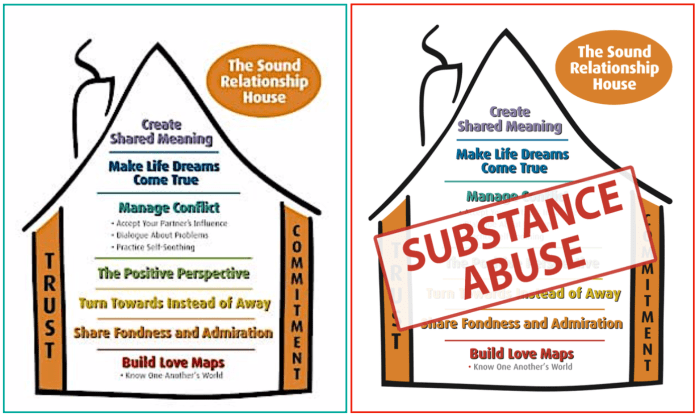
“HOUSE” of Healthy relationships:
Base level:  Building Love Maps – how well partners know one another
2. Share Fondness & Admiration. the amount of affection and respect within a 3. 3. Turn Towards in everyday moments, which are actually the building blocks of relationship. (More….)

BUT – If Substance Abuse intrudes, it will erode an intimate relationship, like an unwanted guest. If the couple is willing to enter recovery (AA, Al-Anon….), the ‘house’ levels can be used for healing, with special attention to building solid walls against the return of the uninvited-invited guest, & open up windows to each other, to communicate growth needs & challenges. (More….)

BUILDINGS
In his classic book Why Buildings Stand Up, architect Mario Salvadori agreed with Maslow’s final addition of spiritual ‘Transcendence’. Salvadori pointed out that spiritual needs have always preoccupied people, even when they are lacking basic physiological comforts.

Once humans abandoned their nomadic lifestyles to live in fixed communities, the larger architectural dwellings were usually places of worship & communion.

Monuments also expressed a culture’s conception of spiritual needs, & of life and death. The Pyramids of ancient Egypt and the mausoleum of the First Emperor, Qin Shi Huangdi, complete with terracotta army…… illustrate obsessions with death & immortality.

Cultures & the way we do architecture may have changed, because of advances in science & technology, but our needs – from physiological to spiritual – have not. We live, eat, sleep & procreate in the same way. However, today our largest buildings are shopping malls, as fewer people are motivated by organized religion.
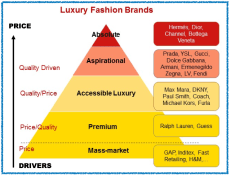
We worship the material, so these large structures express our concept of our greatest need: to consume as much as we can. (re. buildings) //  (re. Fashion needs)

NEXT:

Pyramid Uses: PARENTING

  PREVIOUS : Trauma

SITE: Toddler’s Food pyramid


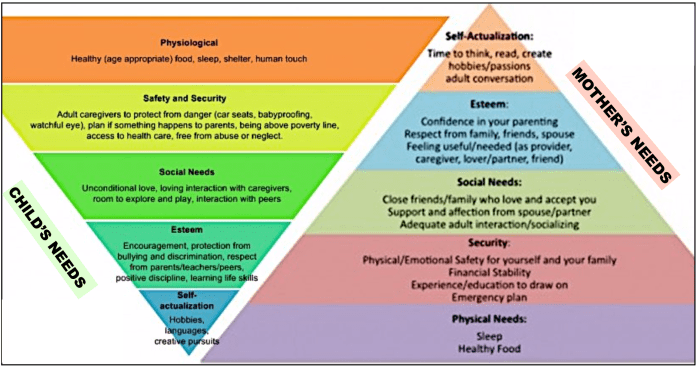
MOTHER & CHILD’S NEEDS

ANNIE (mother of 2) at “PhD in Parenting” points out that “No (wo)man is an island”. For mothers, this means they can’t thrive if they’re isolated, & that they can’t selfishly pursue their own needs all the time

Women are often in a position to have to help others meet their needs, whether directly (feeding an infant) or providing someone with the space to do so (a quiet space to study, a car ride to the doctor….).

But if women feel pressured to meet all their responsibilities by themselves (to spouse, elders, children, work), they’ll end up neglect their own needs and/or those of their child(ren).
Mothers need help too, like being freed up to have a quiet bath, or get away for a few hours. That takes ‘a village’ & ideally, women have to develop support systems before they’re needed, before they’re desperate.

Annie notes that it’s more important for a parent to meet their child’s physiological, safety & security needs (levels 1-3), than to meet their own esteem & self actualization needs (4-5).
It’s also more important for the parent to meet their own physiological, safety & security needs (1-3) than to provide esteem or self-actualization needs of their children (4-5)

After all – she’s unlikely to provide the support & energy required to fulfill the child’s esteem & self-actualization needs if she is hungry, exhausted & insecure.

GOOD PARENTING
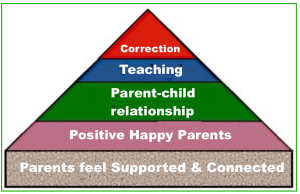
1. Feeling Supported & Connected
Brain systems
have two settings: Responsive and Reactive.
😨 When support in Times of Need is not available or utilized, we React with worry, frustration, anxiety & anger. Then we turn INWARD – isolating.
😄 When each level of needs is met, the system tends to be Responsive. This is provided during Tough Times by turning OUTWARD, to get whatever help is required.

2. Positive Happy Parents
Healthy parents have positive self-regard. And they take care of themselves when they’re in H.A.L.T. When parents have positive connections, they’re more caring toward their children, who learn about building & keeping friendships by watching how adults interact.

Happiness Advantages:
• Performed better (a study) = happy people solved 20% more word puzzles
• Brain is 31% more productive =  Creativity, energy & intelligence rises
• Happiness chemicals turn on all learning centers in the brain, allowing better adaptation to the world by seeing possibilities & practical options

3. CONNECTION: Everyone benefits when parents spend more time developing a strong, loving relationship with their children. After all, teaching & disciplining (levels 4-5) won’t work if the child doesn’t like the parent!

KEYS to healthy parenting:
a. Loving = affection, compassion, involvement, positivity, understanding, warmth…..
b. Guiding = discipline, setting limits, structure, supervision, teaching….

4. TEACHING: Too much focus is on what to do when things go wrong – on discipline strategies & consequences. However, if the goal is to be  effective, parents need to lovingly, patiently teach children what is expected, how to behave, & what the consequences are of disobedience – rather than seeing them as ungrateful, disobedient burdens!

So, effective correction will depend on the quality of the parent’s teaching, & the quality of teaching will depend on the quality of the relationship with their children. (More….)  CONNECTION first, correction last.

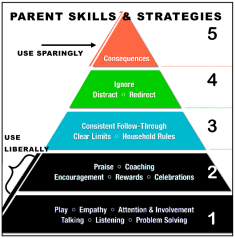
PARENTING SkILLS & STRATEGIES
In order of importance & effort:
1. Base activities lay the foundations for a positive parent-child relationship, making all parts of parenting, even discipline & consequences, easier & more effective.
PARENTS give attention, empathy,  involvement, listening, play, problem-solving, taking
BENEFITS to child: better attachment, co-operation, self-esteem, problem-solving

2. PARENTS: celebrate, coach, encourage, praise, reward
BENEFITS: Improved motivation, thinking & social skills

3. PARENTS: Clear limits, consistent follow-thru & household rules
BENEFITS : Increased obedience, predictability & responsibility

4. PARENTS: Distract, ignore, redirect – child’s demands, noise, tantrums….
BENEFITS : Reduces annoying behavior (don’t get a rise out of parent)

5. PARENTS: Provide consequences (time out, loss of privileges….)
BENEFITS : Less aggression  (From “The Incredible Years” Series)

IF parents overuse consequences & forget to make time for play & positive time, children will become discouraged, & will stop trying to behave properly – because they feel unable to get any attention other than when they’re ‘bad’.

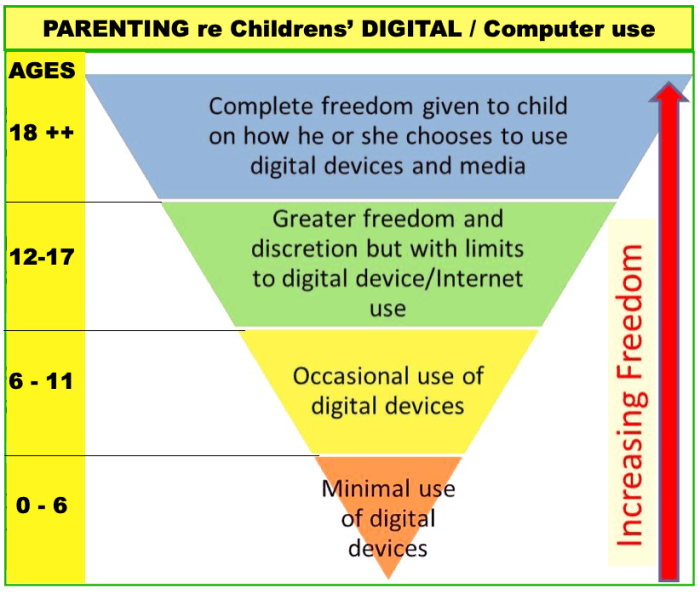
DIGITAL USE (for Children)

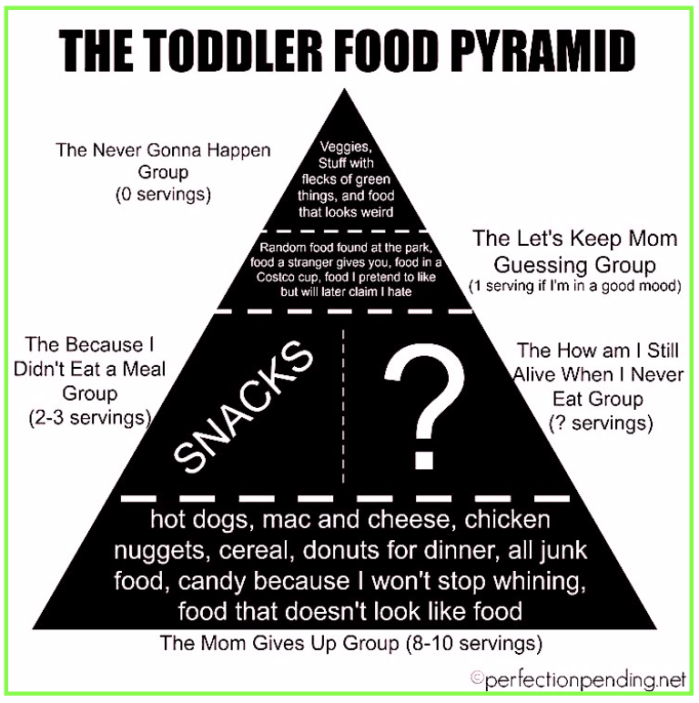
TODDLER’S FOOD GROUPS 😉

NEXT:  MBTI Preference stacks #1