
 PREVIOUS: E vs I brains #1
SITE: Surprising Brain facts
Es = Extroverts // Is = Introverts
FACTORS re. Biological Differences between I & E brains (cont.)
2. BRAIN QUADRANTS // 3. BLOOD FLOW – Front vs Back
4. Blood Flow & NEURO-TRANSMITTERS
Blood of Es & Is brains travel on different pathways in response to a wide variety of stimulation. Each style uses a completely different neurotransmitter, which take a different amount of stops in the brain along the way to processing ideas, info, experiences, interactions….. These chemicals direct where the blood goes, & regulate how much of it flows to various centers, influencing what parts of the Central Nervous System (CNS) are turned ON.
✳ Extroversion is linked with energy-spending dopamine/ adrenaline, while Introversion is linked with energy-preserving acetylcholine.
Energizing: Dopamine (D) is the ‘activating’ transmitter which produces good feelings 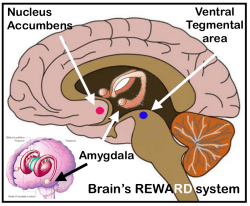 that come from social interaction, physical activities & passion. The D-system affects how we learn & respond to novelty. Setting off an external response, it motivates us to go after situations that are rewarding.
The amygdala & nucleus accumbens (which encode new motor skills) are important components of the brain’s D-reward activation, responsible for processing emotional stimuli, & giving Es a rush when trying something highly exciting. And D’s sidekick Adrenalin makes more D when released from the sympathetic nervous system, needed for fight or flight reactions when we’re faced with real or assumed danger.
Calming: Acetylcholine (A) is the ‘inhibiting’ transmitter that also helps us feel good, but as a relaxing influence. When set off, it activates the parasympathetic nervous system, along with the hypothalamus, providing an internal response that lets us slow down, to maintain or safeguard energy. A is like D’s alter ego, creating a sense of satisfaction & contentment, & plays a role in dreaming & imagination.
Acetylcholine fuels our ability to think deeply, reflect & focus for long periods of time on one thing. It rewards mental concentration by giving hits of ‘happiness’ – but not the charge of glucose & oxygen needed for physical energy.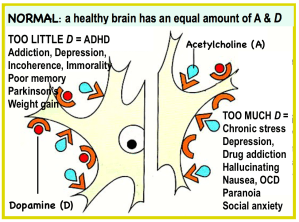
• Extroverts & D
Research has shown that Es have more Dopamine receptors in their brains (than Is), so they need much more of this chemical to fill all those ‘slots’. More activity means producing more D, with then pushes Es to continue social interaction, activity & excitement.
Interesting: People born with a longer D-receptor gene are more likely to become thrill-seekers & adrenaline junkies – if stressed for too long.
• Introverts & D
Is have fewer receptors in the same area that generates D, the substantia nigra, so they need a very specific limited level of dopamine, but a greater amount of acetylcholine – to be comfortable. A normal amount for Es will easily be too much for Is, which can eventually lead to agitation, depression, or mental illness if Is don’t get enough stress-relief. 
5. CIRCUITS
Both styles respond to incoming info from activities picked up by the spinal column (SCS). From there, the I’s brain-path accesses memories or information. Es brain-path mainly accesses sensory info.
➡️ For E’s – when activities stimulate their brain, a Dopamine-response is trigger . The pathway makes a 5-stop circuit (shorter & less complicated) which runs through areas where taste, touch, visual & auditory sensory processing take place.
#2. Data from the RAS goes to the Hypothalamus (thirst/ appetite / temp) switching on the ‘Full Throttle’ system
#3. a relay station amplifying the stimuli
#4. the emotional center – & Es is associated with actions, the motor area being lit up
#5. connects movements to—> short-term memory access, to—> the center for learning, as well as processing sensory & emotional stimuli
↗️ For Is, activities trigger Acetylcholine, needed to balance out any potential or actual overwhelm. It makes a 7-stop loop traveling through areas of the brain dealing with info, meaning, planning, remembering & problem solving. This uses 40% more energy than the extrovert-dopamine circuit.
#1. Stimuli enter the RAS at the top of the brain stem – less active in Is
#2. data is interpreted & the brain placed in ‘Throttle down’ mode
#3. is the relay station turning sensory signals down
#4. where speech & activates self-talk is planned
#5. selects, plans & chooses ideas or actions. Forms expectations & evaluates outcomes
#6. is for environmental awareness & info sent to long-term memory
#7. the emotional center where feelings are attached to thoughts
⬅ In high activity situations, the 2 styles are opposite, because different brain areas are activated.
NEXT: E & I body parts
 HEAL & GROW for ACoAs