
 PREVIOUS : Enneagram positives, Type 9
PODCAST : Rogue’s Gallery – Secret History of the Moguls & Money that Made the New York Metropolitan Museum
“MONEY is a belief that has to be shared with other people… otherwise money is useless: you can’t eat it or wear it, buy love with it (although it may help), & you don’t get to take it with you when you die.
Money can be anything you like — gold or silver, peas or paper, tiny shells or massive stones, or nothing at all but surfing on the electronic highway. But everyone must agree on what it is: we accept money because we believe others in turn will accept it too. It works because it works.” (GREENBACK, by Jason Goodwin)
✳️ 2 possible forms of money:
🐂 A cow. Cattle have been used as money at different points in history.
🏧 A stack of U.S. 20-dollar bills equal to the value of one cow.
Money – MUST BE:
◆ Acceptable — widely accepted as a medium of exchange – the cornerstone characteristic. SO – Even though cows have intrinsic value, some people may not accept cattle as money. In contrast, people are more than willing to accept 20$ bills, & the U.S. government protects your right to use it to pay your bills.
◆ Divisible — easily divided into small parts so that people can purchase goods & services at any price. SO – 20$ bill can be exchanged for other denominations (a 10, a 5, four 1s, and 4) quarters. A cow, on the other hand, is not very divisible. 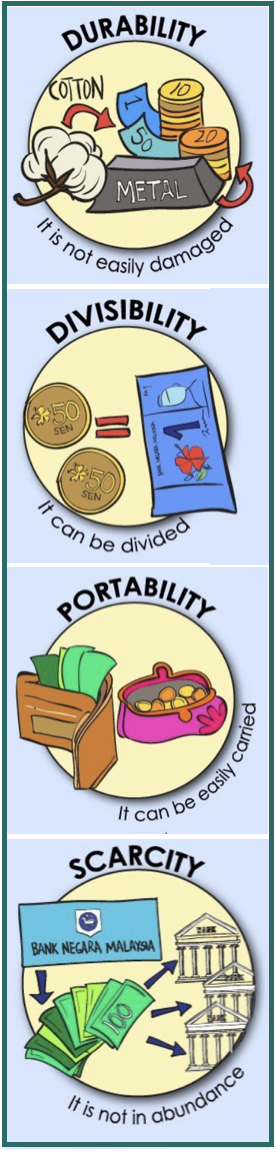
◆ Durable — able to withstand the wear & tear of many people using it without easily deteriorating. SO – 20$ bills are fairly durable & can be easily replaced if they become worn. Even better, a long trip to market does not threaten the health or value of the bill
◆ Fungible / Uniformity – considered the same as another of the same value. BUT – you can get a larger variety of “things” from the cash, while only 3 things from the cow. Cows come in many sizes & shapes, each with a different value, so are not a very uniform form of money. 20$ bills are all the same size, shape & value – very uniform.
◆ Scarce — relatively scarce & hard for people to obtain, in order to maintain its value. While the supply of cows is fairly limited, if they were used as money, ranchers would do their best to increase the supply of cows, which would then decrease their value.
◆ Portable — easy to carry from place to place. SO – while the cow is difficult to transport to the store, the currency can be easily put in your pocket
◆ Stable — Money’s value must remain relatively constant over long periods of time. SO – cows have a limited life span, cash usually lasts for decades.
✳️ 4 financial MINDSETS
♠︎ Scarcity – Based on negativity, this style is rooted in the lack of resources to satisfy basic needs. It can lead to making decisions out of desperation , living week-to-week, & spending most of your money on necessities as soon as the paycheck arrives. EXP : take out loans without regard for the interest rate, or skimp on savings. 
♥︎ Abundance
This is a positive outlook where you’re in the financial driver’s seat, focused on what you have rather than what you lack. You feel empowered, engaged & positive, & inspire those feelings in others. You look for new opportunities to build wealth for Self & family.
♦︎ Consumer
It’s the “shop ’til you drop” attitude, over=buying & spending during shopping sprees, engaging in promotions like tax-free holidays & Black Friday sales. You also may feel compelled to act better off than you are. It can make you justify your spending even when financially strapped & risk getting deeper into debt. Soon, it becomes impossible to avoid delinquent bill payments, & your financial health suffers. 
♣︎ Investor
You’re keenly aware of money, with a clear financial vision, dedicated to putting your money to work. Investing wisely can increase your net worth, provide a comfortable retirement, pay for college tuition, or finance your dream house. Your age, income & risk tolerance all play a role in determining the best way to invest. (Solutions for each type) (MORE in posts re. M vs F)
NEXT : Intro (Part 2)















 HEAL & GROW for ACoAs