MONEY MADNESS – GENDER Differences (#2)


PREVIOUS :  MM- Archetypes, #6

POST : Narcissists’ FINANCIAL Abuses


💴💰🧧 Is Psychology of Money a Gendered Affair?

Gender differences in the financial domain is gaining increasing attention, as evidenced by the UN 2030 Agenda for Sustainable Development. An extensive analytical strategy was employed on Scopus, Web of Science, PsycINFO, & EconLit – identifying 100 empirical papers on the topic, published between 1972 & 2021.
** These include papers from Asia, Europe, North America, Africa….

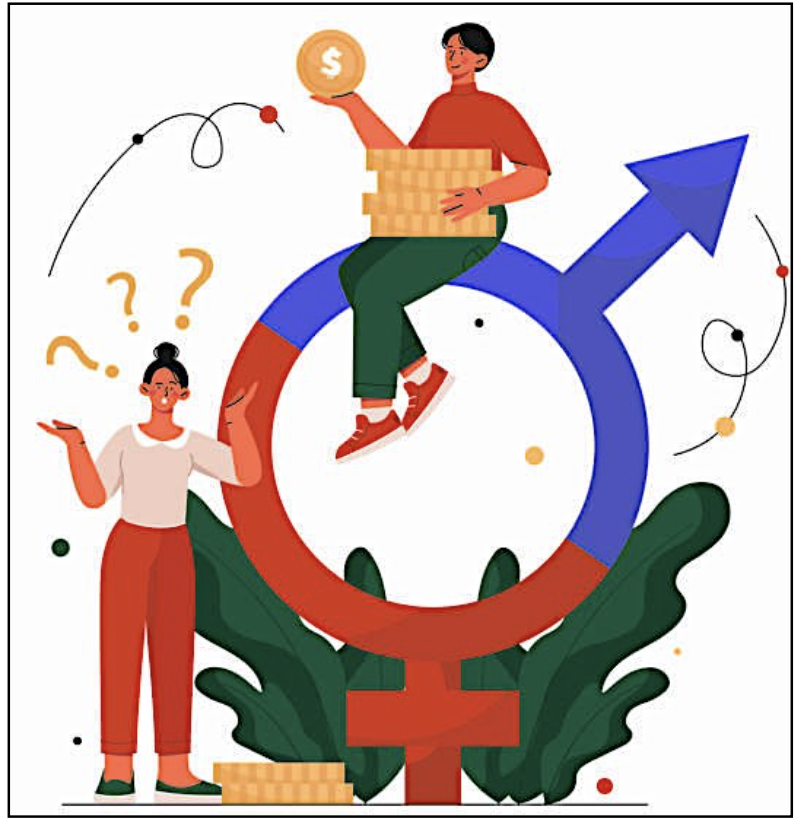
CONCLUSIONS : The research revealed clear differences in how men & women approach money — in attitude & symbolically — while money management practices turned out to be more complex & sometimes conflicting. Re. financial behaviors, studies indicate that both genders have similar approaches to savings & expenses monitoring, but financial investments are mainly pursued by men.
💙 Men often look at it as a symbol of success & power
💛 Women have more ambivalent attitudes, money as both a source of anxiety & a tool to ensure their security & prove their love to others. (MORE… with charts)

✔️ Sex Differences in Money Pathology in the General Population
Studies published in 2014 point to the psychological power of money. Interest has been particularly concerned with the relationship of it to happiness, & its role in personal relationships & in the workplace.
This study examined sex differences in money beliefs & behaviors. Over 100,000 British participants completed 2 measures online, one assessing “money pathology”  & the other four “money types” based on emotional associations.

 Gender can have an impact on how people experience the link between money & mental health.  Nearly all measures showed significant sex differences with medium-to-large effect, with females exhibiting more “money pathology” than males –
💙 men were more likely to be Hoarders
💛 while women did more emotional-regulation purchasing.
The biggest differences showed money being associated with :
♠ Autonomy (money = freedom) men scored higher
♥ Generosity (money = love) : men scoring much lower than females
♠ Power & Security = men, more than women  (MORE….)

Another study, finding from the Journal of Economic Psychology, reported consistently large differences in M vs F money styles. Although both genders tend to see money to be closely linked with Esteem & Power, the research concluded that :
💙 males are more prone to feel involved with & competent in handling money, & take risks to amass wealth
💛 females have a greater sense of envy & deprivation as a way of obtaining things & experiences which they can enjoy in the present.

Demographics – like gender, age & ethnicity – affect how we experience money & mental health problems (MHP).
💛 women with MHP are more likely to have trouble keeping up with domestic bills & credit commitments (59%),
💙 versus 52% of men with MHP.
NOTE :
Financial troubles are a common cause of anxiety, which drastically reduces recovery rates for common MH conditions.  Combined with a range of social issues, life events, cognitive & personality factors, people with depression PLUS problem debt –  are 4.2x more likely to still have depression 18 months later. And research found a strong link between problem debt & suicide, with more than 100,000 people in England attempting suicide each year because of it.

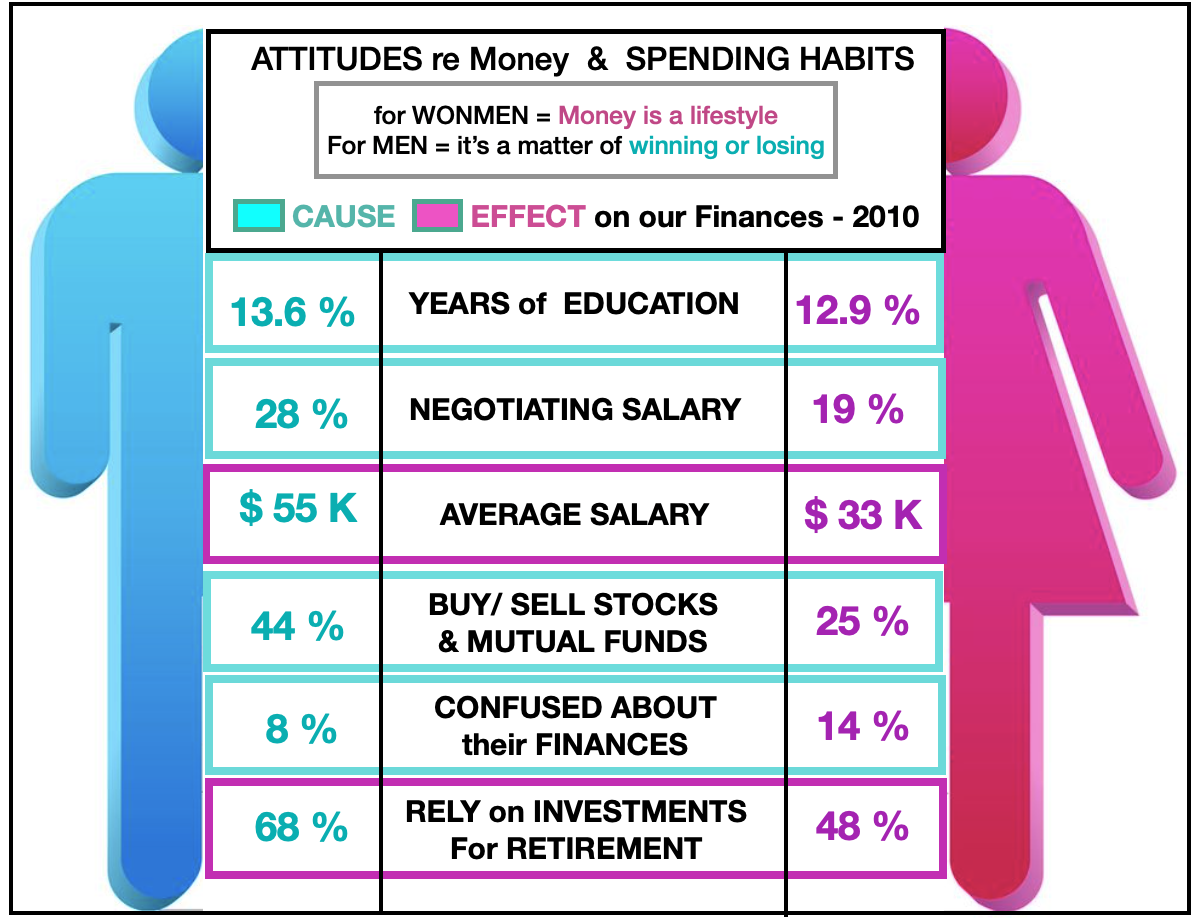
⬇️ Main results re. gender differences in money attitudes  


«
NEXT
: MM – Gender Differences, #2

MONEY MADNESS – GENDER Differences (#1)

PREVIOUS : MM, Archetypes, #6

SITE: Male vs Female Spending STATISTICS


Book (YouTube) :   “Money Madness”  — Herb Goldberg & Phil Donahue


In spite of society’s advancements, there are still significant differences in Male vs Female attitudes & habits about money & its management. Dozens of studies have been created on this subject, with research from around the globe.
EXP : In 2019, UBS Global Wealth Management published a study revealing that 58% of women tend to leave money decisions up to their partners.

USA  – ✔️ Financial goals
A recent survey by The Motley Fool (2018) found they tend to have different priorities
💙 Men are most likely to view saving for a vacation as their top financial goal, followed closely by paying off credit card debt
💛 Women had identical goals, but named debt repayment is bigger

✔️ Investing
💙 Men seem to take more of an interest in investing. 70% of millennial men enjoy managing their investments compared to just 36% of millennial women.
Because of this, men tend to feel confident in their financial knowledge & are more open to risky investments.

💛 Women tend to be cautious, patient investors. Interestingly enough, while females are more likely to admit they know very little about investing, their conservative approach puts them slightly ahead of men over the long term –  because – while they produce smaller gains, they also see smaller losses. Infographic

✔️ Savings goals
Although both have similar financial goals, there’s a vast difference between how much money each gender sets aside .

💛  American women nearing retirement have an average of $81,300 in retirement funds, 
💙 Their male counterparts have $118,400.

However, if you look at the percentage they save from their paychecks, women come in first place. A recent Vanguard study found that women are more likely to participate in workplace retirement plans, putting up to 8% more of their pretax earnings than men in the same earnings bracket.

The discrepancy between $$ amounts saved & the % of income earmarked for savings can be accounted for because the average woman is still earning less than the average man. 

EXP: According to the Census Bureau, the gender pay gap in Louisiana is by far the worst in the nation with a 31% differential. So, women working full-time there make only 69% of what the average full-time working male makes.

✔️ Spending habits
Overall: Single men outspent single women, but only by a slight margin. 💛 women = approx. $33,786., 💙 men $35,018 a year.
– while remembering that men earn roughly $10,000 more per year.

Multiple studies indicate that women are more price-conscious shoppers than men
💛 71% of women say the last item they bought online was on sale
💙 compared to only 57% of men.

💛 Additionally, 74% of millennial women say they look for coupons when shopping online,
💙 compared to 65% of millennial men

✔️ Shopping attitudes
A study by the Wharton School of Business titled “Men Buy, Women Shop” found that :
💙 most men just want to make their purchase & get out
💛 women are more likely to view shopping as a recreational activity, so may be quicker to spot a deal. (How each GENDER SPENDS their MONEY )

✔️ Cars
💙 Men spent a total of $5,507 a year on personal transportation costs
💛 compared to women’s $4,273. However, they spent nearly twice as much on car insurance than their male counterparts, $1,000 per year vs. men  $500.

✔️ Clothing:
💛 Women spent $1,140 per year on apparel
💙  while men spent $813. Interestingly, M & F spend the same amount on shoes = $190 per year.

✔️ Food
💙 Single men spent $4,173 annually on grub, 💛 while ladies spent $3,680. Men also spent more than double on alcohol, $537 vs. $234.

✔️ Healthcare
💛 Women tend to spend slightly more across all healthcare categories. The largest being drugs & medical services, spending more than $200 per year more than men. On things like X-rays and doctor’s appointments, women spend just over $200 per year more than men

✔️ Personal care
💛  Ladies vastly outspent men on personal care products & services. On average, women were willing to pay around $714 a year on self-care, while men spent closer to $297.

✔️ Student Loan Debt
According to the American Association of University Women (AAUW) 2021 Deeper in Debt report. women held approximately 55% of total student debt, & owe approximately 16% more than men at graduation. On average, 💙 men owe $18,880 in student debt while 💛  women owe $31,276.

NEXT : MM – GENDER Differences (#2)

MOMEY MADNESS – POWER Grabbers (#2)

PREVIOUS : Power Grabbers (#1)

POSTS : “Power -Personal….. (20 posts)

AW = Autonomy worshipers, (in 5/25)
LB = Love Dealers
SC = Security Collectors
PG = Power Grabbers


4. POWER Grabbers
(cont) = pg. 126, “MM” by Goldberg & Lewis
a. The Manipulator // b. Empire Builder

c. The GODFATHER (G)
◆ Underlying issue : Behind the quiet & kindly exterior is a very angry & hostile person, which is tightly suppressed. If their authority is not threatened, their anger is only expressed indirectly.
They were embarrassed & overly controlled as a child, to the point of humiliation. It left them with a dread of any form of put-down, real or imagined. “Respect” is always demanded.  Constantly concerned with not being humiliated, they have a powerful obsession to never feel ‘small’.

◆ Payoff  : Because they wield power, there’re usually respected. But this is more often from fear than from love. However, if the godfather can project benevolence, they’ll receive admiration, even affection. They may be able to buy loyalty & devotion, using money to gather an army of “yes-people” who will devote their lives to  doing the will of the ‘master’. Being able to thoroughly control others helps erase the leader’s early feeling of frustration & powerlessness. Many insecure people are attracted to godfather types because they’re experienced as strong & protective, but who end up as zombies – all initiative & individuality destroyed.

◆ Cost :  No matter how ‘generous’,  the godfather never builds meaningful personal relationships – with anyone. He/she may use every possible tactic to keep family members dependent on themself for those people’s very existence,  with the attitude of owning them the same as their house, car, business…  Everyone around them has to walk on eggshells because the tyrant’s rage can flare up unexpectedly – if challenged.
Ironically, godfather types are actually quite dependent on their subservient mate, children, employees….  because they need others to control.

In this category : The main characteristic is summed up by Teddy Roosevelt’s saying  “Speak softly & carry a big stick”.  Godfathers act graciously to those they tightly manipulate – as long as the subject conforms & does what’s expected of them. They’ve learned that people & power can be bought with money, & that their rage can be channeled that way to never be at anyone’s mercy again.

GREEN GIANT (GG) Syndrome
◆ Underlying issue : Power grabbers react with intense anger to being threatened & their needs severely ignored – in childhood. Most are men, & most had a terrible relation with their father : alcoholic, ineffectual & weak. They express this pain with indirect aggression,  not always obvious or even conscious.
If the father was the macho abusive military type ….  the son felt humiliated, not able to overcome the sources of his frustration. They developed the familiar “identifying with the aggressor” – internalizing the value system of their torment. The external threat became internalized, allowing them the illusion of controlling the danger, masking the feeling of being a helpless victim.

A few are women – such as Helena Rubinstein, & Lucille Ball…. However, female GGs are more likely to be the “power behind the throne”, controlling the powerful spouse, or manipulating the mate to become a financial giant (Betty Burnside..

In this category :  Unlike many other angry PGs, those who become Green Giants don’t usually resort to physical assault or join others in fighting / brawling. To feel safe, they gradually come to use money as a barrier against a ‘threatening’ world. It provides them with the power to attack & intimidate others, masking a sense of impotence.

◆ SPOTTING a GG : Being thoroughly cynical, they sneer at the idea that anyone can act out of compassion or humanitarian motives. Money is their only source of  power, so if that gets cut off they revert to feeling impotent.  They expect everyone to mistreat them & this attitude denies their paranoia, which is an underlying rage being projected out on to others.
GGs exhibit type As characteristics, many overworking themselves into a heart attack & early death. Since they don’t see anything wrong with their behavior they refuse or misuse counseling.
They rarely give or receive love, but demand loyalty & respect. However, they secretly believe that without money & power, everyone would abandon them. Fantasizing that their accumulation will bring affection, their paranoia increase, leaving them more & more suspicion & isolated.

AWARENESS

«
NEXT : MM – Love Dealers, #1

MOMEY MADNESS – POWER Grabbers (#1)

PREVIOUS : Security Collectors, #2


4. POWER Grabbers  = (pg. 126, “MM” by Goldberg & Lewis)

a. The MANIPULATOR
◆ Underlying issue : Manipulators experienced a lot of deprivation early in life, so compensate by developing the ability to move  people around like puppets.  This hides feeling frustrated & powerless.
They have an exaggerated need to be important to offset the deep feeling of inadequacy.
In their mind, everyone is either a winner or a loser.  All of their energy is directed toward ending ‘on top’ – the alternative being abhorrent. Their major characteristic is  not having a conscience, so they don’t feel guilt. They misrepresent themself, play one person off against another, take advantage of loopholes in the law…

◆ Payoff : Controlling others with accumulated money & power is a symbolic way to get back at those who manipulated & controlled them early on – to even the score. These types can be found in any & every walk of life – parents,  doctors, lawyers, teachers,  clergy….

A secondary benefit is that successful ones lead ‘exciting’ lives. They mingle with important people & have access to power-circles.  Even the slightly less prosperous manipulators can gain respect & approval based on their level of power & money.

◆ Cost :  A main one if the loss of integrity. although the manipulator considers it an inhibiting weakness.  OR it may be a heavy price for someone who becomes manipulative gradually – on the slippery slope of compromising their weak personal standards. Once sold, it’s hard to buy it back.
Becoming successful, they gradually retreat into a fantasy world, where they can make up their own rules. The law is for fools  but can be use to their benefit. They use power to get more money & that money to get more power.

In this category : Psychologist have found that manipulators have a strong self-destructive streak. Eventually as their arrogance becomes more blatant, they do get caught, but are shocked they can’t talk their way out of trouble. Also, as they become more successful, their desperation increases, because the rewards they’re working so hard for are empty, even boring. Ironically, assuming there’re above everyone else, manipulators can be taken advantage of by someone cleverer than themselves.

b. EMPIRE BUILDER (EB)
◆ Underlying issue : In many cases they lost or were rejected by a parent,  concluding that they can’t rely on anyone other than themself.  Their main motivation is to suppress feeling powerless & weak, carried over from childhood.  They can’t tolerate being dominated, but ironically have an unconscious need for dependency.
Their fear of being exploited leads to never asking for anything from anyone. So the alternative to being vulnerable is being the one who dominates, making others be dependent on them – the compliant wife, the cowed employees… while the children often become rebels to break away from the oppressive control.

◆ Payoff : Their empire might be large or small – being able to create an ‘kingdom’ represents success. As long as they hold on to their money,  holdings, property…. they avoid their horror of neediness & impotence. Having “made it” gives them a feeling of accomplishment & internal satisfaction, as well as being admired & respected by admirer & competitors.
By controlling their rage & with enough money – some can mask their terror  by acting generous & protective. They provide the “better things in life” for themself & family – a better clothes, cars, neighborhood, schools, vacations,  toys….

◆ Cost : They can only relate to others in terms of being “one-up”, all relationships being a power struggle, without warmth or tenderness. The compulsion that drives them to empire build – makes them poor mates & parents, often running the family like a business. They make demands & give orders, tyrannizing everyone. resulting in alienation & being hated.

Their constant focus on achieving & running their domain prevents them from enjoying their accomplishments, being too busy to appreciate what they’ve worked so hard for.  They feel guilty when not working & ‘producing’, dreading social events & holidays.  Their friendships are superficial, people selected from business, who are left behind when projects & contracts end, so are made to feel unimportant.
Actually, their obsession with empire building fulfills a hidden need to isolate from a world they experience as hostile & competitive, seeing people as either allies or enemies.

In this category : Like kings of old, EBs set out to expand & increase their sphere of power & influence. A main characteristic is an overriding drive for self-reliance & independence. They’re ambitions, driven & aggressive, willing to work hard to get what they want.

NEXT : Power Grabbers , #2

MONEY MADNESS – SECURITY Collectors (#2)

PREVIOUS : SECURITY Collectors (#1)


3. SECURITY Collectors 

a. Compulsive saver

b. SELF-DENIER (S-D)
◆ Underlying issue : they play the victim, using that as a way to feel safe. They stress their emotional & financial lack, with the sneaky hope that others will feel sorry for them & offer help. They consider that self-denial & self-sacrifice are virtues, assuming others will compliment & reward them for their unselfish martyrdom.

◆ Payoff : By denying their need for anyone or any “extras” in life, they expect to get sympathy & admiration, rather than contempt & rejection. This is their effort to minimize their fear & distrust of everyone, making the world a slightly safer place.  If they can convince others that they’re satisfied with a Spartan lifestyle & so are no threat of causing envy or resentment,  then – others will relax around them & treat them kindly.
When dealing with ‘rescuing types’, determined S-D can manipulate sympathy into practical help (loans, gift, subsidies….)

◆ Cost : Normal activities that are pleasurable & satisfying or would contribute to meaningful relationships – creates anxiety & insecurity. Their satisfaction comes from doing without, even when they can afford more.  However – these limitations prevent accomplishments & connections, which further erodes self-esteem & self- actualization.

In this category — Health & happiness are unimportant, with an only focus on accumulating money, rationalizing it’s for a rainy day or retirement., but for them every day is ‘rainy”.
They feel guilty spending any money on themself, & their pride is : “In a cold, cruel world no one cares if I live or die – but I won’t let it get me down”.

c. Compulsive BARGAIN HUNTER (cBH)
◆ Underlying issue : cBH are trying to shore up their ego (sense of identity) by seemingly outsmarting others – both the sellers & buyers who pay full price. They only consider the price of an object, never its value or usefulness.
Underneath, they’re covering up a nagging feeling of emptiness, deprived of something that would have given them a sense of security & comfort. Money, attention & love would’ve been scarce & their sibling(s) may have been favored over them.

◆ Payoff : 1. They get a sense of security from believing they cn can survive longer than others because their money will last longer.
2. They believe they’re cleverer by outsmarting others, & in some cases may be admired by friends, be asked for advice for their astuteness, or envied by others.
3. They may temporarily feel more secure & less vulnerable because they can manipulate their environment into giving them something more than what they paid for it.

◆ Cost : In spite of their self-deception of cleverness, actually they often get shortchanged. Because they only focus on price rather than quality, sellers can take advantage of the CBH & sell them inferior items.
Or – they buy clothes that don’t fit or are not suitable – because of a designer label & are on sale.  Their compulsion (addiction) leads to buying things they don’t need – at all, or can’t actually afford.
The excessive time they squander bargain hunting could have been spent doing something more productive or pleasurable.

In this category : The effort they put in to cope with insecurity & distrust is actually self-destructive, they’ can easily become the victim of “get rich quick” schemes, investing in false promises. They disregard sound judgement & helpful advice, becoming the very sucker they’re trying to avoid.

d. FANATIC COLLLECTOR
◆ Underlying issue : They turn away from people for comfort, help & security – trying to get gratification from things – to survive a cold & rejecting world. From earliest childhood they knew they couldn’t rely on their parents for the security they needed. Their only source of identity was from their possessions.

◆ Payoff : They avoid loneliness & isolation by spending endless hours collecting, displaying & admiring their treasures. Having the largest & best collections gives them a feeling of superiority & power.  If they become an authority on a category,  it provides respect & admiration.

Those who are socially awkward may even project human qualities on their favored objects, treating them as friends who they can safely talk to. These treasures don’t talk back, get angry, make demands or compete.

◆ Cost :  To acquire a coveted item becomes a matter of life & death to the obsessed collector. It overrules the consideration for any other person or aspect in their life. Suspicious that others will grab it away, they gradually alienate family & friends. Because objects are more important than relationships, they neglect everyday responsibilities & problems.

In this category : They may have been an only child, or unusual in some way, isolated or bullied. Parents gave them toys instead of attention…. Becoming afraid of loving people, they shower love & devotion on those objects – that can ‘never abandon’ them.

NEXT : MM – POWER Grabbers, #1

MONEY MADNESS – SECURITY Collectors (#1)

PREVIOUS : MM – Love Dealers, #2

POSTs :”Risk Averse
😨 “Patterns of Mistrust”


AW = Autonomy worshipers,
(in 5/25)
LB = Love Dealers (in 6/07)
SC
= Security Collectors
PG = Power Grabbers

3. SECURITY Collectors  (pg 102, “MM” by Goldberg & Lewis)

🔻 SAFTY-FIRST  Syndrome
EXP == W.C. Field’s fear of losing his money caused him to open 200 bank accounts, some of which were never found. Psychologists Goldberg and Lewis cite this as an example of money-related paranoia.

For the S-C, any money spent on pleasure or ‘unnecessary’ items is money wasted. This “sin” is compounded by wasting time – not spent making money. “Time is money” is a Ben Franking quote.

☀︎ Distrust is the cornerstone of the Security Collector (SC) – of people, the world & the future. The possible exception is money – not because of its purchasing power, but because having it makes the owner less anxious, & therefore safer – the SC main goal. 

If the child can’t depend on consistent, loving parents & other authorities, they learn to distrust, & will look for something else to rely on. Unless in poverty, the thing they find to lean on in money. At first the fear of loss is of realistic & practical things.

Eventually, as they depends more on & more on the amount in their bank account for self-esteem & safety, the fear of financial loss becomes all consuming. This preoccupation (obsession) prevents them from thinking in terms of winning, not being able to enjoy the benefits & relaxation their money could provide.

☀︎ Recognizing it –  Over time, S-collectors depend more & more on money for security & self-esteem, so that financial loss is the greatest & constant worry.
Forming internal trust or distrust depends on the quality of mothering received in infancy. Harvard prof Erik Erikson identified Trust as the first stage of development toward social maturity. Without it, responsible adulthood is not possible.

TYPEs
a. COMPULSIVE SAVER (CS)
◆ Underlying issue : these parents did not provide the child’s PMES needs to deal with normal childhood vulnerability & powerlessness (real or imagined ‘dangers’ of infancy).
This left the child forever feeling unable to cope with a world that seems threatening & overpowering. No amount of money is ever enough to quell the insatiable craving to keep accumulating – no  matter how great the bank account’s total. The terror is that some tragedy – out of their control – will wipe it all out, or it will all somehow be stolen!

◆ Payoff : money in the bank helps to lessen their sense of emotional insecurity. Their accumulated wealth allows them to withstand real economic crises, as well as any imaginary doom that does not materialize.  There are parts of society that hold them up as an example of the virtue of thrift, who believe that people get rich by saving their pennies. When some CS experience their compulsion to be socially admired & valued, they may turn saving into a form of religious zeal, letting them feel noble & superior.

◆ Cost : the biggest price are the lost opportunities to enjoy intimate relationships & valuable friendships. An intense focus on making, saving & hoarding money in its various forms – make them distant, boring & selfish. They become defensive rather than relaxed, more secretive & withdrawn.The more they have the more they worry about losing it. The suspicion that others only want to be with them for their money makes the uneasy to be around.

Beside deprive themself of social pleasure, some CS may be vulnerable to physical problems, including various psychosomatic complaints. They skimp on self-care & medical visits, often ignoring small signs of illness which lead to unrepairable damage. To add to their pile they work extra long hours, tolerating severe fatigue, without breaks or rest, so the combination of neglect & stress eventually take their toll

🔺 Breaking out of it
Money attitudes that are learned at an early age can be unlearned. Their importance is often overlooked by psychotherapists, who – the authors believe – sometimes have their own “money madness”.  –Publisher’s Weekly

NEXT : MM – Security Collectors, #2

MONEY MADNESS – LOVE Dealers (#2)

PREVIOUS : Love Dealers, #1

SITE :  “Stealing Love – a desperate search for Connection”

AW = Autonomy worshipers, (in 5/25)
LB = Love Dealers
SC = Security Collectors
PG = Power Grabbers

2. LOVE DEALERS  (cont) = (pg. 159, “MM” by Goldberg & Lewis)

a. Rivers of Money // b.  Love Buyer

c.  Love SELLER
Def :
A transactional relationship where actions are motivated by getting something in return – rather from genuine affection or emotional connection.

◆ Underlying issue : starts in early life, comes from a symbiotic relationship with one or both parents who are ‘love buyers’.They use lots of money to bribe the child to be compliant, sweet & considerate to the parents

◆ Payoff  : based on “supply & demand”, as long as love is in short supply, love-sellers will be in great demand. This is taken advantage by a wide variety of businesses, from brothels to travel agents, sales persons, show business, even some therapists & clergy.

◆ Cost : love relationships are suppose to be trade mostly in equal amounts & give freely, not a purchase.  L-sellers don’t offer love they don[t have to give, so as long as they’re only dealing with L-buyers, their only benefit is money. They’re not likely to get respect, consideration, or emotional connection. However, some L-sellers have the illusion that they’re loved for themself, not just for their money. EXP : They can end up love starved, & some will commit suicide (as in famous actors).  OR – ‘doting’ parents who over-give ‘things’ will find themself being ignored, resented, or put in a home by the L-buying children.

In this category : L-sellers can be overt, such as prostitutes OR more often are covert,  promising attribute of love such as affection, sex, devotion, endearments…. but can’t come thru in the long run. Eventually, what the L-buyer thought was freely given ends up costing a high price – loneliness, stress related illness, physical & emotional abuse….

d. L0ve STEALER
DEF:
a romantic relationship that is considered secret or forbidden, who are already in a committed attachment with others.
OR  : to cause another person to fall in live with them (as in a narcissist’s love bombing). Implies that the love was pursued or taken is without the knowledge or consent of those affected.
OR – a situation where love is unrequited, denied or forcibly taken away from one or both parties involved.

◆ Underlying issue : they’re just as hungry for love & affection, but don’t feel they deserve it.

◆ Payoff : They try to eliminate the risk of rejection, without giving anything back. They seem to be generous (using other’s time, money, energy….) so are admired & respected, who rarely suspect their dishonesty.
By pretending to have a surplus of ‘love’ (co-dependent, rescuing, over-giving….) , they can deny their need & want for it from anyone. Avoiding situations that may lead to their great fear of rejection, love cannot be withheld from them.

◆ Cost : L-stealers pay a heavy price for the illusion of emotional safety. Being a withholder – the love they do need is unavailable. Others are never allowed to get too close, so they’re always in “love-starvation” mode.
EXP: resentful employees who feel “unloved”may become passive aggressive, waste time, or steal money from the company.
Eventually L-stealers get caught, since any relationship must necessarily be superficial & tenuous. People involved with L-Stealers are short-changed, the love they offer being demeaned & unvalued, rather than treasured.

In this category – Some people feel the need to steal love = from lack of money, for the thrill / & challenge, for revenge, from jealousy….. L-stealers try to gather attention by the contributions or work of others. They take what they do not own or haven’t earned – in exchange for affections they pretend not to need. EXP : taking credit for someone else’s work or generosity

The SANTA Syndrome
“Overly-generous” adults are actually controlling, wanting power & domination, in disguise.
Whereas ‘normal’ parents provide money because they love them, parents of potential Love Dealers give money instead of love, who are rigid & emotionally inhibited.
The child comes to confuse money with love, as if those were interchangeable.  Good behavior & perfect compliance is sometimes rewarded with signs of affection, sometimes with money, & are equated with loving the parents rather than being loved.
This leads to a deficiency of love, children who never feel accepted /wanted -unconditionally.

NEXT : MM =

MONEY MADNESS – LOVE Dealers (#1)

PREVIOUS : Archetypes, #6

Posts :Not enough love?
Fear is the absence of Love”

AW = Autonomy worshipers,
(in 5/25)
LD = Love Dealers
SC = Security Collectors
PG = Power Grabbers

2. LOVE DEALERS (pg. 159, “MM” by Goldberg & Lewis)

Love is like a Rorschach ink blot test – everyone sees it differently. Famous definitions :  ♥️ Love is heaven  (Sir Wanter Scot) ,  🖤 Love is blind   (Shakespeare), 💚  Love is bitter  (Conrad Aiken).
BEST : 💛  “Love is what we choose” (UK poet laureate John Masefield).

Less romantic but just as important is that many people equate money with love, or as its symbol. Others act as though love is a commodity which can be bought & sold. 

💘 a. RIVERs of $$
In any family, even in less affluent ones – young children regularly observe a parent reaching into a purse or pocket to pay for food or some other necessity. Money may also be available as exchange-for- pleasure, like for a toy or treat. It seems to be an endless magical stream, providing needs & desires, without having to do anything to earn it.

As the child comes to associate money with pleasure, many parents will use it as reward or punishment – a way to control & manipulate the child into obeying family rules & forge desired behavior patterns. No matter how unrealistic genuine affection is in unhealthy families, this leads to a deeper connection in the child’s mind – that money equals love.

In any case, when the parent curbs this money flow – whether because of a cash shortage, or the child’s request is unacceptable, or the timing is not right (“that’s for after school”….),  the child experiences this as a personal rejection, a withdrawal of love!
EXP : if a child is refused a dollar for some candy, they may beg first but when still getting a no, may scream :” You don’t love me anymore!”

How a child realizes that money is a limited supply for them, and the relative value of spending vs saving – will set the tone for their future emotional reactions to money.
Ideally, with genuine love from family – regardless of income -children will learn that giving or withholding money can be a loving act but that love itself cannot be bought or sold.
☁︎ Love Dealers did not have this experience.

💝 b. Love BUYERs (LB)
Most people who are hungry for love truly feel unlovable in any circumstance. Because we cannot eliminate such basic need ! starving people who feel unworthy will try to buy love, unwilling to just ‘be liked”.  They’ll try to buy attention & admiration by trying to be the ‘nice guy/ gal’ to avoid being rejected, but it never fills the  gaping emotional hole.

Some even try to buy God’s love. Making large contributions to religious groups, building funds, missionary projects…. the  hoped win God’s favour & protection.

◆ Underlying issue – Because LB never experiences being loved enough to avoid their deep feeling of worthlessness & rejection, LB are not able to love others – using money as a substitute.

Underneath – they’re filled with resentment but afraid to own it, expressing it instead as passive-aggressiveness. They may feel guilty for ‘letting’ others love them, so – to even the score they people-please & act generous.

◆ Payoff – Having enough money may put off the LB feelings of anxiety & depression – instead of dealing with underlying causes (PMES abandonment & self-hate.)
By over-doing & over-paying (big tippers….) they expect the recipient of their largesse to provide undying loyalty & devotion !
LB who spread money around are seldom alone – there’s always someone who will do anything for them – except love them.

◆ Cost – No one can buy love, so LB get what they pay for – a substitute, but will settle for fake-caring. Grabbing anything that glitters on the surface yet has no substance – leaves them constantly ‘hungry’.  This desperation for acceptance & affection make them vulnerable to manipulation & scams.
And if they feel someone they ‘need’ is pulling away – they’ll throw more money at them.

LB can alienate family & friends – being too quick to pay for things & over-doing with expensive gifts. It leaves healthier people feeling like they’re being bought or constantly indebted – even thought this is not what the LB intends.

NEXT : Love Dealers, #2

MONEY MADNESS – Archetypes (#6)

PREVIOUS : MM – Archetypes (#5)

SITE :  Sacred Money Archetypes® Quiz


✥ INVESTOR
These are the strategists of the financial world – always thinking about how to grow their wealth. Investors understand their financial situation very well & love to make their money work for them. They’re willing to take calculated risks for the potential of higher returns,  continuing to stay informed about market trends.

The Anxious ones, extremely common among affluent investors, they love risk, believe they have the edge over others. They trade frequently, from an action-bias, which is the tendency to want to do things instead of waiting.  Despite their over-confidence, they are prone to be beaten by the markets & frequent trades mean they often rack up high levels of charges.

Evensky, chairman of Evensky & Katz, says that hobby or day traders typically exhibit an extreme level of overconfidence, who often buy high & sell low, being more comfortable with risk when things are good, & remove risk when times feel bad

But generally they tend to get things wrong,  underperforming the buy-&-hold investor by 1.5 – 2 % a year. And many have absolutely no idea what their returns actually were & only remember their good decisions.
A 2011 study at theU of CA found “most traders underperform standard investment benchmarks because of going by instinctively rather than strategically, repeating past behaviors that gave pleasure while avoiding any that had caused pain”.

Advice : Have a plan, use stop losses, have rules on when & how to rebalance your portfolio. Use some of your saved money to pay a financial planner to help structure your long-term financial goals.

WARRIOR
The Warrior sets out to conquer the money world & is generally considered as successful in the business & financial worlds. They’re re in control, focused, decisive, & skilled adept investors. Although Warriors will listen to advisors, they make their own decisions, relying on their instincts & resources to guide them.

The world is filled with this types, those who run the gamut from enjoying the sport of business & the skillful art of negotiating to those whose single-minded intent is simply to win at any cost.

They can have trouble recognizing the difference between what they consider an adversary vs. a worthy opponent. Worthy opponents are most easily recognized as the person they’re most in conflict with.  See the lesson of Truth this person has to teach,  even indirectly as conflict, their presence is worthy of our attention.

When they recognize the conflict as an opportunity for growth, the “opponent” has served them.  Taking a step back to put down their ego-sword, they’ll be appreciate the potential for growth & transformation which is being offered in disguise.

✥ TYRANT 
This type hoards money, using it to manipulate both people & finances.  They control people, events, & circumstances – for its own sake – & will abandon others if necessary to gain more power. 

They’re over-developed Warriors, highly invested in their need to dominate. But while Warriors are often heroic in their true concern for others’ welfare, Tyrants are purely self interested. They may have everything they need or desire, but never feel complete, comfortable, or at peace. Their greatest fear is loss of control.

Throughout history, the Tyrant has emerged as the ruler who dominates and destroys with no sign of remorse.
Today Tyrants are the political leaders, businesspeople, or family figureheads who use whatever means necessary to win at all costs.  Since they often represent the most financially successful image we have in our society, many people believe that money is the “root of all evil” *(see #2)

Tyrants are not necessarily as rich as they seem. Yes, they may have everything money can buy (often including beautiful people) & never have to worry about paying the phone bill, they lack many things that money cannot buy.  In spite of their apparent success, they’re often very fearful & rarely feel any sense of fulfillment. The Tyrant suffers from a condition we might call “chronic-not-enoughness.”

NEXT : MM – Gender Differences, #1

MONEY MADNESS – Archetypes (#5)

PREVIOUS : Archetypes (#4)

SITE : “8 SACRED Money Archetypes”


✥ MARTYR
Martyrs are so busy taking care of others’ needs that they often neglect their own. Financially speaking, Martyrs generally do more for others than they do for themself – rescuing others (a child, spouse, friend, partner) from some circumstance or other.
However, they don’t give freely, wanting to be appreciated & loved as a payoff. This means they’re repeatedly let down when others don’t meet their expectations – not being mind readers. 

They live in a double bind between two opposite energies which is financially confusing to themself & others : one that wants to be in control & to control others <——> and the other to stay the wounded, often very needy, child.

Martyrs have formed an unconscious attachment to their own suffering. Like Victims, Martyrs often live in high drama, experience a lot of highs & lows, struggling with their attachment to negative experience. They see the glass as half empty instead of half full.   Their focus on the negative often keeps them from realizing the deep wisdom that lies within their experience

However, they don’t give freely, wanting to be appreciated & loved as a payoff. This means they’re repeatedly let down when others don’t meet their expectations – not being mindreaders.  which actually can make them quite capable of realizing their dreams  – because they put so much energy into needing to be right.l. 

Martyrs who are willing to do their own work to heal their woundedness have the capacity to become gifted & and powerful manifestor — money Magicians

✥ VICTIM
Victims are prone to living in the past & blaming their financial woes on external factors. Passive-aggressive style (acting out their angry feelings in passive ways rather than through direct action) they often appear disguised as Innocents, because they seem so powerless & appear to want others to take care of them.
However, this attitude is often either a conscious or subconscious ploy to get others to do for them what they refuse to do for themselves. Victims generally have a litany of excuses for why they’re not more successful, all based on their historical mythology.

That is not to say that bad things haven’t actually happened to the Victim. More often than not, they have been abused, betrayed, or have suffered some great loss. The problem is that they have never faced & processed their pain, so it’s turned on them. Victims are always looking for someone to rescue them, because they believe they have suffered enough. They carry a sense of entitlement: “I paid my dues, look at my battle scars, when do I get a payoff for all my suffering”?

✥ ** FITBIT Checker
They constantly look at their online bank balance & track spending  – as often as someone training for an extreme sporting event , including their calorie intake, resting heart rate & sleep quality.

They obsess over credit card points, probably like to use comparison sites & download apps that track their budget or remind them when to re-mortgage. Fitbit Checkers want/ need control who find it hard to deal with the unpredictability of life can become super-organized about money.

 Prof Beattie: “Some people get very emotionally attached to this behavior. They think they’ve gained intimate knowledge that their neighbor doesn’t have. Having ‘solved’ the mysteries of the financial universe, they can  share it & will be admired.”

Ms Hammond has found some people with an obsession with their money have corresponding eating disorders. Both behaviors can stem from a similar belief – that taking control of something tangible like money or food can substitute for meaningful control of one’s life.
The real trigger could be anxiety about bigger personal changes, such as a major loss, fear of being fired, or children leaving the nest. Some just find it hard to deal with the unpredictability of life, & want to control any aspect they can.”
** Fitbit = a wearable device that tracks your activity & fitness.

NEXT :  Archetypes (#6)