Self-Regulation – GROWTH TOOLS √

PREVIOUS : S-R – Myths

SITE:  Growth mindsets of self-regulation & the influences on effort & perseverance”


SELF- REGULATION TOOLS
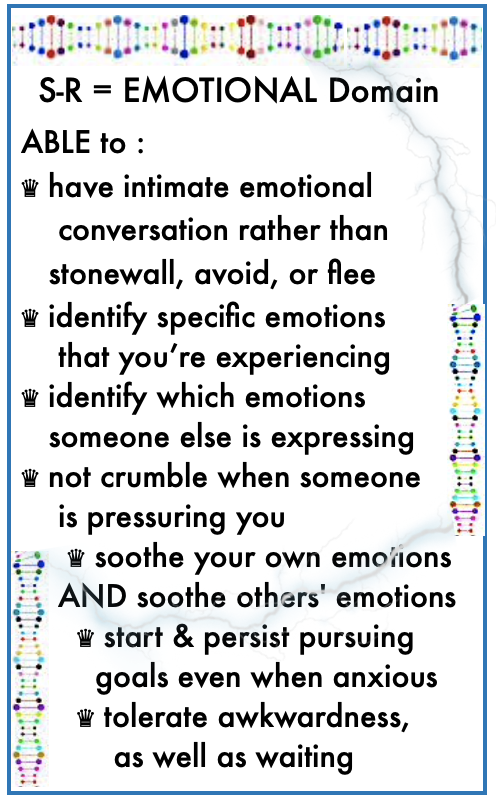
🔘 Be assertive, not aggressive – Don’t crumble when someone is pressuring you. EXP : Stand your ground when a salesperson is trying to upsell you or trying to make the sale by making you feel anxious

🔘 Body Awareness & Sensations – Include exercises in your schedule, to clear everyday stress. Stay mentally awake to keep a check on how your body reacts to different situations & sensations

🔘 Compliment Someone – Doing this every day makes you emotionally stronger, & improves relationship with people you deal with or who pass thru your life.
EXP: ‘That’s a beautiful scarf”  //  ‘I enjoyed your talk”

🔘 Express YourselfCommunicate emotions in healthy ways, both verbally as well as in artistic activities (dance, design, paint, read /write, sing….).  Consistently doing anything you love aligns your mind and body to be more coordinated/unified

🔘 Form a Bedtime Routine – Add a special activity before sleeping as a self-reg strategy. EXP : Read a chapter, thank God for the day, brush your teeth, listen to a soothing visualization….

🔘 Have Intimate Conversations – rather than be superficial, stonewall, avoid, or flee. EXP: Your partner wants to talk about having another baby & you absolutely have no such intention. Take time to calm yourself, think thru how you want to express your feelings & point of view – always using “I” statements.
Don’t give in but don’t attack.

🔘 Identify Emotions – Emotional literacy is the ability to notice & accept all your feelings, as well as those of others. Improve emotional S-R skills by understanding why you feel certain ways & find healthy tools to manage them, instead of suppressing or acting them out on others

🔘 Make a Gratitude List – List them in your journal, regularly review all the things you love, to keep reminding you of goodness in life & a reason to keep going/ growing

🔘 Reframe Negative Thoughts – Most people have negative thoughts sometimes, but strong self-regulators make sure to find solutions or alternatives to feeling hopeless or being a victim of circumstances. Stop as soon as a negative thought shows up & reframe it into a positive belief or solution

🔘 Reinforcement – Reward yourself with something exciting & special – when you’ve achieved a goal.
EXP:  You’ve finally finished that project that took all your brains & perseverance. Now take the time to rest or what fills your heart with quiet happiness. Do something fun you’ve been putting off that doesn’t have to ‘lead to’ an outcome.

🔘 Practice Mindful breathing techniques every day to keep you ‘sane’ & present in the now. It minimizes stress, anxiety & anger, which ultimately helps stay in S-R. Christian prayer & Bible reading (like the Psalms dramatized) also provide comfort & self-control info to guide your actions, especially in tough times

🔘 Positive Self-Talk – Affirmations like “I’m ok just the way I am, I can do this, I know what I know”…. encourages you to function at your best & keep on trying, even when frustrated or can’t see the outcome

🔘 Supplements – Many health problems can be linked to nutritional deficiencies.  Add supplements to support Mind-Body Health, making S-R easier to practice.  EXP :  Vitamin A, B6, B12, C, D, Calcium, Folate Iodine, Iron, Magnesium, Zinc…. for physical, emotional & cognitive health

🔘 Tolerate awkwardness – Communicate clearly & directly when it makes sense to do this, even when feeling awkward. EXP : When you need to explain to someone why you’ve decided not to use their services, having to go back on a promise, cancel a date or appointment….

🔘 Visualizations – Use imagination to create a mental picture as a motivation to pursue goals, TO :
▷ increase confidence   ▷reduce stress ▷ rehearse a scenario the way you want it to turn out   ▷  prepare for a big even at work or personal life  ▷stay connected to your Inner Child & Higher Power

🔘 Wait – Be willing to delay gratification in order to continue working toward a desired goal. Waiting does NOT mean ‘No or Never”- just “Later”. 😣
EXP : You’re trying to lose weight, so you wait ’till tomorrow to eat the rest of the dessert you made since you’ve already had one portion

NEXT : STRESS & Body Parts + Relaxation
Self-Regulation MYTHS √

PREVIOUS: S-R – Adults, #2

SITE : “The Myth of Self-Regulation”


NOTE
: T.E.A. = Thought, Emotions, Actions (moods, feelings, body /behaviors)


BASED on info from The MEHRIT Centre
#1. MYTH“Scientists all mean the same thing about S-R
ANS : Dr. Jeremy Burman documented 447 different uses of “self-regulation” in scientific literature, grouped into 6 distinct concept-families (domains)

#2. Not being able to self-regulate is a ‘moral failure’
ANS : When a child can’t regulate their actions, thoughts or emotions they’re not being disobedient, manipulative, mean or trying to irritate someone. More likely it’s from curiosity (how does this toy come apart?), finding something funny or strange (making fart sounds), by accident, or induced by stress.

#3. It’s just about managing stress & emotions
ANS :
S-R is as much about up-regulating pleasant emotions (interest, love, happiness…) as down-regulating painful ones. It involves controlling & modulating what you do with your body & brain as well as emotions. Learning to manage stress produces a calmness that opens doors to practicing all forms of self-regulation.

#4. It’s just another word for ‘self-control’
ANS :
S-R is concerned with how we manage stress & energy, not about inhibiting impulses or shutting off feelings that arise from excessive stress. It involves learning to control, plan, monitor…our T/E/As. Importantly, it also involves learning when to let loose & just be yourself.

#5. A child’s ability to self-regulate, like intelligence, is genetically determined
ANS : Neither is genetic, although biological issues can make it harder for some children to learn to manage their behavior from life’ stressors

#6. Only children need to learn self-regulation
ANS : Executive functions (E-F) change throughout life, so they have to be adjusted according to our health & circumstances. Having to plan & organize, control our impulses, remember important information, monitor our behavior, & be flexible in our thinking are huge tasks, so are just as critically important for us adults as to our children.

#7. It has to be taught early or not at all
ANS : Excessive stress in the early years can have a strong effect on a child’s ‘reactivity’ (be out of control), but it’s never too late to be appropriately modified & corrected .
Actually, S-R takes more than 20 years to fully develop, so there’s a wide time-window for teaching / learning how to self-regulate. But anyone who has to start much later in their development will have to unlearn some old habits while developing new skills.

#8.  It turns children into ‘tiny tyrants’
ANS : Children learn how to self-regulate their T.E.A.s in ways that fit each family & culture. The adults make sure children learn when they can let loose to do whatever they want – as well as what’s not okay, and how to channel their needs & desires. As children grow they can be freer yet still need adult guidance, but with less close supervision.

#9. It can’t be learned by some children
ANS : All children can learn self-regulation. That means young ones, those with learning challenges, the gifted ones… everyone can improve. Some children will need more support & practice, and some need unique learning tools, but every child can benefit from refining their S-R skills.

 #10. It is just a form of behavior management
ANS : Self-Reg does provide a more effective way to manage behavior than traditional behaviorist approaches, since it’s about understanding, not imposing external control (by fear), & improving negative conditions that cause mis-behavior.

Adults teaching a child S-R skills can reward desired behaviors to decrease acting out or making undesired choices. It includes helping children understand when & where they need to self-regulate.

#11. It lets parents and teachers be permissive
ANS :
S-R is about recognizing & reducing stressors, so structure is important & very much wanted by children, who do not thrive in chaos or neglect. Permissive parents are as great a stress for children as the authoritarian type.

Children need to learn how to control themself & their social interactions in order to get along well in the world, with guidance as to the appropriate times & places to do different things.
EXP: Running down an isle & yelling in a church/ synagogue /mosque is NOT ok, but is both appropriate & encouraged at games, concerts, rallies….

NEXT: S-R  Growth

Self-Regulation – ADULTS (Part 2) √

PREVIOUS: S-R & Adults S-R (#1)

BOOK : “17 Exercises to Foster Self-Acceptance & Compassion”


S-R INFO

Shanker’s Self-Reg® 5-point strategy helps us understand & respond to ourself & others, across all 5 interrelated domains :
🍃 Reframe the ‘difficult’ behavior / event
🍃 Recognize the specific stressor (across any domain)
🍃 Reduce the stress whenever & as much as possible
🍃 Reflect : increase stress-awareness, so you won’t be surprised each time a similar situation shows up – be prepared or avoid it before it happens again
🍃 Restore : develop personalized strategies to promote resilience & healing

Regularly using these strategies can replace impulsive, self-defeating behaviors with mindful, beneficial activities. Notice that the first 3 are immediate & happen “in the now”. The last 2 are ongoing & in a constant state of refinement. However, even though listed in order, any of them can be used at any time – as needed.
«

«
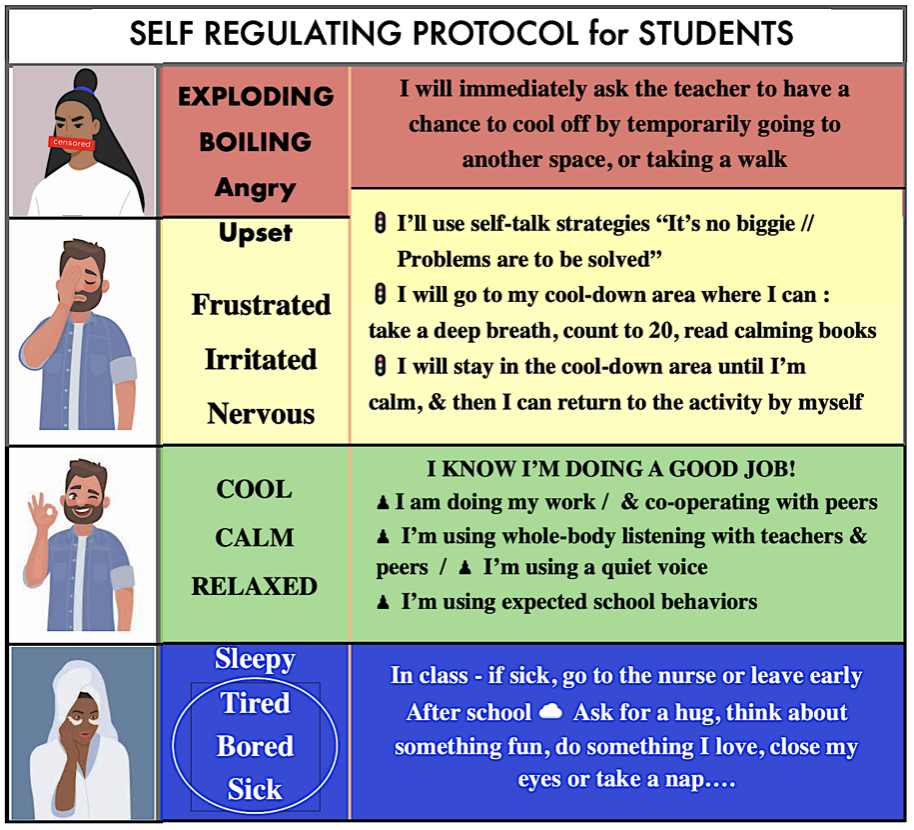
NOTE : This chart was originally compiled to benefit students. However, it can be a useful guide for any ACA who is stuck in childhood stress mode – to make gradual shifts by staying awake for their pattern of self-torture or dissociation.

Remember that everyone has a limbic system, & is affected by daily stress to varying degrees. How we respond depends on our S-R strength at the moment, & what our individual triggers are with a particular person or when in a group.

IMPULSE CONTROL
A major task of S-R is being able to separate our immediate impulses from long-term desires. We can plan, evaluate our behavior, & prevent ourself from taking any action which is self-defeating, socially inappropriate or harmful to others. Violating our deepest values creates guilt, undermining self-esteem & emotional well-being.

The cognitive bias known as illusion of control identifies a person over-estimating their own ability to manage / have an effect on events. It’s often triggered by an early history of chaos, uncertainty & abuse.
Sayette (2004) describes S-R failures in two categories:
1. Under-regulation – when a person fails to control oneself
▷ Trouble managing one’s emotions (lack of self-soothing, correct negative thinking), which can lead to problems in relationships, work, school. EXP : When feeling depressed, anxious, rageful….

2. Mis-regulation – having some control, (weak self-efficacy) but not able to reach a desired goal
▷ Using flawed strategies, like negative self-talk, avoidance / procrastination, & addictive behaviors.

Improve Self-Regulation
✴︎ Live in alignment with your values & acting with integrity. Be a good role model, practice what you preach, create safe, comfortable environments for yourself

✴︎ Believe in yourself: boost self-efficacy by working on self-confidence. Focus on the experiences in your life when you did succeeded, & keep your mistakes in perspective. Choose to believe in your own abilities & surround yourself with positive, supportive people who know your best qualities

✴︎ Identify your triggers: cultivating a sense of self-awareness which will help you learn what your strengths & weaknesses are, and what can trigger you into a troubled mental & emotional state

✴︎ Reframe negative thoughts : practice taking a step back from all your thoughts & emotions.  Evaluate & disagree with the harsh ones, & come up with positive alternative beliefs & present-day reality options

✴︎ Keep calm under pressure: removing yourself from the stressful situation for the short-term — mentally or physically— & use relaxation techniques like deep breathing, exercise, prayer
✴︎  Consider the consequences: stop to think about the results of giving in to some “bad” behavior (remember what happened in the past, what’s likely to happen now & what this behavior could trigger in terms of longer-term consequences)

✴︎ Seek feedback : It can be hard to look at yourself objectively all the time. Asking for feedback from trusted colleagues or friends can be very helpful on your journey of awareness & self-regulation

✴︎ Stay open to change : use your inner strength to deal with life-shifts – in direct, positive ways, improving your ability to adapt to different situations while staying hopeful & creative

✴︎ Practice self-discipline: commit to taking initiative & being persistent, as you work toward your goals, even when it’s the last thing you feel like doing!

NEXT : S-Reg – MYTHS

Self-Regulation – ADULTS (Part 1) √

PREVIOUS: S-R & Students

SITE : “Most Effective Emotion Regulation Strategy


As ADULTS : How we deal with life’s stressors lays the foundation for all other activity.  Developing self-regulation (S-R) requires emotional intelligence, self-awareness, & efficient filtering of sensory input. It’s the ability to cope effectively with problems, interact well-enough with others & keep mentally focused.

FOUNDATION of S-R : Being kind to yourself
One of the most important requirements is practicing self-compassion, especially giving yourself some grace when struggling.  Since nothing & no-one is perfect, we can learn from failing & disappointment – if we reframe situations correctly.

Broadly – S-R is both the ability to START doing something &/or to STOP doing something – when needed. S-R people usually can delay gratification (for an age-appropriate length of time), & suppress immediate impulses long enough to consider consequences or plan alternate behaviors.

In S-R, when triggeredboth our action-responses to stress & the underlying energy or tension need to be identified & addressed. Some coping tools are: good health habits, psychological self-care, developing resilience, religious &/or secular education….  (More….)

Main S-R strategies
❤️ Emotion-focused  – reducing or minimizing internal painful emotions. They’re used when one’s situation cannot be changed.
EXP : Emotional venting, Resigned acceptance, & Preparing for the worst…

Benefits :  • Clearer thinking
• Easier to stay in the present
• Healthier emotional expression
• Reduces toxic stress

💚 Problem-focused – dealing with the cause of stressful experiences, or to correct overtaxed personal resources. They’re used when one’s situation can be changed.
It’s about taking action, creating constructive solutions or strategies to improve things.
Because this approach is externally focused, the goal is to solve realistic problems rather than change one’s emotional state in difficult circumstances.

EXP : A student who is nervous about giving a presentation may cope by practicing it for several days before the event, attending “How to Present”seminars, &/or asking friends to listen to what they’ve written to get helpful feedback.

FOCUS of S-R Strategies
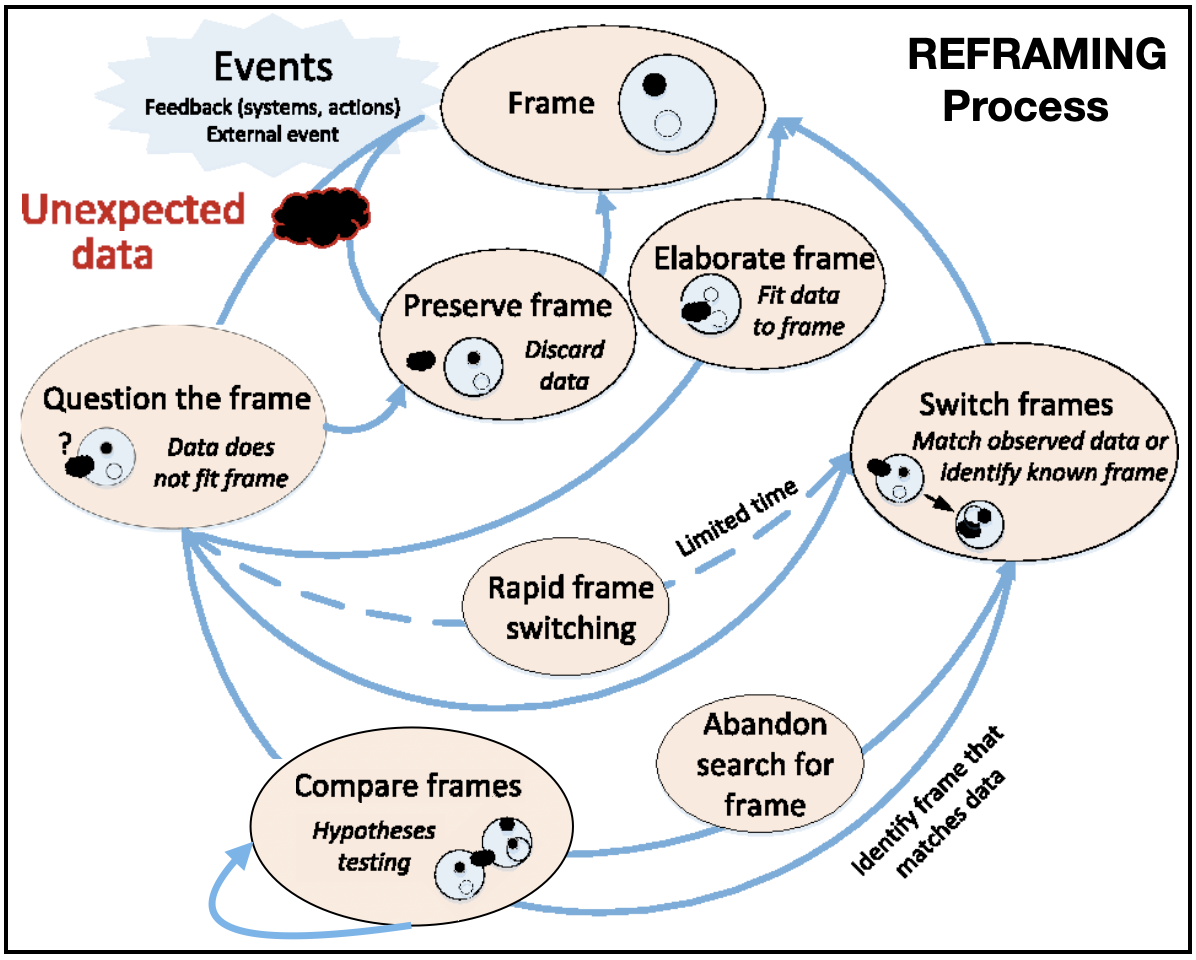
a. MENTAL = Cognitive reframing
(thinking realistically) is when a person “fills the gap” between what is expected & what has been observed, trying to make sense of what is going on following a surprise.
(Explanation of component parts  ⤵️ )

«
S-R is strengthened when we correctly interpret a potentially emotion-eliciting situation (pushes our button), by reversing how we ‘see’ it – from a negative to positive point of view.
Challenging unhelpful thoughts / beliefs (narcissistic, self-hating….) will legitimately change the emotional response to the stressor, ‘lightening’ what might otherwise have an intense impact.

EXP : A friend does’t return your calls or texts for several days. You get more & more upset or angry, & start making up negative scenarios. Rather than being convinced this has something to do with you (rarely!), such as “He/ she hates me” or What did I do wrong?”…..  you could instead think “She must be really busy with family or maybe sick, or HR is interviewing other candidates, so it’s normal to wait, or I just remembered – he said he was going on a trip”….

Research shows that accurate mental evaluations produce fewer painful emotions (anxiety, self-hate) & negative defenses (avoidance, distraction, dissociation).  A 2016 study examined the link between emotional well-being and S-R strategies (mindfulness, cognitive reappraisal & emotion-soothing).

These tools make us feel more grounded, reducing pleasant emotions such as enthusiasm, happiness, satisfaction & excitement or peacefulness.
Other useful S-R strategies include Acceptance of all emotions, Behavioral options, Self-soothing & Problem-solving. Also, being positive by Celebrating small wins or when achieving a goal. (Read all posts inWhat just happened?

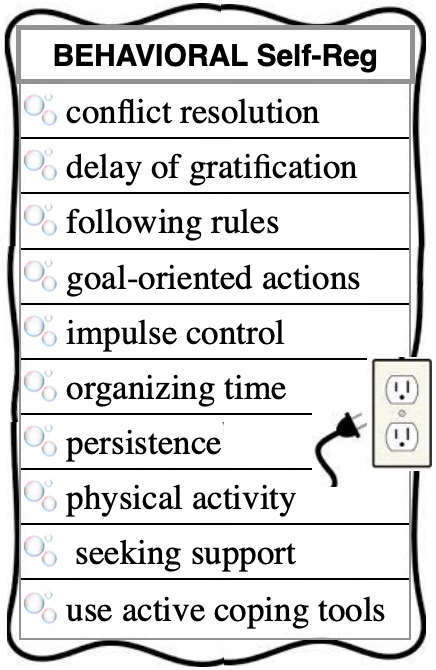
b. ACTIONS = Behavioral S-R is when we DO specific things that move us toward short or long-term goals. This type of strategy lets us us stay in charge of ourself no matter how we’re feeling at the moment.
EXP : You don’t want to go to the office today, but you have to – because the ‘big’ meeting that’s scheduled at 9am will have long-term consequences for you – like a promotion or salary hike in the near future. So, you get out of bed, take a shower, dress & arrive at work on time.

LACK of S-R can cause a range of mental health problems. In children & young people it’s most observable in aggressive & impulsive behavior, attentional difficulties, withdrawal, self-harm, & engaging in hi-risk behaviors such as substance use.
«


«
NEXT
: Self-Reg & Adults, #2

Self-Regulation – STUDENTS √

PREVIOUS : Self-Reg for CHILDREN

SITE : “Components of Self-Regulation” – re. Students w/ EXPs.

REVIEW :  Self-Regulation is a ‘SOFT’ skill, made up of personal characteristics that give s person the ability to regulate one’s reactions. This helps them interact successfully with others. Failure to do so leads to conflict or estrangement. 

S-R forms the conditions that allows the person to guide their thinking & activities. It greatly helps a person to be self-motivating, & be able to use inborn mental abilities for academic skills. 

It’s linked with meta-cognition – (“thinking about thinking”) the awareness of one’s mental strengths & weaknesses (how their mind works & what they know).  SKILLS :▫️declarative knowledge (about oneself as a learner – factors that influence their performance)
▫️procedural knowledge (about strategies & procedures)
▫️conditional knowledge (why & when to use a particular strategy).

STRATEGIES of meta-cognition :  • Set goals
• Have good time management
• Keep an academic / learning journal
• Plan learning activities //      • Do task-analyst of problems
• Ask questions before, during & after reading relevant material

Self-regulated Students do these tasks especially well
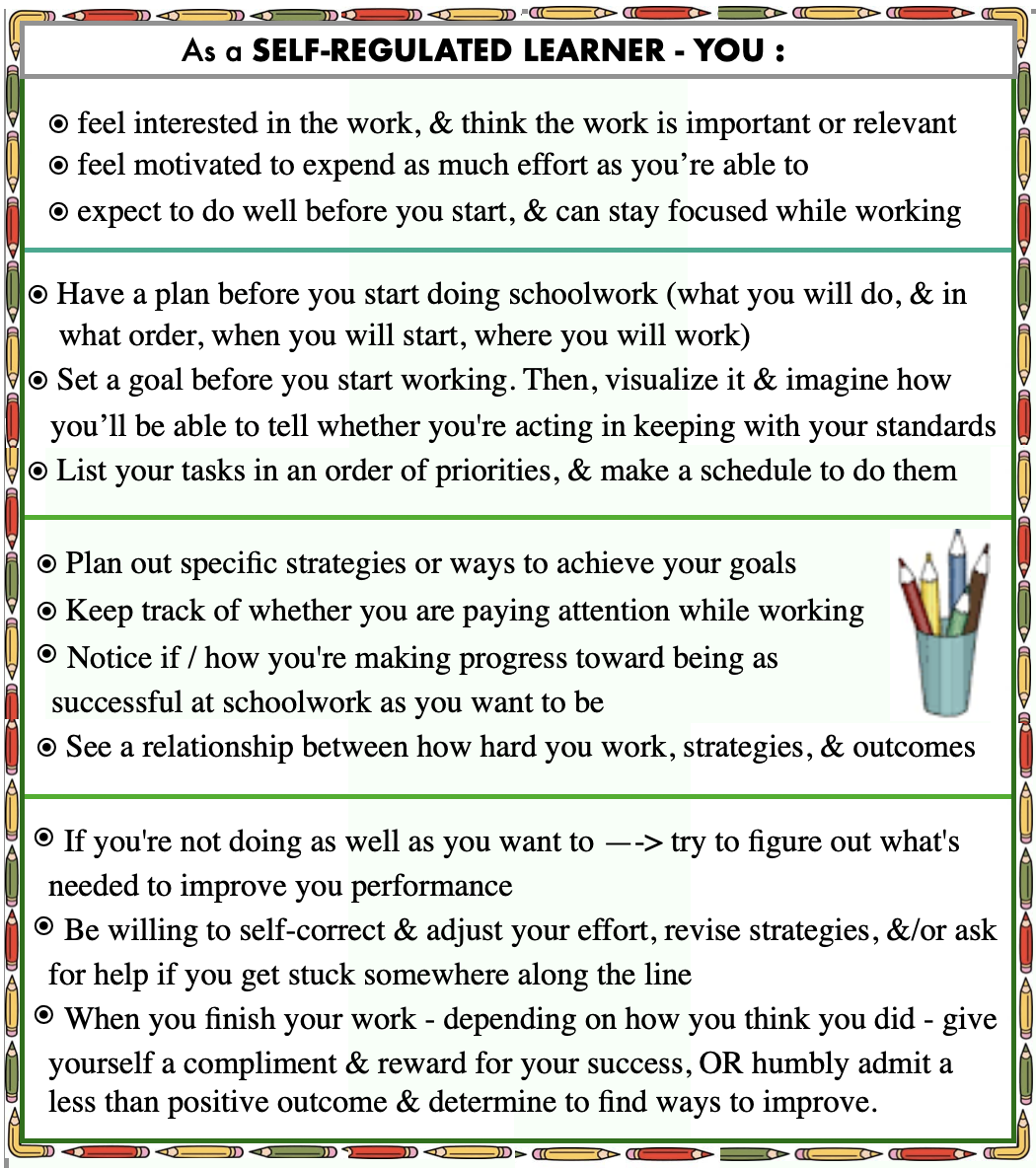
S-R learning is not an innate ability, but rather a skill set that can be developed to help students direct themselves through the learning process. This allows students to become less reactive, & more proactive in their studies. THEY CAN :

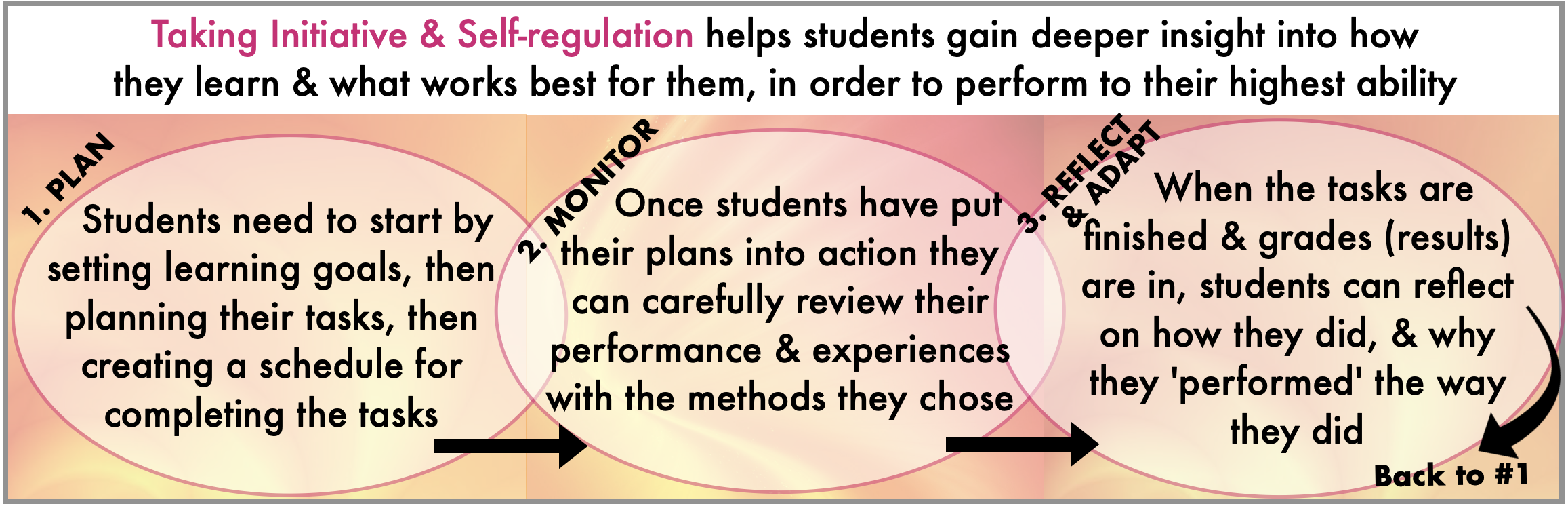
1. Plan: Systematically use meta-cognitive, motivational & behavioral strategies (chart ⬆️) . Set sub-goals, such as thinking about when & where to study, or choosing approaches for a given assignment, exam or assessment format.

2. Monitor: Reflect on how effective certain locations or strategies are when studying, think about what to do when obstacles arise, & determine how good one’s understanding of the content is. They respond positively to feedback about how they’re doing academically

3. Evaluate: Self-perceptions of academic accomplishments – think about both the outcome of the assignment & teacher assessment, & the effectiveness of the strategies used. ☀︎ They attribute performance to their effort & strategies rather than to external influences.
Ways students can monitor progress : 🔸Checklists (EXPs)
🔸Self-monitoring sheet (EXPs) //  🔸Self-monitoring log (EXPs)
«

«
▶︎ Each child is different, which includes children with complex disabilities such as ADHD or Autism, who have trouble self-regulating. Children should be encouraged to self-regulate in their own way, responding to different self-regulation strategies based on their personality, developmental stage & mental capacity.

TEACHERS – of younger students:
✪ Offer the child the chance to take a break from the current activity, environment or being around others
✪ Ask them about their emotions, & validate what they say they’re feeling
✪ Provide & take them through a calming or distracting activity, such as reading their favorite story
✪ Offer an object they find comforting or relaxing, such as a favorite toy, book or blanket
✪ Give them the chance to release their energy if they need to, such as running around in the yard.
«

«
▶︎  If a reactive child can calm down, the following strategies can help them reflect on what has just happened, & build self-regulation skills for the next time they’re ‘triggered’ :
✪ Describe what positive self-regulation responses are / look like
✪ Role-play or encourage the child to practice alternative positive responses
✪ Recognize & acknowledge when the child self-regulates & uses positive responses
✪ Brainstorm with the child what strategies work for them, and what they can do in the next challenging situation.

NEXT : Self-reg for ADULTS, #1

Self-Regulation – CHILDREN √

PREVIOUS : S-R =

SITE : How to crete a safe environment 


⬅️ The 5 Domains


SELF-REGULATE (S-R) in “CONTEXT-CHART ” ⬇️
showing the range of factors that influence if & how well a child / youth can S-R in any given situation. Although the concentric circles begin with the most internal factors & extend outward, each layer will interact with & influence the others.

a. BIOLOGY : The most internal factors include the child’s genetics, physicality & temperament – contributing to individual differences in S-R ability
b. SKILLS : The talents & abilities the child / youth has developed over time, which can serve as areas for interventions, when needed
c. MOTIVATION : The child’s reason to S-R, either from external sources (via rewards or consequences), OR from internal goals & values (intrinsically motivated).

d. CAREGIVER SUPPORT- (from parents, teachers, mentors) which strengthens the  child’s S-R skills, buffering them from distressing experiences in the larger environment.
e. ENVIRONMENT : the overall context also influence the child’s ability to S-R, including demands or stressors placed on it, as well as any external resources available.

EXP : Environment will affect a child’s biology by shaping brain circuitry, while their biology or temperament can influence how a caregiver /parent interacts with the child.

Research suggests that a young child’s self-regulatory (S-R) activities are a better measure of future academic achievement than IQ scores.
EXP: A child unable to self-regulate at age 4 will likely have trouble following teacher directions at age 6.
«

«
SELF-Regulation attars to develop in the toddler & preschool years, & continues into adulthood.

🔆 Babies might suck fingers for comfort, may look away from their caregivers if they need a break from attention or are getting tired. But they can’t actually S-R, so it’s important to comfort them & help them calm down when they’re unsettled.

🔆 Toddlers can only wait a short time for food & amusement. So they may snatch toys from other children if it’s something they really want. Tantrums can happen when they’re overwhelmed by strong emotions.

🔆 Preschoolers start to know how to play with other children & understand what’s expected of them. EXP : they may make an effort to talk softly when at the movies.

🔆 School-agers improve at controlling their own wants & needs, being able to imagine other people’s point of view, & see both sides of a situation. EXP : they may be able to disagree with other children without arguing.

🔆 Pre-teens & teens are better at planning, sticking to hard tasks, behaving in socially appropriate ways, & considering how their actions affects other people. EXP: they may think about the parent’s perspective when negotiating curfew.

ADULTS can help children learn self-regulation
Young children who naturally feel things intensely find it harder to self-regulate, compare to those who are more easygoing, as well as older children & teens who have developed the capacity to S-R.

📍 It’s important to match adult expectations of the child’s behavior TO their age & stage of development. This helps them avoid the frustration of not understanding or having the skills to do what’s being asked of them

📍 Parents can apply calming-down strategies for toddlers, calming down steps for preschoolers, school-age childrensteps for pre-teens & teenagers
📍 Adults can encourage the child’s ability to identify, understand & manage emotions.

📍Parents need to Plan for challenging situations when younger children might find it hard to behave well.
EXP : “The store we’re going to has lots of things that can break. It’s OK to look, but please don’t touch”. Give your child a gentle reminder when entering, “Remember – just looking, OK?”

📍 Adults can model self-regulation for child. EXP: “I’d better stop gardening now so I can get you to ____ on time”. Or ‘That was really tough to deal with, but I managed it”.
📍 Involve pre-teens & teens in problem-solving and negotiating difficult situations. EXP :  “I’m working all weekend, so I know it’ll be boring for you. Let’s figure out how you can make the most of the time while you wait”.
📍 Praise child when they show self-regulation & manage a tricky situation well. EXP: “You were great at waiting your turn’ OR “I liked the way you were calm when Sam teased you”.

NEXT : S-R & Students

Self-Regulation : CO-REGULATION √

PREVIOUS : Pro-social Domain

SITE : LIST of
Blogs & Practice Resources 

CAREGIVER = usually the mother, but may be a substitute.

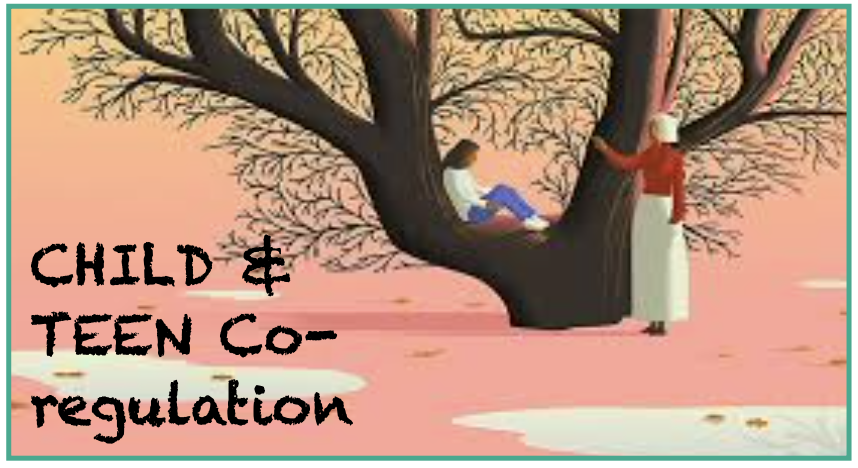
DEF : Co-regulation (Co -reg) is how children develop the ability to soothe & manage scary emotions or painful sensations – through a healthy attachment to nurturing & reliable primary caregivers.

Basically – it’s when a loving adult is able to figure out what a child in emotional distress needs during a stressful incident – that will calm the child or help it calm itself.
EXP :  A warm, gentle presence & tone of voice, verbally acknowledging distress, acting in ways that soften the upset, & in a structured environment providing emotional & physical safety

Our biology is wired for connection. The autonomic nervous system (ANS) plays a crucial role in co-regulation, making it possible to tune in to others’ emotional states, & vice versa. It’s a continual interactive growth process formed by healthy experiences that lead to well-being – rewriting the story of trauma into one of resilience. It expands our capacity to handle intense & complex feelings, especially shame & grief.

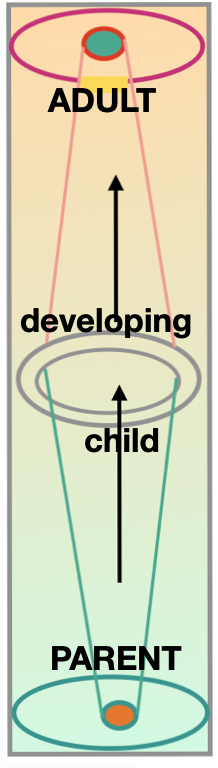
CHILDHOOD : Co-reg is called “caregiver-guided dyadic regulation”, a critical precursor to emotional self-regulation. The most effective way for an infant to cope with distress is to look for help from a caregiver. Sensitive, reliable responses from the mother can show the infant that emotional distress IS manageable, either with her direct comfort, or developed during consistent interactions with her.

Early co-reg is initiated & maintained by the parent, who makes the effort to soothe the child’s emotional distress. ** To be successful, the adult’s responses have to be adjusted to closely fit the infant reactions when stressed, which will encourage it to behave in way that suit its personality. Over time the co-reg becomes more even & more indirect, as children develop their own ways to emotionally self-regulate.

The adults are still willing & available to help with distress when needed, but not over-involved. As the child grows, healthy parents give them space to manage their own style, add suggestions for co-reg improvement, & eventually may have abstract talks about a variety of emotional experiences & appropriate responses.

Emotions are often contagious, whether a person is upset or calm. So before a parent or trusted adult can help a child, they need to understand & own their own emotional limitations & resilience . Recognizing how they’re feeling & being able to actively regulate their own emotions at difficult moments – will allow children to copy those self-comforting skills.

Benefits : Co-regulation teaches kids inner & outer tools to handle stress. Through warm, responsive interactions, caregivers help young people learn better ways to manage their emotions during inevitable upsets & challenges of life. This incorporates all the Executive Functions needed to express the True Self.

ADULTHOOD – DEF : “A bi-directional linkage of oscillating emotional channels between partners, which contributes to emotional stability for both”.
▶︎ ie : the mutual exchange of comfort, support & understanding, a process of interactions with a trusted  “other” which help regulate our emotional & physiological states.

Here the strength of co-regulation is based on categories of attachment – those early experiences with family that become internalized, which guide a person’s expectations of & behaviors in future close relationships.
Some differences from the childhood process:
1. adult co-reg is a form of reciprocity between partners, so that the responsibility to regulate each other is more or less equal
2. it’s more likely to include physical measurements, based on reward systems (oxytocin, opioids), strongly activated by sexual contact
3. it’s a continuous, dynamic process as each participant repeatedly regulates the feelings & behavior of the other – not an exchange of limited or occasional experiences.

Generally – it’s the interactive process by which caring adults :
(1) maintain warm supportive relationships
(2) promote self-reg through coaching, modeling & feedback
(3) develop supportive environments. Co-reg works best when these processes are matchedto individuals or groups by age, fit their values & goals, & are flexible according to the demands of a situation.

EXP : ✥ Romantic relationships : partners supporting each other emotionally through joy, stress & ‘mormal’ challenges – to encourage a deeper understanding & connection
✥ Friendships : sharing experiences, offering empathy & supporting each other through life’s ups & down
✥ Work : colleagues supporting each other emotionally to reduce work-related stress, by acknowledging feelings, collaborating on projects, or celebrating successes.

NEXT : Self-regulation & Children

Self-Regulation : PRO-SOCIAL Domain √

PREVIOUS :
S-Reg — SOCIAL DOMAIN


PROSOCIAL
behavior shows a person’s sense of justice/injustice in society, which promotes empathy, acceptance & friendship.

DEF: General – Prosocial actions benefit others, such as being cooperative, sharing, helping, & caring. In adulthood :
☆ Emotional empathy relates to the feeling-response that comes from recognizing another person’s need
☆ Cognitive empathy is when someone can see things from another person’s
perspective, imagining what they think & feel.
When that happens the empathizer’s neurological activity-pattern is similar to when we experience the same situation, almost as if it were our own.

The Big Five Theory (OCEAN) specifies broad traits :  Openness / Intellect, Conscientiousness, Extraversion, Agreeableness,  Neuroticism.
❖ Conscientiousness & Agreeableness are linked to prosocial responses.

The Prosocial Domain supports self-regulation across all domains
The basic elements of understanding others’ needs & intentions, a general interest in joint activities, empathic concern & caring behavior – emerge during the 1st & 2nd years of life.
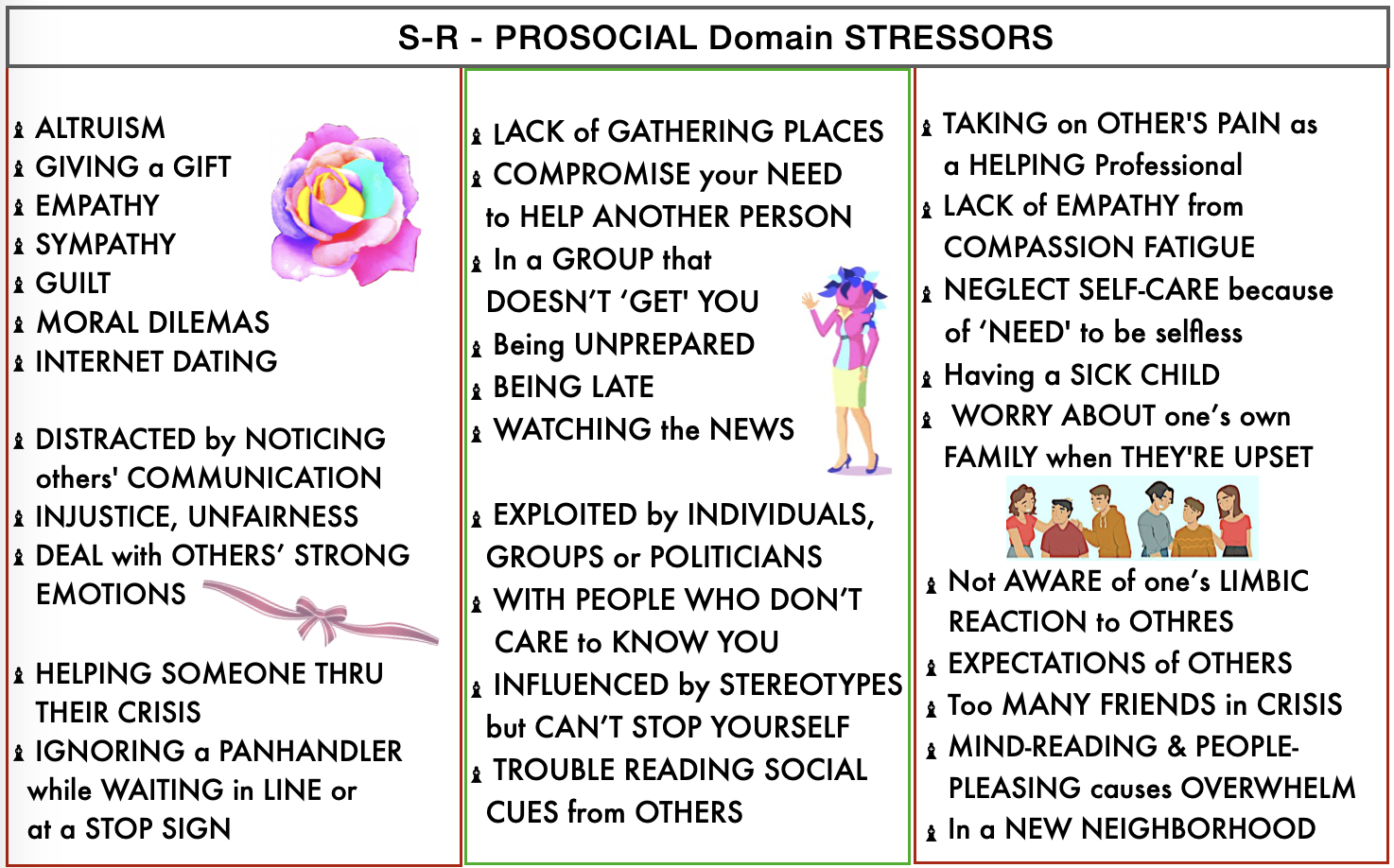
It includes the ability to cope with other people’s distress, having a sense of justice/injustice, & the ability to co-regulate with others, & sometimes putting other’s needs & interests ahead of one’s own. In this category – the focus is on connecting, as in the Social domain, & stressors are also experienced in relation to others.

Children – Theories & evidence indicates that pro-sociality in children develops from a combination of genetic inheritance, emotional & social-cognitive development, and the guidance of parents & teachers who model & reinforce the learning of social & moral norms.

EXP : If a child falls on the playground – other students would notice it, stay calm, maybe identify with their pain, & do something to help.

Their prosocial functioning depends in part on a child’s ability to control their behavior. In developmental psychology, self-reg is considered from 2 broad frameworks :’effortful control’ and ‘executive function‘, having 2 important components in common  :
✴︎ Attentional control – the ability to mentally hold information that’s relevant to completing a task, & to focus without getting distracted
✴︎ Inhibitory control – the ability to suppress a dominant or impulsive response, which includes resisting temptations & waiting one’s turn.

EXP : re. helping others, a child must be able to identify what another person is trying to do, & hold that goal in mind (attention), while also disengaging what they’re currently doing (inhibition), & then follow thru with an action that will help the other person achieve their goal (attention).

Adults – Women engaged in prosocial behaviors more often than men. Other predictors are : community cohesion & grit (perseverance & passion for achieving long-term goals.)

Research re. self-control & life-satisfaction found that people with high levels of self-control have the tendency to engage in more prosocial behavior, which can translate to higher life satisfaction. (More…..)
The prosocial attitude of empathizing with another – with its emotional underpinning – is an important precursor to generosity or self-sacrifice.

💝 Altruistic : Any voluntary action motivated by goodwill & concern for others’ needs, even at one’s own expense. 4 categories : to uphold a moral principle, to benefit oneself, another person, or a group.

🤍 Anonymous : doing something for others without being recognized, so those who receive help don’t know who provided it.
❤️ Compliant : involves helping others when they ask for help (rather than spontaneously).
💚 Emotional : a tendency to respond with sympathy & higher levels of morality – when providing help to another person who is in a highly emotional situation.
💘 Dire : helping in a crisis or emergency, which naturally are emotionally charged circumstances
💟 Public : performing helpful acts in front of others, because they’re not afraid of being watched.

OLDER adults –  Generativity : contributing to the next generation is important for one’s well-being throughout middle & late life. EXP : Parenting & work are common ways, as is Prosocial behavior.

Researched in Western societies during COVID – found 2 opposite prosocial responses. Generally, their prosocial behavior increased, being more in-group focused than younger adults when choosing who to help, & made larger donations to national rather than international charities. (See maps…..)
However, some studies of older adults found heightened anti-prosocial reactions, including a greater focus on their own emotions, increased negative stereotyping of ‘out-groups’ & less support for foreign aid.  (More….)
«

«

«
NEXT : Co-regulation

Self-Regulation : SOCIAL Domain √

PREVIOUS : Emotion Domain

SITE : “Effects of Social Isolation on Mental Health”


The SOCIAL D
omain refers to a category of human interactions with its own distinctive rules, expectations & behaviors for responding appropriately in social situations.  It includes developing social skills such as collaboration, fair play, leadership & communication, that help us enjoy participating effectively with others.

It’s our ability to engage in social networks that promote overall well-being & optimal performance. Being socially healthy doesn’t mean having many intimate friends, a multitude of casual acquaintances, but rather knowing how to make & maintain contacts.

This domain helps to recognize that we aren’t alone – that we need to be attached, have support & a sense of teamwork.  Knowing that we have someone to turn to makes any difficult / painful day much easier to deal with.
Any society can be defined by 3 significant dimensions :
AREAS : A workplace, organization, neighborhood, village, city, state, nation or state
TOPICS : Social domains are relevant to such fields in the social sciences as anthropology, linguistics, & sociology….

PARTICIPANTS : any social, political or religious group or community (family, school, sports teams, clubs….)
EXP : social media influencers, brand managers, content writers….

Optimal :  Being able to recognize social cues & the effect of our behavior on others. Understanding & responding to the feelings & intentions of others, having good communication skills (listener & speaker), & the ability to repair or restore relationships.
EXP:  We’re encouraged to be silent in a church, or mosque. But it’s normal to make lots of happy noise at a game or concert

Social Domain Theory (SDT) examines social thinking & behavior from a developmental perspective, in 3 categories : moral, conventional & psychological. It considers emotions & moral judgments as “reciprocal processes that cannot be disentangled”. Research has found that most people distinguish —
♦︎ conventional issues – about actions that are determined to be “right or wrong” by current social norms, standards or customs
FROM
♥︎ moral issues – about actions that have an impact on the welfare & rights of others, such as minimizing harm, fairness re. individual freedom, the distribution of resources….. (“Beginner’s Guide….)

CHILDHOOD
Brain research consistently indicates that the first 5 years of life are the critical time to form social skills. Problems in this domain are caused by a distorted or traumatizing “social engagement system” &/or learning difficulties. It makes such children have trouble picking up social cues, self-regulating around others, or understanding the effect of their behavior on others.

Children who are chronically hypo- or hyper-aroused in social situations from excessive stress will more easily go into fight-or-flight, or freezes (from peer pressure, bullying, being excluded, meeting someone new….). They can react by being aggressive or withdrawn, which causes problems in several areas of life, especially learning, & then spills over into the other 4 domains.

ADULTS
Self-regulation is how well a person copes when stressed, & then is able to recover from the expended energy.
The 2 adult Social Domains are Romantic & Work relationships. Emotions & actions in these areas are organized in different ways, using different abilities.
Attachment
research has shown that the key is not frequency nor intensity of social activity but knowing how to organize** one’s behavior in each. EXP : functioning at work requires different rules & skills than those needed when dealing with mates & children.

** Organize : how our brain arranges & structures incoming information in a meaningful way, which helps with efficient storage & retrieval of memories.

Social interaction is essential to all humans, but as people age, retire & /or are bereaved, they’re more at risk for withdrawing & a reduction in their social network, with harmful effects on both mental & physical health. Social isolation can be measured objectively, while loneliness is subjective. Research in the UK noted a link between loneliness & low levels of physical activity due to injury or illness, with an increase in risk behaviors such as smoking & alcohol abuse.

However, a 2005-6 US study found that – contrary to popular belief – older Americans are well-connected, having more contact with core confidants & involvement in their community. The association between age & closeness depends on how often they interact with network members. Social contact was found to be greater among women, African Americans, Hispanics, those with less education, & non-retirees. Also – with increasing age (60s —–> 80s), there seems to be greater weekly involvement in Religious, Neighborhood, & Volunteering groups.
«

«
NEXT : Prosocial Domain

Self-Regulation : EMOTIONAL Domain √

PREVIOUS : Cognitive Domain

SITE : 5 STEPS to REGULATE our EMOTIONS


EMOTION (E) Domain (D) – often called “Affective” D.
Successful Emotion-Regulation (E-R) has many adaptive outcomes & connections, increasing our well-being, including better psychological health, social functioning, coping with stressful life events, as well as for school or job success.

The main focus of this domain is on the social-emotional development of the child – about their experience, self-expression,  emotional management, & the ability to form positive, rewarding relationships with others. It involves the ideas, emotions & reactions that influence learning & behavior.

In this context, learning goals usually start with verbs such as appreciate, commit, demonstrate, express & respect.
This Domain tracks the growth of feelings & emotional responses throughout the educational experience. An ‘affective’ learning objective could be : “By the end of this course, participants will appreciate the importance of parental engagement & communication.”

It’s about the whole range of activities, interactions & environments provided for children / students to gain beliefs, knowledge & tools.
It can also be evaluated during psychomotor activities, observing how students work together to master physical skills.

IN GENERAL the domain is about how we handle life-events emotionally, expressed in the form of appreciation, enthusiasm, drive, & values.  Specifically, it’s how well we deal with the stress of intense emotions at both extremes —> very excited or very painful ones.
🔆 It’s about the physical energy & tension created by Es, not which one is experienced nor the event that might have triggered it.

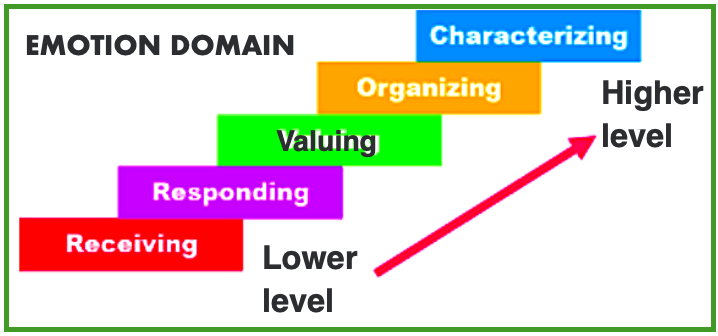
It’s layered into a hierarchy, from simpler feelings & attitudes to the more complex – as the person gradually becomes more involved, committed & internally motivated. In this process, our emotions about a person, event or situation go from a general awareness of them -—> to eventually being incorporated into our ‘selfhood’, so they consistently guide or control our behavior. This helps us understand what our values are & how they’ve developed.

This hierarchy is sub-divided into :
1. RECEIVING stimuli –
being aware of emotions & feelings, with the ability to have selective attention
🔰 Keywords (for content analysis) : ask, attention, courteous, dutiful, follows, gives, listens, & understands
EXP: Listen carefully to someone or a lecture, watch a movie, watch waves crash on the sand….

2.
RESPONDING to stimuli – the listener’s active participation, as well as reacting to various people/ places/ things. (PPT)
🔰 Keywords – answer, assist, comply, discuss, greeting, help, gifts, narrating, shows, tags.
EXP: in a conversation or group discussion, give a presentation, comply with procedures, follow directions…..

3. VALUING : the ability to see the worth we attach to something – “how important is it ?” (a particular object, experience, behavior or piece of info). Also, ways to express it clearly, from simple acceptance to the more complex state of commitment – such as from a desire for a work team to improve its skills —> to taking responsibly for its overall improvement.

🔰 Keywords : appreciate, cherish, demonstrate, initiate, invite, join, justify, propose, respect, share, treasure,
EXP : share ideas about increasing laborers’ salaries, propose ways to improve proficiency, inform leaders of possible project issues….

4. ORGANIZATION ability to prioritize one value over another,  by comparing, classifying, integrating & resolving conflicts between them. Also, forming a unique value system which determines ones priorities, guiding decisions & ways of acting toward others.
🔰 Keywords : compare, relate, synthesize.
EXP : a teen spending more time on her studies than with her boyfriend.

5. CHARACTERIZATION : the ability to internalize values and let them control the person’s behavior. Can work independently, or collaborate in group activities, & use objective methods to solve problems. Have goals which involve individual, social, and emotional patterns – which learners are able to adjust as required. 

🔰 Keywords : act, discriminate, display, influence, modify, perform, qualify, question, revise, serve, solve, verify.
EXP : practice professional ethics, modify beliefs & change behavior based on new evidence, and value people beyond superficial features.
EXP : A man marries a woman for who she is rather than ‘just’ for her looks, job or income.
 «


«
NEXT : SOCIAL Domain