
 PREVIOUS : Grief
🤎 ABBREVIATED
You aren’t showing any of the typical signs of grief , so maybe you’re acting as though no one you know died. This can happen if you’re in complete shock or total denial, & more likely when the death sudden & unexpected.
Other possibilities – √ when you rather quickly replace the diseased with someone or something new in your life, √ or how long ago you knew them, √ or that you were already grieving them a long time before they died (anticipatory grief), √or because you didn’t have a strong connection or attachment to the person lost.
🩶 ABSENT
Similar to Abbreviated Grief, in this case you show absolutely no signs, acting as though nothing ‘bad’ has happened. Again – from shock or denial. But it’s important to remember that just because you can’t tell someone’s hurting doesn’t mean they aren’t. And it also ok to not be sad or feel deep grief if it was someone you didn’t even know.
If the grief is there but hidden, it can ignored for a while by keeping busy with family & work, &/or by drinking a lot. But absent grief will usually show up at some point – usually when least expected. Grief in any form will take its toll on your body. This type only becomes a problem if it goes on for too long.
❤️🔥 AMBIGUOUS Grief (AG)
This is unresolved pain when circumstances don’t provide clear closure, & can lead to having a different attitude about who or what is ‘gone’. You & others may question whether the person is actually dead, or if you should in fact be grieving. Although grief can take many complicated shapes, it can also be shapeless. In “Ambiguous Loss: Learning to Live With Unresolved Grief,” Pauline Boss described :
Type One – is “physical absence with psychological presence”- when you don’t know for sure if the person you love has died or is just missing, without knowing what’s happened to them. EXP: kidnapping, natural disasters, terrorism, war.
OR – you know where the person is or what has happened to them, but there’s a loss of contact. EXP : adoption, divorce, incarceration, and the trend toward ghosting .
Type Two – is “psychological absence with physical presence” – there’re still around, but they’ve changed, whether emotionally or cognitively (or both), so you feel the disconnect because they’re emotionally unavailable or mentally gone.
EXP : active addicted parent, Alzheimer’s, put into foster care, from immigration, miscarriage, suicide…
Ambiguous Loss is very hard to handle
In these cases, the situation is hazy, which makes many people uncomfortable. Closure is an important piece of the complicated puzzle of grief, providing a way to process what’s happened. We crave closure because our brains are wired to analyze information from ourself & our environment. So when we know how &/why someone died, we can move on with our life.
BUT….
….. when we don’t have all the information, we lose a sense of control, & our thoughts fill in the blanks. Those ideas can be terrifying because they’re always the worst scenarios, & there’s nothing to say if what we’re thinking is wrong. That makes us anxious, obsessing about what’s really going on, which can feel like an ongoing trauma. (Solutions….)
A major symptom is that the grieving process is stuck /feels “frozen”, with persistent sadness but unsure why. (Helpful suggestion for recovery)
☀︎ Interesting : One of the most powerful ways humans make meaning out of ambiguous loss is through all the many forms of art. (Heal with art…..)
❤️🩹 ANCESTRAL
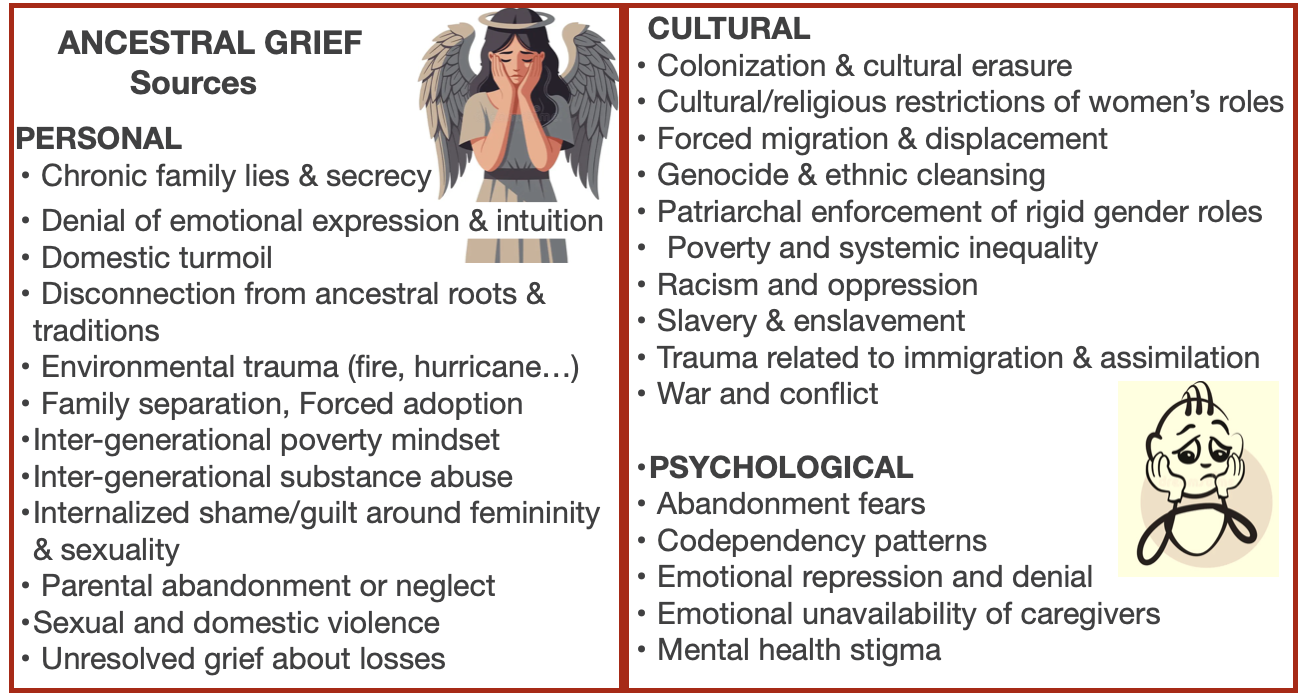
Ancestral grief is about the emotional, psychological & biological wounds passed down through generations from the traumatic experiences of your ancestors. When they faced repeated abuse, addiction, chronic illness, or other hardships, their survival instincts led to developing behaviors, beliefs, & coping mechanisms in behaviors & beliefs that helped them endure harsh, unsupported environments.
While these adaptations were crucial for their survival, they can be unconsciously transmitted to you through dysfunctional dynamics, parenting styles, & cultural norms. You might feel the pull of ancestral grief tied to your specific family traumas, shaping how safe or connected you feel in the world. (Many list of signs, may overlap with ACA after-effects)
«
«
NEXT :
 HEAL & GROW for ACoAs