
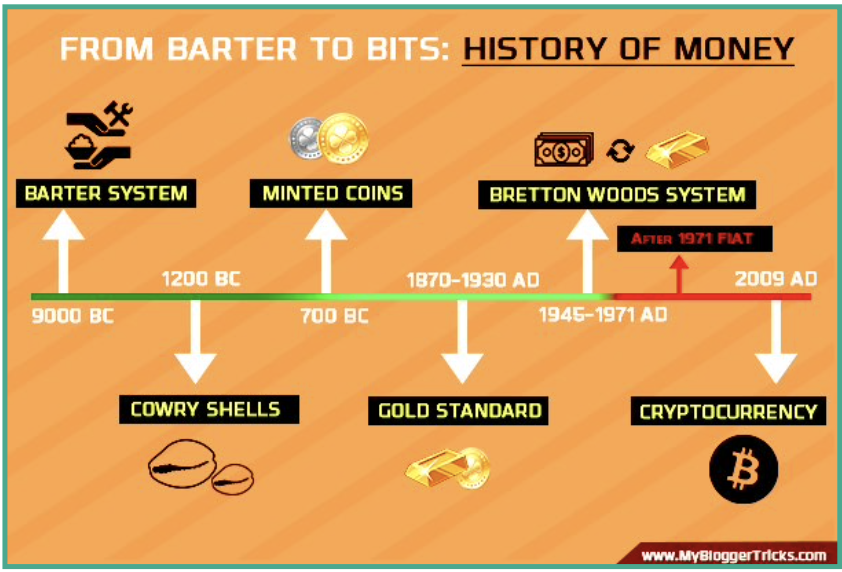
 PREVIOUS : Timeline -#1
TIMELIME (cont)
From BC = BARTER to A.D. = PAPER
A.D. 1500 : Potlatch
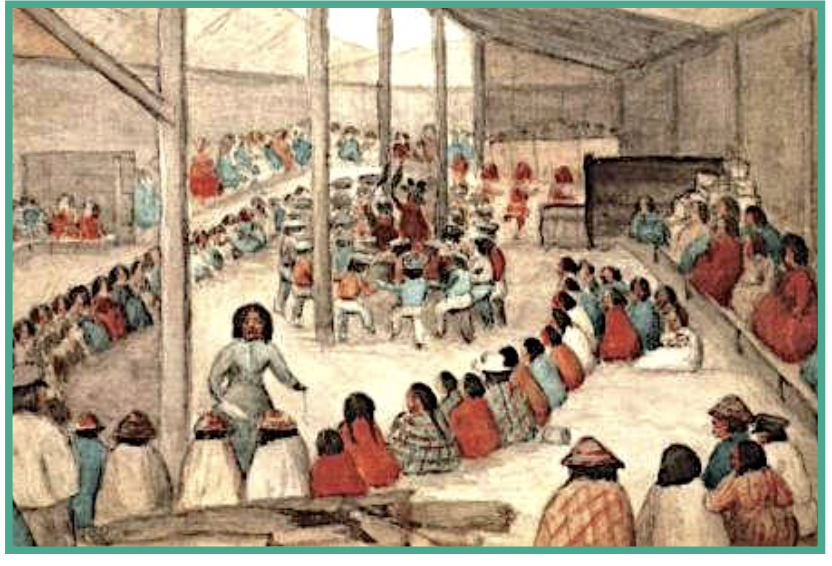 Potlatch means “gift or to give”from a Chinook Indian custom in many North American Indian cultures. In some cases it was a form of initiation into secret tribal societies, a feast where gifts were exchanged, with dances & other public rituals being performed.
Because the exchange of gifts was so important in establishing a leader’s social rank, potlach often spiraled out of control as the presents became progressively more lavish, with tribes putting on larger, grander feasts & celebrations to out-do each other.
A.D. 1535 : Wampum
 The earliest known use (1535) of wampum (short for wampumpeag = ‘white strings of shell beads’) – were made from clam & mollusk shells by North American Indians, but likely existed well before. These were used in ceremonies, as a record of an important agreement or treaty, as an object of tribute given by subject tribes, or for gift exchange. Its value derived from its ritualistic importance & the skill involved in making the objects.
1816 : The Gold Standard
Gold was officially made the standard of value in 1821 by the United Kingdom – then the leader in international finance – in response to currency problems such as fiat money. This is currency issued on the “fiat” (decree) of a sovereign government &, unlike gold and silver coins, has no intrinsic value.
Countries can issued such money at will, potentially making the currency worthless. Banknotes had been used in England & the Continent for several hundred years, but their worth had never been tied directly to gold.
In the “gold standard”, the unit of currency is typically kept at the value of a fixed quantity of gold, increasing confidence in international trade by preventing governments from excessively issuing currency. Eventually other countries, including Germany, France & the US adopted this system in 1900. p which helped lead to the establishment of a central bank.
 However, the system had its drawbacks – it limited a country’s ability to isolate its economy from depression or inflation in the rest of the world. Guidelines were added to allowed for a non-inflationary production of standard banknotes which represent a certain amount of gold.
Since then there have been a number of extreme cases of hyper-inflation. A notable case is Zimbabwe in the early 2000s, when the country issued currency in denominations as high as $100 trillion—which was worth about a loaf of bread.
A.D. 1930 : End of the Gold Standard
The Great Depression (1929–c. 1939), felt worldwide, marked the beginning of the end of the gold standard, & by the 1970s gold was no longer tied to currency. Since then there have been a number of extreme cases of hyper-inflation. A notable case is Zimbabwe in the early 2000s, when the country issued currency in denominations as high as $100 trillion – worth about a loaf of bread.
In the US, it was revised & the price of gold devalued, eventually ending the connection altogether. The British & other gold standards soon ended as well, & the complexities of international monetary regulation began.
🏧 The Present: Forms of money have continually evolved since the days when people accepted seashells for payment, as evidenced by the new $100 U.S. Ben Franklin bill. A gold standard existed until the arrival of fiat currency.
CREDIT CARDS
While credit has existed for ages, the first universal credit card was introduced in 1950. That year the Diners Club was founded in the US. & in 1959 American Express debuted. We have IBM to thank for the magnetic stripe on credit cards, introduced in the 1960s to hold account information.
Because of the stripe, merchants no longer needed to make phone calls for authorization. In the 1990s, cards had embedded chips encrypting information such as account balances, providing even greater security.
In the beginning, card users were required to pay the full balance at the end of the month. Eventually, AMEX allowed consumers to carry balances – though interest was applied – & other credit companies quickly followed. Customers took advantage of this development – maybe a little too much. In 2017 American consumers were carrying $1 trillion in credit card debt.
🁢 The Future : Electronic Money
 In our digital age, economic transactions regularly take place electronically without any physical currency. Digital cash will most likely continue to be the currency of the future. (MORE….)
BITCOINS
Bitcoin is a digital currency system created in 2009 by an anonymous computer programmer or group of programmers known as Satoshi Nakamoto. The currency is not issued by a central bank & not regulated, though a decentralized network of computers keeps track of transactions. Users of Bitcoins are anonymous, known only by their digital wallet ID.
CBDC – a digital form of “central bank money” – that is a liability of the central bank. In the US there are currently two types : physical currency issued by the Federal Reserve & digital balances held by commercial banks at the Federal Reserve.
As of June 2024, the US doesn’t yet have a CBDC. If implemented, the public could use another form of central bank money other than physical cash & digital balances held in individual or corporate bank accounts. The Federal Reserve is committed to ensuring the continued safety & availability of cash, & is considering a CBDC as a way to expand safe payment options, not to reduce or replace them. (MORE….)
SITE : The Future of Reserve Currencies
NEXT : Emotional Effects
 HEAL & GROW for ACoAs