
 PREVIOUS :
S-Reg — SOCIAL DOMAIN
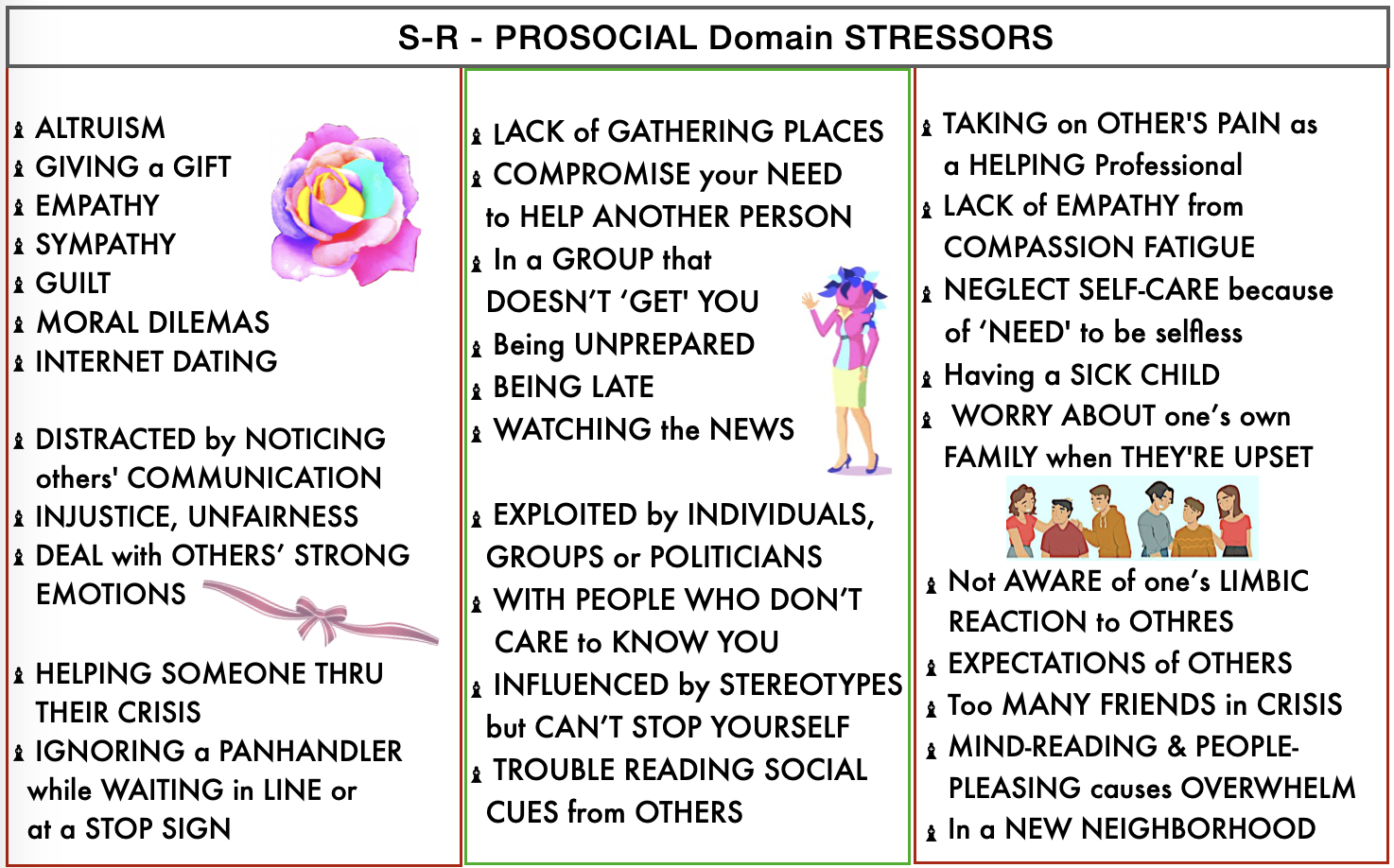
PROSOCIAL
behavior shows a person’s sense of justice/injustice in society, which promotes empathy, acceptance & friendship.
DEF: General – Prosocial actions benefit others, such as being cooperative, sharing, helping, & caring. In adulthood :
☆ Emotional empathy relates to the feeling-response that comes from recognizing another person’s need
☆ Cognitive empathy is when someone can see things from another person’s perspective, imagining what they think & feel.
When that happens the empathizer’s neurological activity-pattern is similar to when we experience the same situation, almost as if it were our own.
The Big Five Theory (OCEAN) specifies broad traits : Openness / Intellect, Conscientiousness, Extraversion, Agreeableness, Neuroticism.
❖ Conscientiousness & Agreeableness are linked to prosocial responses.
The Prosocial Domain supports self-regulation across all domains
The basic elements of understanding others’ needs & intentions, a general interest in joint activities, empathic concern & caring behavior – emerge during the 1st & 2nd years of life.
It includes the ability to cope with other people’s distress, having a sense of justice/injustice, & the ability to co-regulate with others, & sometimes putting other’s needs & interests ahead of one’s own. In this category – the focus is on connecting, as in the Social domain, & stressors are also experienced in relation to others. 
Children – Theories & evidence indicates that pro-sociality in children develops from a combination of genetic inheritance, emotional & social-cognitive development, and the guidance of parents & teachers who model & reinforce the learning of social & moral norms.
EXP : If a child falls on the playground – other students would notice it, stay calm, maybe identify with their pain, & do something to help.
Their prosocial functioning depends in part on a child’s ability to control their behavior. In developmental psychology, self-reg is considered from 2 broad frameworks :’effortful control’ and ‘executive function‘, having 2 important components in common :
✴︎ Attentional control – the ability to mentally hold information that’s relevant to completing a task, & to focus without getting distracted
✴︎ Inhibitory control – the ability to suppress a dominant or impulsive response, which includes resisting temptations & waiting one’s turn.
EXP : re. helping others, a child must be able to identify what another person is trying to do, & hold that goal in mind (attention), while also disengaging what they’re currently doing (inhibition), & then follow thru with an action that will help the other person achieve their goal (attention). 
Adults – Women engaged in prosocial behaviors more often than men. Other predictors are : community cohesion & grit (perseverance & passion for achieving long-term goals.)
Research re. self-control & life-satisfaction found that people with high levels of self-control have the tendency to engage in more prosocial behavior, which can translate to higher life satisfaction. (More…..)
The prosocial attitude of empathizing with another – with its emotional underpinning – is an important precursor to generosity or self-sacrifice.
💝 Altruistic : Any voluntary action motivated by goodwill & concern for others’ needs, even at one’s own expense. 4 categories : to uphold a moral principle, to benefit oneself, another person, or a group.
🤍 Anonymous : doing something for others without being recognized, so those who receive help don’t know who provided it.
❤️ Compliant : involves helping others when they ask for help (rather than spontaneously).
💚 Emotional : a tendency to respond with sympathy & higher levels of morality – when providing help to another person who is in a highly emotional situation.
💘 Dire : helping in a crisis or emergency, which naturally are emotionally charged circumstances
💟 Public : performing helpful acts in front of others, because they’re not afraid of being watched.
OLDER adults – Generativity : contributing to the next generation is important for one’s well-being throughout middle & late life. EXP : Parenting & work are common ways, as is Prosocial behavior.
Researched in Western societies during COVID – found 2 opposite prosocial responses. Generally, their prosocial behavior increased, being more in-group focused than younger adults when choosing who to help, & made larger donations to national rather than international charities. (See maps…..)
However, some studies of older adults found heightened anti-prosocial reactions, including a greater focus on their own emotions, increased negative stereotyping of ‘out-groups’ & less support for foreign aid. (More….)
«
«
«
NEXT : Co-regulation
 HEAL & GROW for ACoAs